


Area Guides
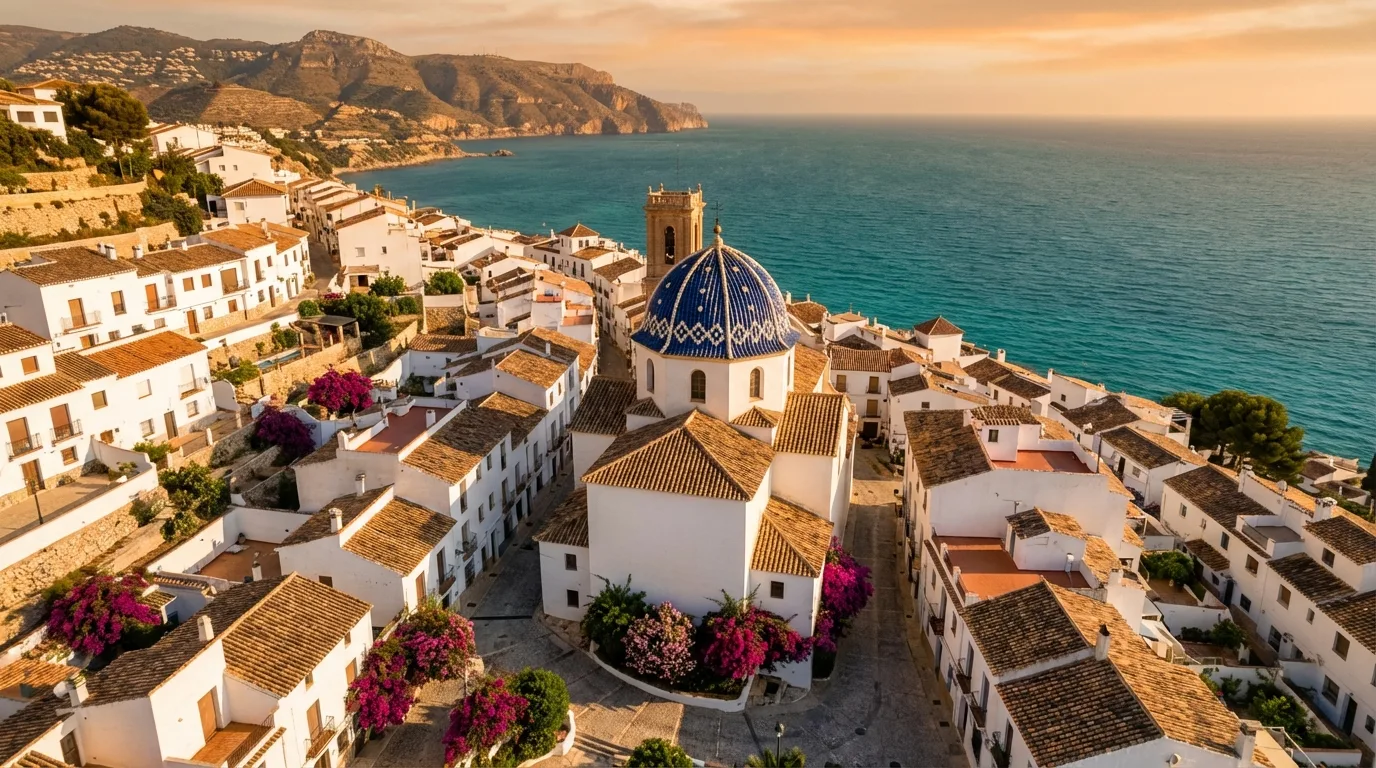
Altea – The Artists' Town on the Northern Costa Blanca 2026
Complete guide to Altea: the white artists' town with its blue church dome, charming lanes, property prices, and why it is called the jewel of the Costa Blanca.
16 min
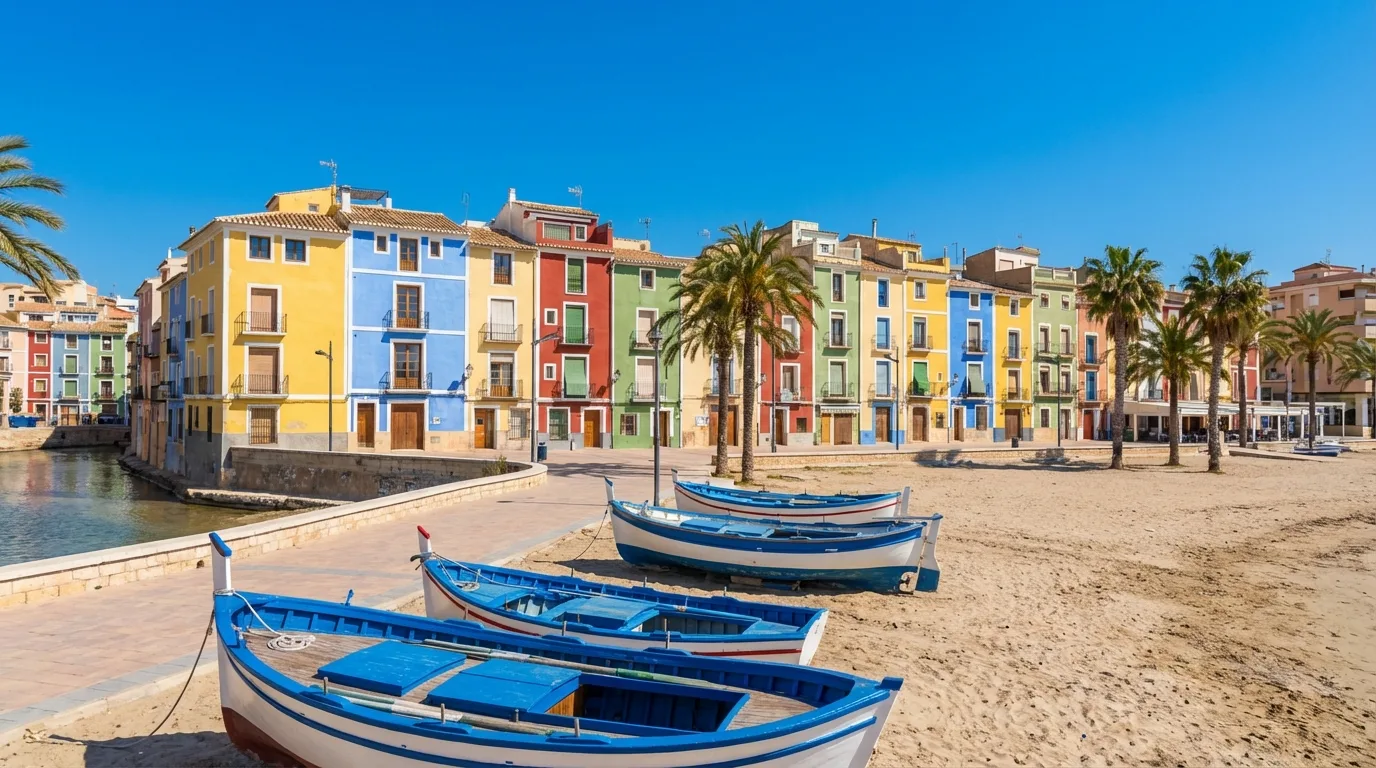
Complete guide to Villajoyosa: the iconic colourful houses, the Valor chocolate factory, beaches, property prices and charm on Costa Blanca.
Villajoyosa is the coastal town on Costa Blanca where the facades are painted yellow, blue, red and green — and where the smell of chocolate drifts from the factory in the town centre. The municipality has just over 36,800 residents, a working fishing harbour and almost 15 kilometres of coastline with sandy beaches. The average price of a property sits at around 2,700–3,200 euros per square metre, which makes Villajoyosa cheaper than the neighbouring towns of Altea and Benidorm but more expensive than inland municipalities.
The town is officially called La Vila Joiosa in Valencian — "the joyful town". It is an apt name. Villajoyosa was named Europe's best hidden gem in 2024 by European Best Destinations, and it shows that tourism has increased. But unlike Benidorm, six kilometres to the north, Villajoyosa keeps its authentic Spanish character with fishing traditions, chocolate craft and an old town not dominated by restaurant chains. In this guide I cover the colourful houses, the Valor chocolate factory, the beaches, property prices and what you should think about before buying.
Villajoyosa lies in the comarca of Marina Baixa in the province of Alicante, midway along Costa Blanca. The town is wedged between Benidorm to the north and San Juan/Alicante to the south, with the Sierra Aitana mountain range as a backdrop. The municipality covers 59 square kilometres — almost twice the size of Benidorm — and has a wide coastal strip with beaches, coves and cliffs.
Distances from Villajoyosa:
The AP-7 motorway (toll-free since 2020) passes through the municipality and gives fast connections in both directions. The TRAM tram line stops in Villajoyosa and links the town with Benidorm (10 minutes), Altea (25 minutes) and Alicante (around one hour). It is one of the few coastal towns on Costa Blanca with functioning public transport beyond the bus.
Information
The TRAM tram makes Villajoyosa unusually accessible without a car. You can commute to Benidorm's amenities in 10 minutes or get to Alicante city in an hour. The ride along the coast also offers sea views almost the entire way.
The colourful houses along the Amadorio river and the seafront promenade are Villajoyosa's most photographed motif — and the story behind them is one of Spain's best urban legends.
The most widely spread explanation is that the fishermen painted their houses in different strong colours so they could identify them from the sea. They were often away for weeks and needed to find their way home. Families also communicated with textiles in the windows: white cloth signalled a birth, black cloth signalled a bereavement. The colours therefore functioned as address, signalling system and identity marker.
Another theory concerns trade. During the 18th century Villajoyosa flourished as a fishing harbour after the Berber pirate attacks ceased. Fishermen, sailors and merchants sailed to northern Italy and southern France and imported the aesthetic from coastal villages such as Cinque Terre and Collioure — low rendered houses in strong colours with small balconies. Villajoyosa's trade boom during the 18th century financed the construction of the current old town.
The old town and the colourful facades are now protected as a Bien de Interés Cultural (cultural heritage site) by the Generalitat Valenciana. The municipality has rules about which colours may be used in renovation — all shades must follow an approved palette. This means the visual character is preserved, but that you cannot freely choose which colour you want if you buy a house in the old town.
Tip
The best place to photograph the colourful houses is from the Pont de Santa Marta bridge that crosses the Amadorio river. Early morning or late afternoon light gives the warmest colours. From the seafront promenade you see the facades with the Mediterranean in the foreground.
Villajoyosa is known as the chocolate town — and that is not a tourist exaggeration. Chocolate production has been going on here since the 1800s, and today Chocolates Valor is Spain's best-known chocolate brand with its head office and factory in Villajoyosa.
The López family founded what would become Valor in 1881. They imported cocoa through the harbour in Villajoyosa and processed it locally. During the 20th century the company grew to become Spain's leading chocolate manufacturer. Today Valor has over 500 employees and exports to more than 50 countries. The head office and factory are still in Villajoyosa — an unusual example of a large company that stayed in its original home town.
The Museo del Chocolate in Villajoyosa is run by Valor and offers guided tours through the history of chocolate — from the cultivation of the cocoa bean to the finished product. Visitors can see historical machinery, learn about different processing techniques and do tastings. The museum has over 100,000 visitors per year and admission is free. It is one of Costa Blanca's most popular family attractions.
In addition to Valor, Villajoyosa has further chocolate manufacturers: Clavileño and Pérez. During the annual chocolate fair Fira de Tots Sants (November) the smell of chocolate fills the entire town.
Villajoyosa's coastline stretches almost 15 kilometres — considerably longer than most municipalities on Costa Blanca. Here you find everything from broad town sand to secluded coves.
Villajoyosa's main beach, 1,830 metres long with fine golden sand and Blue Flag status. Full service with lifeguards, showers, sun loungers, beach bar, pedal boats and a playground. At the southern end, near the harbour, there are adapted facilities for people with reduced mobility. The beach is wide and holds more people than you would think — even in July there is room to spread out. It is Villajoyosa's answer to Benidorm's Playa de Poniente, but with fewer tower blocks in the background.
A sheltered cove between two rocky headlands with crystal-clear water and a mix of sand and gravel. 237 metres long with Blue Flag status. The water is calm and shallow, which makes it popular with families and snorkellers. A chiringuito (beach bar) on site during summer. Bol Nou feels more like a secret cove than a public beach — despite being only a short walk from the town centre.
A kilometre of natural beach with sand and rock south of the town centre. Less service but more seclusion. Free parking nearby, sun loungers for hire and lifeguards during summer. A cycling and walking path along the coast. Paraíso suits you if you want more peace and space.
A rustic pebble beach, 560 metres long, north of the town centre towards Benidorm. Rarely crowded. A beach bar and small car park. Torres suits you if you want to be left in peace. The water is clear and the bottom is rocky — good for snorkelling but bring water shoes.
Between the larger beaches there are hidden coves such as Cala Puntes del Moro and Racó del Conill (the latter is a nudist cove). Rocky bottom, crystal-clear water and few visitors outside July–August.
Note
Playa Centro is a broad sandy beach with full service. But the smaller beaches (Torres, Paraíso) have a rocky and pebbly bottom — bring water shoes. Water quality is consistently high along the entire Villajoyosa coast.
Villajoyosa is a mid-range option on Costa Blanca — cheaper than Altea and parts of Benidorm, but more expensive than inland municipalities such as La Nucía.
The average price of a resale property sits at around 2,700–3,200 euros per square metre. During 2025 prices rose by 15–20 per cent, driven by increased international interest following the award as Europe's best hidden gem. New build costs 3,500–4,500 euros per square metre depending on location and standard.
Price overview
| Area | Apartment | Villa | Townhouse |
|---|---|---|---|
Always budget 10–13 per cent in additional costs on top of the purchase price: transfer tax (ITP, 10 per cent in the Valencian Community), notary fee, land registry and legal fees.
Properties
Explore available properties in villajoyosa
Villajoyosa has a dry Mediterranean climate with long, warm summers and mild winters. The town records an estimated 3,490 sunshine hours per year — among the highest in Europe.
Temperatures through the year:
Rainfall: Around 172 mm per year — extremely low compared with Sweden (600–800 mm). It rains mainly in October and November. Summer is virtually rain-free.
Villajoyosa has just over 36,800 registered residents. The population has grown by 9 per cent since 2013, driven by both domestic migration from Madrid and foreign buyers.
Villajoyosa has a lower proportion of foreign residents than its neighbour Benidorm. An estimated 20–25 per cent of the population are foreign nationals, compared with over 40 per cent in Benidorm and 33 per cent in Altea. This means the town retains a stronger Spanish identity.
The largest foreign groups are:
Villajoyosa differs from purely expatriate towns in that the Spanish population clearly dominates. The fish market at the harbour, the local bars and the chocolate factories create an economy that is not entirely dependent on tourism.
Moros y Cristianos in Villajoyosa is one of Costa Blanca's most spectacular festivals — and the only one on the coast with an authentic beach landing.
The festival celebrates the memory of a Berber attack in 1538, when pirates tried to take the town but were repelled by the residents with the help of a sudden storm that was interpreted as a miracle by the patron saint Santa Marta. The festival has been celebrated for over 250 years and runs from 24–31 July each year.
What makes Villajoyosa's Moros y Cristianos unique is the desembarco — the beach landing. A small fleet of costumed "Moors" sails towards Playa Centro and storms a sand fortress built on the beach. It is dramatic, loud and full of smoke and fireworks. Thousands of spectators gather on the beach and the seafront promenade.
The festival lasts a whole week with parades, music, food and celebrations. Residents dress in historical costumes — Moorish or Christian — and parade through the streets. It is the most important week in Villajoyosa's calendar and most local businesses close.
Benidorm is a city by the sea: skyscrapers, broad sandy beaches, 300+ restaurants, full-service hospital and nightlife. Villajoyosa is understated, colourful and fishing-village-like. Prices are broadly similar, but Villajoyosa gives more character per euro. Benidorm suits you if you want sandy beach and city amenities. Villajoyosa suits you if you want charm and calm — with Benidorm accessible in 10 minutes by TRAM.
Altea has white houses, a blue church dome, galleries and university life. Villajoyosa has colourful houses, chocolate and fishing tradition. Altea is 20–30 per cent more expensive. Altea's beaches are pebble beaches, Villajoyosa's are sandy beaches. Culture enthusiasts choose Altea. Beach lovers and those looking for lower prices choose Villajoyosa.
Alfaz del Pi is further inland and costs 10–15 per cent less. Alfaz has the large Scandinavian community with a Norwegian school and associations. Villajoyosa has the coast, the beaches and the Spanish fishing village charm. If you want to live near Scandinavians and have a lower price — choose Alfaz. If you want the sea at your doorstep — choose Villajoyosa.
Properties
Explore available properties in villajoyosa
Contact
Get in touch and we'll guide you forward — whether you're just starting out or ready to buy.
Contact usLast updated: April 2026. Prices and regulations can change — contact us for current information.
Decision support
Alicante-Elche flygplats ligger cirka 35 kilometer fran Villajoyosa. Med bil tar resan 25-30 minuter via AP-7 motorvagen.
Fran Sverige flyger SAS, Norwegian och Ryanair direkt till Alicante pa 3,5-4 timmar. TRAM-sparvagnen gar ocksa fran Villajoyosa till Alicante, men tar langre tid.
Ja, Villajoyosa ar generellt nagot billigare an Benidorm. Genomsnittspriset i Villajoyosa ligger pa cirka 2 700-3 200 euro per kvadratmeter, jamfort med 2 500-3 500 euro i Benidorm for jamforbara lagen.
Villajoyosa erbjuder mer autentisk spansk karaktar och lagre turisttryck, vilket manga kopare uppskattar.
Ja, Chocolates Valor driver ett chokladmuseum (Museo del Chocolate) i Villajoyosa med guidade turer, historiska utställningar om kakaoprocessen och smakprovning. Museet ar oppet aret runt och intradet ar gratis.
Det ar en av Costa Blancas mest populara familjeattraktioner med over 100 000 besokare per ar.
Ja, Villajoyosa har flera sandstrander. Playa Centro ar huvudstranden med 1 830 meter fin sand och Bla flagg-status.
Playa Paraiso ar en kilometer lang med sand och sten i naturlig miljo. Bol Nou ar en skyddad vik med kristallklart vatten.
Totalt har kommunen nastan 15 kilometer kustlinje.
Villajoyosa ar mer folklig och fiskeby-karaktar medan Altea ar mer konstnarlig och bohemisk. Villajoyosa har farggladda fasader och chokladtradition, Altea har vita hus och gallerier.
Priserna ar hogre i Altea. Bada ar autentiska spanska stader med lite turistifiering, men Villajoyosa kanns mer jordnara och har bredare sandstrander.
Sources

Altea Hills, Alicante

Santa Clara, Alicante

Rincón De Loix, Alicante

Altea Hills, Alicante

Rincón De Loix, Alicante

Rincón De Loix, Alicante
Local expertise
Complete guide to Altea: the white artists' town with its blue church dome, charming lanes, property prices, and why it is called the jewel of the Costa Blanca.
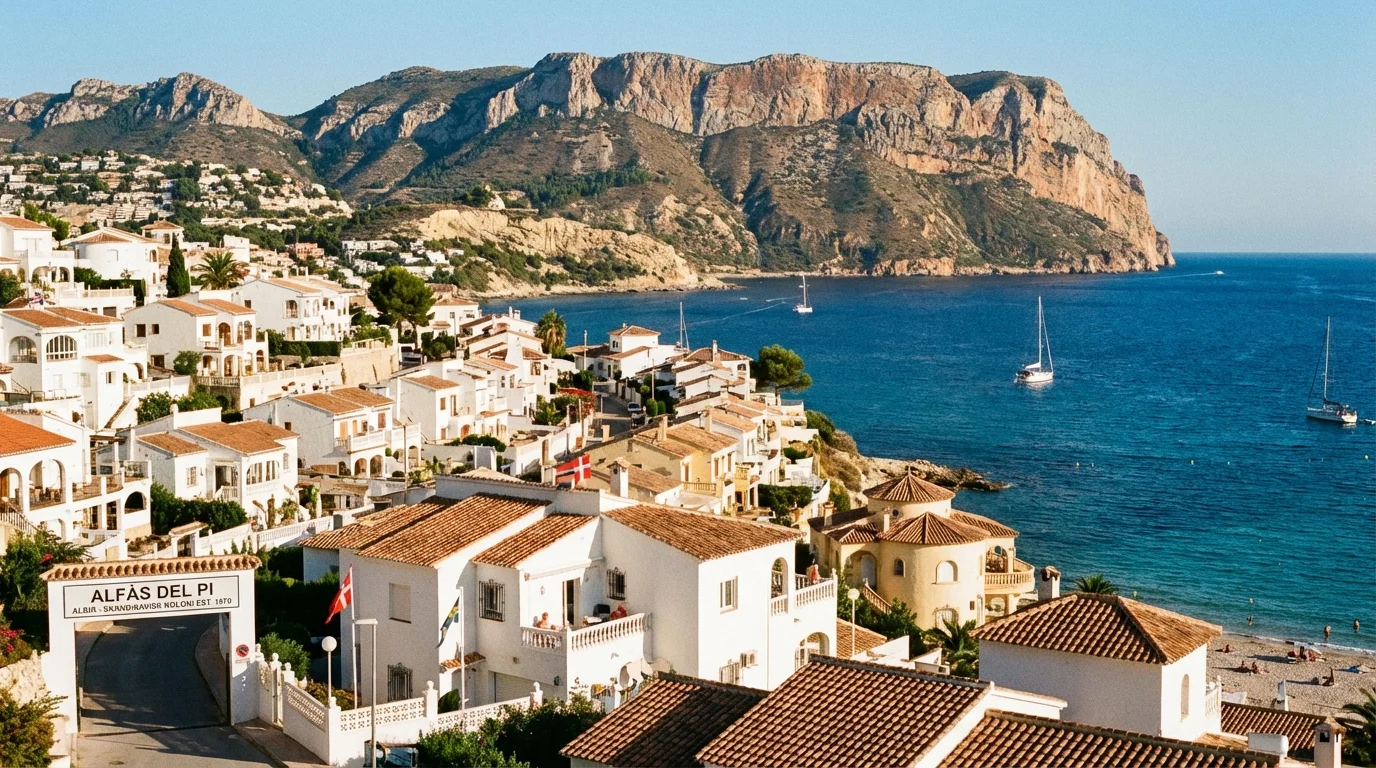
Complete guide to Alfaz del Pi: Scandinavia's largest community in Spain, property prices, healthcare, and why Norwegians and Swedes choose this area.
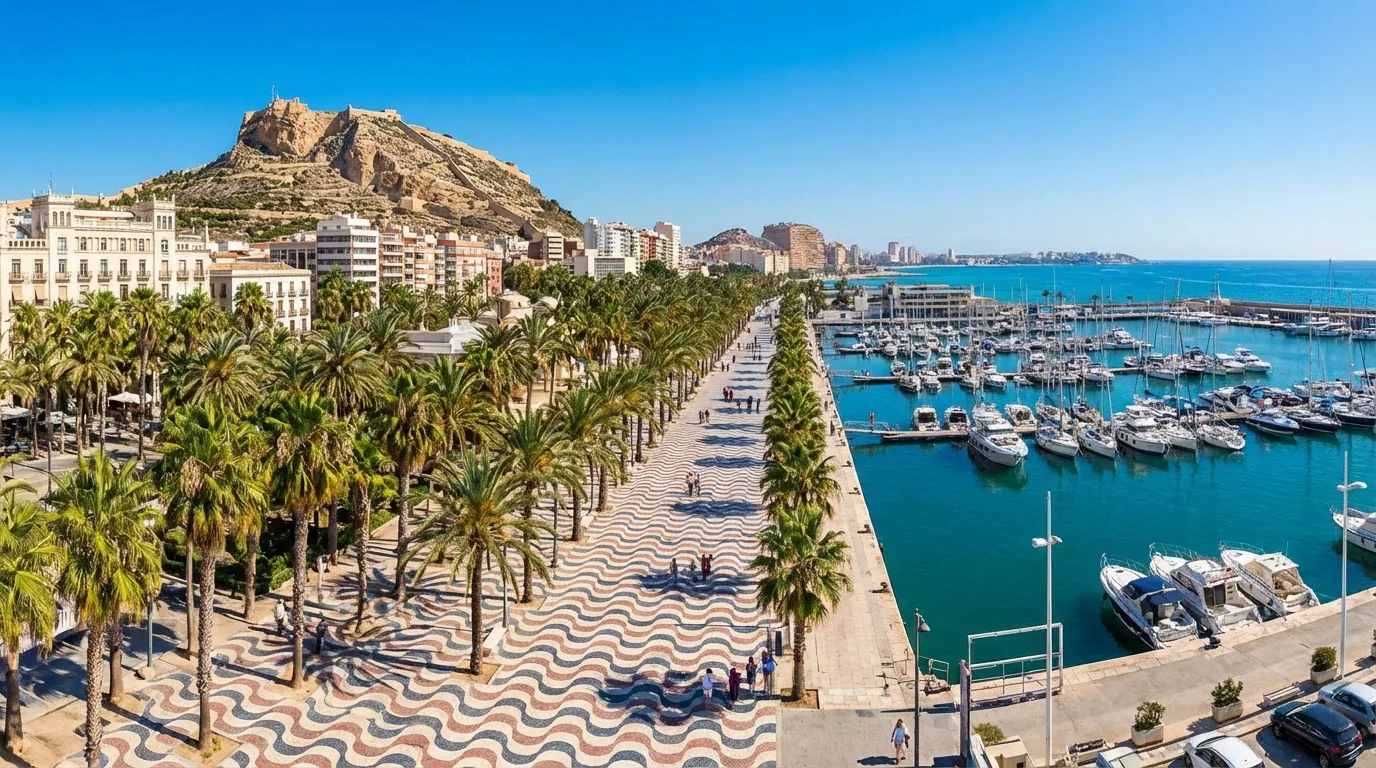
Alicante city as a property market: neighbourhoods, prices, beach, public transport, and flights — practical guide for Swedish buyers looking to buy an apartment in 2026.