


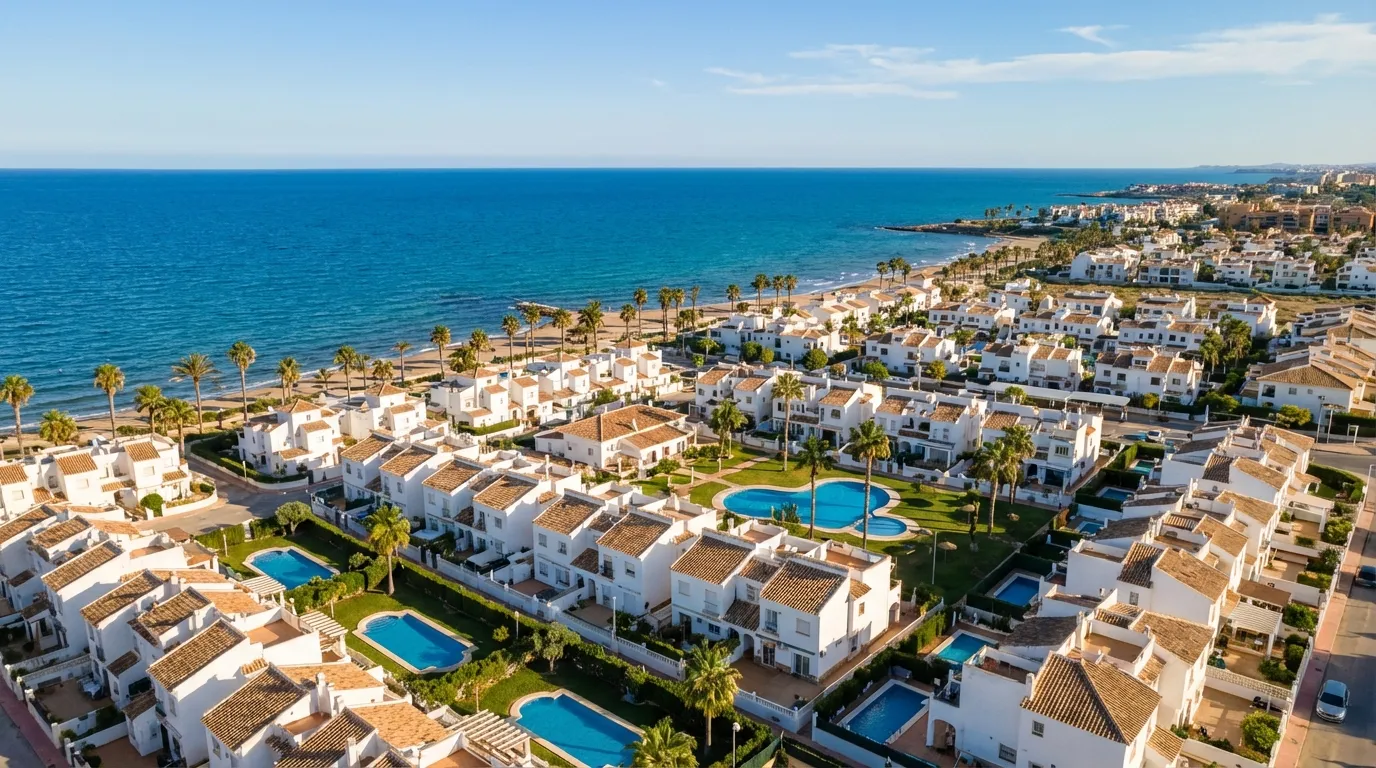
Area Guides
Orihuela Costa – Complete Guide for Swedish Buyers 2026
Everything you need to know about Orihuela Costa on Costa Blanca: areas, property prices, climate, beach life and tips for buying property in southern Spain.
16 min
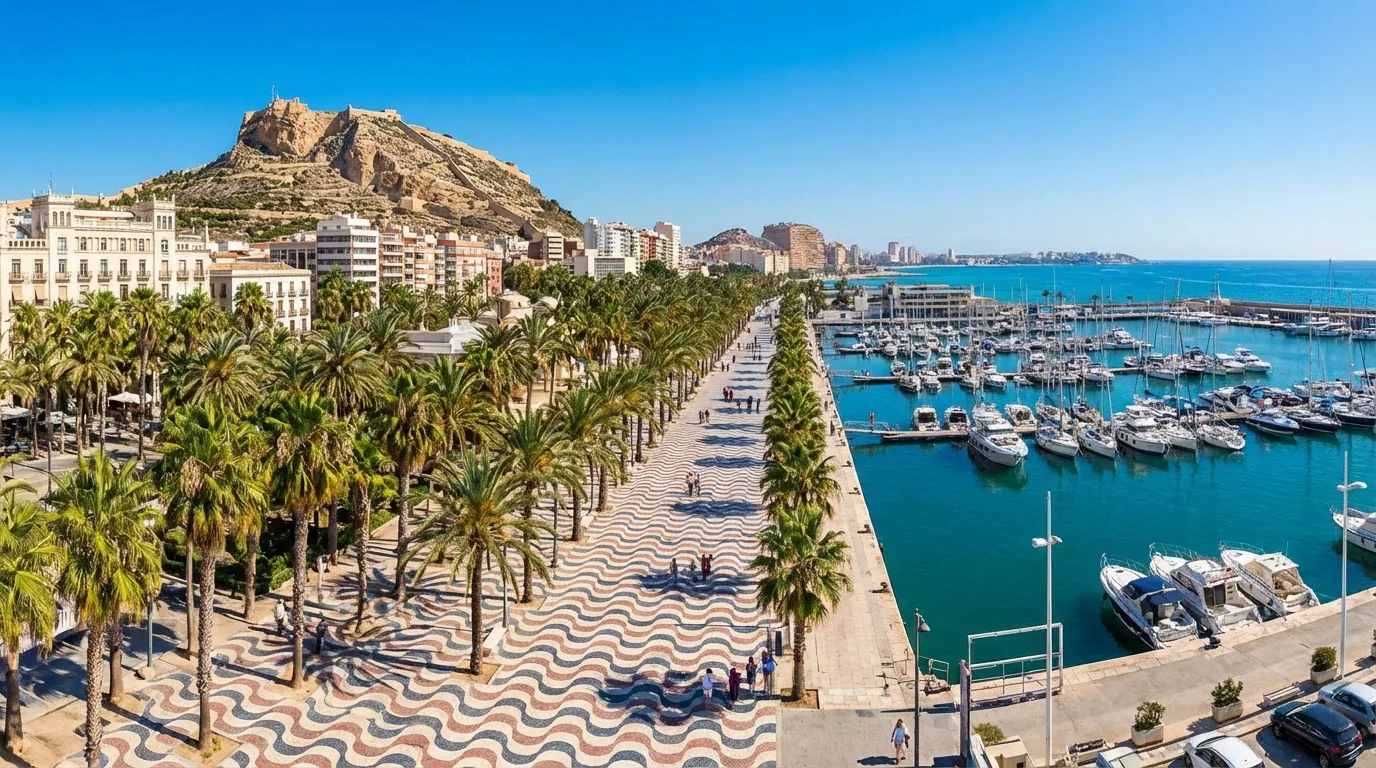
Alicante city as a property market: neighbourhoods, prices, beach, public transport, and flights — practical guide for Swedish buyers looking to buy an apartment in 2026.
Alicante is not a tourist destination. It is a real Spanish city with 340,000 inhabitants, a university with 27,500 students, a tram network, high-speed trains to Madrid, and a gastronomic scene that earned the city the title of Spain's food culture capital 2025. It is also a city where you can buy an apartment with sea views, walk to the beach in five minutes, and fly home to Stockholm in under four hours. The average price for an apartment in Alicante is around 2,535 euros per square metre — roughly half what you pay in Barcelona and a third of Stockholm.
In 2025 Alicante-Elche airport set a new record with almost 20 million passengers. Property values have doubled in ten years. Rental yield is around 5 percent gross. And unlike Torrevieja, Benidorm, or Orihuela Costa, Alicante functions as a city — with real jobs, real culture, and real Spanish-speaking neighbours — even in January.
This guide is written for those considering buying an apartment in Alicante. I go through all the neighbourhoods, current prices, transport, beaches, and give you an honest picture of what makes Alicante unique on the Costa Blanca.
Alicante has neighbourhoods that suit very different lifestyles and budgets. Here are the most important areas for property buyers, from central urban quarters to coastal residential areas.
Alicante's centre is the most vibrant neighbourhood, with Plaza de los Luceros, the beautiful town hall square, and the iconic Explanada de España — Europe's widest palm-lined promenade. Here are the restaurants, museums, the market, and the nightlife. Centro is for those who want to live in the heart of a Spanish city, not in an expat bubble.
Prices in Centro are around 3,150 euros per square metre. A two-bedroom apartment of 80 square metres costs 230,000–310,000 euros depending on floor, condition, and exact location. Rents are 900–2,000 euros per month, giving good rental yield for investors.
Advantages: walking distance to everything, authentic Spanish atmosphere, high rentability. Disadvantages: older buildings that may need renovation, limited parking, livelier at night.
Playa de San Juan is Alicante's most sought-after residential area for international buyers. The three-kilometre golden sandy beach is consistently ranked among Spain's best. A mix of Spanish people and international residents live here in modern apartment complexes with pools, beachside promenades, and good restaurants.
Playa de San Juan is also the most expensive neighbourhood — approximately 3,425 euros per square metre, with an annual increase of over 17 percent during 2025. An 80-square-metre apartment costs 245,000–332,000 euros. Holiday rentals can yield returns of 6–7 percent annually during high season.
Tram line L4 runs directly from central Alicante to Playa de San Juan, so you do not need a car to commute. It is the perfect neighbourhood if you want to combine beach life with access to a real city.
On a headland with open sea views in all directions lies Cabo de las Huertas, Alicante's most exclusive residential area. Buildable land here is virtually non-existent, environmental protection is strong, and the views are unbeatable. The neighbourhood has its own coves with crystal-clear water — quieter and more private than the large beaches.
Prices are Alicante's highest: 3,650–4,950 euros per square metre. An 80-square-metre apartment comes to 293,000–396,000 euros, and villas start at 900,000 euros. Cabo de las Huertas is for buyers who prioritise exclusivity, peace, and sea panorama over a central location.
El Campello lies five kilometres north of central Alicante and has developed from a fishing village into an increasingly attractive residential area. It has a working harbour, a long blue-flag beach, a promenade, and all the basic services you need. Tram line L3 runs directly along the coast from El Campello to Alicante centre — one of Europe's most beautiful tram routes.
The average price is around 3,630 euros per square metre, with a typical 80-square-metre apartment from 245,000 euros. Compared with Playa de San Juan you get more for your money, and the ongoing development of the promenade and infrastructure makes El Campello an area with strong future value growth.
Albufereta offers a calmer beach experience with shallow, family-friendly water and a residential development that appeals to families, university staff, and buyers seeking sea-view property without Playa de San Juan's price premium. Proximity to the Universidad de Alicante gives stable rental demand from students and researchers.
Prices range from 2,550–3,450 euros per square metre. An 80-square-metre apartment costs 204,000–276,000 euros — a marked discount compared with Playa de San Juan, but with retained beach access and good infrastructure.
San Blas is Alicante's most affordable neighbourhood for buyers who prioritise transport links and economics over proximity to the beach. The neighbourhood is next to the Renfe railway station, with fast connections to Madrid, Valencia, and the entire coast. Prices are Alicante's lowest: 2,125–2,875 euros per square metre, with apartments from 170,000–230,000 euros for 80 square metres.
Rental yield often exceeds 5.5 percent thanks to stable demand from commuters and young professionals. San Blas is the smartest choice for investors with a limited budget.
Tip
For best value: San Blas or Albufereta. For beach life with a city feel: Playa de San Juan. For exclusivity: Cabo de las Huertas. For authentic Spanish everyday life: Centro. For future potential: El Campello.
Prices in Alicante have risen sharply — doubling in ten years from 1,250 to 2,535 euros per square metre. In 2025 the price increase was 16.4 percent, the highest in 18 years. For 2026 a calmer but still positive development of 5–8 percent is expected.
Here is an overview of prices by neighbourhood:
Price overview
| Area | Apartment | Villa | Townhouse |
|---|---|---|---|
| Centro | 230,000–310,000 € | — | — |
| Playa de San Juan | 245,000–332,000 € | 900,000–1,600,000 € | — |
| Cabo de las Huertas | 293,000–396,000 € | 900,000–1,600,000 € | — |
| El Campello | 245,000–290,000 € | 400,000–800,000 € | 280,000–400,000 € |
| Albufereta | 204,000–276,000 € | — | — |
| San Blas | 170,000–230,000 € | — | — |
| Casco Antiguo | 238,000–322,000 € | — | — |
Prices refer to a typical apartment of 80 square metres (2 rooms). New builds cost approximately 25 percent more than existing properties. Always budget for 10–14 percent in additional costs on top of the purchase price: transfer tax (ITP, 9 percent in the Valencia region since June 2026), notary fees, land registration, and legal fees.
Note
The market in Alicante is hot — the average negotiation margin is only 6 percent from the asking price. Attractive properties go quickly, especially in Playa de San Juan and Centro. Be prepared with your NIE number and banking connection.
Properties
Explore available properties in alicante
This is the most important question for anyone considering Alicante. The answer is about a fundamental difference: Alicante is a city that has tourism, not a tourist destination trying to be a city.
A functioning labour market. Alicante has provincial head offices, a university, a working harbour, and businesses in tech, logistics, and the service sector. This means there are people who actually work here — not just retirees and tourists.
Spanish as the primary language. In Benidorm and Orihuela Costa you can get by in English. In Alicante, Spanish is the dominant language. That can be a challenge if you do not speak Spanish, but it is also precisely why the city feel is genuine.
Culture beyond tourism. MARQ (the archaeological museum, named Europe's best museum in 2004), theatres, the Las Hogueras festival in June, Michelin-level gastronomy at restaurants like Templo and Nou Manolin. These are not sets for tourists — they are things the city residents themselves participate in.
Year-round function. When Torrevieja and Orihuela Costa are half-empty during low season, life in Alicante continues as normal. Shops are open, restaurants full, trams running, and streets alive — even in February.
For Swedish buyers who want more than just sun and a pool — who want to live in a real city with a Spanish identity — Alicante is the superior choice on the entire Costa Blanca.
Alicante-Elche airport (ALC) is Spain's fifth-largest airport with almost 20 million passengers in 2025 — an increase of 8.5 percent. From Sweden there are direct flights from Stockholm, Gothenburg, and Malmö with SAS, Norwegian, and Ryanair. Flight time is 3.5–4 hours.
The airport is only 12 kilometres from the centre. Airport bus C6 runs regularly and takes approximately 25 minutes to the centre. Taxi costs around 20–25 euros.
Alicante's tram network (Tram Alicante) is something most coastal towns on the Costa Blanca completely lack. Five lines connect the city:
Services run from 07:30 to 22:30 on weekdays. A single ticket costs 1.45 euros. With a Mobilis card you get cheaper fares.
From Alicante Terminal (Renfe) the high-speed train AVE goes to Madrid in 2.5 hours. There are also connections to Valencia and the entire coast.
A car is convenient but not necessary if you live in the centre, along the tram lines, or in Playa de San Juan. For El Campello and outer areas it is an advantage. Parking in the centre costs 80–120 euros per month in a garage.
Information
Alicante is one of the few coastal towns on the Costa Blanca where you can realistically live without a car. Tram lines L3/L4 connect the centre, the beach, and El Campello. This represents a significant quality-of-life difference compared with car-dependent towns like Orihuela Costa or Torrevieja.
Alicante has some of the Costa Blanca's best beaches — and most are accessible by public transport.
Playa de San Juan is the main beach: three kilometres of golden sand, blue flag, beach restaurants, water sports, and a lively promenade. It is regularly ranked among Spain's ten best beaches. Tram L4 takes you there from the centre in 15 minutes.
Playa del Postiguet is the city-centre beach, directly below the Castillo de Santa Bárbara. Perfect for a quick lunchtime swim if you live in Centro. Compact but very well equipped with good facilities.
Playa de la Albufereta offers calm, shallow water — ideal for families with children and older bathers who prefer a quieter beach setting.
Coves at Cabo de las Huertas — Cala Piteres, Cala d'Enmig, and several other small coves offer crystal-clear water in a more natural setting. Less service but more of an adventure feel. Perfect with a snorkel.
El Campello beach is a wide blue-flag beach with a promenade, chiringuitos, and a relaxed village feel. Tram L3 stops practically on the beach.
Alicante has over 300 sunny days per year — among the highest in Europe. The climate is semi-arid Mediterranean with warm, dry summers and mild winters.
Temperatures throughout the year:
One thing to be aware of: the DANA phenomenon with intense downpours can occur in autumn. Always check the property's elevation and avoid ground-floor units in low-lying areas.
Yes, but it is different from Torrevieja or Orihuela Costa. Alicante has a more integrated Scandinavian presence — people who actually live and work in the city, not just retirees in isolated urbanisations.
The Norwegian community has the longest history on the Costa Blanca, with settlement since the 1960s. L'Alfàs del Pi (30 kilometres north of Alicante) is nicknamed "Little Norway" and celebrates Norwegian National Day on 17 May. There is a Norwegian church, a Norwegian school, and Norwegian-owned businesses throughout the region.
Swedes and Danes are also present, albeit in smaller numbers. InterNations organises meet-ups for Scandinavians in Alicante. The Swedish church in Torrevieja (40 minutes away) holds regular services.
The large British community, with over 70,000 registered residents in the Alicante province, creates infrastructure with English-speaking doctors, international schools, and social clubs that Scandinavians also benefit from.
For Swedish buyers who want to integrate with Spanish culture but still have access to a northern European network, Alicante city is the ideal middle ground — you avoid the expat bubble but are never more than a conversation away from someone who understands you.
Alicante is excellent for retirees, but in a different way from the dedicated retirement destinations further south.
Healthcare: Alicante has both public and private healthcare at a high level. University General Hospital is the region's largest public hospital. Privately there is Vithas Medimar with multilingual staff and Clínica Vistahermosa. As an EU citizen you have the right to Spanish healthcare via an S1 certificate or EHIC card.
Cost of living: A couple can live comfortably on 1,800–2,500 euros per month (excluding housing). Restaurant visits are considerably cheaper than in Sweden — a lunch with a drink costs 10–15 euros. A three-course dinner at a good restaurant: 25–45 euros.
Activities: Access to culture, gastronomy, beach life, nearby golf courses, hiking in the Sierra de Aitana mountains, and a rich associational life. Alicante offers intellectual stimulation beyond the golf course — something many retirees appreciate after a few years in pure resort environments.
An honest downside: Summer (July–August) is warm — daytime temperatures around 32–35 degrees. Many Swedish retirees choose to spend the hottest period in Sweden, giving themselves the best of both worlds.
The figures speak for themselves. Alicante properties have doubled in value over ten years. Rental yield is around 5 percent gross, with higher figures for holiday rentals in attractive locations. The forecast for 2026 is a further 5–8 percent value increase.
Three factors drive the market:
For a realistic return after transaction costs (10–14 percent on purchase), a holding period of at least 5–7 years is recommended. Then rental income covers ongoing costs while value growth generates capital appreciation.
Information
Foreign buyers account for 44 percent of all property purchases in the Alicante province — the highest proportion in the whole of Spain. Two out of three newly built properties are bought by non-Spaniards. This signals both strong international demand and confidence in the market.
Advantages:
Disadvantages:
Contact
Get in touch and we'll guide you forward — whether you're just starting out or ready to buy.
Contact usDecision support
En tvårumslägenhet på 80 kvadratmeter kostar från 170 000 euro i San Blas till över 330 000 euro i Playa de San Juan eller Cabo de las Huertas. Genomsnittspriset i staden är cirka 2 535 euro per kvadratmeter (2026), men varierar kraftigt mellan stadsdelarna.
Alicante-Elche flygplats ligger bara 12 kilometer från stadskärnan. Med bil tar det 15–20 minuter, och flygbuss C6 går regelbundet till centrum på cirka 25 minuter.
Från Sverige finns direktflyg med SAS, Norwegian och Ryanair.
Ja, Alicante är en fullt fungerande spansk stad med 340 000 invånare, universitet, sjukhus, spårväg och ett rikt kulturliv. Till skillnad från rena turistorter har Alicante en levande spansk atmosfär året om, med över 300 soldagar per år.
Det beror på vad du söker. Playa de San Juan passar dig som vill ha strand och internationell gemenskap.
Centro är bäst för stadsliv och gastronomi. San Blas erbjuder lägre priser och bra kommunikationer.
Cabo de las Huertas är det exklusiva valet med havsutsikt.
Nej, till skillnad från många andra orter på Costa Blanca har Alicante bra kollektivtrafik med spårväg, stadsbuss och tågförbindelser. Du kan bo utan bil i centrum, Playa de San Juan och längs spårvagslinjerna.
För El Campello och ytterområden är bil en fördel.
Sources

Los Balcones, Alicante

Lago Jardín II, Alicante

Platja de L´Amerador, Alicante

Platja de L´Amerador, Alicante

Platja de L´Amerador, Alicante

Platja de L´Amerador, Alicante
Local expertise
Everything you need to know about Orihuela Costa on Costa Blanca: areas, property prices, climate, beach life and tips for buying property in southern Spain.
Buying an apartment in Torrevieja: prices by area, new-build vs second-hand, community fees and rental yields — step by step for Swedish buyers 2026.
Cheap houses in Spain from 80,000 €: prices on Costa Blanca, Costa Cálida, Torrevieja and Mazarrón — hidden costs, risks and tips for bargains in 2026.