



Area Guides
Alicante City – Complete Guide for Buying an Apartment 2026
Alicante city as a property market: neighbourhoods, prices, beach, public transport, and flights — practical guide for Swedish buyers looking to buy an apartment in 2026.
17 min
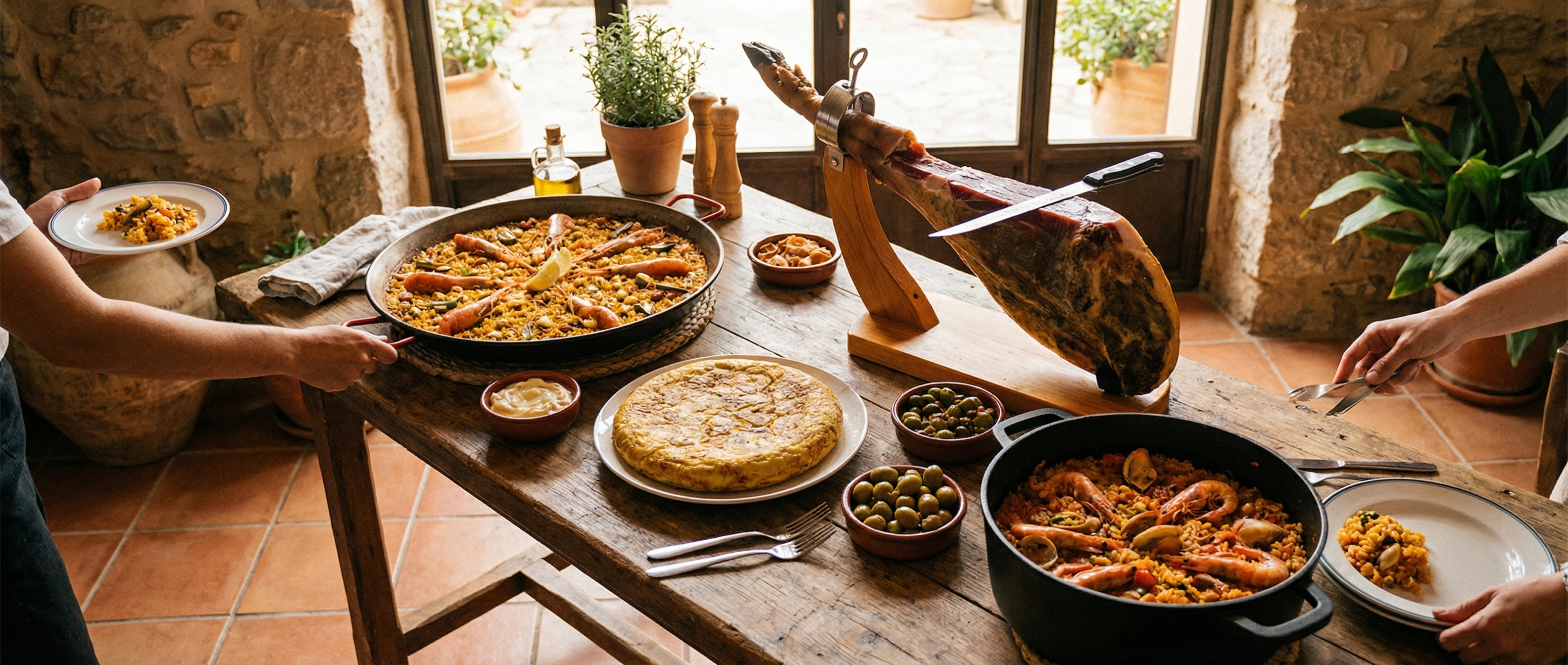
Want to truly understand Spanish food? Here is the guide to regional dishes, tapas, paella, Costa Blanca flavours and how Swedish food habits clash with Spain.
Coastal cities like Torrevieja and Alicante often have more international menus than smaller towns — same country, different habits.
Spanish food is much more than paella, tapas and sangria. This is also where many Swedish visitors misunderstand Spain from the very beginning. They assume the country has a single cuisine, a single way of eating and a handful of "classic" tourist dishes. In reality, Spain is a patchwork of regional food cultures, different mealtimes and local prides that the Spanish often defend far more fiercely than visitors expect.
The most obvious example is paella. Many people see it as a standard national dish and are surprised when Valencians react to wrong ingredients or poor tourist versions. The same goes for tapas, tortilla and the whole idea of what counts as "typically Spanish". This guide covers what you need to understand about Spanish food whether you are travelling, considering living in Spain or simply want to avoid eating your way through the country on autopilot.
Information
Quick summary: To understand Spanish food, you need to think regionally, not nationally. Always ask what the area is known for before ordering whatever looks most "Spanish" on the most touristy menu.
The editorial review highlights three classic misunderstandings in particular.
Paella is strongly associated with the Valencia region, and the classic Valencian version does not include seafood as standard. That is precisely why many locals react to tourist versions or add-ons like chorizo. For them it is not just a variation but sometimes a genuine misrepresentation of a cultural marker.
For a Swede thinking of Friday-night tacos, the word tortilla means something completely different than it does in Spain. A tortilla española is a thick potato omelette, not a thin bread. It sounds simple but says a great deal about how easy it is to translate incorrectly in your head.
Tapas is more a way of eating socially than a single type of dish. In some regions you get something small with your drink; in others you order several small dishes to share. The format varies more than many people expect.
Note
The tourist trap often starts in the mind: If you assume that everything you recognise from Sweden means the same thing in Spain, you will almost always understand the food worse, not better.
Spain is not one cuisine but several.
Southern Spain is strong on olive oil, cold soups such as gazpacho and salmorejo, and fried fish. This is often the cuisine Swedish holidaymakers encounter first in the south.
The Basque Country is known for pintxos, a strong bar culture and fish and shellfish dishes with a distinct local identity. It is a good example of how Spain's best food experiences are often deeply regional.
Galicia represents a north-western, seafood-rich and more Atlantic food culture. It has a different weight, different flavour profile and different ingredient logic than the Mediterranean coast.
In the Castilian interior, a more meat-driven cuisine prevails, with dishes such as roast suckling pig, lamb and blood sausage. This is far from the Mediterranean image many Swedes spontaneously carry.
If you are spending time on the Costa Blanca, it is wise to go beyond the most generic "paella menu". The editorial review highlights several local or regionally relevant dishes that say more about the area than the most tourist-driven options.
On the Costa Blanca, rice dishes are central but not just in the form of paella. Arroz a banda is a rice dish cooked in fish stock with a clear coastal connection, while arroz del senyoret follows the same logic but is served with peeled, easy-to-eat seafood.
These are often smarter choices than reflexively ordering "house paella" from the nearest tourist menu.
The red prawns from Dénia are often cited as one of the most prestigious local ingredients, with a sweet and delicate flavour profile. They are a good example of how the most interesting food on the Costa Blanca is not always the loudest item on the menu.
Coca amb tonyina, a savoury pastry-like dish with tuna, onion and pine nuts, gives a better picture of everyday local food than many more touristy dishes. The same goes for turrón from Jijona, which for many is just Christmas confectionery but on the Costa Blanca also lives on as an ice cream flavour and regional signature all year round.
Properties
Explore available properties in Costa Blanca
Browse current homes in the area and compare locations, price levels and property types at your own pace.
Tapas is not just about quantity or portion size. It is about rhythm, company and movement.
The editorial review describes tapas as a socially ritualised way of eating, often standing at the bar, sometimes shared between several people and in some cases combined with moving on to another venue during the evening.
This differs from how many Swedes approach restaurants. In Spain, an evening might be less about "we go to a restaurant and stay all evening" and more about "we have something here, something there and let the evening build step by step".
In Alicante, the phenomenon of el tardeo is often highlighted, where a late afternoon, tapas, extended socialising and further evening activities are woven together. It is a good example of how Spanish food culture is often as much about social rhythm as about the dish itself.
This is where one of the biggest practical culture clashes for Swedes arises.
The editorial review points out that lunch is often the main meal of the day, eaten around 14:00 to 15:30, while dinner does not start until around 21:00 or later. For Swedes, this is often more disorienting than the flavours themselves.
Because you are hungry at "Swedish time" and land in the gap where many traditional kitchens are closed. Some tapas bars serve continuously, but many proper kitchens close between lunch and dinner.
Tip
The best everyday hack for the Sweden-to-Spain adjustment: do not just push dinner later. Also push lunch forward and make it bigger. Then the Spanish mealtime rhythm becomes much easier to settle into.
If the menu feels like a catalogue of every conceivable "Spanish hit" in six languages, that is rarely where you will find the strongest local food. Instead ask about the day's rice dish, the day's fish, the house tapas or the regional speciality.
The editorial review highlights menú del día as a strong value proposition, often with a starter, main course, drink and coffee or dessert at a reasonable price. It is often a better way to understand everyday food than simply walking the evening tourist strip.
If you want to eat serious rice dishes in strong restaurants, you should book ahead, especially in Alicante and during peak times. This is a detail many visitors miss and then think good dishes are hard to find, when the real problem is the planning.
Yes, for most people — but not if you expect everything to work on a Swedish rhythm. Spain rewards those who adapt more than those who try to push the country into Nordic habits. If you open up to later dinners, longer lunches, more sharing and more regional variety, you usually get much more back.
For Swedish visitors and prospective residents, it is therefore smart to see food as part of how the country works, not just as something you consume between other activities. When you understand the mealtime rhythm, the regions and the social interplay, you also begin to understand Spain better.
Properties
Explore available properties in alicante
Contact
We help Swedish buyers understand both areas, daily life and the differences that actually affect how it feels to live in Spain. Get in touch if you want help finding the right place and the right lifestyle.
Book a free consultationLast updated: 2026-04-02. Restaurant offerings, menus and local food habits can shift between regions and seasons.
Decision support
Att allt kretsar kring paella och tapas som enhetliga nationella rätter. I verkligheten varierar spansk mat mycket mellan regioner, och många lokala stoltheter är starkt knutna till sitt geografiska ursprung.
Paella är till exempel i grunden en valenciansk rätt, inte en generisk symbol för hela landet.
På Costa Blanca bör du särskilt leta efter risrätter som arroz a banda och arroz del senyoret, lokala skaldjur, röda räkor från Dénia, coca amb tonyina och turrón från Jijona. Det säger mer om regionen än att bara beställa en turistanpassad paella.
Tapas är mer ett socialt sätt att äta än en exakt rättkategori. Du delar ofta flera mindre rätter, står eller sitter kortare stunder och rör dig ibland mellan flera barer.
I vissa delar av Spanien får du fortfarande en enklare tapa till drycken, men det varierar mycket regionalt.
Generellt senare än i Sverige. Lunch är dagens tyngsta mål och äts ofta runt 14 till 15:30, medan middag vanligtvis börjar först runt 21-tiden eller senare.
För svenska besökare är detta en av de största praktiska omställningarna.
Välj ställen där lokalbefolkningen faktiskt äter, undvik att beställa de mest generiska "internationella" versionerna av spanska rätter och fråga gärna efter dagens risrätt eller lokala specialiteter. Menú del día på lunch är ofta ett bättre värdetest än kvällsservering på de mest turistiska stråken.

Los Balcones, Alicante

Los Balcones, Alicante

Lago Jardín II, Alicante

Villa Amalia, Alicante

San Luis, Alicante

San Agustín
Local expertise
Alicante city as a property market: neighbourhoods, prices, beach, public transport, and flights — practical guide for Swedish buyers looking to buy an apartment in 2026.
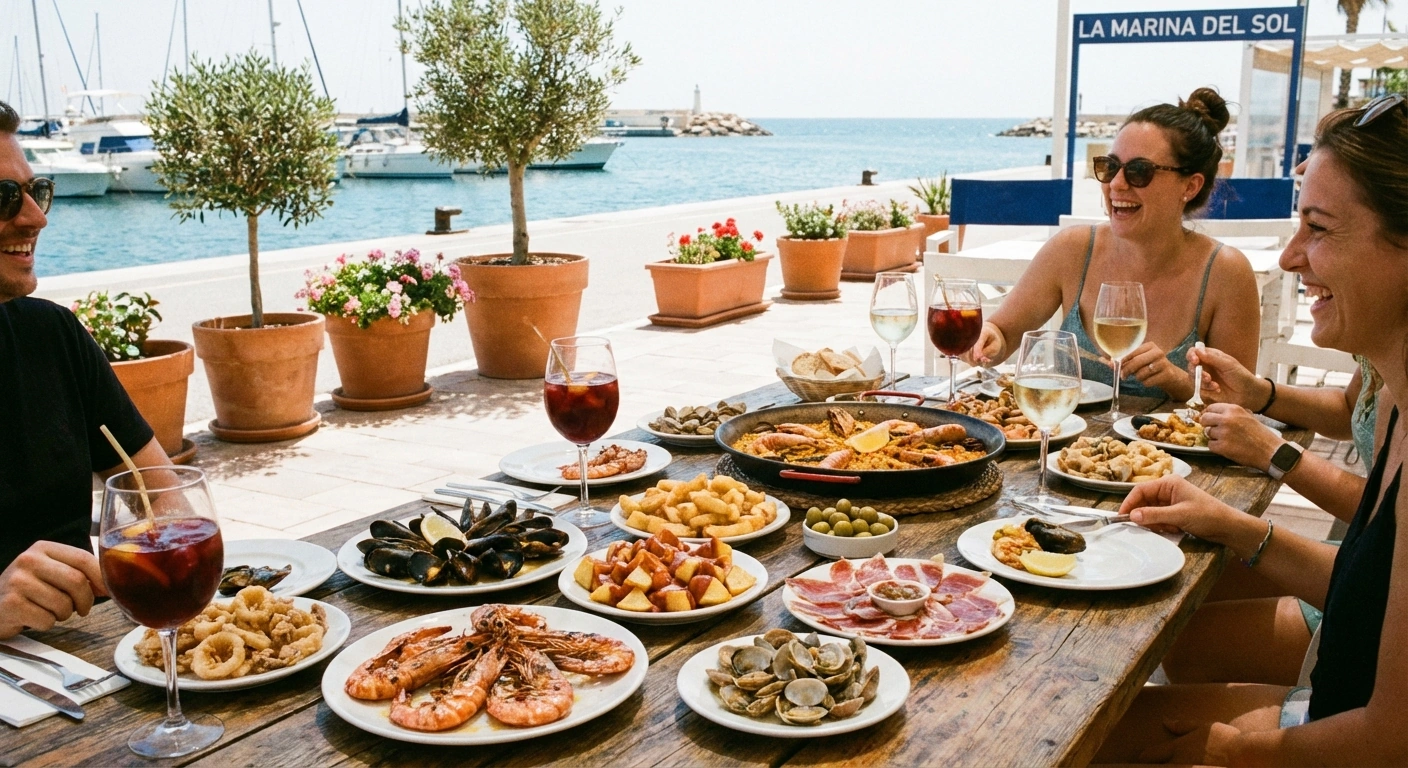
Guide to restaurants in Torrevieja: tapas, fish, set menus, price levels and which areas suit you if you want to live near the city's best dining spots.
How is Christmas celebrated in Spain? Nochebuena, New Year's grapes, Three Kings Day and how it differs from Swedish Christmas. Guide for Swedish residents.