Murcia Region – Complete Guide for Swedish Property Buyers 2026
Murcia and Costa Cálida: prices, climate, flights, taxes and areas. Compare with Costa Blanca and understand whether the region suits you before you buy.
·17 min read·Spanienfastigheter·Updated 16 September 2026
In the Murcia region, property prices are still below the average for many comparable coastal areas in eastern Spain, while prices have risen sharply in recent years. According to Idealista's price reports for Murcia city, the average price for properties was around 1,531 euros per square metre in January 2026, with an annual increase of around 19 percent compared to the year before. Across the entire province, levels close to 1,539 euros per square metre were recorded at the end of 2025. This means Murcia is no longer a "secret" market, but you often still get more space or newer standard than in the most expensive parts of Costa Blanca for the same budget.
The region had 1,569,164 inhabitants at the start of 2024, a semi-arid Mediterranean climate with high summer temperatures and a coastline (Costa Cálida) that stretches from Águilas in the southwest to San Pedro del Pinatar in the northeast. For Swedish buyers, the choice is often about affordable coast, golf resorts, Mar Menor or city life in Murcia and Cartagena — with fewer Scandinavian service networks than around Alicante but a clear price discount in many segments.
This guide answers where Murcia is located, which sub-areas suit different buyers, what the prices mean practically in 2025–2026, how climate and transport work, and how the region compares to Costa Blanca — including drawbacks you should know about.
Market in brief
Murcia city
1,531 €/m²
average price in January 2026
Annual rate
+19%
increase vs the year before
The province
1,539 €/m²
level at end of 2025
Cost of living
8–9% lower
than Alicante in open comparisons
Information
In short: The Murcia region often offers a lower price per square metre and lower overall cost of living than Alicante in user-based comparisons — for example, the total consumer index including rent has been roughly 8–9 percent lower in Murcia than in Alicante. At the same time, expect strong summer heat, a more Spanish-speaking daily life outside the largest expat towns, and an environmental debate around Mar Menor that affects some buying decisions.
What is the Murcia region and where is it located?
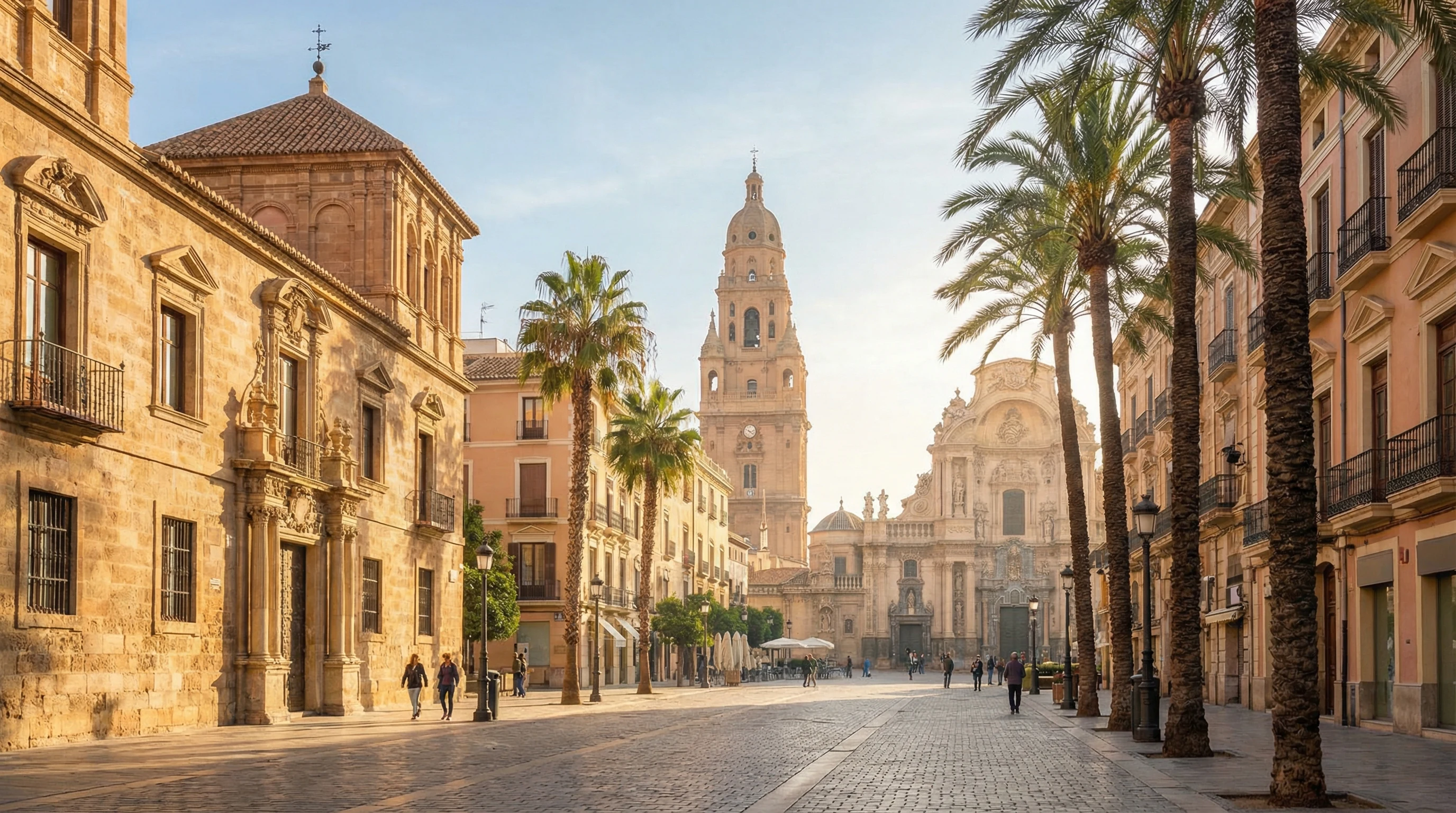
Murcia is both the name of a Spanish autonomous region (Región de Murcia) and of the regional capital. Geographically the region lies in the south-eastern corner of Spain, bounded by Andalusia, Castilla–La Mancha, Valencia and the Mediterranean. For property buyers, two scales are important: the entire region (inland plus coast) and Costa Cálida, the roughly 250-kilometre long coastal strip that coincides with Murcia's Mediterranean coast.
The inland climate is more continental and extremely hot in summer; the coast gets cooling breezes but also high summer heat when land winds dominate. Murcia city lies approximately 45 kilometres from the Mar Menor coast and around 50 kilometres from the open Mediterranean, for example at Cabo de Palos — distances you notice in daily life if you commute between city and beach.
Practical distances
Murcia city → Corvera
often just over 20 minutes by car
25–30 km
often just over 20 minutes by car
Murcia city → Alicante airport
often 50–60 minutes
75–85 km
often 50–60 minutes
Los Alcázares → Corvera
often 30–35 minutes
35 km
often 30–35 minutes
Cartagena → Corvera
short transfer for much of Costa Cálida
25–30 km
short transfer for much of Costa Cálida
Rail connections have been strengthened: high-speed trains (AVE) link Murcia to Madrid in approximately three hours, making the region more attractive for those combining work in the capital with a home in the south-east.
Which areas in Murcia suit different buyers?
Murcia should not be bought "as a single place". Here are four clear buyer profiles.
Buyer profiles
Mar Menor and northern Costa Cálida
Suits buyers who prioritise calmer bathing, relatively flat terrain and an established international buyer base.
shallow bathing and water sports
distinct holiday profile
requires you to follow developments around Mar Menor
Cartagena and the historic coast
Suits those who want a harbour city, cultural heritage, restaurant life and a clearer year-round daily routine.
port city with more everyday amenities
rental market with year-round population
central locations can be above the regional average
Golf resorts and new builds
Suits buyers seeking convenient management, a pool and resort structure rather than a village-centre feel.
new construction common
shared maintenance and security gates
always compare ITP vs IVA/AJD before buying
Mazarrón and the southern coast
Suits those who accept a quieter network in exchange for lower prices and less tourist density.
less pressure from mass tourism
fewer services in Swedish and English
longer journey to some airports
Who suits Mar Menor and northern Costa Cálida?
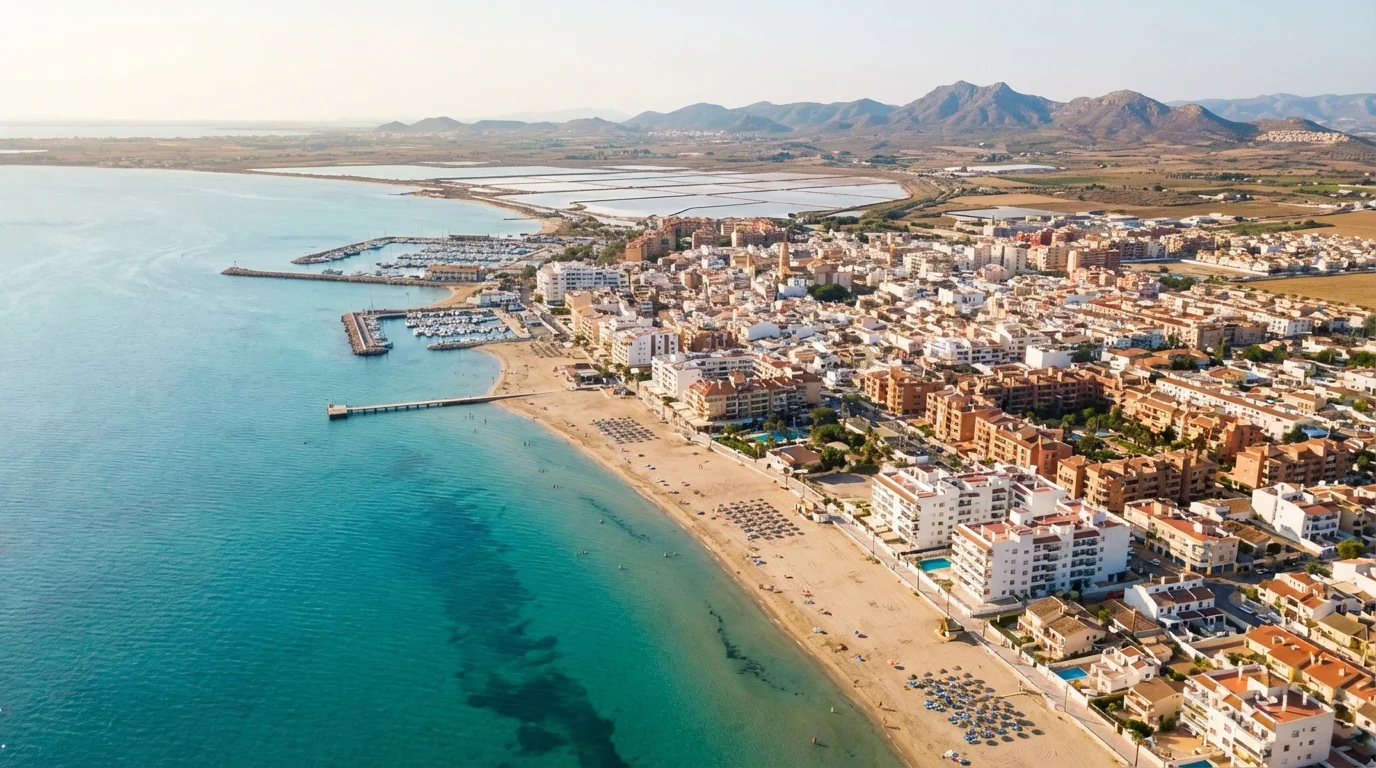
Towns such as Los Alcázares and San Pedro del Pinatar suit those who want shallow bathing, water sports and relatively flat terrain. There is also an established international buyer base compared to many smaller coastal villages. Read more about the environment and daily life in our Los Alcázares guide before committing — Mar Menor has its own history of algal blooms and restoration efforts that affect both sentiment and long-term risk assessment.
Who suits Cartagena and the historic coast?
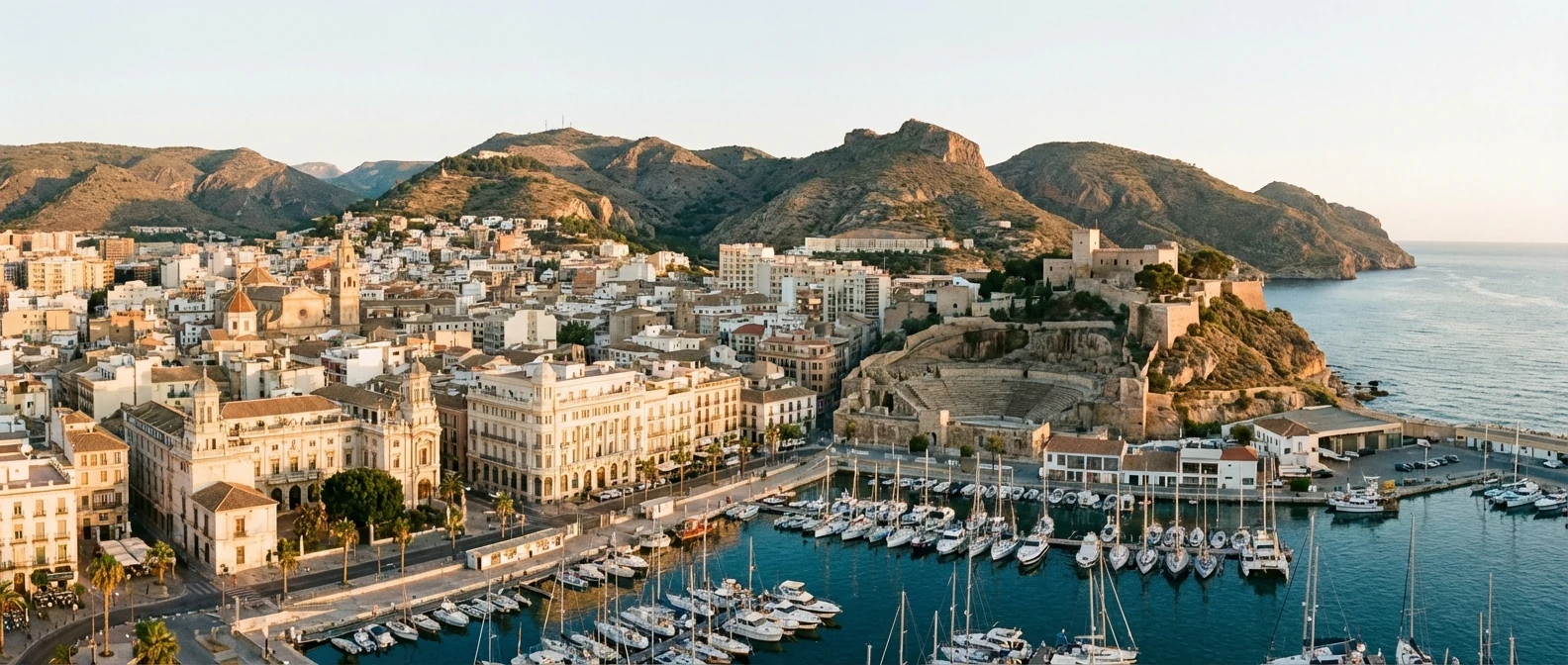
Cartagena suits those who want a harbour city, cultural heritage, restaurant life and a rental market with a clear year-round population. Nearby coastal gems such as Cabo de Palos attract with cliffs and diving rather than long sandy beaches everywhere. The price level in central locations can be above the regional average, while certain outer areas and older properties can still offer good value.
Who suits golf resorts and new builds?
Areas around Condado de Alhama, Mar Menor Golf, Roda Golf, La Torre and similar resorts suit buyers who want a pool, security gates, shared maintenance and often rental potential during the winter season. New construction is common here — good if you want to avoid hidden renovation risks, less good if you are looking for a genuine village-centre feel. Always compare the total tax cost against second-hand (ITP vs IVA/AJD) with a solicitor before making your decision.
Who suits Mazarrón, Puerto de Mazarrón and the southern coast?
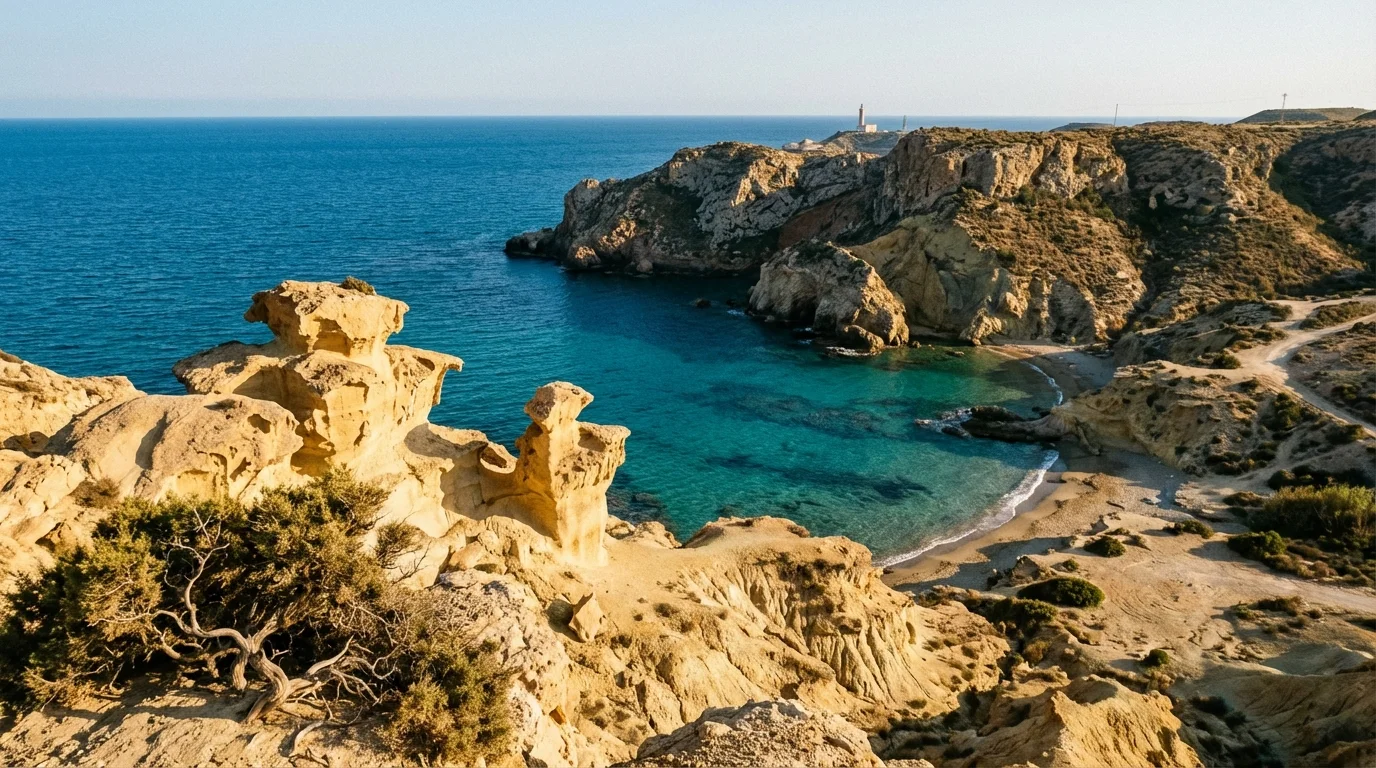
Mazarrón and Puerto de Mazarrón suit those who accept a quieter winter network and fewer international schools in exchange for lower prices and less tourist density than in the largest Costa Blanca hubs. For buyers comparing with the Swedes' "standard towns", it is often here that the difference from Torrevieja or Orihuela Costa is most visible in the wallet — but also in the availability of services in Swedish and English. On the southern coast, Águilas is an alternative for those who want a more dramatic coastline, fewer high-rise buildings and often less pressure from mass tourism — at the cost of a longer journey to the airport and fewer international estate agent offices on the ground.
Tip
Rule of thumb: First decide whether you are going to live there year-round, winter half-year or just for holidays. Year-round living rewards Murcia city, Cartagena or larger coastal towns with schools and healthcare nearby. A pure holiday home can work excellently in the resort segment, but be aware of off-season dead areas and high electricity bills for air conditioning.
For sale right now
83 homes for sale in and around Murcia (Stad & Inland)
What do properties cost in Murcia in 2025 and 2026?
After several years of price increases, Murcia is still below the national average that Idealista often reports for Spain as a whole, but the gap has narrowed. Local peaks and troughs differ significantly: central or seafront locations in popular towns can be far above the regional average, while inland municipalities can still show below 600 euros per square metre in the cheapest segments.
The ranges below are indicative for planning purposes and reflect the advertised segment — not an offer on a specific property. Figures for the average price per square metre in Murcia city and the province are continuously updated in industry reports.
Indicative purchase ranges per segment
Murcia city
Average price per sqm in the city shows strong annual change.
90,000–220,000 € (apartment)
Average price per sqm in the city shows strong annual change.
Los Alcázares / Mar Menor
Premium near beach and golf. See [Los Alcázares guide](/nyheter/los-alcazares-guide).
140,000–320,000 € (2–3 rooms)
Premium near beach and golf. See [Los Alcázares guide](/nyheter/los-alcazares-guide).
Cartagena
Centre and harbour often more expensive than outer areas.
120,000–280,000 € (apartment)
Centre and harbour often more expensive than outer areas.
Golf resorts
New construction and townhouses dominate; resort fees often apply.
180,000–450,000 €
New construction and townhouses dominate; resort fees often apply.
Mazarrón / Puerto
Often lower than Mar Menor. See [Mazarrón guide](/nyheter/mazarron-guide).
110,000–250,000 €
Often lower than Mar Menor. See [Mazarrón guide](/nyheter/mazarron-guide).
How do the taxes differ from Costa Blanca?
For second-hand properties you pay ITP (transfer tax). In the Murcia region the rate is 7.75 percent for ordinary property purchases since 25 July 2025, compared to 9 percent in the neighbouring Valencia region (since June 2026). For new builds, 10 percent VAT applies to the property plus regional stamp duty (AJD) — expect to need around 10–13 percent on top of the purchase price in total for legal fees, notary and land registry, with the exact breakdown depending on the property and financing.
Tax levels
ITP 7.75%
Second-hand property in Murcia
Common level often cited in the region for ordinary property purchases.
lower than the usual comparison with Valencia
legal fees, notary and registry costs come on top
makes a clear difference to the total budget on more expensive purchases
VAT 10% + AJD
New build
Higher VAT component but a different cost profile from second-hand.
stamp duty varies by region
total often around 10–13% on top of the purchase price
can be reasonable if you prioritise new and low renovation risk
What should you check legally before signing?
The buying process in Spain is formalistic for good reasons: you need to know exactly who owns the property, whether there are mortgages, tax debts, community fees and whether the building is legally registered. In Murcia, just as on Costa Blanca, you see both well-managed new builds and older houses where extensions lack complete documentation.
Practical approach for Swedish buyers: reservation agreement (small sum), then arras (deposit with clear conditions), then notary where the purchase is registered. Have your solicitor check the nota simple from the land registry, the seller's identity and whether there are rental licences if you are buying as an investment. If you are financing through a Spanish bank a valuation is often required — allow 4–8 weeks extra in the timeline compared to a cash purchase.
What is the climate, daily life and transport like?
Murcia is often described as one of Spain's sunniest zones. According to AEMET's climate normals for Murcia city, the climate is warm and dry, with limited annual rainfall and a distinct summer heat. For buyers this means low heating costs but high cooling costs — look for properties with efficient AC, good insulation and shade on the terrace if you plan to be there in June–August.
Daily life and language: Outside the largest international towns, Spanish is the norm in official contacts, healthcare and tradespeople. This is an advantage if you want to integrate; a disadvantage if you expect the same English-speaking ecosystem as near Pilar de la Horadada or larger tourist centres on Costa Blanca.
Flights: Corvera airport has developed more seasonal routes to northern Europe; many Swedes still combine with Alicante when the range of flights is broader. This is a strength — you are rarely locked to a single airport if you accept a slightly longer transfer.
Local transport: City buses and regional trains work better in Murcia city and Cartagena than in small coastal villages, where a car is almost always practical. During peak hours buses can feel crowded, which you notice if you commute without your own car.
How does healthcare, banking and daily costs work?
Spanish public healthcare is funded through taxes and social contributions when you are insured in the system; many expats combine this with private health insurance for faster appointments. In Murcia city and Cartagena there are larger hospitals and broader specialist care, while small towns can mean a longer drive to A&E — something you should map out if you have chronic healthcare needs or young children.
Banking and payments: A Spanish bank account makes taxes, insurance and standing charges easier (IBI, refuse collection, community of owners). Allow for annual fees and currency exchange if you are moving large sums from Sweden; compare banks on transparency around exchange rates, not just "free card".
Daily costs: Beyond property prices, your budget is affected by food, restaurants, electricity and water. Murcia tends to come in somewhat below Alicante in aggregate consumer indices in open comparisons, but the difference varies with lifestyle: a family that eats out often will notice a higher total than a couple who cook at home and travel rarely.
What applies to rentals and community fees?
Many buyers in Murcia count on short-term letting in certain urbanisations and golf resorts. Before you buy, ask for the town's licensing rules for your street and the association's statutes — some communities restrict or prohibit tourist lettings. For long-term rental, demand is stronger in university cities and larger coastal towns than in very small villages in winter.
Community fees vary considerably: a simple apartment may be a few tens of euros per month, while a resort with security, pools and gardens can cost significantly more. Always ask for the latest accounts and whether there are ongoing disputes or planned maintenance works (roof, facade, lift) that will push up the fee.
What are the advantages and disadvantages of Murcia compared to Costa Blanca?
Murcia vs Costa Blanca
Advantages
You often get more space for the same money than in the premium segment on Costa Blanca.
The ITP rate of 7.75% in Murcia can make a clear difference to the total budget.
The region accommodates several lifestyles: Mar Menor, Cartagena, golf and the southern coast.
Many towns feel more Spanish and less holiday-bubble-like.
Disadvantages and risks
Summer heat can be very severe, especially inland and in sheltered locations.
Environmental issues around Mar Menor affect the risk picture near the lagoon.
The Scandinavian service and community network is thinner than in the Torrevieja zone.
The job market is harder if you need local income without Spanish.
Note
Warning: Always engage your own solicitor (abogado) and building technical advice for older houses or rural properties. Check the Cédula de Habitabilidad, solar panels on the roof, pool licence and boundaries against public land — especially with agricultural land or older construction.
How does Murcia compare to Costa Blanca in practice?
Costa Blanca often wins on maturity of expat services, flight options and Scandinavian networks. Murcia wins on price per square metre, lower ITP and in many cases a newer housing stock in the resort segment. If you travel between countries, the distance from northern Mar Menor to Torrevieja is only around 35–45 minutes by car — many buyers therefore treat the border as a comparison within the same holiday region rather than as two isolated worlds.
Murcia suits you well if you want to maximise property for money, can tolerate the heat, accept more Spanish in daily life and are open to Mar Menor, golf or city life in Murcia/Cartagena. The region suits you less well if you need maximum Scandinavian close-hand services from day one, or if you dislike high-summer heat without the budget for effective climate control.
A pragmatic approach is to rent for a month in your chosen town during the time of year you will actually be living there, drive around with a car and talk to neighbours about electricity, water, internet and winter-closed restaurants before you put down a reservation.
Frequently asked questions about Murcia
Contact
Would you like to compare Murcia with Costa Blanca based on your budget?
We help Swedish buyers find the right area — from Mar Menor and Cartagena to golf resorts and quiet coastal towns. Book a free call and we'll go through your priorities with no obligations.
Last updated: 2026-04-02. Prices, taxes and flight times change — always verify against current sources before buying.
Decision support
Frequently asked questions
Behöver jag NIE-nummer för att köpa bostad i Murcia-regionen?
Ja. Som utländsk köpare behöver du NIE (Número de Identificación de Extranjero) för att underteckna hos notarius publicus, öppna bankkonto och deklarera skatter i samband med köpet.
Du ansöker via spanskt konsulat eller polisen i Spanien. Handläggningstiden varierar ofta mellan fyra och åtta veckor, så planera i god tid innan du reserverar objekt eller betalar större depositioner.
Hur långt är det från Murcia till Alicante och Corvera flygplats?
Región de Murcia International Airport vid Corvera ligger ungefär 25 kilometer sydväst om Murcia stad och cirka 35–40 minuters bilresa till Mar Menor-områden som Los Alcázares. Alicante-Elche flygplats ligger omkring 75–85 kilometer från Murcia stad beroende på rutt, ofta runt 50–60 minuter med bil via motorväg.
Många svenskar använder Alicante när tider och priser passar bättre, och Corvera när destinationen är närmast Costa Cálida.
Vad skiljer Mar Menor från öppna Medelhavet längs Murcia-kusten?
Mar Menor är en grund saltvattenlagun som avgränsas från Medelhavet av La Manga. Vattnet blir ofta varmare och lugnare än utanför, vilket passar familjer och vattensport, men lagunen har också en egen miljödebatt och skiftande vattenkvalitet som du bör följa innan köp nära stranden.
Utanför lagunen, till exempel vid Cabo de Palos eller Mazarrón, möter du mer klassisk medelhavskust med klippor och djupare vatten.
Är det billigare totalt att köpa begagnat eller nyproduktion i Murcia?
Inköpspriset per kvadratmeter kan vara högre för nyproduktion, men skattesidan skiljer sig: begagnade bostäder beläggs med ITP som i Murcia-regionen är 7,75 procent på bostäder sedan juli 2025, medan nyproduktion normalt har 10 procent IVA plus regional stämpelskatt. Räkna därför alltid total kostnad inklusive skatter, notarie och inskrivning — inte bara annonspriset.
Exakt procentsats kan variera med objekttyp och politiska beslut, så be juristen bekräfta gällande tabell.
Finns internationella eller svenska skolor i Murcia-regionen?
I Murcia stad och Cartagena finns flera privata och internationella alternativ med undervisning på engelska eller flerspråkiga spår, medan utbudet i små kustorter är mer begränsat än kring Alicante eller Malaga. För barnfamiljer som prioriterar skolplacering är det ofta klokt att välja bostad efter skolors kösystem och busssträckor, inte bara efter strandnära läge.
Kontrollera alltid aktuella köregler och språkprofiler direkt med skolan.