
Area Guides
Los Alcázares – Mar Menor's gem for Swedish buyers 2026
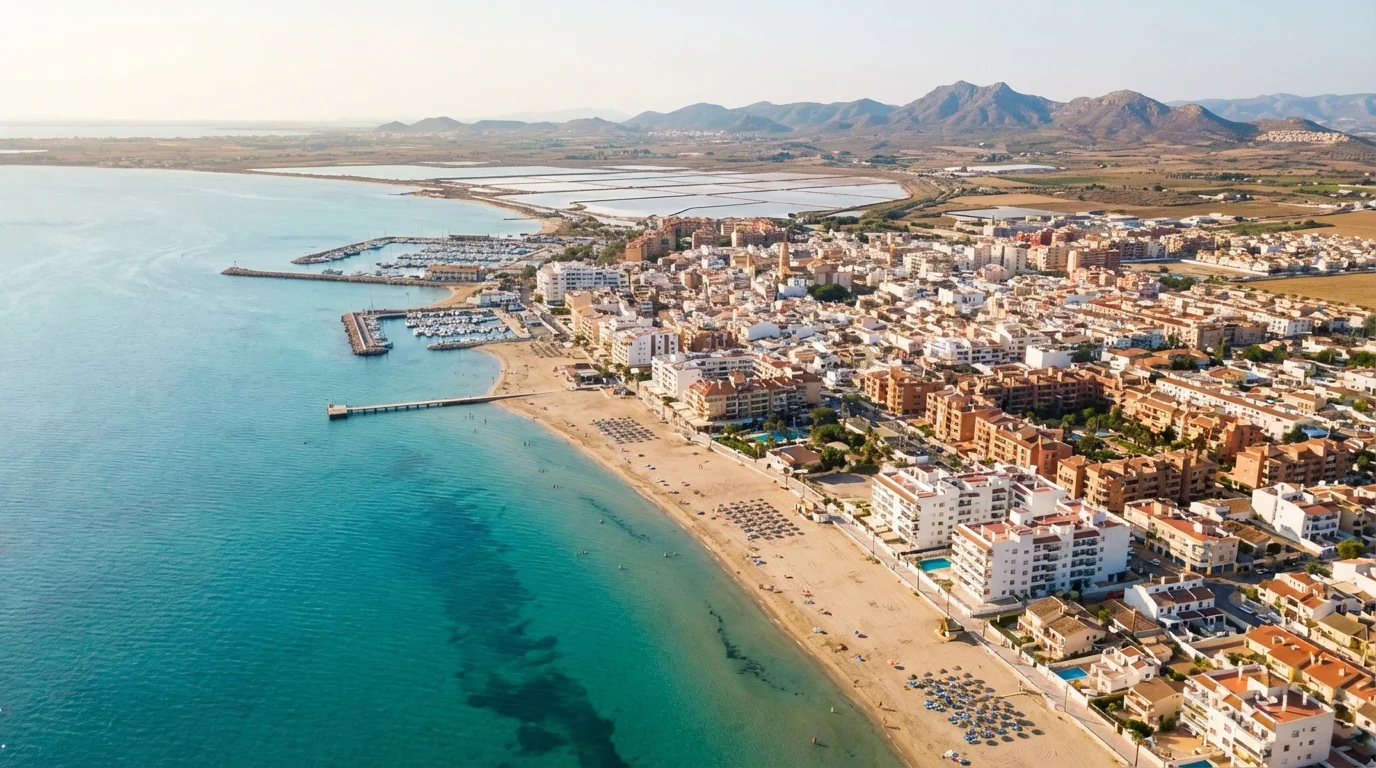
Complete guide to Los Alcázares on the Mar Menor: property prices, beaches, climate and why it is popular among Scandinavians. Costa Cálida.
16 min
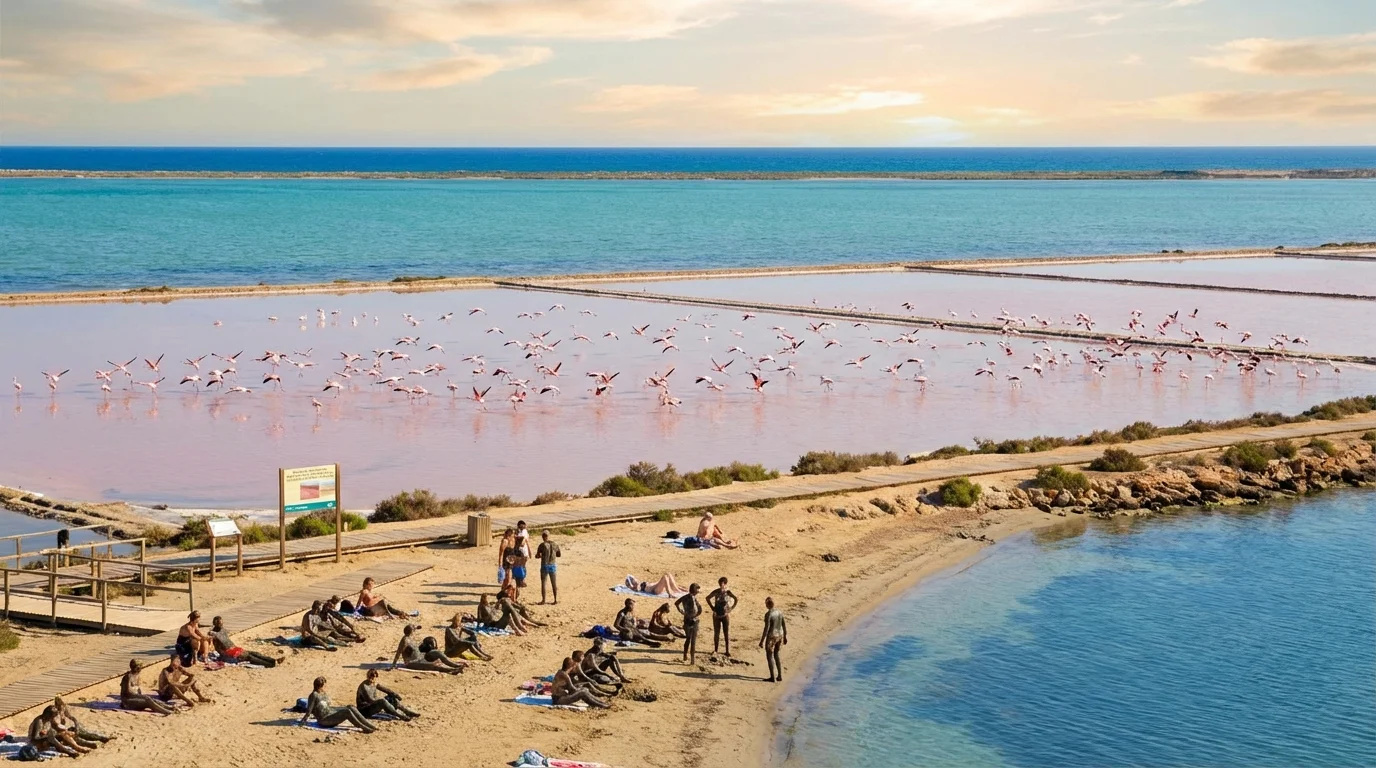
Complete guide to San Pedro del Pinatar at Mar Menor: the mud baths, flamingos, property prices and why this spa paradise attracts Scandinavians.
San Pedro del Pinatar is a coastal municipality at Mar Menor in the Murcia region with 28,700 residents, known for two things no other town on the Spanish coast can match: natural mud baths at Lo Pagán and thousands of flamingos in the salt lakes. The average price for an apartment sits at 2,100–2,270 euros per square metre, cheaper than the neighbouring town of Los Alcázares and significantly cheaper than the Costa Blanca. The sun shines over 300 days a year and the average temperature is 18 degrees.
San Pedro del Pinatar is not a tourist resort. It's a small Spanish town that happens to lie between two seas, with the Mediterranean on one side and Mar Menor's shallow lagoon on the other. The international community is growing, but daily life is conducted in Spanish. This guide covers the mud baths, flamingos, property prices, beaches, climate and who thrives here. Including what no estate agent tells you voluntarily.
San Pedro del Pinatar lies at the northernmost point of Mar Menor in the Murcia region, south-eastern Spain. The municipality borders Los Alcázares to the south and belongs to the Costa Cálida — the coastal stretch running from Águilas to the border with Alicante province. The main town of San Pedro and the coastal community of Lo Pagán together form a compact municipality of just over 22 square kilometres.
Useful distances:
From Sweden there are direct flights to Murcia-Corvera with Ryanair and to Alicante with SAS, Norwegian and Ryanair — both charter and scheduled during high season. Corvera is closest, but Alicante has more departures and often cheaper tickets outside summer.
Lo Pagán — the coastal part of the municipality — is the part that most foreign buyers focus on. Here you'll find the seafront promenade, restaurants, mud baths and direct contact with Mar Menor. San Pedro del Pinatar itself (the inland part) is more of a traditional Spanish town with a square, market and everyday services.
Parque Regional de las Salinas y Arenales de San Pedro del Pinatar is an 856-hectare nature reserve between Mar Menor and the Mediterranean. The park has had international Ramsar status as a protected wetland since 1994.
The area consists of active salt flats (salt extraction has been taking place here since Phoenician times), sand dunes, Mediterranean beaches and shallow lagoons. The flamingos nest in these lagoons.
Pink flamingos (Phoenicopterus roseus) are present in the park year-round. The largest flocks gather in June and July, but you can see them in their hundreds even during autumn and winter. Black-winged stilts, avocets and Sandwich terns also nest here. In total, over 100 bird species have been recorded.
The visitor centre at Las Salinas has birdwatching towers and information signs. The best time to see the flamingos is early mornings and late afternoons, when the light is soft and the birds are most active. The park is free and open around the clock.
Information
Did you know? The Salinas park has been a Special Bird Protected Area (ZEPA) since 1998 and is part of the EU's Natura 2000 network. Salt extraction is still ongoing — the company Salinera Española produces salt here on an industrial scale, and the activity coexists with nature protection.
The mud baths at Las Charcas in Lo Pagán are San Pedro del Pinatar's most famous attraction, and one of the few places in Europe where you can take natural mud baths entirely free of charge, directly outdoors.
The mud forms in shallow pools between the salt flats and Mar Menor. Strong sun, high salinity and still water create muddy sediment with high concentrations of calcium, magnesium, potassium, fluoride, chloride and sulphate. The result is an unusually fine-grained mineral mud that local people have used for joint pain and skin complaints for generations.
According to research published by, among others, the Universidad de Murcia, mud application causes local vasodilation (widening of blood vessels) and improves blood flow. It raises the pain threshold in people with osteoarthritis, arthritis, tendinitis and fibromyalgia. Patients with psoriasis have shown a reduced PASI index (a measure of disease severity), and improvements have been reported in eczema, acne and dermatitis.
The mud baths are traditionally recommended for rheumatic conditions (arthritis, osteoarthritis, gout), skin diseases (psoriasis, eczema, dermatitis) and rehabilitation after bone fractures. The mineral mud is also used in commercial spa treatments worldwide.
You don't need tickets and there are no opening hours. Go to the Las Charcas area south of Lo Pagán, take mud from the bottom of the pools, apply it to your body and let it dry in the sun (15–20 minutes). Then rinse off in Mar Menor's water. The whole process takes about 45 minutes.
During the summer months there can be hundreds of people at the pools at the same time — many tourists but also local residents who come regularly. During the low season (October–March) you often have the place almost to yourself.
Note
Bear in mind: The mud can permanently stain clothing. Use an old swimsuit. Avoid getting mud in your eyes — the salt content is high. People with open wounds or sensitive skin should be cautious. The mud baths are a folk tradition, not medical treatment — for serious skin conditions, consult a doctor.
The property market in San Pedro del Pinatar has taken off in recent years. More European buyers have discovered the area, and the reputation of the town as affordable and still genuinely Spanish has spread.
Current price data (2025):
Apartments:
Townhouses:
Villas:
| Year | Average price (euros/m²) | Change |
|---|---|---|
| 2025 | 2,111 | +34% |
| 2024 | ~1,780 | +15% |
| 2023 | ~1,540 | +10% |
34 percent in a year is a figure that should make you both curious and cautious. Part of the increase reflects that prices were unusually low following Mar Menor's environmental crisis. San Pedro was simply undervalued. But the pace is also driven by the supply of beachfront properties being small and British, German and northern European buyers having started to compete for the same properties.
Forecasts for 2026 point to continued price increases in the order of 8–12 percent, faster than the Murcia region's average but considerably calmer than 2024–2025.
Note
Always allow for 10–13 percent in additional costs on top of the purchase price. In the Murcia region this includes ITP (transfer tax, 7.75 percent since July 2025), notary fees, land registry registration and legal fees. Murcia's ITP of 7.75 percent is lower than the Valencia region's 9 percent (since June 2026) — a concrete advantage if you're comparing with Torrevieja or Orihuela Costa.
Properties
Explore available properties in san-pedro-del-pinatar
Browse current homes in the area and compare locations, price levels and property types at your own pace.
San Pedro del Pinatar has the Murcia region's semi-arid Mediterranean climate, one of Europe's driest and sunniest. The municipality receives an estimated 3,600 hours of sunshine per year. That's more than most coastal towns on the Costa Blanca.
Temperatures throughout the year:
Key figures:
Mar Menor acts as a thermal buffer. Summer nights are cooler at the coast than inland, and winters are milder thanks to the water's heat capacity. That makes Lo Pagán a more comfortable option than inland municipalities like Murcia city, where summer temperatures regularly exceed 40 degrees.
San Pedro del Pinatar has 14 kilometres of coastline with beaches on both sides: Mar Menor to the west and the Mediterranean to the east. Few coastal towns in Spain give you two entirely different bathing experiences within cycling distance.
The Mar Menor beaches share the same basic character: shallow water (you can wade out 50 metres and still stand), minimal waves, and water temperature reaching 28–30 degrees in summer. Ideal for young families and older swimmers who want safe bathing.
The Mediterranean beaches lie within the nature park and have deliberately been kept free from development. No beach kiosks, no sun loungers for hire. Bring your own picnic.
San Pedro del Pinatar has 28,706 registered residents. Of these, approximately 24 percent are foreign nationals — a high proportion, but lower than in the most touristified towns on the Costa Blanca.
Demographic composition:
San Pedro del Pinatar is considered the largest English-speaking expat area in the Murcia region, despite the largest immigrant group being Moroccan. British pubs and associations exist, but Scandinavian presence is limited compared to Torrevieja or Orihuela Costa. No Swedish food shops, no Swedish church.
Daily life is genuinely Spanish. The Thursday market in central San Pedro attracts hundreds of stalls with local vegetables, fruit, clothing and household goods. The fish market (la lonja) in the harbour gets going early in the mornings with freshly caught fish and seafood. It's not unusual for a neighbour to invite you for café con leche, and you'll need to bring out your Spanish.
The Murcia region is often called "Europe's garden" thanks to its farming, and the food culture here is honest rather than fancy. San Pedro del Pinatar benefits from proximity to the sea and the fertile land inland.
The local speciality is caldero murciano, a rice dish with fish and fish broth served with aioli. Think paella, but with Mar Menor fish and without the tourist price. San Pedro is also known for its sardine festivals in summer, and fresh oysters and mussels from Mar Menor are on most restaurant menus.
Lo Pagán's seafront promenade has several really good restaurants. Venezuela has been on the square and marina for over 30 years and serves fresh fish. Juan Mari, situated between San Pedro and Lo Pagán, is recommended in the Michelin guide. Rubio 360° has Mar Menor views and sunset terraces that make you stay longer than planned.
Advantages:
Disadvantages:
Mar Menor has gone through a serious environmental crisis since 2015, driven by nutrient pollution from agriculture in Campo de Cartagena. Algal blooms and fish die-offs occurred in 2016, 2019 and 2021. The situation has improved — the lagoon was granted legal personhood in 2022 and the Spanish state has allocated 484 million euros for restoration — but the roots of the problem take time to solve. 92 percent of the seabed has vegetation again, but new episodes cannot be ruled out.
As a buyer in San Pedro del Pinatar you should be aware of this. It has kept prices down compared to similar towns, but it also represents a risk if you count on Mar Menor as your primary bathing spot. The Mediterranean side — with the beaches at La Llana — is not affected.
Properties
Explore available properties in san-pedro-del-pinatar
Browse current homes in the area and compare locations, price levels and property types at your own pace.
Los Alcázares lies 10 kilometres to the south at Mar Menor and is the most common alternative that buyers compare with San Pedro del Pinatar. Here is an honest comparison of the differences.
| Aspect | San Pedro del Pinatar | Los Alcázares |
|---|---|---|
| Average price/m² | 2,111 euros | 2,962 euros |
| Residents | 28,700 | 18,500 |
| Character | Small Spanish town | More international |
| Mud baths | Yes, free at Lo Pagán | No |
| Flamingos/nature park | Yes, 856 hectares | No (but nearby) |
| Beaches | Both Mar Menor and Mediterranean | Mar Menor only |
| Water sports | Limited | Spain's best (kitesurfing, sailing) |
| Seafront promenade | Pleasant but shorter | 7 km continuous |
| Airport distance (RMU) | 44 km | 36 km |
| Purchase taxes (ITP) | 7.75% | 7.75% |
| Expat community | British dominance | Broader international mix |
Choose San Pedro del Pinatar if: You want lower prices, nature experiences (flamingos, mud baths, nature park), a dual coastline and a more genuinely Spanish daily life.
Choose Los Alcázares if: You prioritise water sports, a livelier seafront promenade, better infrastructure and a broader international community.
The municipalities are so close to each other that the choice doesn't need to be dramatic. Living in San Pedro you can cycle to the Los Alcázares promenade in 20 minutes. Living in Los Alcázares you can drive to the mud baths in Lo Pagán in 10 minutes. The question is mostly which base you prefer to wake up in.
Contact
Get in touch and we'll guide you forward — whether you're just starting out or ready to buy.
Contact usLast updated: March 2026. Prices and rules can change — contact us for current information.
Decision support
Ja, slamkurerna vid Las Charcas i Lo Pagán är helt gratis och öppna dygnet runt. De ligger inom Parque Regional de las Salinas y Arenales de San Pedro del Pinatar, som är ett offentligt naturskyddat område utan inträdesavgift eller öppettider.
Du tar helt enkelt leran från bottnen, smörjer in dig och låter den torka i solen innan du sköljer av dig i havet.
Ja, flamingos finns i saltsjöarna vid San Pedro del Pinatar under hela året, men de största flockarna samlas i juni och juli samt under höstflyttningen i september till oktober. Parque Regional de las Salinas har ett besökscenter med utsiktsplatser och informationsskyltar.
Tidiga morgnar och sena eftermiddagar ger bäst förutsättningar för att se fåglarna på nära håll.
Murcia-Corvera flygplats (RMU) ligger cirka 44 kilometer från San Pedro del Pinatar, ungefär 35 minuters bilresa. Alicante-Elche flygplats (ALC) ligger 63 kilometer bort, cirka 50 minuters körning via AP-7.
Från Sverige finns direktflyg till båda flygplatserna under högsäsong med Ryanair, Norwegian och SAS.
Snittpriset för en lägenhet i San Pedro del Pinatar ligger på cirka 2 100 till 2 270 euro per kvadratmeter (2025). En tvårumslägenhet nära Mar Menor kostar från ungefär 95 000 euro, medan strandnära lägenheter med sjöutsikt kan kosta 150 000 till 250 000 euro.
Priserna har stigit kraftigt de senaste åren, med ökningar på över 30 procent under 2024 till 2025.
De största nackdelarna är begränsad kollektivtrafik som gör bil nödvändigt, Mar Menors miljöhistorik med algblomning, färre skandinaver än Costa Blanca-orterna, samt risk för DANA-skyfall i september och oktober. Nattlivet och kulturutbudet är begränsat, och sjukvården kräver resa till Cartagena eller Murcia för specialistvård.
Sources

Serena Golf, Murcia

Serena Golf, Murcia

Serena Golf, Murcia

Serena Golf, Murcia

Serena Golf, Murcia

Serena Golf, Murcia
Local expertise
Complete guide to Los Alcázares on the Mar Menor: property prices, beaches, climate and why it is popular among Scandinavians. Costa Cálida.
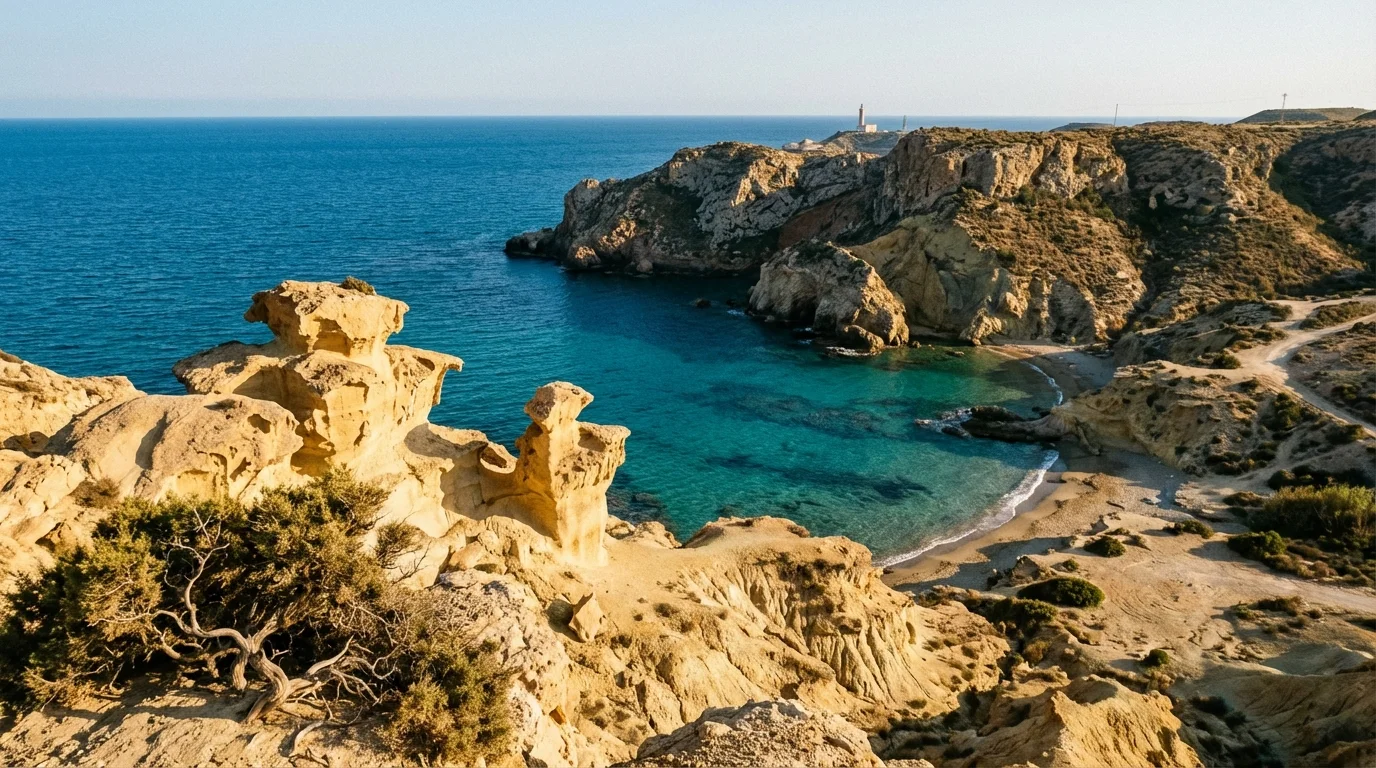
Complete guide to Mazarrón in Murcia: property prices, beaches, climate and why this hidden coastal gem is attracting more and more Swedish buyers.
Cheap houses in Spain from 80,000 €: prices on Costa Blanca, Costa Cálida, Torrevieja and Mazarrón — hidden costs, risks and tips for bargains in 2026.