

Buying Guides
Cheap Houses in Spain for Sale 2026 – Where Do You Find the Best Prices?
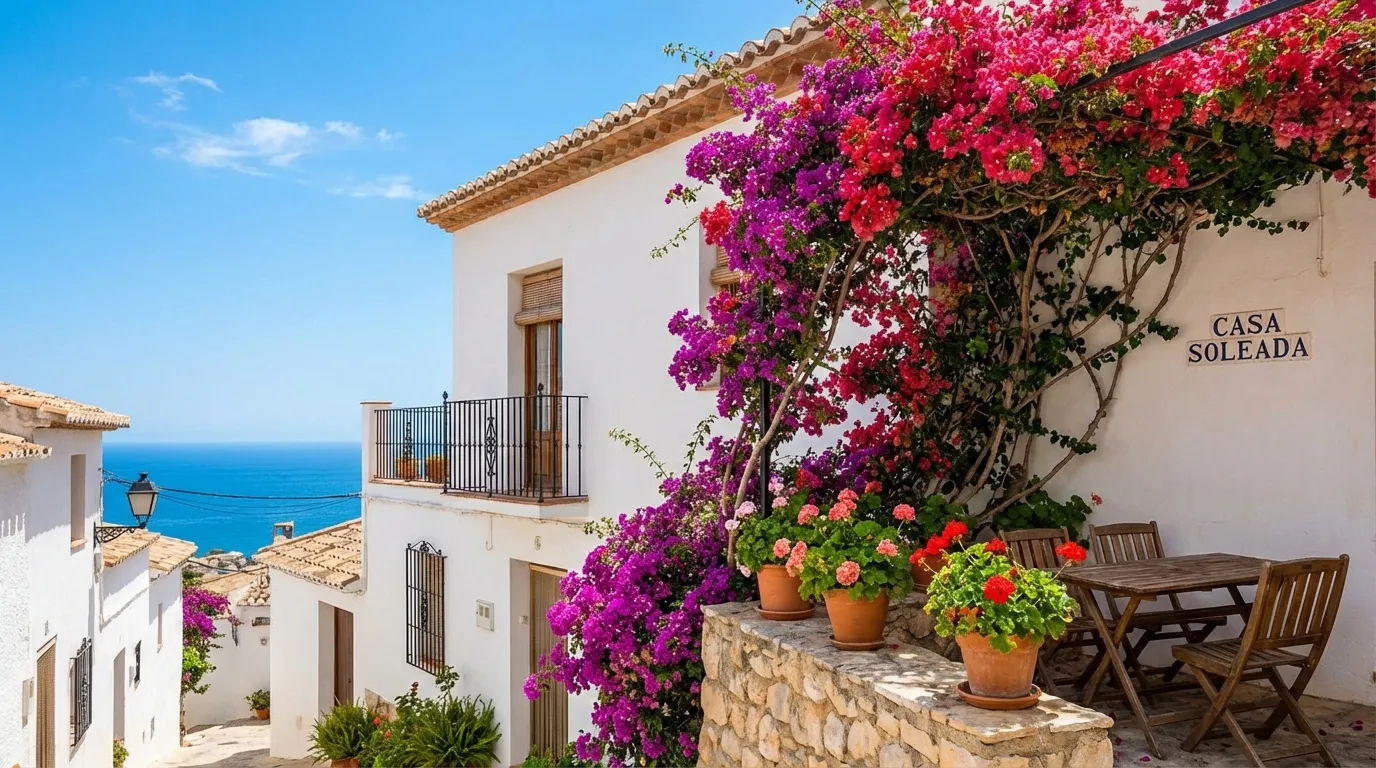
Cheap houses in Spain from 80,000 €: prices on Costa Blanca, Costa Cálida, Torrevieja and Mazarrón — hidden costs, risks and tips for bargains in 2026.
15 min
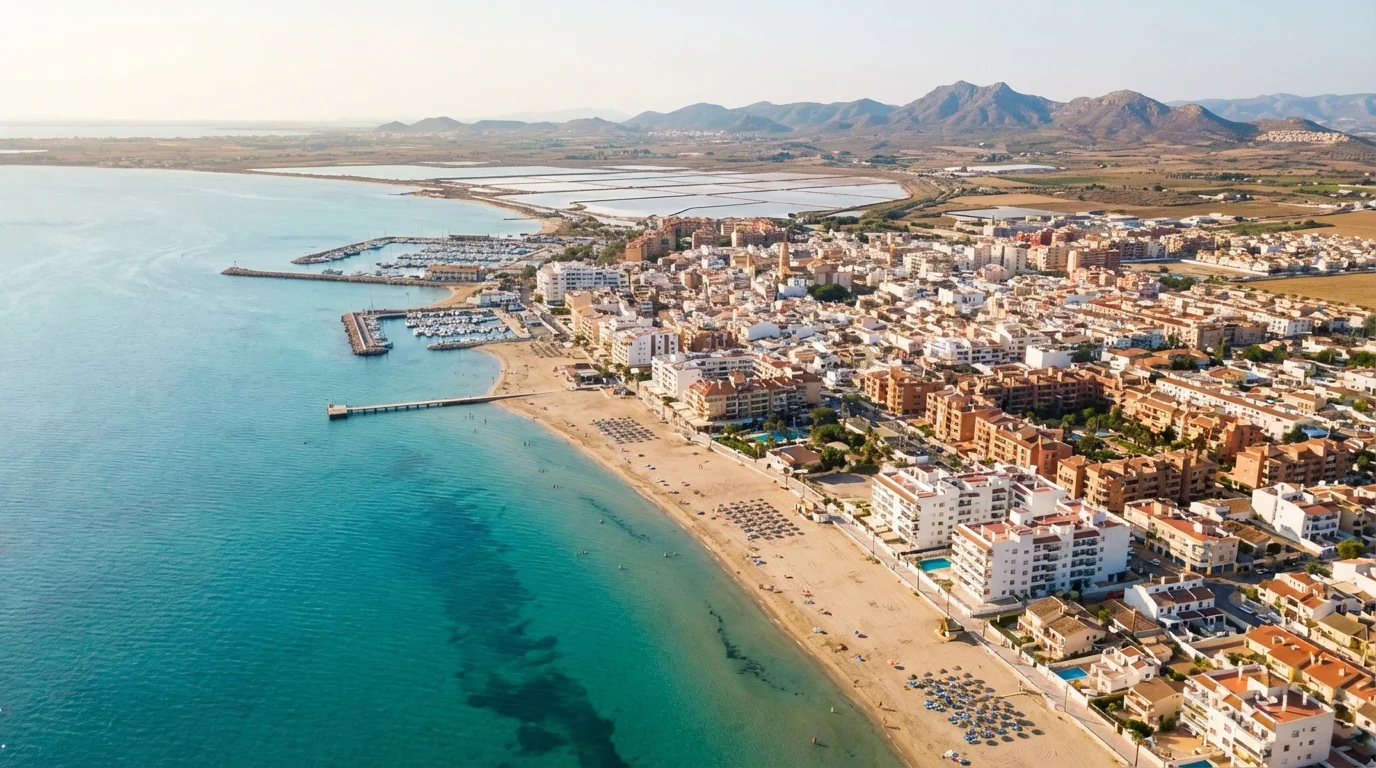
Complete guide to Los Alcázares on the Mar Menor: property prices, beaches, climate and why it is popular among Scandinavians. Costa Cálida.
Los Alcázares is a coastal town on the Mar Menor in the Murcia region, and it is one of Costa Cálida's most affordable options for Swedish property buyers seeking sun, shallow beaches and water sports. The average price for an apartment is 2,200–2,960 euros per square metre depending on the area, which is 30–40 per cent cheaper than comparable locations on the Costa Blanca. The Mar Menor — Europe's largest saltwater lagoon — gives you bathing water that is 2–3 degrees warmer than the Mediterranean, shallow enough to wade 50 metres out and still stand with the water at your waist, and conditions that make the town one of Spain's leading centres for kitesurfing and sailing. The climate delivers over 300 sunny days per year and an annual average temperature of 18 degrees.
But Los Alcázares comes with an important asterisk: the Mar Menor has undergone a serious environmental crisis with algal blooms and fish deaths since 2016. The lagoon is recovering — 92 per cent of the seabed has vegetation again — but you need to know the history before you buy. This guide covers everything: prices, climate, water sports, the Mar Menor's environmental status, and why Los Alcázares is attracting more and more Scandinavian buyers despite the challenges.
Los Alcázares is located on the western shore of the Mar Menor in the Murcia region, south-eastern Spain. The municipality belongs to Costa Cálida — the stretch of coastline running from Águilas in the south to San Pedro del Pinatar in the north. The town has around 18,500 registered residents, but the population swells to over 100,000 during the summer months.
Useful distances:
From Sweden there are direct flights to Murcia-Corvera with Ryanair and to Alicante with SAS, Norwegian and Ryanair — both charter and scheduled services during peak season. Murcia-Corvera is the closest and most straightforward, but Alicante has more departures and cheaper flights during the low season.
Getting around locally is easiest by car. Public transport is limited — there are only a couple of buses a day from Corvera airport. Los Alcázares also has a historical connection to the air force: the old seaplane base Academia General del Aire has left its mark on the town's architecture, and there is a seaplane museum along the promenade.
The property market in Los Alcázares has grown strongly in recent years, driven by increased demand from European buyers and improvements to the Mar Menor's environment.
Current price data (2025/2026):
Apartments:
Townhouses:
Villas:
| Year | Average price (euros/m²) | Change |
|---|---|---|
| 2025 | 2,962 | +24.6% |
| 2024 | 2,378 | +18.2% |
| 2023 | 2,012 | +12.4% |
Prices in Los Alcázares have risen faster than the Murcia region average, partly due to the Mar Menor's environmental recovery and increased interest from international buyers. Forecasts for 2026 show a continued price rise of 5–7 per cent.
Note
Always budget 10–13 per cent in additional costs on top of the purchase price. In the Murcia region this includes ITP (transfer tax, 7.75 per cent since July 2025), notary fees, land registration and legal fees. Murcia's ITP is lower than the Valencia region's 9 per cent (since June 2026) — an advantage if you are comparing with the Costa Blanca.
Properties
Explore available properties in los-alcazares
Los Alcázares shares the Murcia region's semi-arid Mediterranean climate — one of Europe's driest and sunniest. The town averages 4,010 sunshine hours per year, significantly more than Torrevieja (3,200) or Marbella (2,900), for example.
Temperatures throughout the year:
Key figures:
The Mar Menor has a unique property that makes the climate even more pleasant: the lagoon acts as a thermal buffer. Summer nights are cooler near the Mar Menor than inland, and winters are milder thanks to the thermal mass of the water.
Note
The DANA phenomenon (severe flash flooding) affects the Murcia region mainly in September–October. In 2019, Los Alcázares suffered serious flooding. Always check the elevation of any property you are considering, avoid ground-floor units in low-lying areas, and ask about historical flood maps.
Los Alcázares has an unusually international population for a municipality of its size. Of the 18,500 registered residents, approximately 37 per cent are foreign nationals. That is more than double the Murcia region average of 16 per cent.
Demographic composition:
The European expat community is dominated by British and German nationals, but there is a growing Scandinavian presence — particularly Swedes and Norwegians who have discovered that Los Alcázares offers a similar lifestyle to the Costa Blanca at lower prices. The Scandinavian community is, however, less established than in Torrevieja or Orihuela Costa. There are no Swedish grocery shops or Swedish church within walking distance here.
What you will find:
Los Alcázares suits those who want to be part of an international community without it feeling like a Swedish enclave. Everyday life here is more Spanish than in the large expat pockets on the Costa Blanca.
Los Alcázares is above all known as a water sports destination. The Mar Menor's shallow, warm water and stable thermal winds create conditions that attract both beginners and professionals. The British Olympic sailing team uses CAR Infanta Cristina — the national high-performance centre in Los Narejos — for winter training.
Popular water sports:
Every year the Surfari Mar Menor is held — a water sports festival that brings together hundreds of participants from across Europe.
Los Alcázares has seven kilometres of continuous sandy beach along the Mar Menor, connected by a paved promenade. All the beaches share common features: fine sand, shallow water with a gradual slope, and full services during the summer season.
The main beaches:
The promenade is the town's social backbone. Here you will find restaurants, bars, ice cream kiosks and outdoor gym equipment. On summer evenings, half the town strolls along the promenade — a typical Spanish tradition.
Los Alcázares has a respectable restaurant scene focused on fresh seafood and local Murcia dishes. Caldero — a rice dish with fish cooked in Mar Menor water — is the local speciality. The promenade has several chiringuitos and fish restaurants.
For a wider selection, head to Cartagena (25 min), which has one of the best food scenes in the Murcia region, or San Pedro del Pinatar (10 min), which has an excellent fish market.
The Mar Menor is Europe's largest saltwater lagoon. It is 170 square kilometres in size, a maximum of 7 metres deep, and is separated from the Mediterranean by La Manga — a 22-kilometre long, narrow strip of land. The lagoon is fed with Mediterranean water through five channels (golas), but its shallow depth means the water is warmer, saltier and calmer than the open sea.
| Aspect | Mar Menor | Mediterranean |
|---|---|---|
| Water temperature summer | 28–30°C | 24–26°C |
| Depth at 50 metres from shore | Waist | Chest/shoulders |
| Waves | Minimal | Moderate |
| Suitable for children | Excellent | Good |
| Water sports | Perfect (shallow, stable) | Good (but deeper) |
| Snorkelling/diving | Limited | Better |
| Mediterranean beach | 15 min by car (La Manga) | Direct |
One of Los Alcázares' great advantages is that you have both seas within reach. Want calm, warm water — go to the Mar Menor beach outside your door. Want waves, deeper water and snorkelling — drive 15 minutes to La Manga and swim in the Mediterranean.
This is the part of the guide that no estate agent talks about voluntarily, but which you need to know.
The Mar Menor has been affected by serious environmental problems caused by eutrophication from agriculture, tourist pressure and climate change since 2015. In brief:
But — and this is important — the situation is improving:
What does this mean for you as a buyer? Two things: First, there is a real risk that new environmental episodes could occur — the investments are substantial but the root cause of the problem (agriculture) takes time to resolve. Second, the environmental crisis has kept prices lower compared with similar coastal resorts, which creates an opportunity for buyers who believe in the long-term recovery.
Information
According to a study published in Scientific Reports (2023), property prices around the Mar Menor fell by up to 45 per cent during the worst crisis years. The sharp price rise in recent years (24 per cent in 2024–2025 alone) partly reflects the market recovering from that dip.
The market in Los Alcázares has gone from being one of Spain's most depressed coastal markets (due to the Mar Menor crisis) to being one of the fastest growing. This creates both opportunities and risks.
What is driving the market:
What you should be aware of:
Properties
Explore available properties in los-alcazares
Advantages:
Disadvantages:
Los Alcázares vs. San Pedro del Pinatar: San Pedro del Pinatar is located 10 kilometres to the north and offers a similar Mar Menor location but with access to natural mud treatments at Las Salinas beach. San Pedro has a slightly more Spanish character and lower prices. Los Alcázares has better beaches, more water sports and a livelier promenade.
Los Alcázares vs. La Manga: La Manga is a narrow strip of land with beaches on both sides — the Mar Menor and the Mediterranean. That sounds spectacular and it is, but La Manga is more resort-oriented with tall buildings and limited year-round services. Los Alcázares is a real town with everyday services and a permanent population.
Los Alcázares vs. Santiago de la Ribera: Santiago de la Ribera is just north of Los Alcázares on the Mar Menor and has a charming fishing village character with 4 kilometres of beaches. Prices are similar. Santiago de la Ribera is quieter and less touristy; Los Alcázares has better infrastructure for water sports.
Los Alcázares vs. Torrevieja: Torrevieja (Costa Blanca) has a much larger Scandinavian community, more shops and restaurants, better healthcare and stronger public transport. But prices are higher, beaches more crowded, and you do not have the Mar Menor's unique water sports conditions. Choose Los Alcázares if water sports and lower prices are more important to you than Swedish-friendly infrastructure.
Contact
Get in touch and we'll guide you forward — whether you're just starting out or ready to buy.
Contact usLast updated: March 2026. Prices and regulations may change — contact us for current information.
Decision support
Snittpriset i Los Alcázares ligger runt 2 200 till 2 960 euro per kvadratmeter beroende på område (2025/2026). En tvårumslägenhet nära Mar Menor kostar från cirka 110 000 euro, medan strandnära lägenheter med sjöutsikt kan kosta 180 000 till 280 000 euro.
Priserna har stigit med omkring 15 till 25 procent per år de senaste åren.
Ja, Mar Menor är öppen för bad och stränderna i Los Alcázares har behållit sina blå flaggor. Lagunen har visat tydliga tecken på ekologisk återhämtning sedan 2023, med 92 procent av havsbotten åter täckt av vegetation.
Vattenkvaliteten övervakas kontinuerligt och myndigheterna investerar 484 miljoner euro i restaurering fram till 2026.
Murcia-Corvera flygplats (RMU) ligger 36 kilometer från Los Alcázares, cirka 35 minuters bilresa. Alicante-Elche flygplats (ALC) ligger 90 kilometer bort, ungefär en timmes bilresa.
Från Sverige finns direktflyg till båda flygplatserna under högsäsong med Ryanair, Norwegian och SAS.
Los Alcázares är en av Spaniens bästa platser för vattensport. Mar Menors grunda, varma vatten och stabila vindar skapar perfekta förhållanden för kitesurfing, windsurfing, segling och paddle surf.
Det brittiska olympiska teamet tränar här vintertid och det finns flera kitesurfskolor i Los Narejos.
De största nackdelarna är Mar Menors miljöhistorik med algblomning och fiskdöd (2016, 2019, 2021), begränsad kollektivtrafik som gör bil nödvändigt, färre skandinaver än Costa Blanca-orterna, samt risk för DANA-skyfall på hösten. Serviceutbudet är sämre än i Torrevieja eller Alicante.
Sources

Serena Golf, Murcia

Serena Golf, Murcia

Serena Golf, Murcia

Serena Golf, Murcia

Serena Golf, Murcia

Serena Golf, Murcia
Local expertise
Cheap houses in Spain from 80,000 €: prices on Costa Blanca, Costa Cálida, Torrevieja and Mazarrón — hidden costs, risks and tips for bargains in 2026.
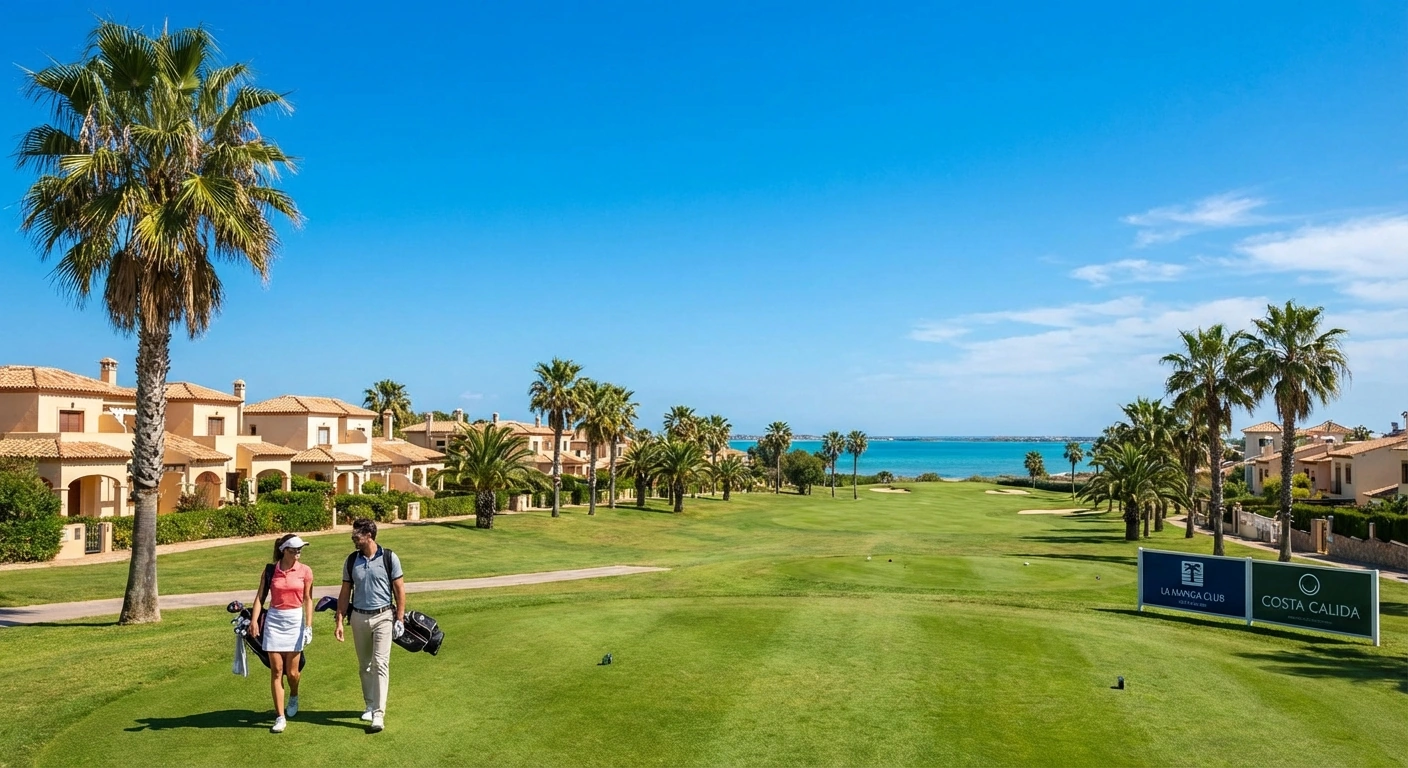
Guide to golf on the Costa Cálida: courses, green fees, areas and why the Murcia coast attracts buyers who want to combine affordable property with year-round golf.
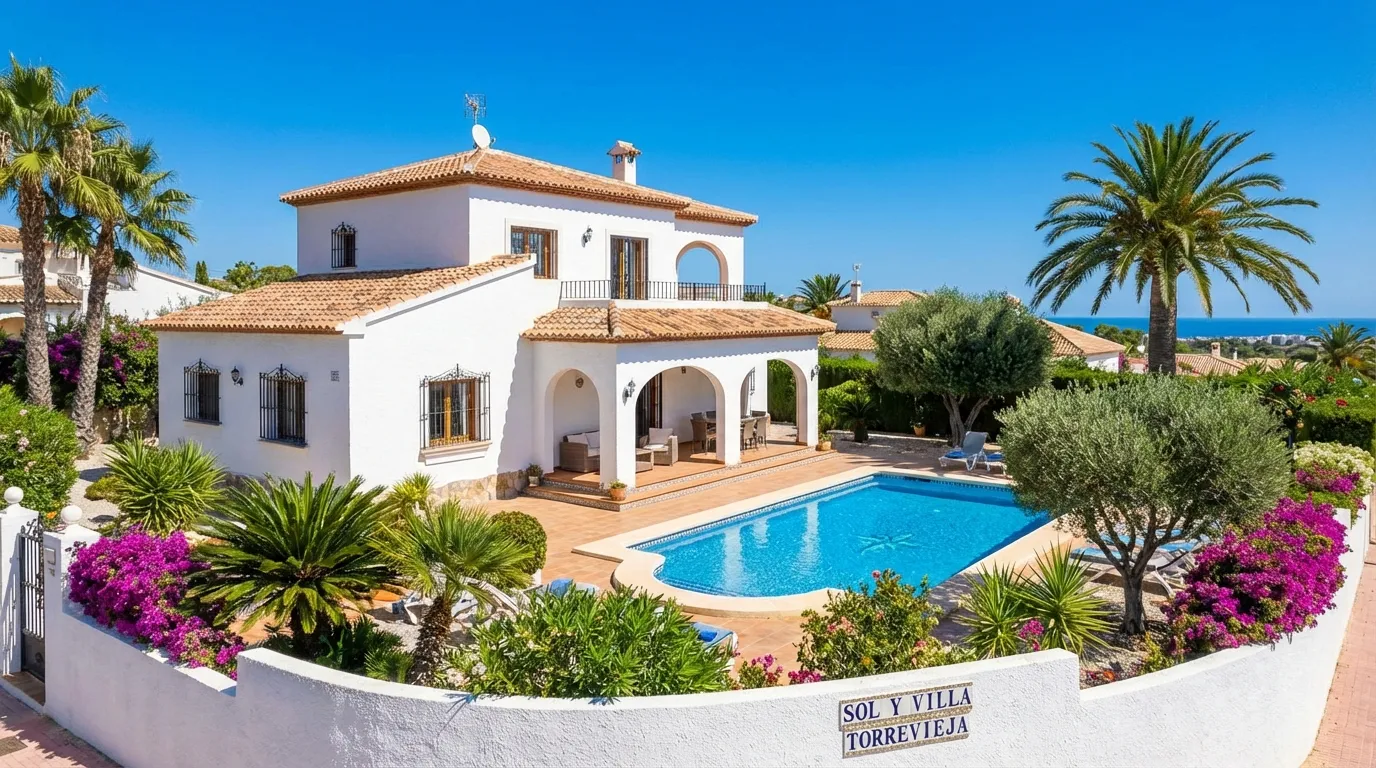
Buying a house in Torrevieja: prices by area, purchase process, taxes, NIE and mortgages — practical guide for Swedes who want to live on Costa Blanca 2026.