
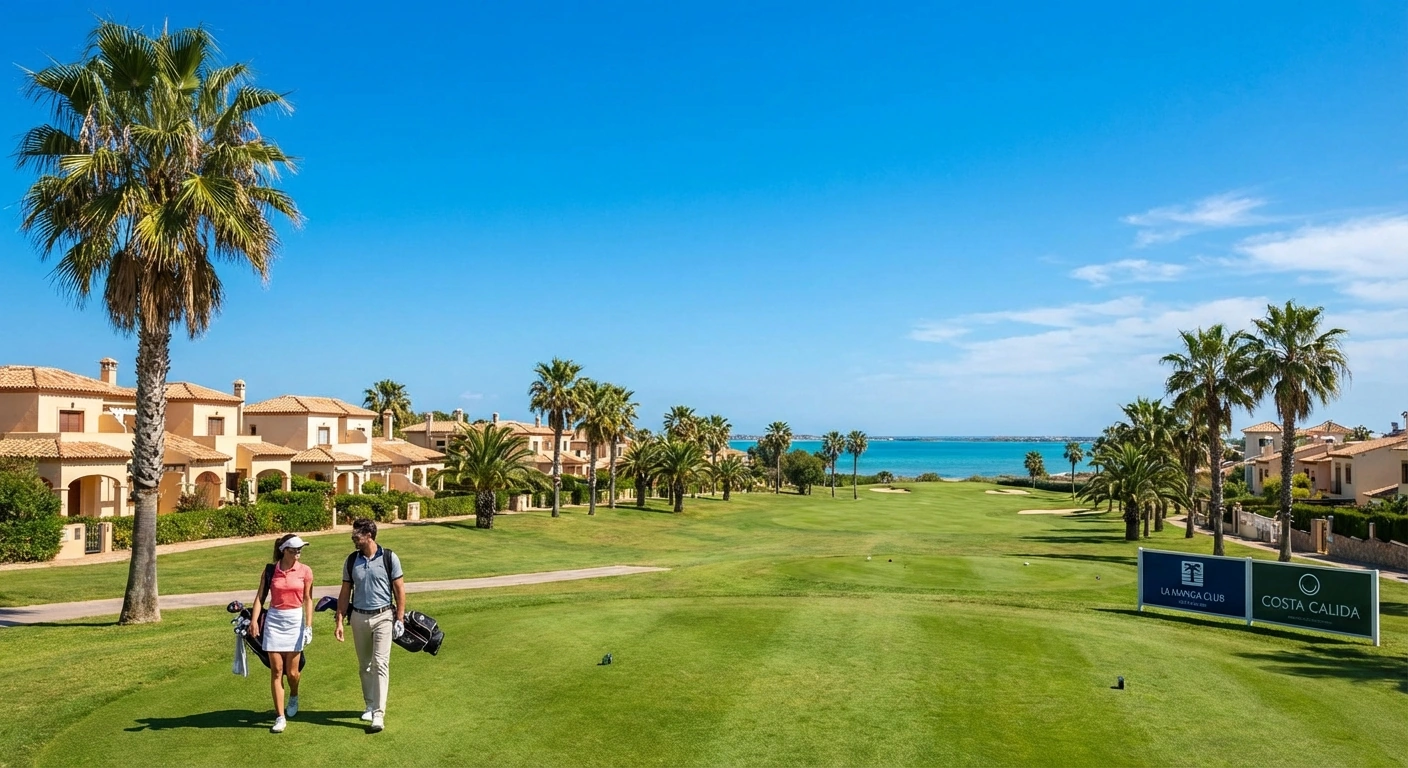
Lifestyle
Golf on the Costa Cálida – Mar Menor and Murcia 2026
Guide to golf on the Costa Cálida: courses, green fees, areas and why the Murcia coast attracts buyers who want to combine affordable property with year-round golf.
17 min
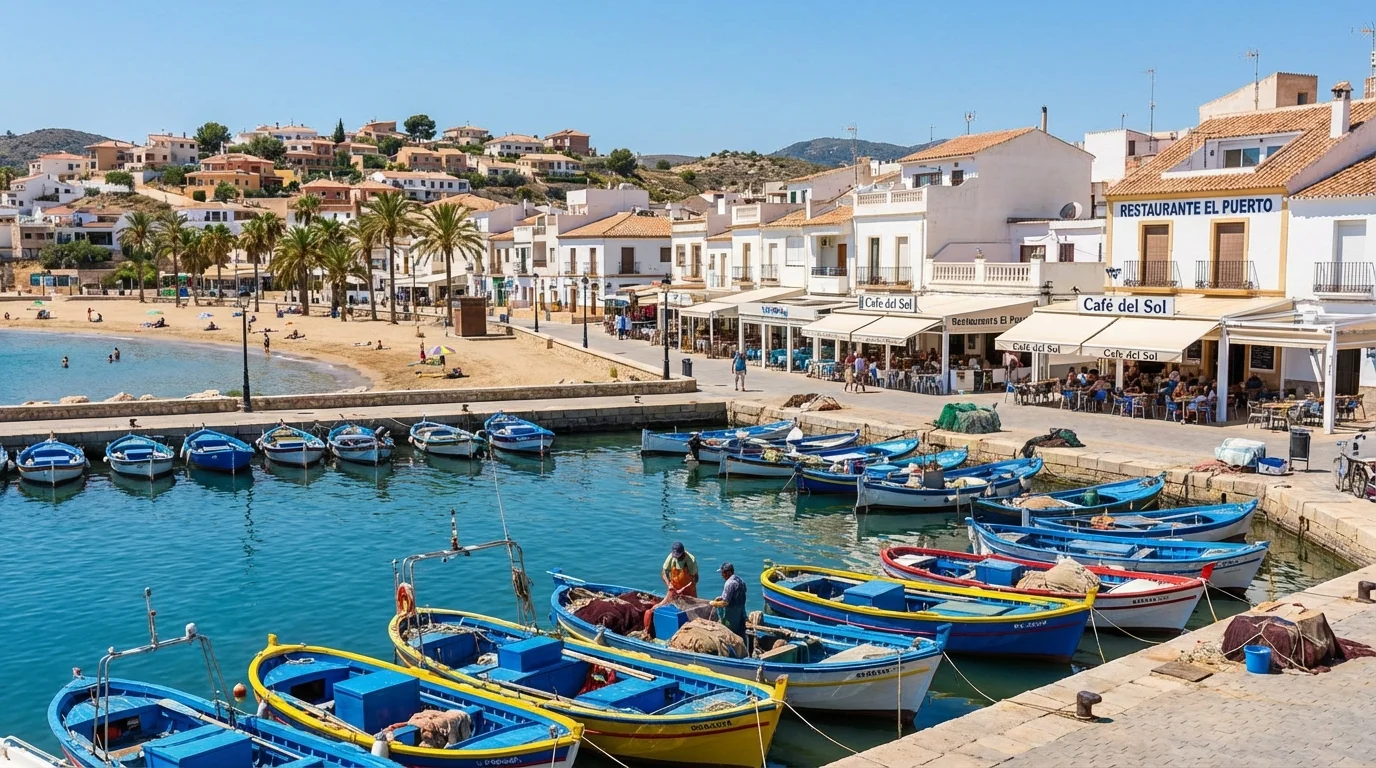
Complete guide to Puerto de Mazarrón: property prices, beaches, the harbour, restaurants and why this is Costa Cálida's best-kept secret.
Puerto de Mazarrón is a fishing village on the Costa Cálida in the Murcia region with 35 kilometres of coastline, 33 beaches and property prices around 1,800 euros per square metre — significantly lower than the Costa Blanca and Costa del Sol. There is an active fishing harbour where the fish auction is held every weekday, six beaches with Blue Flag certification and Bolnuevo's surreal sandstone erosions that look like sculptures from another planet. Unlike tourist-heavy coastal stretches further north, Puerto de Mazarrón has retained a genuinely Spanish character: local bars, fish restaurants along the quayside and a pace that isn't dictated by package tourism. From Puerto de Mazarrón you can reach Murcia airport (Corvera) in 40 minutes and Cartagena in 25 minutes — close enough for urban energy, far enough away for peace and quiet.
This guide is written for you if you're considering buying property in Puerto de Mazarrón. I go through what sets the town apart from the rest of the Costa Cálida, current property prices, the beaches, the harbour, the restaurant scene and the honest downsides.
Puerto de Mazarrón sits in the middle of the Costa Cálida — the Murcia region's coast stretching roughly 250 kilometres from El Mojón in the north to Águilas in the south. The town belongs to the municipality of Mazarrón and sits on the Mediterranean, sheltered in a natural bay that gave it its historical significance as a fishing harbour.
Useful distances:
From Sweden there are direct flights to Corvera (RMU) and Alicante (ALC) during high season with SAS, Norwegian and Ryanair. Corvera is the most practical airport — it opened in 2019 and replaced the old San Javier. Year-round connections to Alicante make Puerto de Mazarrón reachable in all seasons.
Locally you need a car. Public transport in the municipality of Mazarrón is limited, and the bus to Cartagena or Murcia takes considerably longer than by car. There are car parks in the centre and at most beaches.
Information
Puerto de Mazarrón is on the Costa Cálida — not the Costa Blanca. This means you belong to the Murcia region (not Valencia) with its own tax rules, healthcare system and property legislation. Transfer tax in Murcia is 7.75 percent for second-hand properties, compared with 9 percent in the Valencia region since June 2026.
This is a common source of confusion, and it's important to sort out before you start looking for property.
Mazarrón pueblo lies six kilometres inland and has approximately 12,500 residents. It is the municipality's administrative centre with the town hall (ayuntamiento), a daily indoor market with fresh produce, banks, pharmacies, a health centre and local shops. Historically Mazarrón was a mining town — iron and galena extraction was a major industry in the late 19th and early 20th centuries. Today the pueblo is a quiet, authentic small Spanish town with little tourism.
Puerto de Mazarrón is the coastal town with the harbour, beaches, restaurants and the vast majority of properties that international buyers are interested in. The town has approximately 10,300 residents, but the population quintuples during the summer months. Here you'll find the active fishing harbour, the seafront promenade, hotels, bars and a growing urbanisation of apartments and villas.
When people say "I want to buy in Mazarrón" they almost always mean Puerto de Mazarrón. That's where the beaches, sea views and restaurants are. Mazarrón pueblo can be relevant if you're looking for a cheaper property inland and don't need the sea outside your door — but the vast majority of international buyers end up in Puerto.
In this guide I focus on Puerto de Mazarrón unless otherwise stated.
Puerto de Mazarrón is one of the most affordable coastal areas in southern Spain. Prices sit noticeably below the Costa Blanca and Costa del Sol, but have been rising steadily in recent years.
Current price data (2025/2026):
Apartments:
Townhouses:
Villas:
Price development in recent years:
| Year | Average price (euros/m2) | Change |
|---|---|---|
| 2025 | 1,808 | +9.4% |
| 2024 | 1,652 | +11.2% |
| 2023 | 1,486 | +8.5% |
Prices in the municipality of Mazarrón have risen by nearly 28 percent for apartments and 24 percent for villas over the past four years. Yet the average price still sits 30–40 percent below popular Costa Blanca towns like Torrevieja (around 2,500 euros/m2) or Orihuela Costa.
Note
Always factor in 10–12 percent in additional costs on top of the purchase price. In the Murcia region, transfer tax (ITP) is 7.75 percent for second-hand properties since July 2025 — 1.25 percentage points lower than in the Valencia region (9 percent since June 2026). Beyond ITP, notary fees, land registry registration and legal fees apply.
Properties
Explore available properties in mazarron
This is Puerto de Mazarrón's strongest card. The municipality has 35 kilometres of coastline with 33 beaches and coves — ranging from wide sandy beaches with Blue Flags to wild, untouched rocky inlets. Six beaches have Blue Flag certification in 2025: Bahía, Rihuete, Playa Grande-Castellar, El Mojón, El Alamillo and Nares.
Bahía is Puerto de Mazarrón's most popular beach, located in a residential area just west of the harbour. It's a wide, golden sandy beach with shallow water that slopes gently — perfect for families with children. Blue Flag certified with lifeguards during the summer season, showers, toilets and wheelchair-accessible access ramps. Along the seafront promenade there are restaurants, bars and ice cream parlours.
Bolnuevo lies three kilometres south of Puerto de Mazarrón and is perhaps the municipality's most famous spot. The beach is 1.6 kilometres long and up to 24 metres wide with fine golden sand. But what makes Bolnuevo unique is Las Gredas de Bolnuevo — surreal sandstone erosions shaped by wind and sea air over millions of years. The formations look like giant mushrooms and sculptures and date from the Pliocene, approximately 4.5 million years ago. They are sometimes called "Mazarrón's enchanted city" and are a protected natural monument.
Bolnuevo has a calmer, more rural feel than central Puerto. There is camping, a few restaurants and villas along the coast. West of Bolnuevo a series of wild rocky coves opens up — Percheles, Cañadas del Gallego — popular with hiking enthusiasts and naturists.
Playa de la Reya lies east of the harbour and is a calm town beach with fine sand. Rihuete, right next to it, is one of the Blue Flag-certified beaches with a wide range of water sports. Both are easily accessible from Puerto de Mazarrón's centre.
Further west along the coast, towards Cartagena, lie the small coastal villages of Isla Plana and La Azohía. Isla Plana has a sheltered cove with crystal-clear water, excellent for snorkelling and paddleboarding. La Azohía sits at the foot of Sierra de la Muela and offers one of the most spectacular views along the entire Costa Cálida. There are no high-rises here — just white houses, a small beach and a handful of restaurants.
Playa Grande-Castellar is a wide beach east of Puerto, also Blue Flag certified. El Alamillo lies within a nature park with pine trees down to the waterline — one of the few beaches on the Costa Cálida with natural shade. Perfect for those wanting to avoid parasols and concrete.
Tip
If you prefer calm and wild landscape over a town beach: explore the rocky coves west of Bolnuevo towards Percheles. Here you can find completely empty coves during the low season. Bring water and water shoes — there are no facilities.
Puerto de Mazarrón's fishing harbour is not a museum or a tourist attraction in the conventional sense — it's a functioning workplace. Every morning the fishing boats come in with the catch, and in the afternoon the traditional fish auction (La Lonja) is held on the fishing quay, Monday to Friday.
The fish auction is open to visitors and gives a fascinating insight into Mediterranean fishing culture. The fishermen unload the catch — often dorada, lubina (sea bass), squid, prawns and sardines — which are then auctioned to local restaurants and fish merchants. The whole thing moves fast and noisily. The auction is so central to local life that in summer the mass in honour of Virgen del Carmen (the patron saint of fishermen) is celebrated in the auction hall itself, followed by a sea procession.
Unlike many other coastal towns on the Costa Cálida, which are in practice purely tourist resorts, the fishing harbour gives Puerto de Mazarrón an economic base outside tourism. This shows in what's on offer: the fish restaurants along the quayside serve the day's catch, not imported frozen fish. Prices for seafood and fresh fish are lower here than in most coastal towns.
The harbour also has a marina for leisure boats, and there are diving and snorkelling companies that organise trips to the nearby coves and underwater reserves.
Information
Mazarrón's coast has one of the richest marine ecosystems in the Murcia region. Posidonia oceanica meadows (Neptune grass) grow on the seabed and are EU-protected. They provide crystal-clear water and excellent snorkelling — but also mean there are restrictions on anchoring in certain coves.
The restaurant scene in Puerto de Mazarrón is shaped by the fishing culture. Fish and seafood dominate, prepared in the traditional Murcian style. Prices are generally lower than in more tourist-heavy towns.
Restaurants worth visiting:
Food culture in the area:
The Murcia region has a rich gastronomic tradition. Local specialities include caldero (a rice and fish dish typical of coastal fishermen), marinera (a tapas with Russian salad and anchovy), zarangollo (eggs with courgette and onion) and pastel de carne (meat pie with shortcrust pastry). The fish market in Mazarrón pueblo sells the day's catch at local prices.
Puerto de Mazarrón shares the Costa Cálida's excellent climate — "the warm coast" is not just a marketing name. The Murcia region has one of Europe's driest and warmest coastal climates.
Temperatures throughout the year:
Key figures:
Note
The DANA phenomenon (intense downpours) can affect the entire Murcia coast in autumn, particularly September–November. It is rare but intense and can cause flooding. Always check the elevation of the property you're looking at and avoid ground floor units in low-lying areas. Ask the estate agent specifically about the area's DANA history.
The municipality of Mazarrón has a total of just over 35,000 residents, distributed across Puerto de Mazarrón (approximately 10,300), Mazarrón pueblo (approximately 12,500) and surrounding areas including urbanisations like Camposol. During the summer months the population multiplies with Spanish and international holidaymakers.
Puerto de Mazarrón has a growing international community, but it's different compared to Costa Blanca towns like Torrevieja. The majority of residents in Puerto de Mazarrón outside the summer period are Spanish. The international presence is dominated by British residents, followed by Germans, Dutch and to some extent Scandinavians.
Camposol — a large urbanisation 15 minutes inland — is the clearest expat community in the municipality. Camposol has predominantly British residents with their own pubs, a golf course, restaurants and social clubs. It is in practice its own world, separate from the Spanish Puerto de Mazarrón.
The Swedish community in Puerto de Mazarrón is small compared to Torrevieja or Orihuela Costa. There are no Swedish shops or Swedish associations in the town itself. If you want a strong Swedish network within walking distance, this is honestly not the right place. However, there are Swedish communities in Cartagena (25 minutes away) and a broader Scandinavian presence in the Mar Menor area.
What attracts the Swedes who do choose Puerto de Mazarrón is precisely the absence of a "little Sweden" — they want to live Spanish, eat at local restaurants and learn Spanish. If that's your motivation, Puerto de Mazarrón is an excellent fit.
The property market in Puerto de Mazarrón has gone from being virtually unknown among international buyers to becoming one of the most talked-about growth markets on southern Spain's coast.
Several factors are driving the price increase:
Properties
Explore available properties in costa-calida
Browse current homes in the area and compare locations, price levels and property types at your own pace.
No guide is complete without an honest summary. Here is my assessment after examining the area carefully:
Advantages:
Disadvantages:
Torrevieja is a city of around 100,000 residents with complete services, a huge international community (including thousands of Swedes), large healthcare facilities and a broad range of restaurants and shops. Puerto de Mazarrón is a fishing village of 10,000 residents with an entirely different character.
| Aspect | Puerto de Mazarrón | Torrevieja |
|---|---|---|
| Residents | ~10,300 | ~100,000 |
| Price/m2 | ~1,800 euros | ~2,500 euros |
| Beaches | 33 beaches, 6 Blue Flag | Several town beaches |
| Swedish community | Small | Large |
| Character | Spanish fishing village | International city |
| Airport | Corvera 40 min | Alicante 45 min |
| Service level | Basic | Complete |
| Nightlife | Minimal | Wide range |
Choose Puerto de Mazarrón if you prioritise lower prices, better beaches, an authentic Spanish feel and don't need a Swedish social context. Choose Torrevieja if you want everything within walking distance, healthcare, Swedish shops and an active expat community.
Águilas lies 60 kilometres south of Puerto de Mazarrón, near the border with Almería. It is a larger city (approximately 35,000 residents) with a more urban character, impressive beaches and its own cultural life. Prices in Águilas sit slightly below or on a par with Puerto de Mazarrón, but the town is less accessible — further from the airport and with poorer road connections northwards.
Puerto de Mazarrón wins on proximity to Cartagena and Corvera airport. Águilas wins if you're looking for a Spanish city with more local energy and care less about international accessibility.
Within the Costa Cálida, Puerto de Mazarrón competes primarily with La Manga del Mar Menor and Los Alcázares. La Manga offers unique geography (a narrow strip of land between the Mediterranean and the Mar Menor) but higher prices and a more resort-oriented feel. Los Alcázares is popular among Scandinavians and golfers but lacks Puerto de Mazarrón's beach variety and fishing harbour character.
Puerto de Mazarrón has a Centro de Salud (health centre) with GPs, paediatricians and nurses. Opening hours are weekdays, with out-of-hours and emergency care around the clock. For specialist care and hospitals, Hospital General Universitario Los Arcos del Mar Menor in San Javier is the nearest (approximately 45 minutes), and Hospital Santa Lucía in Cartagena (25 minutes) is the most used.
There are also private clinics in Puerto de Mazarrón and Mazarrón pueblo. Many international residents have private health insurance (around 60–150 euros/month depending on age) as a supplement.
In Puerto de Mazarrón there are supermarkets (Mercadona, Consum, Lidl), pharmacies, banks, hairdressers and smaller shops. For major shopping, IKEA trips or specialist stores you drive to Cartagena (25 minutes) or the retail area at Alhama de Murcia.
The daily indoor market in Mazarrón pueblo with fruit, vegetables, meat and fish is an affordable alternative to the supermarket — and an experience in itself.
Contact
Get in touch and we'll guide you forward — whether you're just starting out or ready to buy.
Contact usDecision support
Genomsnittspriset i Puerto de Mazarrón ligger runt 1 800 euro per kvadratmeter (2025/2026). En tvårumslägenhet nära stranden kostar från cirka 100 000 euro, medan strandnära lägenheter med havsutsikt kan kosta 175 000 till 250 000 euro.
Villor varierar mellan 250 000 och 500 000 euro beroende på läge och skick.
Mazarróns kommun har 35 kilometer kustlinje med 33 stränder och vikar. Sex av dessa har Blå Flagg-certifiering: Bahía, Rihuete, Playa Grande-Castellar, El Mojón, El Alamillo och Nares.
Bolnuevo, med sina berömda sandstenserosioner, är en av de mest fotograferade stränderna på hela Costa Cálida.
Mazarrón pueblo ligger sex kilometer inåt land och är kommunens administrativa centrum med stadshus, marknad och banker. Puerto de Mazarrón är kustorten vid havet med hamn, stränder, restauranger och den absoluta majoriteten av bostäder som internationella köpare är intresserade av.
De flesta menar Puerto de Mazarrón när de pratar om att köpa bostad i Mazarrón.
Närmaste flygplats är Región de Murcia International Airport (Corvera), cirka 40 minuter med bil. Alicante-Elche flygplats ligger ungefär 1 timme och 30 minuter bort.
Från Sverige finns direktflyg till båda flygplatserna under högsäsong med SAS, Norwegian och Ryanair.
Puerto de Mazarrón passar bäst för dig som söker en genuin spansk kustort utan massturism, med lägre priser än Costa Blanca och Costa del Sol. Området är populärt bland pensionärer, par och familjer som uppskattar havet, lugnet och en aktiv fiskeby med autentiska restauranger.
Det passar mindre bra om du vill ha svenskt expat-sammanhang på gångavstånd eller livligt nattliv.
Sources

Country Club, Murcia

Country Club, Murcia

Country Club, Murcia

Country Club, Murcia

pueblo, Murcia

pueblo, Murcia
Guide to golf on the Costa Cálida: courses, green fees, areas and why the Murcia coast attracts buyers who want to combine affordable property with year-round golf.
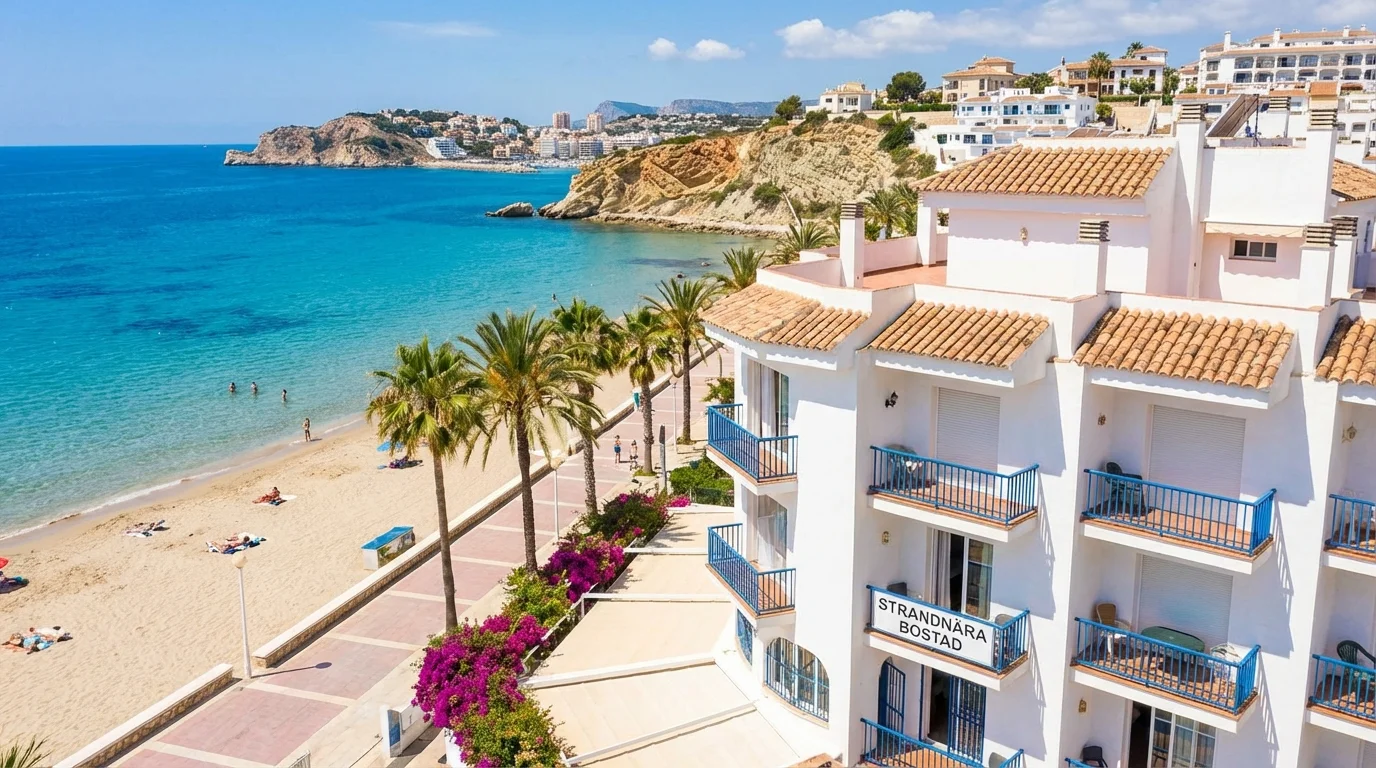
Find beachside property in Spain: the best areas, prices by region, what counts as beachside, the Ley de Costas and what to think about as a buyer in 2026.
What is it like to live in Spain as a Swede? Cost of living, healthcare, bureaucracy, social life and everything you need to know about everyday life in Spain.