
Moving & Living
Healthcare in Spain – How It Works for Swedes 2026
Complete guide to healthcare in Spain: public care, private options, EU card, SIP card and how to access healthcare as a Swedish resident.
16 min
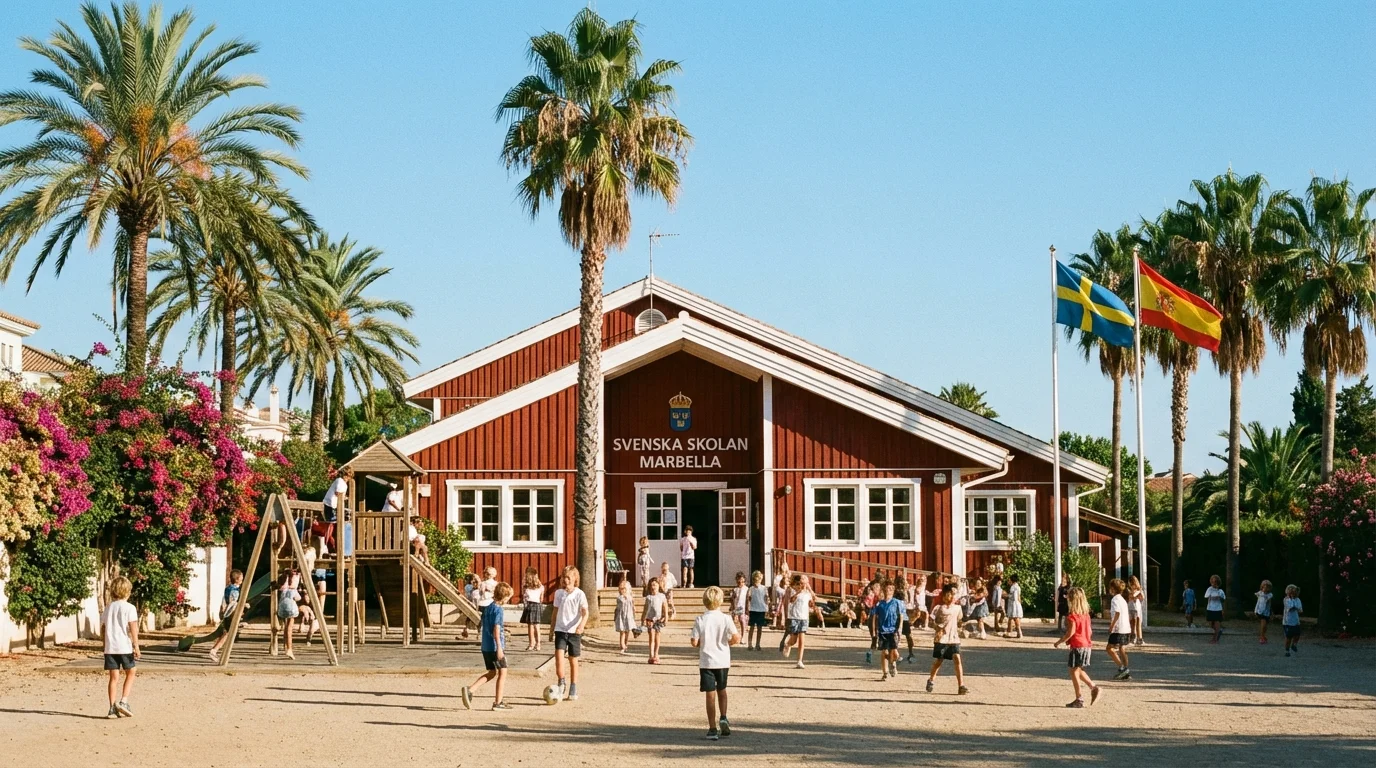
Swedish schools in Spain 2026: 5 Skolverket-approved schools in Fuengirola, Orihuela Costa and more. Fees, levels and how to choose and apply.
There are at least five Swedish schools in Spain approved by the Swedish National Agency for Education (Skolverket), concentrated on the Costa del Sol and the Costa Blanca. The two largest are Svenska Skolan Costa del Sol in Fuengirola (approximately 270 pupils, from pre-school year to upper secondary) and Skandinaviska Skolan Costa Blanca in Orihuela Costa (approximately 150 pupils, from pre-school year to Year 9). All follow the Swedish curriculum, award Swedish grades and have Spanish and English as compulsory subjects.
If you are planning to move to Spain with children, school choice is one of the most important issues. You have four main options: a Swedish school, an international school (British, IB or American), a Spanish state school or distance learning through Sofia Distans and Hermods. The right choice depends on the child's age, how long you plan to live in Spain and your budget.
This guide covers all the options — where the Swedish schools are located, what they cost, how the Spanish school system works, which international schools are available and how distance learning can complement the picture.
Information
Key Takeaways
Spain has more Swedish schools abroad than any other country outside the Nordic region. Skolverket lists seven approved Swedish schools abroad in Spain — all with the Swedish curriculum, Swedish grades and eligibility for state grants. Here are the most important ones.
Svenska Skolan Costa del Sol is the largest Swedish school abroad in Spain and one of the largest in the world. The school is located in Fuengirola and has been running since the late 1960s.
The fact that the school offers the full upper secondary programme on site is a major advantage compared with most other Swedish schools abroad, where pupils have to switch to distance learning after Year 6 or Year 9.
Skandinaviska Skolan Costa Blanca is located in Orihuela Costa, close to Torrevieja and La Zenia. The school was founded in 1999 and takes in Swedish, Norwegian and Finnish pupils.
Information
Did you know? Skandinaviska Skolan Costa Blanca is just 10 minutes from La Zenia Boulevard and close to popular residential areas such as Playa Flamenca, Villamartin and Punta Prima. This makes it a natural choice for Swedish families purchasing property in southern Costa Blanca.
Svenska Skolan Marbella is located on the Costa del Sol and offers regular teaching for the pre-school year to Year 6. Pupils in Years 7–9 study via Sofia Distans with tutoring from teachers on site, and upper secondary pupils study through Hermods with support from school staff.
In addition to the three above, there are further Swedish schools approved by Skolverket:
All follow the Swedish curriculum and are supervised by Skolverket.
Swedish schools abroad are partly funded by state grants from Skolverket, but the largest share of the cost is paid by parents through term fees. Prices vary between schools.
Swedish schools — approximate costs
Svenska Skolan Costa del Sol
Registration approx €1,000
Term fee varies by year group · Pre-school year to upper secondary.
Skandinaviska Skolan Costa Blanca
Registration approx €750
Term fee approx €2,700 · Pre-school year to Year 9.
Svenska Skolan Marbella
Registration varies
Term fee approx €4,100–€6,500 · Pre-school year to upper secondary (distance).
On top of term fees, there are often costs for school meals (€100–€200/month if not included), school materials, school uniform (if required) and optional school bus.
Tip
Tip: Check whether your child is eligible for a state grant. Skolverket awards state grants to Swedish schools abroad for pupils whose parents are posted abroad or have another qualifying reason to live overseas. The grant reduces the term fee — at Skandinaviska Skolan Costa Blanca by up to €700. Contact the school to see whether you qualify.
If you are considering a Spanish state school — or simply want to understand the system your children's friends attend — it is worth knowing the basics. Spain's education system differs from Sweden's in several ways.
Spanish school levels (state school)
Educación Infantil (pre-school)
Ages 3–6
Not compulsory · free state pre-school.
Educación Primaria
Ages 6–12
Compulsory · free.
ESO
Ages 12–16
Compulsory · free.
Bachillerato (upper secondary)
Ages 16–18
Optional · free state provision.
Formación Profesional
Ages 16+
Optional · free state provision.
Compulsory schooling applies to all children between the ages of 6 and 16 who are registered (empadronados) in a Spanish municipality — regardless of nationality. This applies to your child too if you move to Spain.
The Spanish school year begins in September and ends in June. Children have a longer summer holiday (mid-June to mid-September) but shorter holidays during the rest of the year. The school day is often split: teaching in the morning (9:00–14:00) with optional afternoon activities. Some schools operate a full-day schedule (jornada continua or jornada partida depending on the region).
The grading scale in Spain runs from 0 to 10, where 5 is a pass. Pupils who do not achieve a pass may need to resit in September. ESO ends with a final certificate (Graduado en ESO) which is required to proceed to Bachillerato. After Bachillerato, pupils sit the Selectividad (now called EBAU) — a national examination that determines university entrance.
International schools are a popular option for Swedish expatriates who do not live near a Swedish school or who want their children to be educated in a more international environment. There are over 30 international schools in the province of Alicante alone and a similar number on the Costa del Sol.
Most international schools charge a one-off registration fee (€1,000–€3,000) in addition to term fees. Sibling discounts are common — ELIS Villamartin, for example, gives 10–40% discount depending on the number of siblings.
Properties
Explore available properties in Costa Blanca
Browse current homes in the area and compare locations, price levels and property types at your own pace.
Yes, and they are also free. State schools (colegios públicos) are free of charge for all children registered in the municipality. You only pay for school materials, optional school meals (€50–€120/month) and voluntary activities.
Note
Note: If you plan to move back to Sweden within a few years, bear in mind that children need valid Swedish grades to apply to Swedish upper secondary school. Spanish grades can be validated but the process is complicated. Supplementary Swedish through a Swedish school abroad or distance learning makes the transition back much smoother.
Distance learning is an important supplement — especially for families living far from a Swedish school or for secondary school and upper secondary level, where several Swedish schools do not offer regular teaching.
Sofia Distans is Skolverket's designated provider of distance learning for Swedish pupils abroad in compulsory school. Teaching takes place digitally with qualified teachers.
Hermods offers complete upper secondary programmes by distance learning for Swedish young people abroad.
If children live abroad and attend an international or Spanish school, they can study supplementary Swedish through a Swedish school abroad. This means they receive teaching in Swedish, social studies and possibly science in accordance with the Swedish curriculum — usually a few hours per week. Skandinaviska Skolan Costa Blanca, for example, offers supplementary Swedish as a separate service.
The choice depends on four factors: the child's age, how long you plan to stay, budget and where you live.
A Swedish school is the safest choice. Children retain Swedish grades, do not lose their written Swedish and can return smoothly to school in Sweden. Supplementary Swedish is a minimum if children attend an international or Spanish school.
Then an international or Spanish school may be worth considering. Children become bilingual (or trilingual) and integrate better. Combine with supplementary Swedish if you want to keep the door open for Swedish education later.
Younger children adapt quickly. A Spanish state school works excellently — they learn the language within months and gain a natural social network. Supplement with Swedish at home.
Older children find language switching more difficult. A Swedish school or international school (with English as the language of instruction) usually works better. Starting in Spanish ESO without any knowledge of Spanish at age 13 is a major challenge.
Three school types in brief
Swedish grades
IB / IGCSE etc.
Free tuition
Contact
We help Swedish families find the right property near schools on the Costa Blanca and Costa del Sol. Tell us about your wishes — we will guide you to the right area. Book a free video meeting.
Book a free consultationLast updated: April 2026. Fees and regulations can change — contact the respective school for up-to-date information.
Decision support
Ja. De svenska utlandsskolorna i Spanien (exempelvis Svenska Skolan Costa del Sol i Fuengirola och Skandinaviska Skolan Costa Blanca) är godkända av Skolverket, följer svensk läroplan och ger svenska betyg som är fullt giltiga vid ansökan till svensk gymnasieskola eller universitet.
Eleverna läser dessutom spanska och engelska som tillägg.
Terminsavgifterna varierar mellan skolorna. Räkna med cirka 2 700-5 500 euro per termin beroende på skola och årskurs.
Till det kommer inskrivningsavgift (750-1 000 euro engångsbelopp) samt kostnader för skolmat, skolmaterial och eventuell transport. Vissa elever kan få statsbidrag från Skolverket som sänker avgiften.
Ja, Spanien har skolplikt för alla barn mellan 6 och 16 år, oavsett nationalitet. Det gäller dig som är folkbokförd (empadronerad) i en spansk kommun.
Obligatorisk utbildning omfattar Educación Primaria (6-12 år) och Educación Secundaria Obligatoria, ESO (12-16 år). Offentlig grundskola och ESO är avgiftsfria.
Ja. Hermods Distansgymnasium erbjuder hela svenska gymnasieprogram på distans för utlandsboende ungdomar.
Avgiften är cirka 35 800 kronor per läsår (2025/26). Flera svenska skolor i Spanien fungerar som samarbetsskolor och erbjuder handledning på plats medan eleven studerar via Hermods.
Sofia Distans erbjuder distansundervisning för årskurs 6-9.
Ja, alla svenska utlandsskolor i Spanien har spanska som obligatoriskt ämne från första årskursen. Barnen får dessutom naturlig exponering för spanska i vardagen — på fritidsaktiviteter, med grannar och i butiker.
De flesta barn blir funktionellt tvåspråkiga inom 1-2 år. Engelska lärs också ut från tidig ålder.
Sources
Complete guide to healthcare in Spain: public care, private options, EU card, SIP card and how to access healthcare as a Swedish resident.
Spanish NIE number 2026: step-by-step guide from Sweden or Spain. EX-15 form, Modelo 790, €9.84 fee, waiting times and NIE/NIF/TIE explained.
Everything about empadronamiento in Spain: why you need to register, how to do it, what documents are required and what it gives you as a Swedish resident.