
Moving & Living
NIE Number in Spain – Complete Guide 2026 (Application, Forms, Waiting Times)
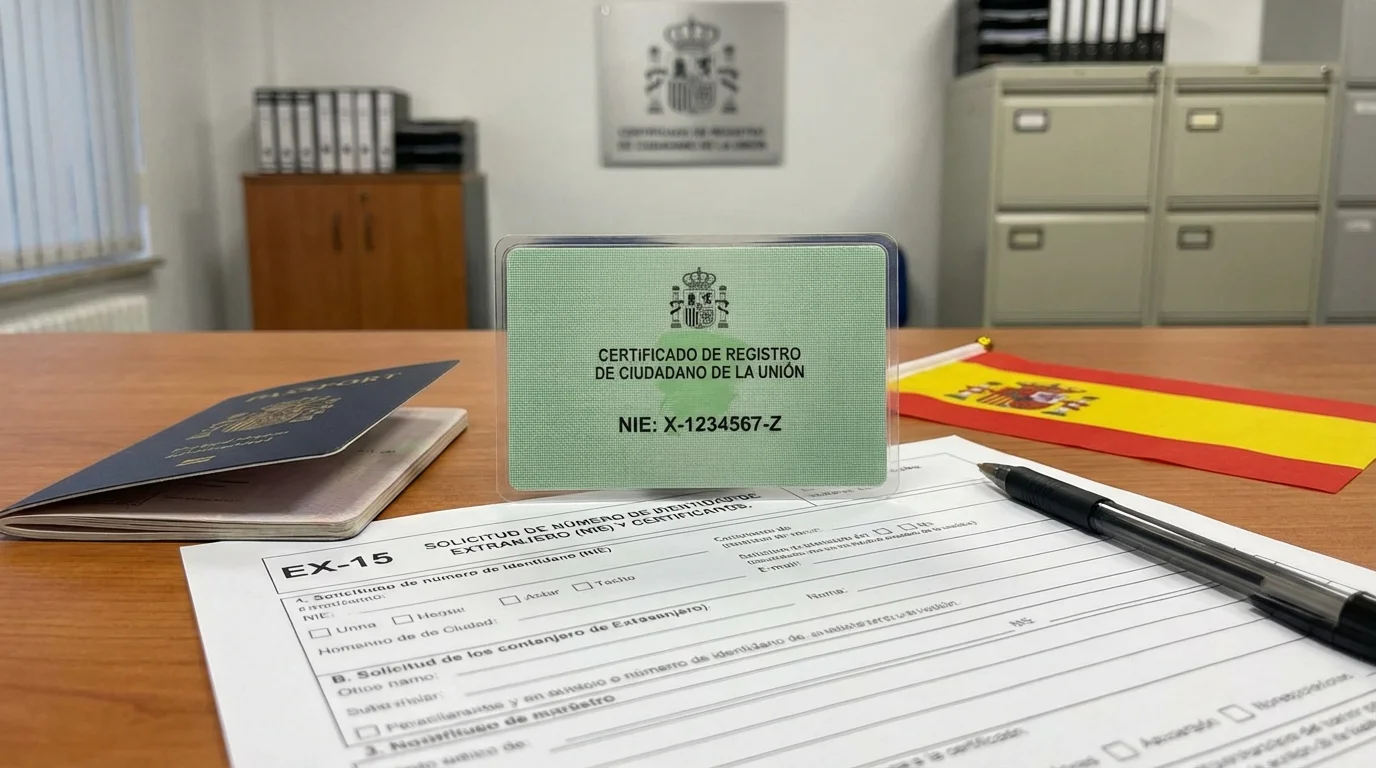
Spanish NIE number 2026: step-by-step guide from Sweden or Spain. EX-15 form, Modelo 790, €9.84 fee, waiting times and NIE/NIF/TIE explained.
15 min
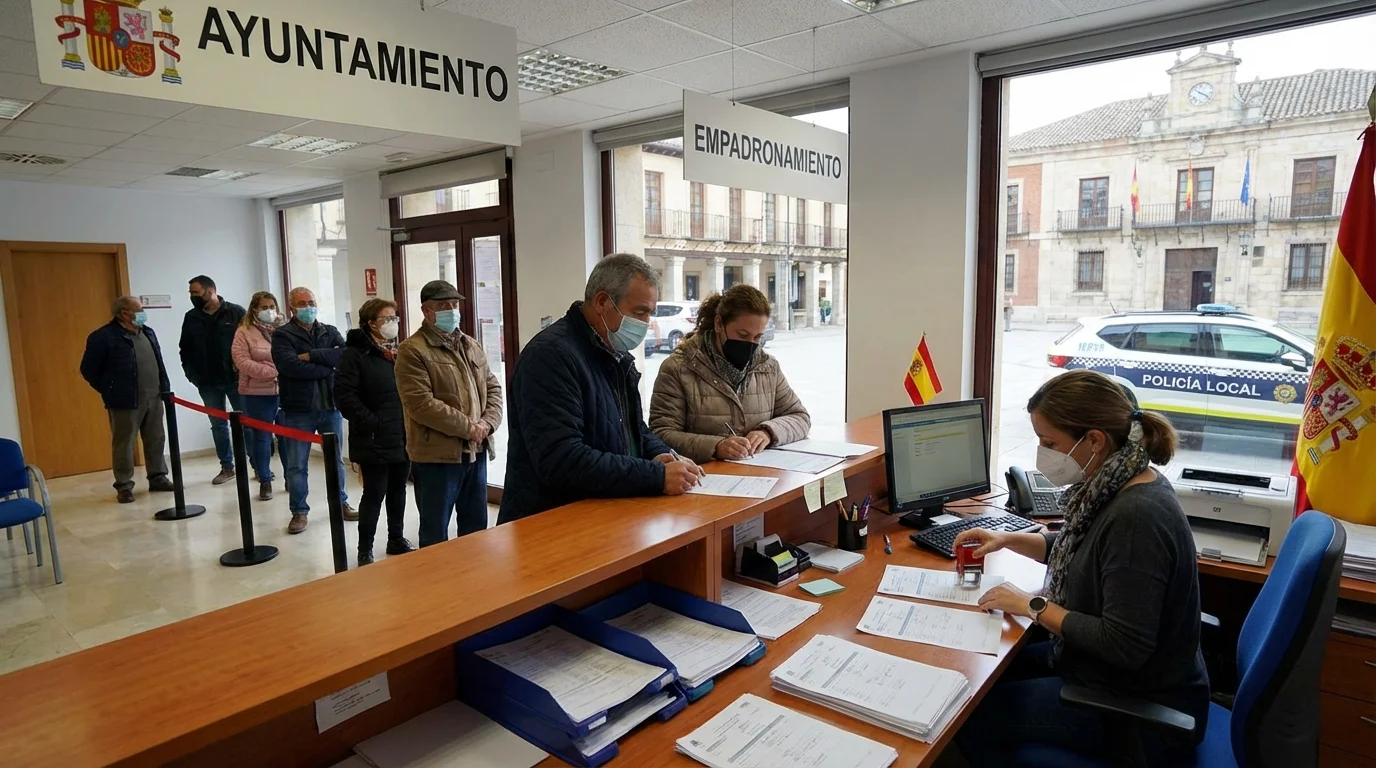
Everything about empadronamiento in Spain: why you need to register, how to do it, what documents are required and what it gives you as a Swedish resident.
Empadronamiento — Spanish municipal registration — is one of the first administrative steps you need to take when you move to Spain. It is a registration with your local municipality (ayuntamiento) that proves where you live. Without it you cannot get a Spanish healthcare card, enrol children in school or apply for a residence permit (residencia).
The process is free, normally takes 15–30 minutes at a personal visit and gives you a certificate immediately — the certificado de empadronamiento. The tricky part is not the registration itself but knowing which documents to bring and booking an appointment in advance. This guide takes you through the whole process step by step, with specific information for the municipalities where most Swedes live: Torrevieja, Orihuela Costa and Alicante.
Empadronamiento is registration in the padrón municipal de habitantes — the municipality's official population register. Every person living in Spain, regardless of nationality or residence status, has a statutory obligation to register in the municipality where they live.
The concept can be confusing for Swedes because there is no direct equivalent in Sweden. In Sweden population registration is handled centrally by the Swedish Tax Agency (Skatteverket). In Spain each individual municipality is responsible for its own padrón. This means the registration is done locally — at your ayuntamiento (town hall) — and the process can differ somewhat between municipalities.
When you register you receive a certificado de empadronamiento (registration certificate). That document shows your full name, NIE or passport number, your registered address and the date of registration. The certificate has a validity of three months for most administrative purposes, but the actual registration in the padrón is permanent (for EU citizens).
Information
Worth knowing: Empadronamiento does not give you a residence permit or a work permit. It is simply proof of where you live. Think of it as the Spanish equivalent of being enrolled in a population register — an administrative fact, not a legal status.
Empadronamiento is the key to accessing public services in Spain. Without it you are locked out of most of what makes daily life function. Here are the most important reasons:
You need empadronamiento to apply for the tarjeta sanitaria — the Spanish healthcare card. The card is called an SIP card in the Comunitat Valenciana (the region where the Costa Blanca is located) and gives you access to your local health centre (centro de salud) and hospitals within the public system. Without empadronamiento you can only use your European Health Insurance Card for emergency care — not for routine doctor visits, prescription medication or specialist referrals.
State schools in Spain require a certificado de empadronamiento on enrolment. School places are allocated based on proximity to home, so your registered address determines which schools your child can apply to. Without empadronamiento you cannot even begin the application process.
As an EU citizen (Swede) you have the right to live in Spain, but if you stay longer than three months you must register for the Certificado de Registro de Ciudadano de la Unión — the green residence certificate. Empadronamiento is a compulsory document in that application.
Registered EU citizens can vote — and stand as candidates — in local elections (elecciones municipales) in Spain. You need to have been registered in the municipality in advance and to have enrolled in the electoral roll.
Note
Important for property owners: Even if you only live part-time in Spain, empadronamiento can be beneficial. In the Comunitat Valenciana it entitles you to a reduced IBI in certain municipalities, and it is a requirement to be able to vote locally. If you have a property on the Costa Blanca and spend more than a few months per year there it is worth registering.
The process is the same regardless of whether you live in Torrevieja, Alicante or Marbella — but the practical details (appointment booking, office locations, waiting times) vary by municipality. Here is the general process:
Before you register you need an NIE number (Número de Identidad de Extranjero). It is not a formal requirement everywhere — you can register with only a passport — but in practice most ayuntamientos ask for your NIE. If you do not yet have your NIE, read our guide on NIE numbers in Spain.
See the complete checklist in the next section. The basic principle: you need ID, address proof and a completed form.
Most municipalities require an appointment — cita previa — for empadronamiento. Appointments are usually made via the municipality's website or by telephone. Book well in advance — in popular municipalities like Torrevieja the wait can be several weeks.
Go to your booked appointment with all documents (originals + copies). The official checks your papers, registers you in the system and gives you a certificado de empadronamiento — usually on the spot, during the same visit.
The certificate is valid for three months for administrative purposes (such as applying for residencia or a tarjeta sanitaria). If you need it after three months you simply request a new one — your registration in the padrón remains active.
Tip
Tip: Ask for several copies of the certificate at the visit. You will need it for your healthcare application, residencia and possibly the bank — and each institution wants a "fresh" certificate (no more than 3 months old).
The document requirements are in principle the same everywhere, but some municipalities may ask for additional papers. Here is the complete checklist:
Checklist — documents for empadronamiento
Passport or national ID
Original + copy
Valid passport — a Swedish driving licence is not sufficient as ID here.
NIE certificate
Original + copy
Not mandatory everywhere but strongly recommended.
Address proof
Rental contract, escritura or utility bill
An electricity or water bill in your name usually works.
Hoja padronal
Completed form
Collect from the ayuntamiento or the municipality's website.
Owner's consent
If staying with someone else
Authorisation + copy of owner's ID and often the escritura.
Family register / birth certificate
For minors
Apostille and authorised translation into Spanish.
Bring the escritura pública (the purchase deed, the notarised copy) or a nota simple (extract from the land registry). The original must be shown — the official takes a copy.
Bring your rental contract (contrato de alquiler). The contract must be signed by both parties. Some municipalities also require the landlord to accompany you in person or provide a written authorisation (autorización del propietario).
The property owner must give written authorisation and in some municipalities accompany you to the ayuntamiento. You also need a copy of the owner's ID and the owner's escritura or rental contract.
Torrevieja has over 83,000 inhabitants, of whom around 40% are foreign nationals — one of the highest proportions in the whole of Spain. The municipality is accustomed to foreign registrations and has staff who often speak English.
Where: Oficina de Estadística y Padrón, Calle Unión Musical Torrevejense 22, Torrevieja. Alternatively the PAC (Punto de Atención Ciudadana) at Plaza de la Constitución 5.
Appointment: You can visit the office without an appointment, but waiting times can be long. Phone booking on 607 822 861. Since 2025 you can also complete empadronamiento digitally via the municipality's sede electrónica (electronic office), but this requires digital identification (certificado digital).
Waiting time: Allow 1–3 weeks' wait for an appointment during peak season (September–November and January–March, when many foreigners register).
Are you in Torrevieja and looking for a property? See our current listings in the area.
Orihuela Costa administratively belongs to the municipality of Orihuela — despite being 30 kilometres from Orihuela town. This means you register at Orihuela's municipal office, but there is a local office on the coast:
Where: Oficina Municipal de Orihuela Costa, Plaza del Oriol 1, Urbanización Playa Flamenca, 03189 Orihuela Costa. Telephone: 966 760 000.
Opening hours: Monday to Friday 08:30–13:30.
Appointment: Via the municipality's website (orihuela.governalia.es) or by telephone. You can also register at the main office in Orihuela town (Calle Marqués de Arneva 1).
Thinking of living in Orihuela Costa? The area has some of the Costa Blanca's most affordable properties.
Where: Oficina de Atención al Ciudadano (OAC), several offices around the city. The main office is at Calle Jorge Juan 1 (Edificio Séneca).
Appointment: Compulsory. Book via Alicante's municipal website (alicante.es) under "Cita Previa". There is also an app — "Cita Previa Ayuntamiento de Alicante".
Digital registration: Alicante offers empadronamiento online for those with a Spanish digital certificate (certificado digital) or Cl@ve PIN.
This is one of the most common questions among Swedes in Spain, and the confusion is understandable. The two concepts are connected but are entirely separate matters:
Empadronamiento and residencia — not the same thing
The short version: Empadronamiento = where you live. Residencia = that you have the right to live there. You need the first in order to apply for the second. As a Swedish EU citizen you automatically have the right to live in Spain, but you must formally register if you stay longer than 90 days.
The recommended order for sorting out all the paperwork in Spain is:
Beyond being required by law, there are concrete practical advantages to being registered:
Healthcare at public rates. With a tarjeta sanitaria you pay heavily subsidised prices for prescription medication — often only 10–40% of the full price depending on your income. Without the card you pay full price or must rely on private health insurance.
School place on the proximity principle. Children of registered families have priority access to the nearest state schools. Without empadronamiento you end up at the back of the queue and risk being assigned a school far from home.
Municipal discounts. Several municipalities offer discounts on municipal services for registered residents: reduced fees at municipal sports facilities, library cards, cultural activities and sometimes a reduced IBI (property tax).
Legal protection. Empadronamiento can be used as proof that you live in Spain in tax matters, insurance claims and legal disputes. It is an official document issued by a public authority.
Voting. As a registered EU citizen you can vote in local elections and European Parliament elections in Spain. You must enrol in the local electoral roll — but empadronamiento is the basic requirement.
Properties
Explore available properties in Costa Blanca
Browse current homes in the area and compare locations, price levels and property types at your own pace.
Yes and no. Empadronamiento in Spain does not automatically affect your Swedish population registration — Spain and Sweden do not share their registers. But if you live more than 183 days per year in Spain you are required to deregister from Skatteverket in Sweden and become tax resident in Spain. Remaining in the Swedish population register when you are actually living in Spain can lead to double taxation problems.
You are breaking Spanish law — empadronamiento is compulsory for everyone living in Spain. In practice fines are rarely issued, but you are locked out of healthcare, schools and other public services. You also cannot apply for residencia without being registered.
It depends on how much time you spend in Spain and what you need. If you spend more than three months per year there and want access to healthcare and municipal services you should register. There is no minimum time requirement — you can be registered even if you only live in Spain for part of the year. Bear in mind, however, that empadronamiento can affect your tax situation.
No. The registration in the padrón remains even if your rental contract expires, as long as you are still living at the address. If you move you should either make a baja (deregistration) or a new alta at your new address. The new municipality automatically deregisters you from the old one.
A landlord cannot legally prevent you from registering at your address — it is your legal right as a resident. Some landlords are however reluctant to cooperate, especially in the case of informal rental arrangements without a contract. In such cases you can contact the ayuntamiento — they can sometimes carry out a home visit verification (verificación domiciliaria) as a substitute for a rental contract.
Contact
Get in touch and we'll guide you forward — whether you're just starting out or ready to buy.
Contact usLast updated: April 2026. The process and document requirements can vary by municipality — contact us for current information about your specific municipality.
Decision support
I de flesta kommuner får du ditt certificado de empadronamiento direkt vid besöket, samma dag. Du fyller i formuläret, visar dina dokument och handläggaren registrerar dig på plats.
I större städer med hög belastning kan det ta 1-3 arbetsdagar. Den längsta väntetiden är ofta att boka en cita previa (tidsbokning), som i populära kommuner som Torrevieja kan vara flera veckor framåt.
Ja, empadronamiento (folkbokföring) är ett krav för att ansöka om tarjeta sanitaria, det spanska sjukvårdskortet som ger dig tillgång till offentlig vård. Utan det kan du bara använda ditt europeiska sjukförsäkringskort (EU-kortet) för akutvård.
Är du permanent bosatt i Spanien behöver du vara empadronerad för att få tillgång till din lokala vårdcentral (centro de salud).
Empadronamiento är registrering i kommunens folkbokföring (padrón municipal) och visar var du bor. Residencia är ditt uppehållstillstånd som EU-medborgare, utfärdat av Policía Nacional, och visar att du har laglig rätt att bo i Spanien.
Du behöver empadronamiento först, det krävs som dokument när du ansöker om residencia. Empadronamiento ger inte automatiskt uppehållstillstånd, och residencia kräver att du redan är folkbokförd.
Ja, du behöver inte äga en bostad. Hyr du en lägenhet kan du folkbokföra dig med ditt hyreskontrakt som adressbevis.
Bor du hos någon annan kan fastighetsägaren ge sitt skriftliga medgivande (autorización del propietario) och följa med till ayuntamiento. Vissa kommuner accepterar även räkningar på el eller vatten som adressbevis.
Det viktiga är att du kan visa att du faktiskt bor på adressen.
Som EU-medborgare (svensk) behöver du inte förnya din registrering; den är permanent så länge du inte flyttar. Byter du adress inom samma kommun gör du en modificación (adressändring).
Flyttar du till en annan kommun gör du en ny alta (nyregistrering) på det nya stället, och den gamla kommunen avregistrerar dig automatiskt. Icke-EU-medborgare utan permanent uppehållstillstånd måste bekräfta sin registrering vartannat år.
Sources
Spanish NIE number 2026: step-by-step guide from Sweden or Spain. EX-15 form, Modelo 790, €9.84 fee, waiting times and NIE/NIF/TIE explained.
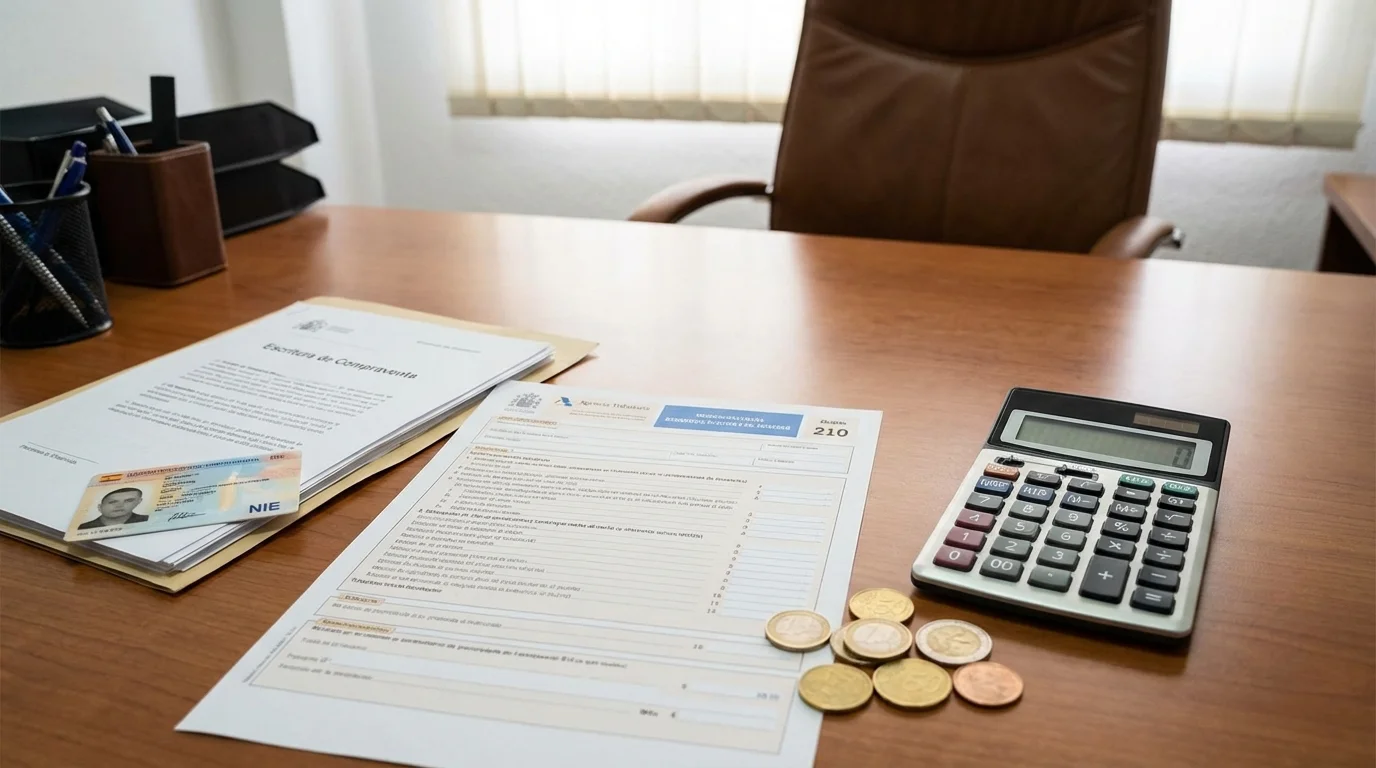
Complete tax guide for Swedes with property in Spain: IBI, IRNR, wealth tax, capital gains and the double taxation agreement. Updated 2026.

Buying a house in Torrevieja: prices by area, purchase process, taxes, NIE and mortgages — practical guide for Swedes who want to live on Costa Blanca 2026.