


Moving & Living
Residencia in Spain – Documents, Timeline and NIE vs Padrón 2026
Complete guide to residencia in Spain: requirements, documents, application and what it means for your taxes. Step-by-step for Swedish citizens.
16 min
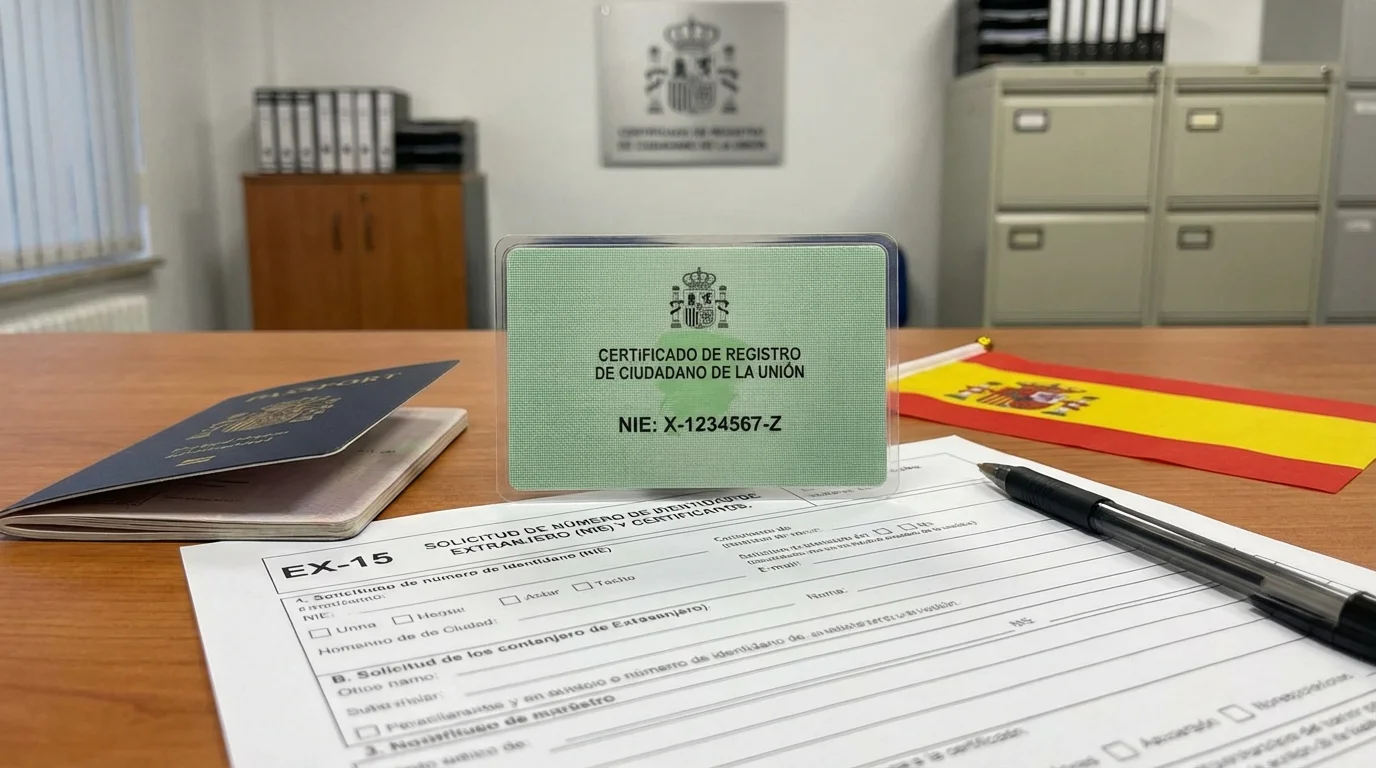
Spanish NIE number 2026: step-by-step guide from Sweden or Spain. EX-15 form, Modelo 790, €9.84 fee, waiting times and NIE/NIF/TIE explained.
Information
Key Takeaways
NIE (Número de Identidad de Extranjero) is a personal identification number assigned to all foreign nationals with economic, professional or social interests in Spain — regardless of whether you reside in the country. The format is always a letter followed by seven digits and a check letter, for example X-1234567-A.
The NIE number is not a residence permit and does not give you the right to live or work in Spain. It is an administrative identification number — similar to a tax identification number for foreign nationals. For Swedes planning to buy property on the Costa Blanca or Costa del Sol, the NIE is the very first document you should arrange.
You need an NIE for virtually every financial or legal transaction in Spain. The most common situations requiring an NIE:
If you plan to buy property, apply for your NIE at least 4–6 weeks before the planned purchase — ideally before you've even found your dream home. A Swedish estate agent in Spain can often guide you through both the NIE process and the property purchase.
Tip
Pro tip: Apply for your NIE before finding your dream home. It's much smoother to have the number ready than to rush the application while a seller is waiting for your signature.
These four terms are often confused, but they have distinct meanings in the Spanish system:
NIE (Número de Identidad de Extranjero): the identification number for foreign nationals. One letter + seven digits + check letter. Permanent and unchanged for life.
NIF (Número de Identificación Fiscal): the tax number. For Spanish citizens, NIF is their DNI number with a letter. For foreign nationals, NIF is identical to your NIE number — you do not get a separate tax number.
TIE (Tarjeta de Identidad de Extranjero): a physical plastic card with photo, fingerprints and chip issued to non-EU citizens residing in Spain for more than 6 months. Swedes (EU citizens) normally do not get a TIE card.
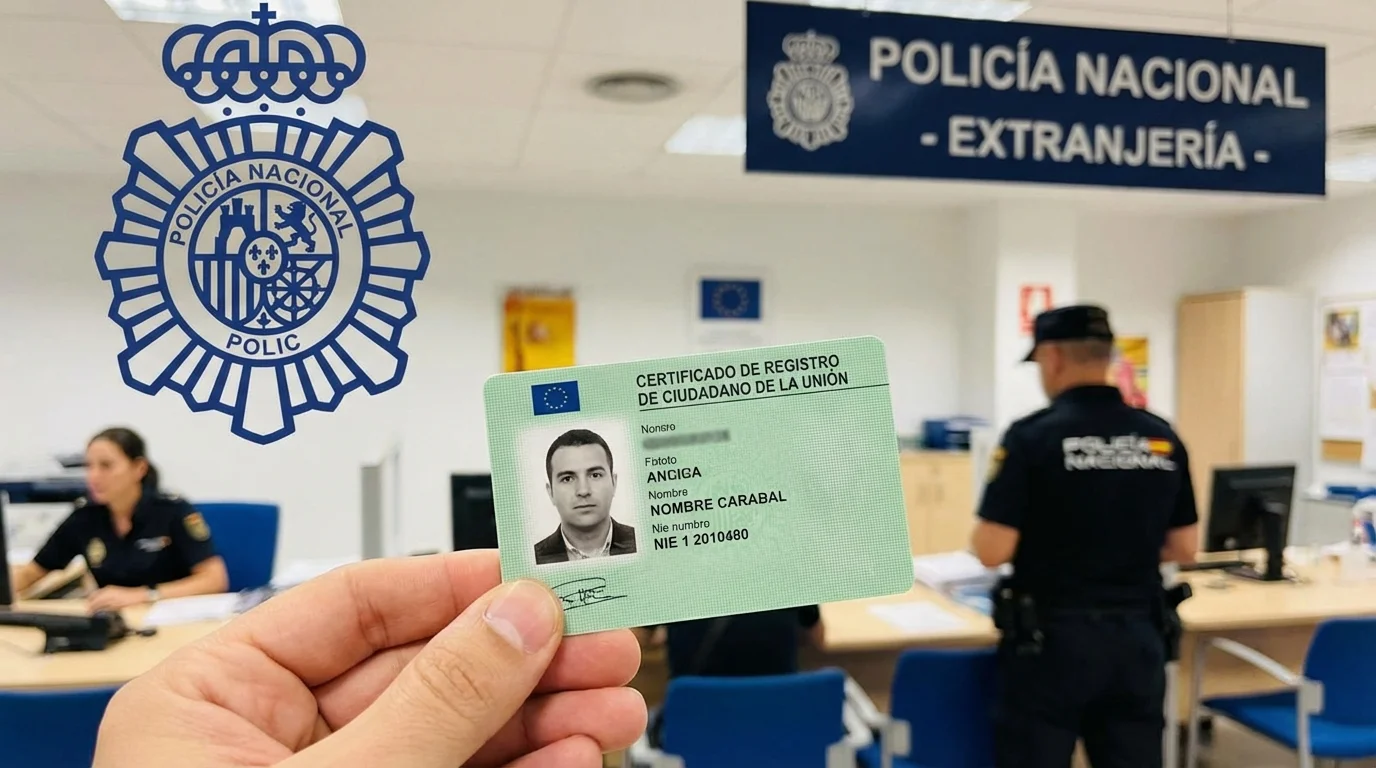
Residencia / Certificado de Registro: EU citizens (including Swedes) living in Spain for more than 90 days must register with the Registro Central de Extranjeros and receive a green A4 certificate or plastic card — not a TIE, but a "Certificado de Registro de Ciudadano de la Unión".
OVERVIEW
Identification
Residence card
Green certificate
You don't need to travel to Spain to get your NIE number. Applications can be made through Spain's diplomatic representations in Sweden.
NIE applications in Sweden are handled by:
An appointment is mandatory for NIE applications. Contact the embassy or consulate by email stating you want to book an appointment for "Solicitud de NIE" (NIE application). Book early — waiting times for available slots can be several weeks during peak season.
You need the following documents for your visit:
EX-15 is the official application form (Solicitud de Número de Identidad de Extranjero y Certificados). It must be completed in Spanish and can be printed after digital completion.
Key fields on EX-15:
Modelo 790 (código 012) is the fee form for the government NIE fee of €9.84 (2026). You can generate the form via the Agencia Tributaria website (sedetramites.agenciatributaria.gob.es) — fill in your details, select "Tasa 012" and pay at a Spanish bank if you are in Spain. If applying via the Stockholm embassy, payment is made on site in Swedish kronor, in cash or by card.
Bring all documents as originals + copies. At your appointment you submit the application and pay the fee. The embassy forwards your application to the Policía Nacional in Spain for processing.
Processing time via the embassy is normally 2–4 weeks. You will receive notification when your NIE certificate is ready for collection, or it may be sent to your home address. The certificate is an A4 document with your assigned NIE number — keep the original document, you will need it repeatedly.
If you are already in Spain, the process is often faster — in some cases you get your number the same day.
All NIE processing at Policía Nacional requires an appointment (cita previa). Book via the official website:
Appointment availability varies significantly between provinces and seasons. During peak season (spring and autumn), waiting times for an appointment can be 2–6 weeks in popular areas. Some smaller police stations have shorter waiting times than central offices.
Before your appointment you must have paid the government fee of €9.84. Go to a Spanish bank (e.g. BBVA, Santander or CaixaBank) with your completed Modelo 790 código 012 and pay the fee in cash. The bank stamps the form as proof of payment — bring the stamped form to the police station.
Go to the police station at your appointed time with all documents. In many cases you receive your NIE number immediately on the spot — an A4 certificate with your assigned number. In larger provinces or during peak season you may instead receive a return date 1–2 weeks later for collection.
NIE NUMBERS AT A GLANCE
Government fee
€9.84
Tasa 012, Modelo 790
Embassy, Stockholm
2–4 weeks
Processing time
Spain, in person
0–14 days
Same day in smaller towns
Certificate validity
3 months
Practical limit — number is permanent
Gestoría
€100–200
On top of government fee
Apply before purchase
4–6 weeks
Recommended lead time
The government fee for an NIE application is €9.84 (2026) — a Tasa 012 paid via Modelo 790 código 012. This is the only mandatory cost.
Many Swedish buyers choose to hire a gestoría (Spanish administrative agency) that handles the entire process: booking the appointment, completing forms, accompanying you to the police station and collecting the certificate. The cost of a gestoría typically ranges from €100–200 on top of the government fee.
Some buyers also use a power of attorney (poder notarial) to allow a lawyer or gestor to apply for NIE on their behalf, meaning you don't need to attend the application in person. The cost of the power of attorney is added via a notary.
Note
Watch out for overcharging: Some unscrupulous operators charge €300–500 for an NIE application. The government fee is always €9.84 — everything above that is their administration fee. A reputable gestoría normally charges €100–200 for the entire process.
1. Waiting too long to apply The most common mistake is starting the process too late. Without an NIE the purchase cannot be completed before a notary. Apply at least 4–6 weeks before the planned possession date — preferably earlier.
2. Incorrectly completed EX-15 EX-15 must be completed in Spanish. A common error is ticking "De residente" (resident) instead of "De no residente" (non-resident) in section 4.1. If you are not registered as a resident in Spain, you are a non-resident — regardless of how often you visit the country.
3. Forgetting to pay Modelo 790 in advance If applying in Spain, Modelo 790 código 012 must be paid and bank-stamped before your appointment at the police station. Without proof of payment you will be turned away.
4. Bringing only a copy of your passport You must bring your passport in original form — the police verify your identity against the original document. The copy is needed as an attachment to the application.
5. Inadequate supporting documentation Spanish authorities require a valid reason to issue an NIE. A verbal "I'm going to buy a property" isn't enough. Bring a preliminary contract, a letter of intent from an estate agent, or at minimum a written explanation in Spanish.
6. Confusing certificate expiry with number expiry The NIE number itself is permanent and never expires. But the certificate — the paper document — may be considered "too old" by some notaries and banks after 3 months. If you have an older certificate you can request a new printout (certificación de vigencia) without redoing the entire application.
Your NIE number is permanent — you keep the same number for life. However, in practice you may need a fresh certificate in these situations:
To obtain a new printout (duplicado), go to the nearest Policía Nacional office (comisaría) with your passport and NIE number. The process is straightforward — fill in a request, possibly pay a small administrative fee, and receive a new certificate with the same number, often the same day.
Properties
Explore available properties in Torrevieja
No. An NIE is required to sign the escritura (title deed) before a notary, pay transfer tax and register ownership in the Registro de la Propiedad. Without an NIE the property purchase cannot be completed. You can, however, begin the purchase process (bid, sign a preliminary contract) while your NIE application is in progress.
The NIE number is permanent — it never expires and you keep the same number for life. The physical certificate (paper document) has a practical validity of about 3 months with some notaries and banks. After 3 months you may need a freshly printed certificate with the same number.
Yes. A gestoría (Spanish administrative agency) can handle the entire process: complete the EX-15, generate and pay the Modelo 790, book the cita previa, attend the application and collect the certificate. With a power of attorney (poder notarial) you don't even need to be personally present. Cost: €100–200 on top of the €9.84 government fee.
Yes. All Spanish banks require an NIE to open an account — even a simple current account. The bank uses your NIE as your tax identification and reports account holdings to the tax authority.
NIF (Número de Identificación Fiscal) is Spain's tax number. For Spanish citizens, NIF is their DNI number. For foreign nationals, NIF is identical to the NIE number — you do not get a separate number. When forms ask for "NIF", enter your NIE number.
No. TIE (Tarjeta de Identidad de Extranjero) is a physical residence card issued only to non-EU citizens residing in Spain for more than 6 months. As a Swedish (EU) citizen, you instead receive a Certificado de Registro de Ciudadano de la Unión (green certificate) when you register as a resident in Spain.
Contact
Get in touch and we'll guide you forward — whether you're just starting out or ready to buy.
Contact usDecision support
Nej. NIE krävs för att skriva under escritura (köpehandlingen) hos notarien, betala överlåtelseskatt och registrera äganderätten i Registro de la Propiedad.
Utan NIE kan fastighetsköpet inte slutföras. Du kan dock inleda köpprocessen (buda, skriva föravtal) medan din NIE-ansökan pågår.
NIE-numret är permanent — det går aldrig ut och du behåller samma nummer livet ut. Det fysiska certifikatet (pappersdokumentet) har dock en praktisk giltighetstid på cirka 3 månader hos vissa notarier och banker.
Efter 3 månader kan du behöva ett nytt utskrivet certifikat med samma nummer.
Ja. En gestoría kan sköta hela processen: fylla i EX-15, generera och betala Modelo 790, boka cita previa, närvara vid ansökan och hämta ut certifikatet.
Med en fullmakt (poder notarial) behöver du inte ens vara personligen närvarande. Kostnad: 100–200 euro utöver den statliga avgiften på 9,84 euro.
Ja. Samtliga spanska banker kräver NIE för att öppna ett bankkonto — även ett enkelt lönekonto.
Banken använder NIE som din skatteidentifikation och rapporterar kontoinnehav till skattemyndigheten.
NIF (Número de Identificación Fiscal) är Spaniens skattenummer. För spanska medborgare är NIF deras DNI-nummer.
För utlänningar är NIF identiskt med NIE-numret — du får inget separat nummer. När formulär efterfrågar 'NIF' fyller du i ditt NIE-nummer.
Nej. TIE (Tarjeta de Identidad de Extranjero) är ett fysiskt uppehållskort som endast utfärdas till icke-EU-medborgare som är bosatta i Spanien längre än 6 månader.
Som svensk (EU-medborgare) får du istället ett Certificado de Registro de Ciudadano de la Unión (grönt intyg) när du folkbokför dig i Spanien.
Sources
Complete guide to residencia in Spain: requirements, documents, application and what it means for your taxes. Step-by-step for Swedish citizens.

Complete guide to buying a property or apartment in Spain for Swedes: purchase process, taxes, costs, mortgages, regional differences and risks — updated 2026.
Everything about IBI and annual costs for property owners in Spain: how the tax is calculated, what you pay per municipality, and how to avoid late payment penalties.