


Finance & Law
Tax in Spain – Guide for Swedish Property Owners 2026
Complete tax guide for Swedes with property in Spain: IBI, IRNR, wealth tax, capital gains and the double taxation agreement. Updated 2026.
16 min
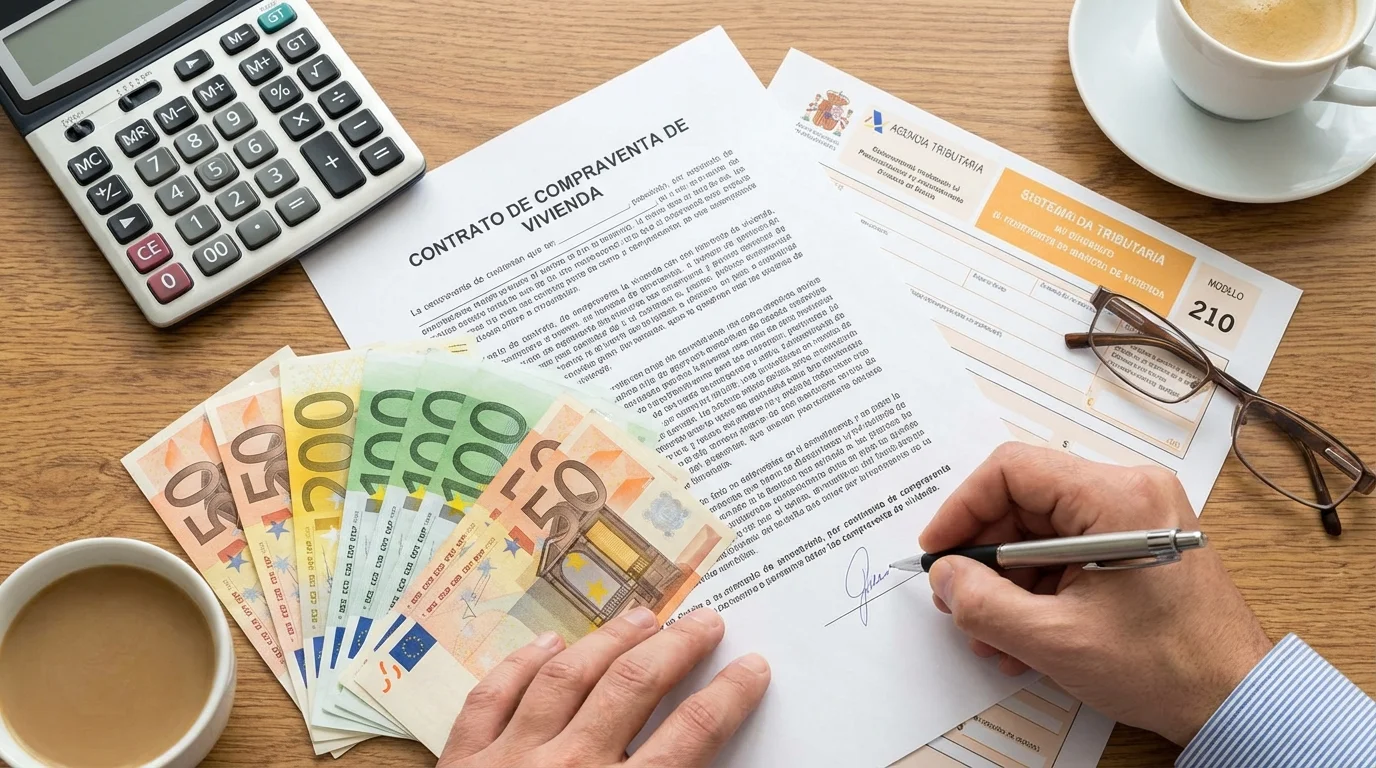
Everything about tax when selling property in Spain: capital gains tax, plusvalía municipal, 3% retention and how to file in both Spain and Sweden.
If you sell a property in Spain as a non-resident, you pay 19% capital gains tax on the profit plus a municipal plusvalía tax on the increase in land value. The buyer automatically withholds 3% of the sale price as an advance on your tax — money you can claim back if your actual tax is lower. In addition to the Spanish tax, you must also declare the sale in Sweden, where the profit is taxed at 22% after apportionment.
In practice, a Swede selling an apartment on the Costa Blanca with a €50,000 profit pays approximately €9,500 in Spanish capital gains tax, plus plusvalía and potentially a remaining amount in Sweden. With the right deductions — purchase costs, renovations and estate agent fees — you can significantly reduce your taxable profit.
This guide walks through each tax step by step: capital gains tax, plusvalía municipal, 3% retention, deductible costs, exemptions and how to file in Sweden. We do not provide tax advice — rules change and your situation may require assessment by a qualified asesor fiscal.
When selling a property in Spain, two separate taxes are triggered regardless of your nationality. In addition, there is a mandatory retention if the seller is not a tax resident in Spain.
Taxes and retention on sale
Non-resident
Sellers who are not tax residents in Spain. Fixed rate of 19% on the capital gain for EU/EEA citizens.
Resident
Sellers who are tax residents in Spain. Progressive tax of 19–30% depending on the size of the gain.
Municipal tax
Paid by the seller. The amount varies by municipality and years of ownership.
Buyer's withholding
The buyer withholds 3% of the sale price as an advance on the seller's tax (Modelo 211).
As a non-resident Swede with a holiday property, you therefore pay three items: capital gains tax, plusvalía and the temporary 3% withholding (which is offset against your final tax). In Sweden you must also declare the same profit — but with a credit for the Spanish tax.
Note
Important: Even if you sell at a loss, you must declare the sale in Spain via Modelo 210. If you sell at a loss, you are entitled to reclaim the entire 3% retention paid by the buyer. If you miss the declaration, you risk late filing penalties — and the money stays with the tax authorities.
Capital gains tax — formally Impuesto sobre la Renta de No Residentes (IRNR) for those not living in Spain — is calculated on the difference between your adjusted sale price and your adjusted acquisition cost.
As an EU/EEA citizen who is not a tax resident in Spain, you pay a flat rate of 19% on the capital gain. If you are resident outside the EU/EEA, 24% applies instead.
The tax is calculated as follows:
If you live in Spain (more than 183 days per year), the capital gain is taxed progressively as savings income (renta del ahorro) at 19–30% depending on the size of the gain. The bands are cumulative: 19% on the first €6,000, 21% up to €50,000, 23% up to €200,000, 27% up to €300,000 and 30% above. A gain of €100,000 generates approximately €22,630 in tax — more than double what a non-resident pays on the same gain (€19,000).
Plusvalía municipal — formally Impuesto sobre el Incremento de Valor de los Terrenos de Naturaleza Urbana (IIVTNU) — is a municipal tax on the increase in land value since you purchased the property. All sellers pay it, regardless of nationality or whether they live in Spain.
Since the 2022 reforms, you can choose between two calculation methods — and use the one that results in the lower tax:
1. Objective method: The land's cadastral value (valor catastral del suelo) × standard coefficient (based on years of ownership) × the municipality's tax rate (max 30%).
2. Real increase in value: The tax is based on the actual difference in land value between purchase and sale, proportionally based on the cadastral value.
Since 2022: if you sell at a loss, you pay no plusvalía. But you must still declare the sale within 30 days at the town hall (Ayuntamiento) to demonstrate that no increase in value has occurred. If you do not, the municipality may still issue a tax demand based on the objective method.
The amount varies considerably depending on municipality, years of ownership and cadastral value. A typical apartment may generate €500–€3,000 in plusvalía. Villas with high cadastral values and long ownership periods can be higher.
Properties
Explore available properties in torrevieja
When a non-resident sells property in Spain, the buyer is obliged to withhold 3% of the entire sale price and pay the amount directly to the Agencia Tributaria via Modelo 211 — within one month of the purchase. This is not an extra tax but an advance on your capital gains tax.
The system exists to ensure the tax authority receives the tax — a safeguard against the seller leaving the country without filing.
If your actual tax is lower than 3% of the sale price, you claim a refund via Modelo 210 within four months. Processing time is usually three to six months. If you sell at a loss, you are entitled to reclaim the full amount.
Worked example: You sell for €200,000. The buyer withholds €6,000. Your capital gains tax is €4,750. You reclaim €1,250.
Tip
Tip: Make sure your asesor fiscal submits Modelo 210 immediately after the sale — do not wait until the last day. The sooner you file, the sooner you receive any overpaid amount back. Ask the buyer for a receipt (certificado de retención) as proof that the 3% has been paid.
The more deductible costs you can substantiate, the lower your taxable gain — and therefore your tax. Here is what the Agencia Tributaria accepts as deductions:
Increases acquisition value (deductions)
Purchase price
Full amount
What you paid for the property.
ITP or IVA + AJD
At time of purchase
Transfer tax or VAT + stamp duty.
Notary fee (purchase)
Escritura
At time of purchase.
Land registry (Registro)
Registration
Registration cost at purchase.
Lawyer (purchase)
Fee
Legal advice at time of purchase.
Capital improvements
With invoice
Renovation, extension, new kitchen — documented.
You can deduct the estate agent fee, notary fee on the sale, plusvalía municipal and energy certificate.
Routine maintenance (painting, minor repairs), community fees, IBI (property tax) and work without an invoice. The Agencia Tributaria only accepts costs you can substantiate with a factura — always keep all receipts for up to four years after the sale.
There are legal ways to avoid or reduce capital gains tax — but most apply only to tax residents in Spain. As a non-resident with a holiday property, your options are limited.
1. Over 65 years old — primary residence If you are a tax resident in Spain, over 65 and sell your primary residence (vivienda habitual), you are completely exempt from capital gains tax — with no reinvestment requirement. The condition is that you have lived in the property for at least three years.
2. Reinvestment in a new primary residence If you sell your primary residence and reinvest the entire profit in a new property within two years, you can obtain complete tax exemption. If you reinvest only part of the profit, the exemption applies proportionally. The new property can be located anywhere within the EU/EEA.
3. Over 65 years old — annuity If you sell any asset at 65+ you can exempt up to €240,000 if you reinvest in a qualifying annuity (renta vitalicia) within six months.
These exemptions do not apply to you as a non-resident. As a Swede with a holiday property on the Costa del Sol or Costa Blanca, there is no way to completely avoid capital gains tax. However, you can minimise it by deducting all purchase costs, documented renovations and selling costs.
As a Swedish tax resident, you must declare the sale of your Spanish property in your Swedish tax return — in addition to the Spanish declaration.
Profit on the sale of a private property is taxed at 22% in Sweden. Technically the gain is apportioned to 22/30 and then taxed at 30% as capital income — but the end result is 22%.
Thanks to the double taxation agreement between Sweden and Spain (from 1976), you are entitled to offset the tax you paid in Spain against your Swedish tax. You pay 22% in Sweden, deduct 19% paid in Spain and pay the difference (often 3 percentage points).
Worked example: Profit €50,000 (approximately SEK 575,000). Swedish tax (22%): SEK 126,500. Credit for Spanish tax (19%): SEK 109,250. To pay in Sweden: SEK 17,250.
The credit can never exceed the Swedish tax. If you pay more in Spain than you would have in Sweden, the excess disappears.
Sweden also allows deferral of capital gains if your Spanish property was your primary residence and you purchase a new property within the EU/EEA — but this rarely applies to holiday properties.
Let us calculate a concrete situation: a Swedish non-resident sells an apartment in the Torrevieja area that was purchased for €150,000 and sold for €220,000 after eight years of ownership.
Step 1 — acquisition value (example)
Purchase price
€150,000
ITP (10%, Valenciana)
€15,000
Rate at the time of purchase; since June 2026 it is 9%.
Notary (purchase)
€800
Land registry (Registro)
€500
Lawyer (purchase)
€2,000
Renovation (with invoice)
€12,000
Bathroom and kitchen.
Adjusted acquisition value
€180,300
Step 2 — sale price after deductions
Sale price
€220,000
Estate agent fee (3%)
−€6,600
Energy certificate
−€150
Adjusted sale price
€213,250
Step 3 — capital gain and IRNR
Adjusted sale price
€213,250
Adjusted acquisition value
−€180,300
Taxable gain
€32,950
Capital gains tax (19%)
€6,260.50
Step 4 — retention vs actual tax
3% of price (Modelo 211)
€6,600
Paid by the buyer.
Actual tax
€6,260.50
Refund (Modelo 210)
€339.50
Approximate overpaid amount.
Plusvalía varies by municipality — estimate €800–€1,500 with eight years of ownership in Torrevieja. In Sweden, the profit is taxed at 22%: €32,950 × SEK 11.50 = SEK 379,925. Swedish tax: SEK 83,584 minus credit for Spanish tax (SEK 71,996) = SEK 11,588 to pay in Sweden.
Total tax cost: Approximately €6,260 (capital gains tax) + €1,007 (Swedish remaining amount) + €800–€1,500 (plusvalía) = €8,067–€8,767 in total. This corresponds to an effective tax rate of 24–27% of the profit.
Properties
Explore available properties in costa-blanca
Browse current homes in the area and compare locations, price levels and property types at your own pace.
The deadlines are absolute — miss them and automatic late filing penalties apply. Here is the order:
Timeline after the sale
Within 1 month
3% retention
Buyer · Modelo 211.
Within 30 days
Plusvalía
Seller · municipal form.
Within 4 months
Capital gain
Seller · Modelo 210.
Spring of the following year
Sweden
K5 / K6 / K7 depending on property type.
Late filing penalties in Spain: 5% (up to 3 months), 10% (3–6 months), 15% (6–12 months) and 20% (over 12 months), plus late payment interest.
Having followed hundreds of sales, we see the same mistakes over and over. Here are the most common — and how to avoid them.
1. Not keeping receipts for renovations The most common and most expensive mistake by far. If you renovate the bathroom for €8,000 but have no invoice (factura) with your NIE number, you cannot deduct the cost. The difference in tax: €1,520 (€8,000 × 19%). Always keep every invoice.
2. Forgetting the plusvalía deadline You have only 30 days after the sale to declare and pay plusvalía municipal at the town hall. Many people focus on Modelo 210 and miss the shorter deadline. Late filing penalties apply automatically.
3. Not reclaiming the excess 3% If your tax is less than 3% of the sale price, you have money to reclaim — but you must actively request it via Modelo 210. If you do nothing, the money stays with the Agencia Tributaria. This often amounts to €1,000–€3,000.
4. Missing the Swedish filing Spanish tax and Swedish tax are two separate systems. If you pay in Spain but forget to file in Sweden, you risk tax surcharges. And without the credit, you effectively pay double.
5. Not engaging an asesor fiscal A Spanish tax advisor costs €200–€500 for the entire sale declaration. You recoup the cost through correct deductions and avoiding late filing penalties.
6. Being unable to substantiate purchase costs The Agencia Tributaria only accepts deductions you can document. Dig out the original invoices from the purchase — the notary can provide a copy of the escritura and your lawyer should have all documents archived.
Contact
We can connect you with experienced tax advisors and lawyers who help Swedes with sale declarations, plusvalía and crediting against Swedish tax. Book a free consultation — no obligations.
Book a free consultationLast updated: April 2026. Tax rules and amounts can change — always consult a qualified asesor fiscal for your personal situation. This guide does not constitute tax advice.
Decision support
Som icke-resident EU-medborgare betalar du 19 % kapitalvinstskatt på vinsten (försäljningspris minus köpeskilling och avdragsgilla kostnader). Utöver det tillkommer plusvalía municipal — en kommunal skatt på markvärdets ökning — som varierar beroende på kommun och innehavstid.
Köparen håller också inne 3 % av försäljningspriset som förskott på din skatt.
Ja, om din faktiska skatt understiger de 3 % som köparen höll inne kan du begära återbetalning via Modelo 210. Du har fyra månader från försäljningen att lämna in deklarationen.
Agencia Tributaria återbetalar mellanskillnaden, men handläggningstiden kan vara flera månader. Säljer du med förlust har du rätt att få tillbaka hela beloppet.
Ja. Som obegränsat skattskyldig i Sverige deklarerar du kapitalvinsten på bilaga K6 (bostadsrätt) eller K5/K7 (fastighet).
Vinsten kvoteras till 22/30 och beskattas med 30 % i inkomstslaget kapital — vilket ger en effektiv skattesats på 22 %. Den skatt du betalat i Spanien kan du avräkna mot den svenska skatten för att undvika dubbelbeskattning.
Det finns undantag för skatteresidenta i Spanien: är du över 65 och säljer din permanentbostad (vivienda habitual) slipper du kapitalvinstskatt helt. Säljer du din permanentbostad och återinvesterar hela beloppet i en ny bostad inom två år kan du också få skattefrihet.
Dessa undantag gäller dock inte icke-residenta — som de flesta svenska semesterbostadsägare.
Kapitalvinstskatten (Modelo 210) ska deklareras och betalas inom fyra månader från försäljningsdatumet. Plusvalía municipal ska betalas inom 30 dagar.
Missar du deadlines tillkommer automatiska förseningsavgifter på 5–20 % beroende på förseningen, plus dröjsmålsränta. Anlita en asesor fiscal som sköter deklarationerna åt dig — arvodet är normalt 200–500 euro.
Sources
Complete tax guide for Swedes with property in Spain: IBI, IRNR, wealth tax, capital gains and the double taxation agreement. Updated 2026.
Buying property in Spain costs 10–14% on top of the price: ITP, notary, land registry, lawyer and more. Calculation examples and a region comparison.
Complete guide to inheritance in Spain: inheritance tax by region, forced heirship, Spanish will, and how to protect your heirs as a Swedish property owner.