


Finance & Law
Tax in Spain – Guide for Swedish Property Owners 2026
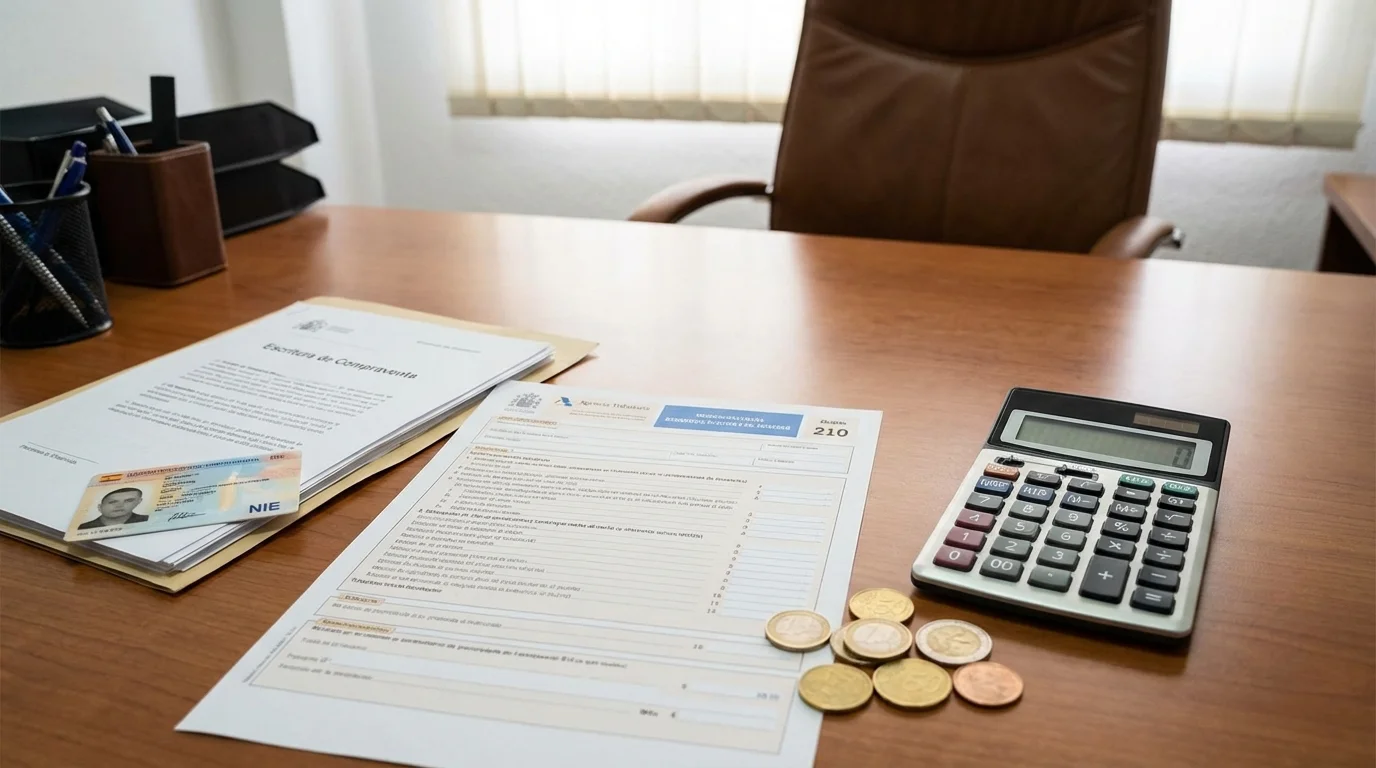
Complete tax guide for Swedes with property in Spain: IBI, IRNR, wealth tax, capital gains and the double taxation agreement. Updated 2026.
16 min
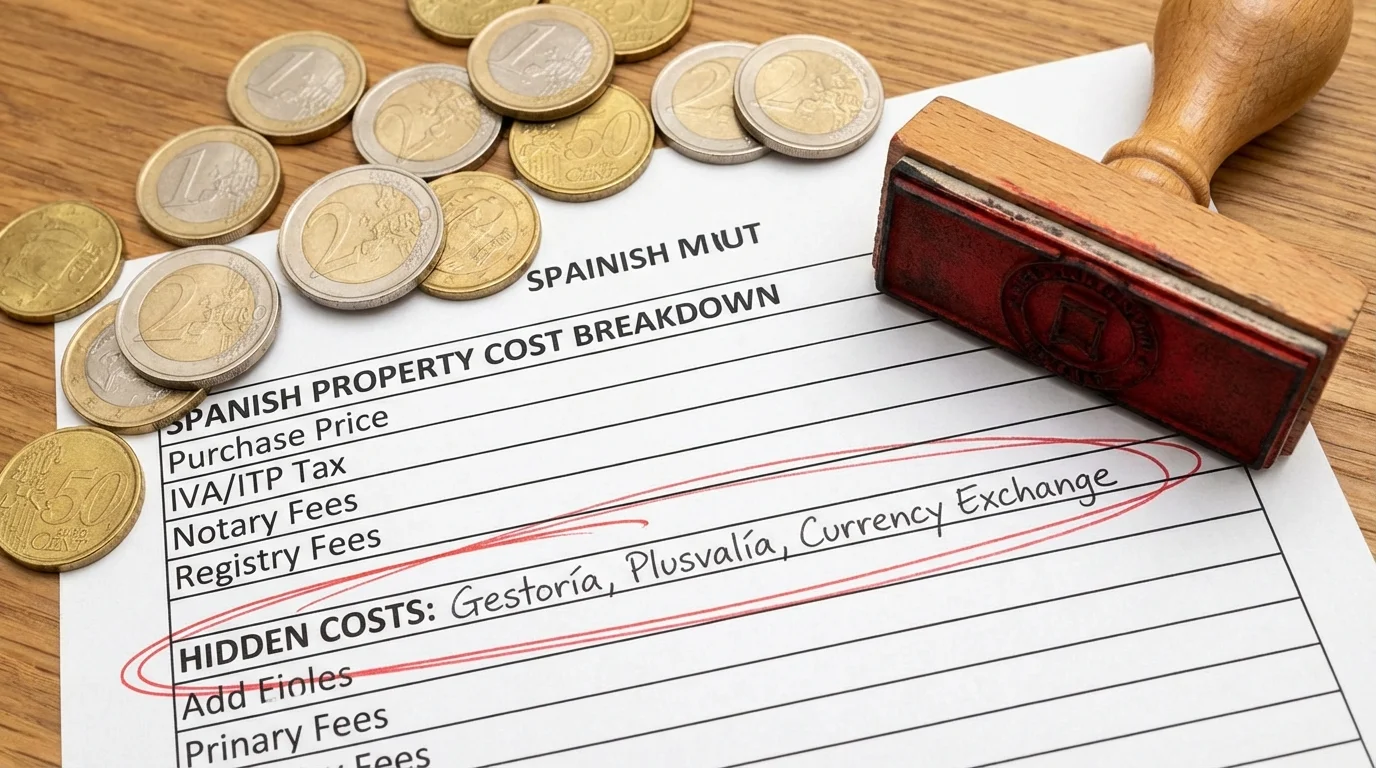
Buying property in Spain costs 10–14% on top of the price: ITP, notary, land registry, lawyer and more. Calculation examples and a region comparison.
Budget for 10–14% of the purchase price in additional costs when buying property in Spain. A property costing 200,000 euros means 20,000–28,000 euros extra in taxes, fees and professional charges — money that must be in your account before you sign at the notary. The biggest item is transfer tax ITP (6–10% depending on the region), but there are a further six to eight costs that many buyers fail to budget for.
Spain has no system of hidden add-on fees that appear at the last moment — all costs are known in advance. The problem is that many Swedish buyers never receive a complete list before they set their budget. You see a house for 200,000 euros and think that is the final price. It is not.
This guide lists every cost step by step: taxes, notary, land registry, lawyer, gestoría and mortgage costs. We go through the difference between second-hand and new-build, compare ITP rates by region and finish with a complete calculation example. You also get a checklist of running costs that await after the purchase.
Key takeaways
- Always budget 10–14% on top of the purchase price; for a house at €200,000 that means €20,000–28,000 extra
- ITP varies sharply by region: 6% in Madrid versus 9% in Valencia, a €6,000 difference on the same property
- Valencia lowered ITP from 10% to 9% on 1 June 2026, which saves €2,000 on a €200,000 purchase compared with before
- Taxes are paid in cash at the time of purchase; the bank does not finance taxes through the mortgage
- Without a lawyer you risk missing debts, unregistered extensions and incorrect ownership details
Here is an overview of all typical costs beyond the purchase price. Exact amounts depend on the region, property type (second-hand or new-build) and whether you take out a mortgage.
Second-hand vs new-build
ITP + notary, land registry, legal fees
IVA + AJD + same fees
Source: Agencia Tributaria 2026, Consejo General del Notariado, Colegio de Registradores
The percentage varies considerably depending on where in Spain you buy. In Madrid, where ITP is 6%, the total cost comes closer to 10%. In the Valencia region, with 9% ITP since June 2026, you land around 11–13%. The difference on a property worth 200,000 euros can therefore be 6,000 euros — based purely on geography.
Note
Important: All costs in the table above must be paid in cash at the time of purchase. The bank does not finance taxes and fees through the mortgage. If you have been granted 70% financing on a property for 200,000 euros you therefore need 60,000 euros of your own funds (30% deposit) plus at least 20,000 euros for additional costs — a total of 80,000 euros in liquid funds.
ITP (Impuesto de Transmisiones Patrimoniales) is the single largest purchase cost when buying a second-hand property in Spain. The tax is set by each autonomous region and the differences are significant.
ITP by region (reference 2026)
Madrid
6 %
Reduced: 4% (under 32, first home).
Canary Islands
6.5 %
Reduced: 5% (first home under 150,000 €).
Andalusia
7 %
Reduced: 3.5% (social housing, young buyers).
Cantabria
7 %
La Rioja
7 %
Reduced: 4% (under 40).
Murcia
7.75 %
Since 25 July 2025 (previously 8%). Reduced: 3% (aged 40 or under, large families or disability, main residence with income caps), 4% for VPO.
Balearic Islands
8–11 %
Reduced: lower for primary residence.
Galicia
9 %
Reduced: 3% (single parents).
Valencia region
9 %
Since 1 June 2026 (previously 10%); 11% on the part of the value above 1 million €. Reduced: 6% (under 35, only for a permanent home and with an income cap).
Catalonia
10 %
Reduced: 5% (under 32, disability).
Source: Tax authority of each region, 2026
A couple of things to note. The Valencia region, where Costa Blanca is located, lowered ITP from 10% to 9% on 1 June 2026 for properties under one million euros. That means a saving of 2,000 euros on a property worth 200,000 euros compared with the old rate.
Murcia cut ITP from 8% to 7.75% and stamp duty (AJD) on new-build from 2% to 1.5% on 25 July 2025. The region also offers 3% ITP on a main residence for buyers aged 40 or under, large families and people with a disability, subject to income caps.
Madrid is consistently the cheapest with 6% ITP — but property prices per square metre are considerably higher there. An apartment costing 200,000 euros on the Costa Blanca would likely cost 350,000–400,000 euros in central Madrid, which more than eats up the tax difference.
Tip
Tip: Check whether you qualify for reduced ITP. Young buyers, large families (familia numerosa) and people with disabilities are entitled to lower rates in most regions. Your lawyer or gestor can confirm which conditions apply in your specific region.
If you buy a new-build property (primera entrega — first transfer from the developer) you do not pay ITP. Instead:
The AJD rate varies by region just like ITP:
AJD (new-build) by region
Madrid
0.75 %
Andalusia
1.2 %
Valencia
1.4 %
Catalonia
1.5 %
Murcia
1.5 %
Balearic Islands
1.5 %
Basque Country
0 %
Source: Agencia Tributaria, 2026
This means a new-build property for 200,000 euros in the Valencia region is subject to 20,000 euros in IVA plus 2,800 euros in AJD — a total of 22,800 euros in tax. That is more expensive than buying second-hand with 9% ITP (18,000 euros), but new-build has other advantages: a 10-year building warranty, modern energy standards and lower maintenance costs in the first few years.
Properties
Explore available properties in torrevieja
The notary fee (notaría) in Spain is regulated by the state and based on a fixed tariff linked to the purchase price and the complexity of the deed. You cannot negotiate this fee — it is the same regardless of which notary you choose.
Typical amounts:
Notary fee (approximate)
Purchase 100,000 €
600–850 €
Purchase 200,000 €
800–1,000 €
Purchase 300,000 €
900–1,100 €
Purchase 400,000 €
1,000–1,200 €
The fee includes drawing up the escritura pública (the public deed of sale), verifying the parties' identities and checking that all documents are correct. If you have a mortgage there is a separate notarial act for the mortgage deed, but that cost is paid by the bank since 2019.
Budget for a total of 0.2–0.5% of the purchase price for the notary. It is one of the smaller items, but it must be included in the budget.
The land registry entry — inscription in the Registro de la Propiedad — is what makes you the registered owner of the property. Just like the notary fee, the cost is regulated and based on a tariff.
Typical amounts:
Land registry / inscription (approximate)
Purchase 100,000 €
350–500 €
Purchase 200,000 €
450–600 €
Purchase 300,000 €
500–700 €
Purchase 400,000 €
550–750 €
The fee is normally 0.1–0.25% of the purchase price. It is the smallest of the mandatory costs, but it is absolutely necessary. Without inscription in the land registry your ownership is legally protected through the escritura, but not visible to third parties. This creates risk in disputes and makes it harder to resell.
Your gestor (administrative specialist) normally handles the inscription for you. The process takes between two and eight weeks depending on the municipality.
An independent lawyer (abogado) is not a legal requirement, but in practice it is essential — especially as a foreign buyer. The lawyer reviews purchase documents, checks that the property has no debts or encumbrances (cargas), retrieves the nota simple from the land registry and looks after your interests throughout the entire process.
Typical fees:
There are no statutory minimum fees — you can compare quotes. But never choose a lawyer recommended by the seller or estate agent. You risk the lawyer having a conflict of interest. Ask for a reference from other Scandinavian buyers in the area or search through the Colegio de Abogados (bar association) in your region.
Note
Warning: Never skip the lawyer to save money. The most common problems in Spanish property purchases — unregistered extensions, unpaid community fees, encumbrances from a previous owner's debts — are identified by a good lawyer before the purchase. Sorting them out after the purchase costs many times more. Treat the lawyer as a mandatory cost, not an optional one.
A gestor (gestoría) is an administrative specialist who handles paperwork, tax payments and bureaucratic processes. The gestor takes care of what you could in theory do yourself — but which requires visits to tax offices, banks and authorities with the right forms at the right time.
Typical tasks:
The gestoría fee is normally 300–600 euros. Some lawyers include the gestor service in their fee — ask before hiring separately.
Unlike the lawyer, who provides legal advice and reviews contracts, the gestor handles the administrative logistics. You often need both. The lawyer protects you legally; the gestor makes sure all the paperwork ends up in the right place.
If you take out a mortgage (hipoteca) with a Spanish bank there are additional costs. Since the law change in 2019 the bank pays the majority of mortgage costs — but not all of them.
Mortgage — costs you pay
Property valuation (tasación)
300–600 €
Approved valuer · valid for 6 months.
Bank arrangement fee
0–1.5 %
Of the loan amount — often negotiable.
The property valuation (tasación) must be carried out by an approved valuation company and is paid by you as the buyer. The valuation is valid for six months. The bank's arrangement fee is negotiable — several Spanish banks, particularly those targeting foreign buyers, offer zero arrangement fees as a promotional offer.
Since Spain's mortgage law (Ley de Crédito Inmobiliario) came into force in 2019, the bank pays:
Before 2019 the borrower paid all of these items. That could add 2–3% of the loan amount in extra costs. The law change saves you thousands of euros.
Spanish banks normally grant 60–70% of the property's value to non-resident EU citizens, compared with up to 80% for residents in Spain. The maximum term is usually 20–25 years. You need a NIE number, a Spanish bank account and income documentation (pay slips, tax return) from Sweden.
Properties
Explore available properties in costa-del-sol
Browse current homes in the area and compare locations, price levels and property types at your own pace.
Purchase costs are one-off items. But there are running costs you must budget for every year as a property owner in Spain.
IBI (Impuesto sobre Bienes Inmuebles) is Spain's equivalent to the Swedish property tax. The tax is calculated on the cadastral value (valor catastral) and varies by municipality — typically 0.4–1.1% of the cadastral value. In practice that means:
If you live in an urbanisation or apartment complex with shared areas you pay a community charge (cuota de comunidad). The fee covers the pool, garden, lift, cleaning, lighting and insurance for shared spaces.
Typical amounts: 50–250 euros per month, depending on the size and facilities of the development. A simple urbanisation with a pool can cost 60–80 euros per month. A modern complex with a gym, concierge and heated pool can cost 200–300 euros per month.
Always ask for the last three years' community minutes (actas) and budget before buying. They reveal planned renovations and any derramas (special assessments). A derrama of 3,000–10,000 euros for a roof replacement or pool renovation can come as an unpleasant surprise.
Budget for 80–200 euros per month depending on the season and property size. Spanish electricity prices vary considerably throughout the day — the hourly pricing system (PVPC) means it can be twice as expensive to run the washing machine at 20:00 as at 03:00. Water typically costs 30–60 euros per month, gas 20–50 euros.
Home insurance (seguro de hogar) costs 200–500 euros per year for a typical apartment. If you have a mortgage the bank usually requires you to have insurance. Compare quotes — prices vary between insurance companies, and Spanish-based insurance is often cheaper than international alternatives.
Even if you do not rent out your property you must as a non-resident declare IRNR (Impuesto sobre la Renta de No Residentes) via Modelo 210. The tax authority imputes a notional income based on the cadastral value. Budget for 100–300 euros per year in tax — but the amount depends on the cadastral value.
Let us calculate a specific property: a second-hand two-bedroom apartment in the Torrevieja area at 200,000 euros. The buyer is Swedish, not resident in Spain, and is not taking out a mortgage.
Calculation example: 200,000 € second-hand, without mortgage (Valencia, 2026)
Purchase price
200,000 €
ITP (9 %)
18,000 €
Valencia since 1 June 2026 (previously 10%).
Notary fee
900 €
Land registry (Registro)
550 €
Lawyer (1.2% + 21% VAT)
2,904 €
Gestoría
450 €
Total to pay
222,804 €
Additional percentage
11.4 %
Of the purchase price.
Before 1 June 2026 ITP was 10%, which would have given a total of 224,804 euros (12.4% in additional costs). The reduction therefore saves 2,000 euros on this purchase.
Same property with 70% mortgage
Purchase price
200,000 €
ITP (9 %)
18,000 €
Notary fee
900 €
Land registry
550 €
Lawyer's fee
2,904 €
Gestoría
450 €
Tasación
450 €
Arrangement fee
700 €
0.5% of 140,000 € loan.
Total to pay
223,954 €
Own funds needed (30% + costs)
83,954 €
With a mortgage you therefore need at least 84,000 euros available — 60,000 euros as a deposit plus 24,000 euros in taxes and fees. The bank finances the remaining 140,000 euros.
New-build — same 200,000 € (Valencia)
Purchase price
200,000 €
IVA (10 %)
20,000 €
AJD (1.4 %)
2,800 €
Valencia region.
Notary fee
900 €
Land registry
550 €
Lawyer's fee
2,904 €
Gestoría
450 €
Total to pay
227,604 €
Additional percentage
13.8 %
New-build costs 4,800 euros more in this example: 10% IVA instead of 9% ITP, plus the AJD stamp duty that is not charged on second-hand purchases. But new-build comes with a 10-year building warranty, lower energy costs and no immediate renovation needs.
The same property for 200,000 euros (second-hand, without mortgage) produces very different total costs depending on where in Spain you buy. Here we compare the regions most popular among Swedish buyers.
Total cost 200,000 € — region by region
216,804 € · 8.4 %
ITP 12,000 € · Notary + registry 1,450 € · Lawyer + gestor 3,354 €.
218,804 € · 9.4 %
ITP 14,000 € · Notary + registry 1,450 € · Lawyer + gestor 3,354 €.
220,304 € · 10.2 %
ITP 15,500 € · Notary + registry 1,450 € · Lawyer + gestor 3,354 €.
222,804 € · 11.4 %
ITP 18,000 € · Notary + registry 1,450 € · Lawyer + gestor 3,354 €.
224,804 € · 12.4 %
ITP 20,000 € · Notary + registry 1,450 € · Lawyer + gestor 3,354 €.
Notary, land registry, lawyer and gestor costs are roughly the same throughout Spain. The tax is what makes the difference.
The gap between the cheapest (Madrid, 8.4%) and the most expensive (Catalonia, 12.4%) is 8,000 euros. That is enough to furnish an entire apartment. On the other hand, property prices per square metre in Madrid and Catalonia are generally higher — the lower tax rate does not necessarily compensate for the higher purchase price.
After following hundreds of transactions we see the same mistakes repeated. Here are the most common — and how to avoid them.
1. Only budgeting for the purchase price The most common mistake by far. The buyer finds a property for 200,000 euros, has 200,000 euros in the bank and only realises at the notary signing that 25,000 euros is missing for taxes and fees. The solution: always add 13% as a buffer on top of the price you are searching at. Looking for a property for a maximum of 200,000 euros total? Search in the price range up to 175,000 euros.
2. Not checking the ITP rate in the right region A buyer who reads "ITP is 7%" in an article about Andalusia and assumes the same rate applies in the Valencia region gets an unpleasant surprise — it is 9% there since June 2026. Always check the current tax rate in the specific region.
3. Skipping the lawyer Some buyers save 2,000–3,000 euros by skipping the lawyer. The risk is that you miss debts attached to the property, unregistered extensions or incorrect ownership records. A problem that would have cost 2,500 euros to prevent can cost 15,000–30,000 euros to resolve after the fact.
4. Forgetting running costs IBI, community charges, insurance and electricity/water add up to 3,000–8,000 euros per year for a typical apartment. Many buyers only budget for the purchase and are surprised by the annual costs. Do an annual cost calculation before making a decision.
5. Not asking about derramas A derrama (special assessment from the community) for pool renovation, facade repair or lift replacement can cost 2,000–10,000 euros per owner. Always ask for the most recent community minutes — they show planned investments and whether there is an active or upcoming derrama.
6. Budgeting with old tax rates ITP in the Valencia region was cut from 10% to 9% on 1 June 2026. Many older calculations and articles still use 10%. Check that your budget is based on the current rate — it is a 2,000 euro difference on a property worth 200,000 euros.
Contact
We help you calculate the total cost — purchase price, taxes and fees — for the property you are interested in. Book a free call with one of our advisers.
Book a free consultationLast updated: April 2026. Tax rates and fees may change — always verify current amounts with your lawyer or gestor before completing a purchase. This guide does not constitute legal or financial advice.
Decision support
Räkna med 10–14 % av köpeskillingen i tilläggskostnader. För en begagnad bostad på 200 000 euro innebär det 20 000–28 000 euro extra.
Den största posten är överlåtelseskatten ITP (6–10 % beroende på region), följt av notarieavgift (600–1 200 euro), lagfart (400–700 euro) och advokatarvode (1–1,5 % av priset). Nyproduktion beskattas med 10 % moms (IVA) plus stämpelskatt (AJD) istället för ITP.
Skatter och offentliga avgifter (ITP, notarie, lagfart) är fasta och går inte att förhandla. Däremot kan du jämföra advokatarvoden — vissa tar fast pris, andra procent av köpeskillingen.
Gestoría-avgiften (300–600 euro) varierar mellan byråer. Tar du bolån kan du förhandla bankens öppningsavgift, och flera spanska banker erbjuder noll i uppläggningsavgift för att attrahera utländska kunder.
Nej. Överlåtelseskatten ITP sätts av varje autonom region och varierar mellan 6 % (Madrid) och 10 % (Katalonien).
Valenciana-regionen ligger på 9 % sedan juni 2026, Andalusien på 7 %, Murcia på 7,75 % och Kanarieöarna på 6,5 %. Flera regioner erbjuder reducerade satser för unga köpare och förstagångsköpare.
Skillnaden kan innebära tusentals euro — kontrollera alltid aktuell skattesats i din region innan du budgeterar.
Det är inte lagkrav, men starkt rekommenderat — särskilt som utländsk köpare. En oberoende advokat (abogado) granskar köpekontrakt, kontrollerar att fastigheten saknar skulder och belastningar, och bevakar dina intressen vid notarieakten.
Räkna med 1–1,5 % av köpeskillingen plus 21 % moms. För en bostad på 200 000 euro blir det ungefär 2 400–3 600 euro inklusive moms.
De viktigaste årliga kostnaderna är IBI (fastighetsskatt, 300–1 500 euro), community-avgifter (50–250 euro per månad beroende på anläggning), hemförsäkring (200–500 euro), och el/vatten/gas (80–200 euro per månad). Dessutom ska du deklarera IRNR (icke-resident-skatt) via Modelo 210 även om du inte hyr ut — det ger vanligtvis 100–300 euro per år i skatt.
Sources
Complete tax guide for Swedes with property in Spain: IBI, IRNR, wealth tax, capital gains and the double taxation agreement. Updated 2026.
Complete guide to new builds in Spain: prices, payment plans, guarantees, VAT vs transfer tax and what to consider as a Swedish buyer of new-build property.
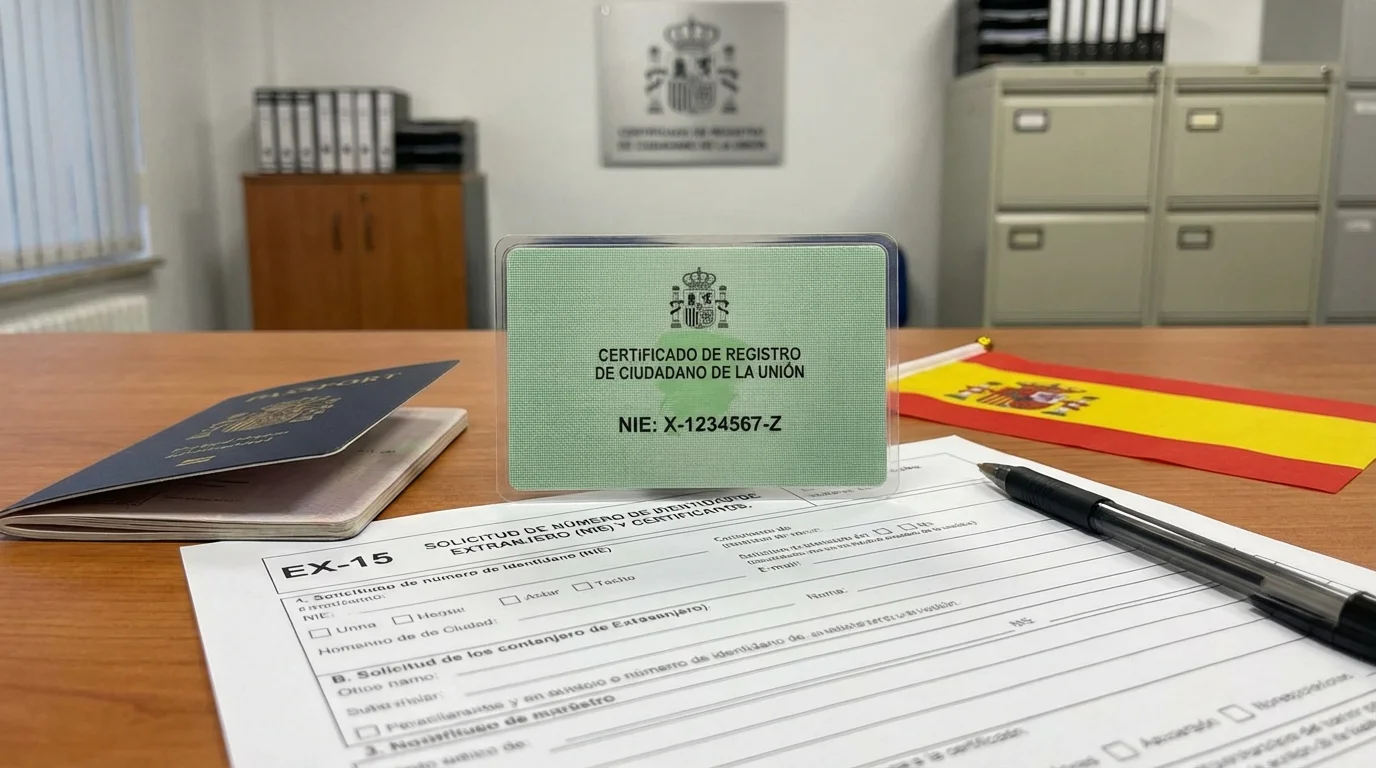
Spanish NIE number 2026: step-by-step guide from Sweden or Spain. EX-15 form, Modelo 790, €9.84 fee, waiting times and NIE/NIF/TIE explained.