


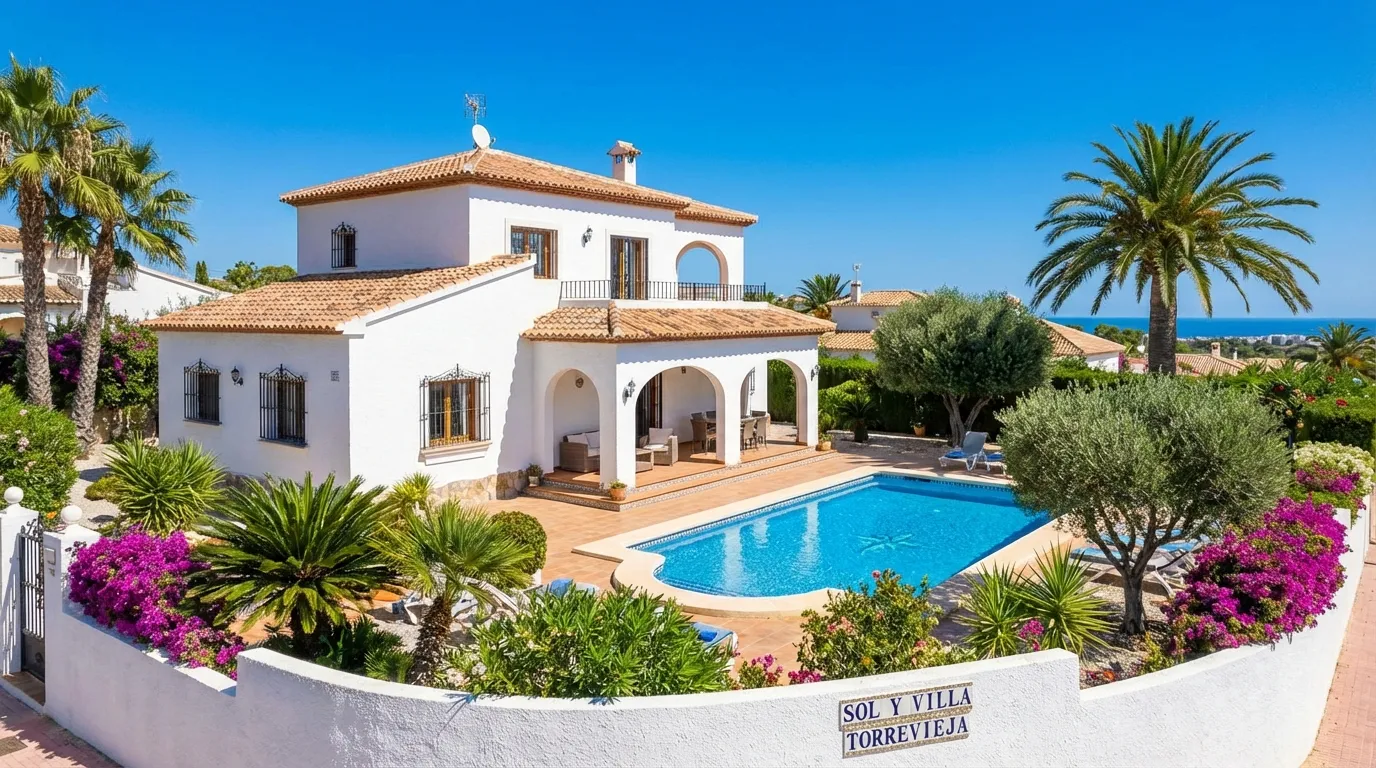
Buying Guides
Buying a House in Torrevieja – Complete Guide for Swedish Buyers 2026
Buying a house in Torrevieja: prices by area, purchase process, taxes, NIE and mortgages — practical guide for Swedes who want to live on Costa Blanca 2026.
17 min

Complete tax guide for Swedes with property in Spain: IBI, IRNR, wealth tax, capital gains and the double taxation agreement. Updated 2026.
If you own a property in Spain you pay at least two annual taxes: IBI (property tax) of 300–1,500 euros and non-resident tax (IRNR) via Modelo 210. As a Swedish property owner not registered in Spain you are taxed at 19% on rental income — with the right to deduct expenses such as insurance, repairs and mortgage interest. If the property stands empty you still pay an imputed income tax based on the cadastral value.
Beyond the annual taxes there is wealth tax (for assets over 700,000 euros), capital gains tax on sale and the municipal plusvalía tax. The double taxation agreement between Sweden and Spain ensures you don't pay full tax in both countries — but you must actively apply for a credit.
This guide explains each tax step by step, with current amounts, deadlines and the mistakes Swedes most commonly make. We do not provide legal advice — tax rules change and your situation may require individual assessment from a qualified asesor fiscal (Spanish tax adviser).
Spain has a multi-layered tax system. As a foreign property owner you operate across three levels: municipal, regional and national. Which taxes you pay depends primarily on whether you are a tax resident in Spain or not — and whether you rent out your property.
Here is an overview of the most common taxes:
Most common taxes
IBI (property tax)
300–1,500 €/year
All property owners
IRNR (non-resident tax)
19% on income / imputed income
Non-residents
Wealth tax
0.2–3.5% (regional)
Assets > 700,000 €
Capital gains tax (sale)
19% for EU citizens
Sellers
Plusvalía municipal
Varies by municipality
Sellers
Rental income tax
19% (EU) / 24% (non-EU)
Those who rent out
Most Swedish property owners not resident in Spain pay IBI plus IRNR — totalling often 500–2,000 euros per year for a typical apartment on the Costa Blanca.
Note
Important: You are obliged to file a tax return in Spain even if you only own a holiday home you never rent out. Many Swedes miss this and discover the problem only when selling, when unpaid taxes block the transaction.
IBI (Impuesto sobre Bienes Inmuebles) is Spain's equivalent of the Swedish property charge. It is a municipal tax paid by every property owner regardless of nationality or where they live.
The tax is based on your cadastral value (valor catastral), which is set by the Spanish cadastral authority. The cadastral value is normally considerably lower than the market value — often just 30–50% of what the property is actually worth. The municipality then multiplies the cadastral value by its local tax rate.
The tax rate varies between 0.4% and 1.1% of the cadastral value depending on the municipality. The differences can be large even within the same region.
Some examples from popular areas:
IBI examples by municipality
Torrevieja
200–500 €
IBI rate (urban): 0.40%
Orihuela (incl. Orihuela Costa)
350–700 €
IBI rate (urban): 0.58%
Alicante city
500–1,000 €
IBI rate (urban): 0.73%
Dénia
600–1,200 €
IBI rate (urban): 1.05%
Marbella
500–1,500 €
IBI rate (urban): 0.72%
The IBI notice is sent out by the municipality (Ayuntamiento), usually between May and October. You can pay by bank transfer, direct debit or at the municipal office. Many owners set up a direct debit (domiciliación bancaria) via their Spanish bank — it's the simplest way to avoid missing the payment.
Tip
Tip: Check your IBI receipt (recibo de IBI) — it shows your cadastral value (valor catastral). You need that figure when filing your IRNR return. If you've lost the receipt you can retrieve the information on the Catastro portal (catastro.meh.es) with your NIE number.
IRNR (Impuesto sobre la Renta de No Residentes) is the income tax that all non-tax-resident property owners pay in Spain. It is declared via form Modelo 210 with Agencia Tributaria.
There are two scenarios: either you rent out your property, or you don't. In both cases you must file a return.
Spain considers that a property you don't rent out still generates a fictitious income — a so-called "renta imputada". The calculation works like this:
Worked example: You own an apartment with a cadastral value of 80,000 euros. The cadastral value was updated in 2018 (within 10 years). Imputed income: 80,000 × 1.1% = 880 euros. Tax: 880 × 19% = 167.20 euros per year.
That's not a large sum, but you must declare it. And for a villa with a high cadastral value the amount can be considerably higher.
If you rent out your property you pay 19% on net income as an EU/EEA citizen (24% if you are resident outside the EU). The advantage as an EU citizen — and this applies to you as a Swede — is that you can deduct costs directly related to the rental:
Worked example: Rental income 10,000 euros. Deductible costs: IBI 400 euros + insurance 300 euros + community fees 1,200 euros + maintenance 600 euros = 2,500 euros. Taxable income: 7,500 euros. Tax (19%): 1,425 euros.
Since 2024 Spain has simplified the return for rental income — you can now declare annually instead of quarterly, which considerably reduces the administration.
Properties
Explore available properties in torrevieja
Periods when you rent out are taxed as rental income (see above). Periods when the property stands empty — including the time you use it yourself — are taxed as imputed income. That means you often do two separate calculations in the same return.
Say you rent out your apartment on the Costa Blanca during June–August (3 months) and it stands empty for the rest of the year (9 months). You then declare:
You can only deduct costs in proportion to the rental period. The IBI deduction in the example above therefore becomes 3/12 of the total IBI cost.
2025 legislation update: Spain's national court (Audiencia Nacional) ruled in July 2025 that even non-EU citizens have the right to deduct costs on rental — something that previously only applied to EU/EEA citizens. The decision may affect future legislation and is worth monitoring if you have British friends with property in Spain.
Spain's wealth tax (Impuesto sobre el Patrimonio) taxes net assets. As a non-resident it only applies to your assets in Spain — not your global assets.
As a non-resident Swede with an apartment worth 250,000 euros you don't need to pay wealth tax. It only becomes relevant when your Spanish assets (properties, bank accounts, vehicles) exceed 700,000 euros.
Wealth tax varies greatly between Spain's autonomous regions, and the differences can be decisive for where you choose to buy:
However, Spain introduced in 2023 a national solidarity tax (Impuesto Temporal de Solidaridad de las Grandes Fortunas) which applies regardless of region if your net assets in Spain exceed 3.7 million euros. The tax was extended in 2025 and applies until further notice. This means that Andalusia's and Madrid's zero-percent tax avoidance has a ceiling — if you have really large assets you still pay.
If you sell your Spanish property it triggers two taxes: national capital gains tax and municipal plusvalía.
As a non-resident EU citizen you pay 19% on the gain (sale price minus purchase price and improvement costs). The buyer withholds 3% of the sale price and pays it directly to Agencia Tributaria as an advance on your tax (via Modelo 211).
You then have four months to file a return (Modelo 210) and reclaim any excess — if the actual tax is lower than the 3% withholding.
Worked example: You bought an apartment for 150,000 euros and sell for 200,000 euros. Gain: 50,000 euros. Tax (19%): 9,500 euros. The buyer withheld 3% of 200,000 = 6,000 euros. You pay the difference: 3,500 euros.
Don't forget that you can deduct costs that have increased the property's value — renovation, additions and purchase costs (notary, ITP). Keep all receipts.
Plusvalía (Impuesto sobre el Incremento de Valor de los Terrenos de Naturaleza Urbana) is a municipal tax on the increase in land value since you bought the property. All sellers pay it, regardless of nationality or residential status.
Since 2022 you can choose between two calculation methods and use the one that gives the lowest tax:
The amount varies greatly depending on the municipality and length of ownership — from a few hundred euros to several thousand. If you sell at a loss you have since 2022 the possibility of being exempt from plusvalía entirely, but you must still declare it within 30 days of the sale.
Properties
Explore available properties in costa-del-sol
Browse current homes in the area and compare locations, price levels and property types at your own pace.
Sweden and Spain signed a double taxation agreement in 1976 which is still in force. The purpose is that you shouldn't have to pay full tax on the same income in both countries.
Income from property is taxed in the country where the property is located — i.e. Spain. But since Sweden taxes its citizens' global income you may also be liable to tax in Sweden on your Spanish property. This is where the agreement steps in: you have the right to credit the Spanish tax against your Swedish tax.
In practice this means:
The credit can never be larger than the Swedish tax on the same income. If you pay more in Spain than you would have in Sweden on the same amount, the excess "disappears".
Wealth tax is a special case. Sweden abolished its wealth tax in 2007, but Spain has kept its. There are no Swedish provisions to credit Spanish wealth tax against, since that type of tax doesn't exist in Sweden. You therefore pay Spanish wealth tax "straight" if you reach the thresholds.
Keeping track of deadlines is crucial — a late return triggers automatic surcharges. Here are the most important dates:
Most important tax deadlines
IBI (property tax)
May–October (varies by municipality)
Paid via municipality
IRNR — imputed income (not rented)
31 December the following year
Modelo 210
IRNR — rental income (annual return)
1–20 January the following year
Modelo 210
Wealth tax
June–July (same period as IRPF)
Modelo 714
Capital gains tax on sale
4 months after completion
Modelo 210
Plusvalía municipal
30 days after sale
Municipal form
Example: Rental income during 2025 must be declared by 20 January 2026. Imputed income (not rented) for 2025 must be declared by 31 December 2026. Missed deadlines attract a surcharge of 5% (up to 3 months), 10% (3–6 months), 15% (6–12 months) or 20% (over 12 months), plus interest.
Note
Warning about delays: The Spanish tax authority can go up to four years back and demand unpaid taxes with surcharges. If you have never declared your property since purchase, retroactive demands can be significant. The sooner you sort it out, the cheaper it will be.
After speaking with tax advisers and Swedish property owners in Spain, we see the same mistakes over and over. Here are the most common — and how to avoid them.
1. "I didn't know I had to file a return" The most common mistake by far. Many Swedes buy a holiday home, pay IBI and think that's enough. But IRNR (Modelo 210) must be declared separately — even if the property is never rented out. The tax authority doesn't send a reminder. It's your responsibility.
2. Not keeping receipts for renovations If you renovate the kitchen or replace windows you can deduct the cost against capital gains tax at a future sale. But only if you have receipts (facturas) with your NIE number. Cash jobs without invoices generate no deductions.
3. Missing the double taxation credit If you pay tax in Spain but forget to declare it in Sweden you pay twice. Skatteverket doesn't make the credit automatically — you must actively request it.
4. Using old cadastral values The cadastral value (valor catastral) is revised periodically. If you use an old value in your IRNR return the calculation can be wrong. Always check the current value on your most recent IBI receipt.
5. Not having an asesor fiscal A Spanish tax adviser costs 150–350 euros per year for a standard return. That cost is recovered through correct deductions and avoiding late payment charges. It's not a luxury — it's necessary if you don't have deep knowledge of Spanish tax law.
6. Confusing tax residency rules If you spend more than 183 days per year in Spain you automatically become a tax resident. Completely different rules then apply — you are taxed on your global income in Spain. The difference in tax burden can be dramatic. Keep a careful count of your days if you spend longer periods there.
Contact
We can connect you with reliable tax advisers along the Costa Blanca and Costa del Sol who speak Swedish. Book a free call — no commitment.
Book a free consultationLast updated: April 2026. Tax rules and amounts can change — always consult a qualified asesor fiscal for your personal situation. This guide does not constitute tax advice.
Decision support
Ja. Alla som äger fastighet i Spanien utan att vara skatteresidenta måste betala årlig IBI (fastighetsskatt), icke-resident-skatt (IRNR via Modelo 210) och eventuellt förmögenhetsskatt.
IRNR betalas även om fastigheten står tom — skattemyndigheten tillskriver dig en fiktiv inkomst baserad på taxeringsvärdet. Försummar du att deklarera riskerar du böter och tilläggsavgifter.
Som svensk (EU-medborgare) betalar du 19 % skatt på nettohyresinkomsten. Det betyder att du får dra av kostnader som IBI, försäkring, reparationer och bolåneränta innan skatten beräknas.
En fastighet som genererar 12 000 euro i hyra med 4 000 euro i avdragsgilla kostnader beskattas alltså på 8 000 euro — det ger 1 520 euro i skatt.
Spanska skattemyndigheten (Hacienda) kan gå flera år tillbaka och kräva in obetalda skatter med tillägg. Förseningsavgiften är 5–20 % beroende på hur sent du deklarerar, plus dröjsmålsränta.
Dessutom kan obetalda skatter registreras som skuld på fastigheten, vilket komplicerar en framtida försäljning. Anlita en asesor fiscal (skatterådgivare) för att komma ifatt om du hamnat efter.
Ja, tack vare dubbelbeskattningsavtalet mellan Sverige och Spanien. Skatt du betalat i Spanien på fastighetsrelaterade inkomster kan avräknas mot din svenska skatt på samma inkomst.
Du ansöker om avräkning i din svenska inkomstdeklaration via bilaga K8 hos Skatteverket. Avräkningen kan dock aldrig överstiga den svenska skatten på samma inkomst.
Sök en asesor fiscal (auktoriserad skatterådgivare) med erfarenhet av utländska fastighetsägare. Be om referens från andra skandinaver i området, kontrollera att rådgivaren är registrerad och fråga efter fast pris för din årliga skattedeklaration.
Räkna med 150–350 euro per år för en standarddeklaration av Modelo 210. Undvik rådgivare som bara pratar om att minimera skatten — regelefterlevnad är viktigast.
Sources
Buying a house in Torrevieja: prices by area, purchase process, taxes, NIE and mortgages — practical guide for Swedes who want to live on Costa Blanca 2026.
Cheap houses in Spain from 80,000 €: prices on Costa Blanca, Costa Cálida, Torrevieja and Mazarrón — hidden costs, risks and tips for bargains in 2026.
Everything you need to know about Orihuela Costa on Costa Blanca: areas, property prices, climate, beach life and tips for buying property in southern Spain.