
Moving & Living
NIE Number in Spain – Complete Guide 2026 (Application, Forms, Waiting Times)
Spanish NIE number 2026: step-by-step guide from Sweden or Spain. EX-15 form, Modelo 790, €9.84 fee, waiting times and NIE/NIF/TIE explained.
15 min
Complete guide to residencia in Spain: requirements, documents, application and what it means for your taxes. Step-by-step for Swedish citizens.
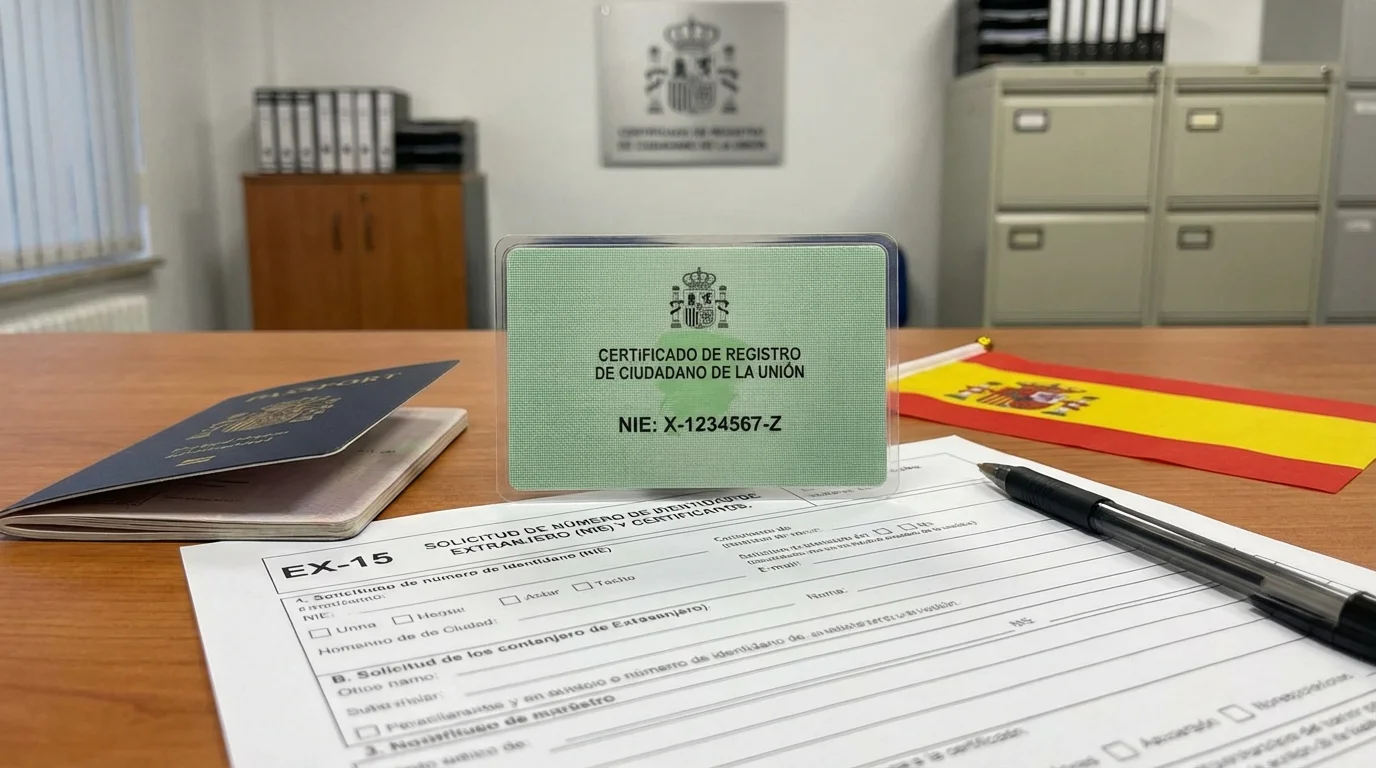
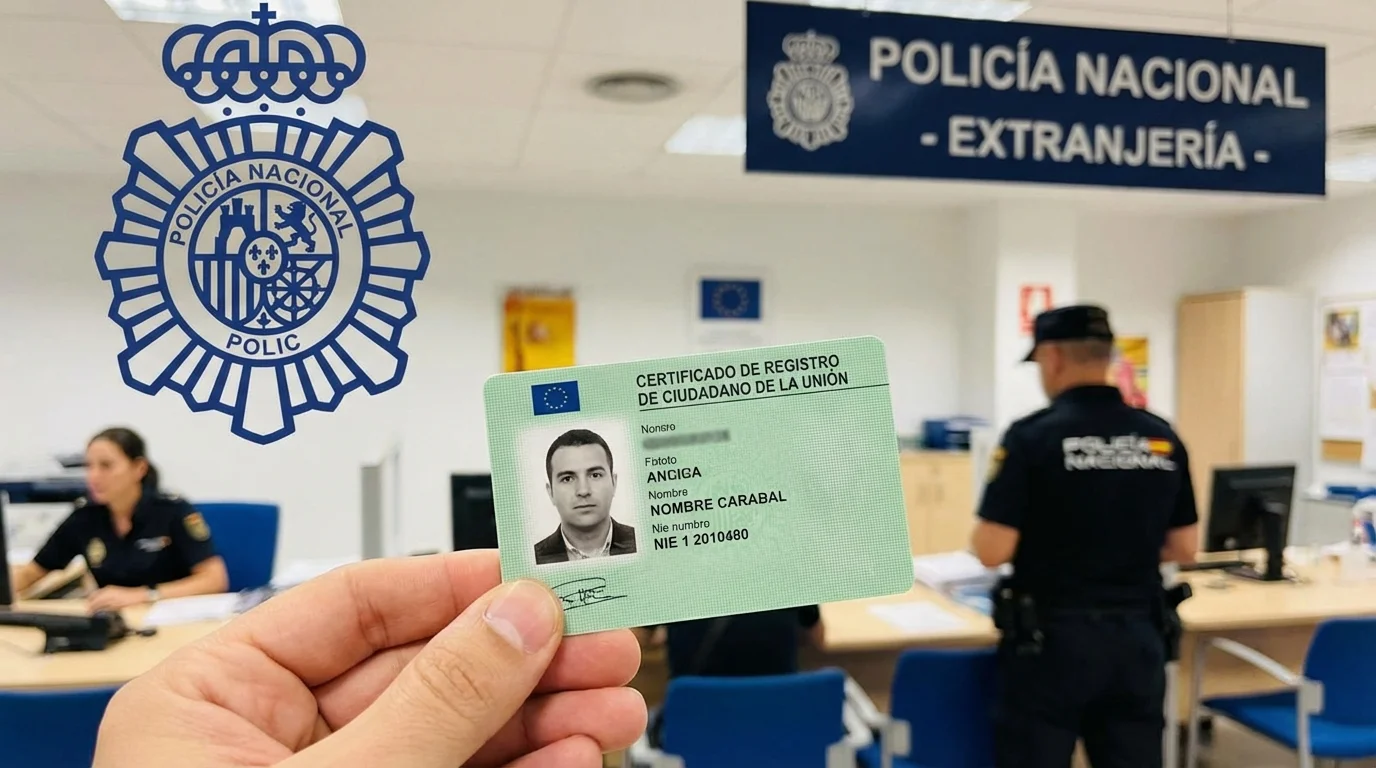
As a Swedish EU citizen you have the right to live in Spain, but if you stay longer than three months you must register and obtain residencia — a so-called Certificado de Registro de Ciudadano de la Unión. It is a green A4 document (often called the "green NIE") that proves your legal right of residence. Without it you risk fines and will struggle to take out insurance, register a car or access public healthcare.
The good news: the process is simpler than many people think. The fee is 12 euros, processing normally takes 1–3 weeks, and essentially you just need to show that you can support yourself and have health insurance. In this guide we go through everything step by step — from what requirements apply to what residencia actually means for your taxes and rights.
Residencia — formally Certificado de Registro de Ciudadano de la Unión Europea — is the document that confirms that you as an EU citizen have registered in Spain's central foreigners' register. It is issued as a green piece of paper (hence the nickname "green NIE") and contains your name, nationality, address, NIE number and registration date.
It's important to understand what residencia is not. It is not a residence permit in the traditional sense — as an EU citizen you have automatic right of residence under EU freedom of movement. The registration is an administrative obligation, not a permit that can be refused as long as you meet the basic requirements.
Your registration certificate has no expiry date. Once you are registered it is valid indefinitely, unlike residence permits for non-EU citizens which must be renewed regularly.
The obvious reason: it's a legal requirement. Under Spanish law (Real Decreto 240/2007) EU citizens staying longer than 90 days are required to register. Fines for failure to register sit at 500–10,000 euros, although in practice they are rarely imposed.
But there are a range of practical reasons that make it worthwhile:
Information
Did you know? Residencia is also a requirement to be able to buy property with a Spanish mortgage at certain banks. Having residencia signals to the bank that you are established in Spain, which can give better loan terms — typically 70% loan-to-value compared with 50–60% for non-residents.
As an EU citizen you need to meet one of the following requirements to register:
If you have employment in Spain (with a work contract and registration with Seguridad Social) you automatically meet the requirement. You need to show your work contract or a certificate of employment.
If you run your own business in Spain — registered as an autónomo with Agencia Tributaria — that is sufficient as a basis. Bring your registration certificate and most recent quarterly return.
If you have neither a job nor a business in Spain you need to show that you can support yourself. That means:
In practice you demonstrate this through bank statements from the last three months, pension notices, or income certificates.
If you are studying at a recognised Spanish educational institution you can register with proof of enrolment, health insurance and sufficient funds.
Tip
Tip for pensioners: If you have a Swedish pension you can show a pension notice from Pensionsmyndigheten as proof of sufficient funds. Request an S1 certificate from Försäkringskassan before you move — it gives you the right to Spanish public healthcare and satisfies the health insurance requirement.
The entire process can be divided into five steps. Allow 4–8 weeks from start to green paper in hand, of which the longest waiting time is often getting an appointment.
If you don't already have a NIE number (Número de Identidad de Extranjero) you must arrange that first. NIE is your identification number for all official matters in Spain. You can apply for NIE and residencia simultaneously at the same visit, but in practice many offices prefer you to already have a NIE. See our separate guide on NIE numbers for details on that application.
Go to your local Ayuntamiento (town hall) and register in the padrón — the municipal residential register. You need:
Empadronamiento is normally free and takes 15–30 minutes. You receive a certificado de empadronamiento which you need for the residencia application.
All residencia processing requires an appointment. Book via the official website Sede Electrónica (sede.administracionespublicas.gob.es). Select your province and then "Policía — Certificado de Registro de Ciudadano de la UE".
In popular coastal areas like Torrevieja and Alicante available slots may be fully booked weeks ahead. Check the system daily at 08:00–09:00 Spanish time — new slots are often released then.
Download Modelo 790 código 012 from the Agencia Tributaria website or the Policía Nacional's Sede Electrónica. Select the option "Certificado de registro de residente comunitario". Fill in the form, print it out and pay the fee of 12 euros at any Spanish bank. Keep the receipt — without it you cannot complete the application.
Bring all documents (see complete checklist below) to your booked appointment. The visit normally takes 20–45 minutes. The official checks your papers, and in many cases you receive your green registration certificate directly on the spot. In larger cities you may need to collect it after 1–3 weeks.
Checklist — EU registration (EX-18)
Form EX-18
In duplicate
Completed and signed — template at sede.policia.gob.es.
Passport or national ID
Original + copy
Copy of the main page.
Certificado de empadronamiento
Max 3 months old
Obtained from the town hall.
Modelo 790 código 012
12 € paid
Receipt from a Spanish bank.
Economic proof (a)
Employment
Work contract or certificate.
Economic proof (b)
Self-employed
Autónomo registration + most recent return.
Economic proof (c)
Bank funds
3-month statements, at least approx 7,200 €/year in traceable income.
Economic proof (d)
Pension
Pension notice.
Health insurance
S1 / private / SS
S1 certificate, private insurance without copago, or Seguridad Social.
Passport photo
1 piece
Not always required — good to have.
Note
Warning: Bring two copies of each document. The official keeps one set. If you're missing copies you'll be sent to the nearest photocopier — and risk your appointment slot going to the next person in the queue.
Timeline — roughly
NIE (if you don't have one)
1–4 weeks
Empadronamiento
Same day
At the town hall.
Cita previa
1–6 weeks
Waiting time varies greatly.
Visit Extranjeros
20–45 min
Certificate
Same day or 1–3 weeks
Total (realistic)
4–8 weeks
Often faster in smaller municipalities.
In smaller municipalities along the Costa Blanca the whole process can take 2–3 weeks. In Madrid or Barcelona it takes longer.
The residencia application itself is inexpensive:
Costs (approximate)
Tasa 012 (Modelo 790)
12 €
Government fee.
Empadronamiento
Free
Gestoría / solicitor
100–300 €
If you use an agent.
Private health insurance
60–150 €/month
If the requirement applies to you.
Total DIY application
From 12 €
Plus any insurance.
Total via gestoría
approx 120–320 €
In typical cases.
Many Swedish property buyers engage a gestoría (administrative agency) that handles the whole process. It costs more but saves time and bureaucratic hassle.
Properties
Explore available properties in Costa Blanca
Browse current homes in the area and compare locations, price levels and property types at your own pace.
The three concepts are often confused. Here is the simple explanation:
NIE (Número de Identidad de Extranjero) — Your personal identification number as a foreigner in Spain. It is a number, not proof that you live there. You need NIE for all financial and legal matters — banking, property purchase, tax returns. You keep the number for life.
Empadronamiento (padrón) — Municipal residential registration. Everyone living in a Spanish municipality should register, regardless of nationality or legal status. It is a municipal register — not proof of legal right of residence. You can be empadronado without having residencia.
Residencia (Certificado de Registro) — Your formal registration as an EU citizen with legal right of residence. Issued by the police/Oficina de Extranjeros. It is proof that you meet the requirements and have the right to live in Spain for longer than 90 days.
NIE, padrón and residencia
Number — not a residence permit
Municipal residential registration
Right of residence as EU citizen
The order: First NIE, then empadronamiento, lastly residencia. You need the first two to apply for the third.
Here it becomes crucial to distinguish between administrative residencia and tax residency — they are not the same thing.
Spain's Agencia Tributaria counts you as a tax resident if you meet any of these criteria during a calendar year:
If you become a tax resident in Spain you must declare all global income to Agencia Tributaria — including Swedish pension, capital gains and rental income from Sweden. Spain has progressive income tax of 19–47%.
Sweden and Spain have a tax treaty that prevents double taxation. But be aware that Sweden considers you a tax resident for five years after emigration if you have been resident in Sweden for at least ten years — regardless of where you actually live. You may need to prove that all substantial ties to Sweden have been severed.
Engage an asesor fiscal (tax adviser) with experience of Scandinavian clients. Getting the tax registration wrong can be expensive — Hacienda (the Spanish tax authority) can go back several years and demand unpaid taxes plus interest.
After five years of uninterrupted legal residence in Spain you are entitled to residencia permanente — permanent right of residence. This means you no longer need to meet the requirements for employment, means or health insurance.
You may qualify earlier in certain cases:
Permanent residencia gives you essentially the same rights as a Spanish citizen, except the right to vote in national elections.
Having a NIE number does not mean you are a resident. NIE is just an identification number. Many people think they "have residencia" because they have received their NIE — but that is not correct. Residencia requires separate registration.
Pensioners who haven't arranged an S1 certificate from Försäkringskassan before the move often get stuck in queues at Swedish authorities. Without S1 or private insurance you cannot show that the health insurance requirement is met. Arrange S1 before the move.
The three-month deadline starts ticking from the day you arrive in Spain. Many Swedes "try" living in Spain for a while and only realise after 4–5 months that they should have registered. Apply within the first weeks — it takes time anyway to get a cita previa.
The form must be completed in duplicate and signed. Common mistakes: wrong nationality (write "Sueca" in Spanish), wrong address format or forgetting the signature. Double-check every field.
Registering as a resident does not automatically make you a tax resident — but spending more than 183 days does. Many Swedes don't realise they've passed the threshold until Hacienda gets in touch. Keep track of your days and consult a tax adviser before you pass 183 days.
Contact
Get in touch and we'll guide you forward — whether you're just starting out or ready to buy.
Contact usLast updated: April 2026. Fees and processing times can change — contact us for current information.
Decision support
Som EU-medborgare får du vistas i Spanien i upp till 90 dagar utan att registrera dig. Stannar du längre än tre månader är du skyldig att ansöka om registreringscertifikat (residencia).
Bryter du mot regeln riskerar du böter på 500-10 000 euro enligt spansk utlänningslag. I praktiken kontrolleras det sällan, men utan residencia kan du inte teckna spanskt sjukförsäkringsavtal, registrera bil eller få tillgång till det offentliga sjukvårdssystemet.
Själva handläggningen tar normalt 1-3 veckor efter att du lämnat in ansökan hos Oficina de Extranjeros eller Policía Nacional. Den verkliga väntetiden är ofta att få en cita previa (tidsbokning) — i populära kustområden som Costa Blanca kan det ta 2-6 veckor att få en ledig tid.
Räkna med 4-8 veckor totalt från det att du börjar processen.
Administrativ residencia (registreringscertifikatet) gör dig inte automatiskt skatteresident. Det är 183-dagarsregeln som avgör: vistas du mer än 183 dagar per kalenderår i Spanien, eller har din huvudsakliga ekonomiska verksamhet där, blir du skatteresident och ska deklarera all global inkomst i Spanien.
Sverige och Spanien har ett dubbelbeskattningsavtal som förhindrar att du beskattas dubbelt.
Det beror på din situation. Jobbar du i Spanien som anställd eller egenföretagare täcks du av det spanska socialförsäkringssystemet.
Är du pensionär kan du använda S1-intyget från Försäkringskassan. Saknar du anställning och S1-intyg måste du visa upp en privat sjukförsäkring utan självrisk (sin copago) som täcker primärvård, specialister och sjukhusvård.
Räkna med 60-150 euro per månad beroende på ålder.
Empadronamiento (padrón) är kommunal folkbokföring — ett register över alla som bor i kommunen, oavsett legal status. Du kan vara empadronerad utan att ha residencia.
Residencia är din legala uppehållsrätt som EU-medborgare, registrerad hos polisen via Oficina de Extranjeros. Du behöver empadronamiento som ett av dokumenten när du ansöker om residencia.
Båda behövs, men de fyller helt olika funktioner.
Sources
Spanish NIE number 2026: step-by-step guide from Sweden or Spain. EX-15 form, Modelo 790, €9.84 fee, waiting times and NIE/NIF/TIE explained.
Complete tax guide for Swedes with property in Spain: IBI, IRNR, wealth tax, capital gains and the double taxation agreement. Updated 2026.

Cheap houses in Spain from 80,000 €: prices on Costa Blanca, Costa Cálida, Torrevieja and Mazarrón — hidden costs, risks and tips for bargains in 2026.