Padrón and Empadronamiento – Registration in Spain Explained 2026
What is padrón and empadronamiento in Spain? The difference, how to get a certificado de empadronamiento, and why it matters for Swedish residents.
·13 min read·Marcus Ohlander·Updated 14 April 2026
Padrón in Spain is the municipal population register — and your certificado de empadronamiento is the document that proves you are in that register. It sounds simple, but most Swedes moving to Spain confuse the terms padrón, empadronamiento and certificado. These are three different things, and understanding the distinction will save you time and frustration at government offices.
In brief: padrón is the register, empadronamiento is the act of registering, and certificado de empadronamiento is the document you receive as proof. It is the certificate — the physical document — you need to present when applying for residencia, a healthcare card or exchanging your driving licence. The certificate has a validity period of three months. The registration itself is permanent for EU citizens.
In this guide we focus specifically on the padrón certificate: what it contains, all the situations where you need it, how to obtain it (including digitally), and what to do when it expires. If you are looking for a broader overview of the entire registration process, we recommend our guide on registering in Spain.
What is padrón municipal de habitantes?
Padrón municipal de habitantes is Spain's municipal population register. Each municipality (municipio) in Spain is responsible for its own padrón, unlike Sweden where the Swedish Tax Agency manages registration centrally. This means the register is administered locally by your ayuntamiento (town hall) — not by the state.
The register contains information about everyone living in the municipality: full name, nationality, date of birth, ID number (NIE for foreigners), address and date of registration. It is updated continuously and forms the basis for electoral rolls, municipal budget allocation and statistics.
Every person living in Spain — regardless of nationality, residency status or length of stay — is legally required to register in the padrón of the municipality where they live. This obligation also applies to part-time residents who spend the majority of their time in Spain.
Information
Good to know: The padrón register is not linked to the tax authority (Agencia Tributaria) or the police. Registering in the padrón does not give you residency or create tax liability. It is a purely municipal register that proves where you live — nothing more.
What is the difference between padrón, empadronamiento and certificado?
This is the most common source of confusion among Swedes in Spain, so let us clarify these terms once and for all:
Padrón (padrón municipal de habitantes) — The register itself. A database maintained by the municipality containing all residents' information. You cannot "see" the padrón — it is an internal list.
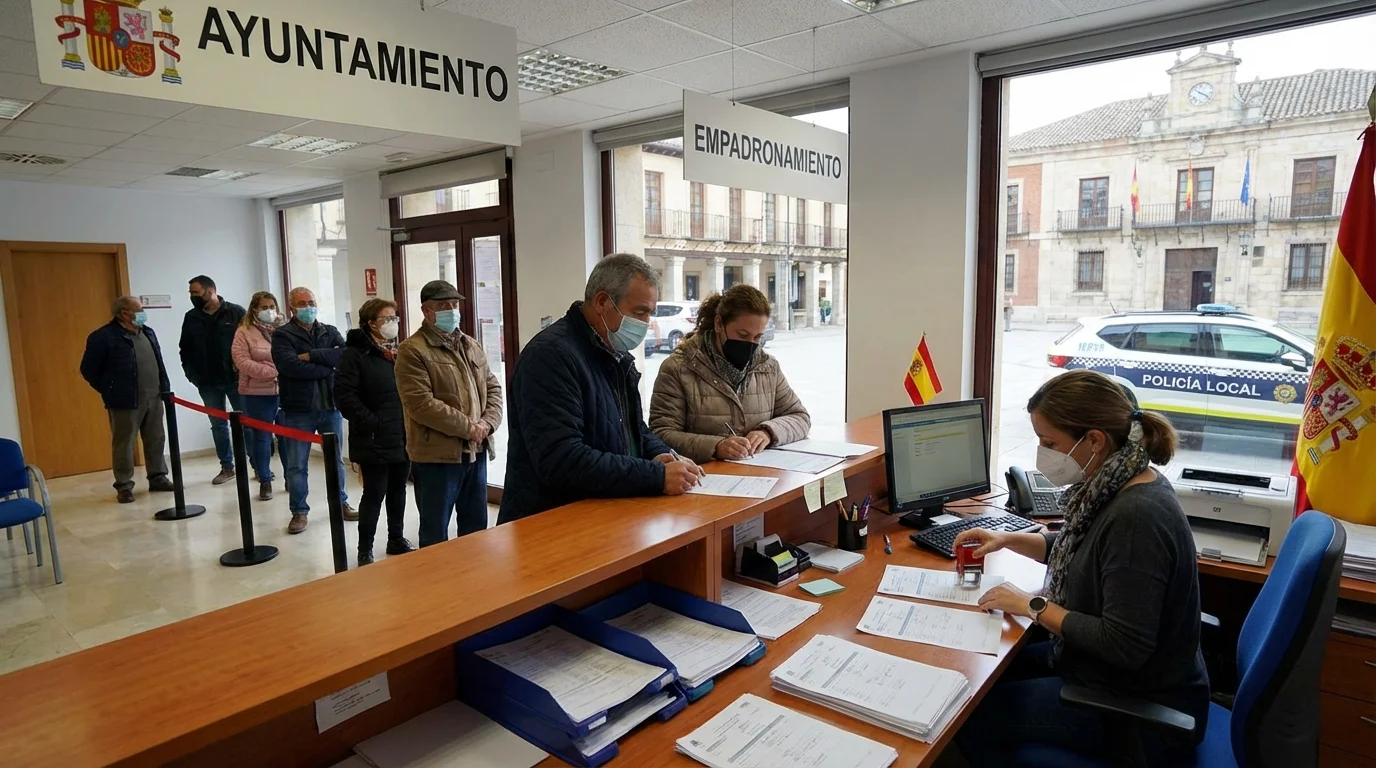
Empadronamiento — The act of registering. When you go to the ayuntamiento and declare your address, you are doing an empadronamiento (alta in the padrón). It is the process, not the document.
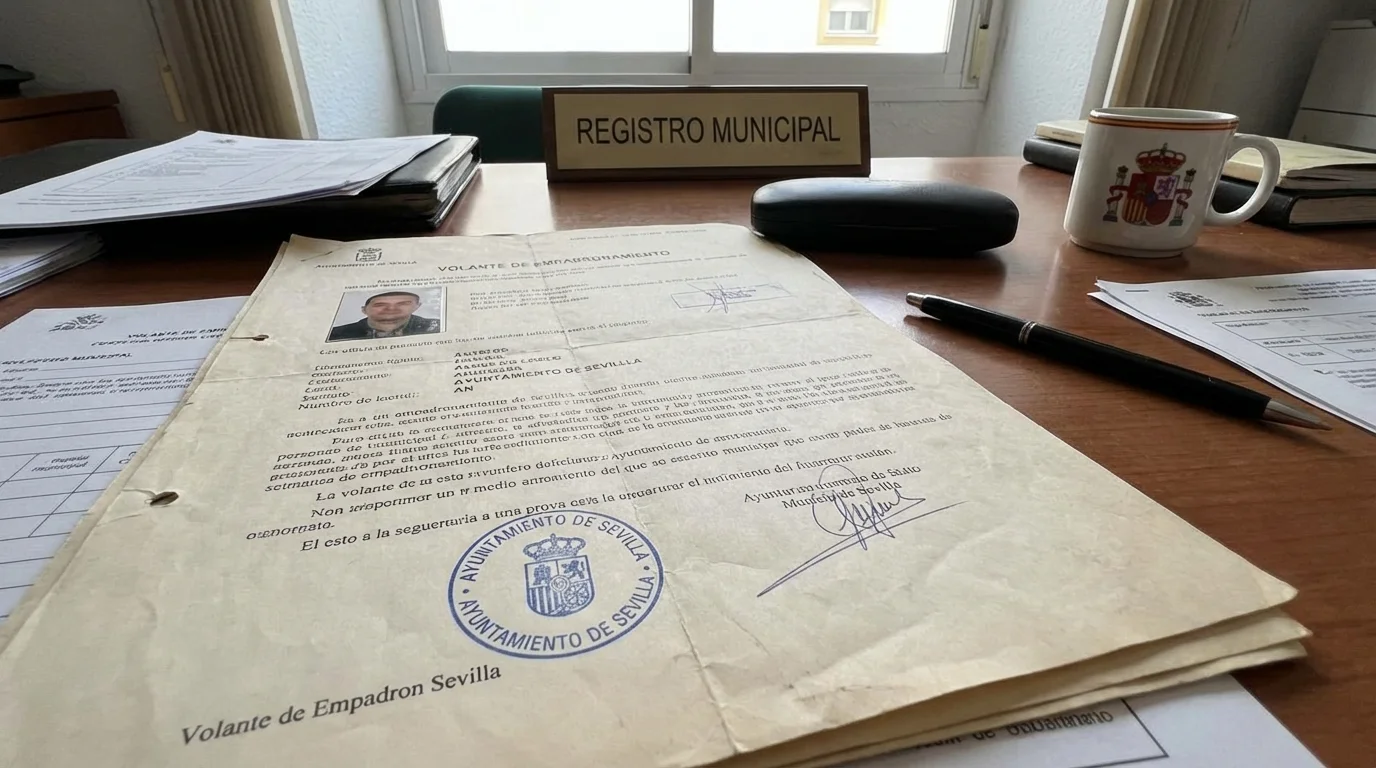
Certificado de empadronamiento — The physical (or digital) document you receive as proof that you are registered. This is the paper you take to the Policía Nacional, health centre or bank. It contains your name, NIE number, address and date of registration.
There is also an important distinction between two types of extract:
Volante vs certificado de empadronamiento
Volante de empadronamiento
Everyday use: SIM card, school enrolment. Often free and issued on the spot.
Informal extract without stamp
Everyday use: SIM card, school enrolment. Often free and issued on the spot.
Certificado de empadronamiento
Government offices: residencia, driving licence, Policía, court. Same day or within 1–3 working days.
Formal certificate with stamp and signature
Government offices: residencia, driving licence, Policía, court. Same day or within 1–3 working days.
A volante is sufficient for everyday matters. But for all official dealings — residencia, driving licence exchange, property purchase — you need the formal certificado. If in doubt, always ask for the certificado. It works everywhere, whereas a volante is not always accepted.
Tip
Tip: Ask for the certificado (not the volante) every time you visit the ayuntamiento. It takes no longer, and you avoid having to make another trip if it turns out the volante is not accepted. Some municipalities, such as Torrevieja, issue both types at the same visit.
Why do you need a certificado de empadronamiento?
The certificado de empadronamiento is the most widely used document in Spanish bureaucracy after your NIE number. Here are all the situations where it is required:
Residencia (residence certificate)
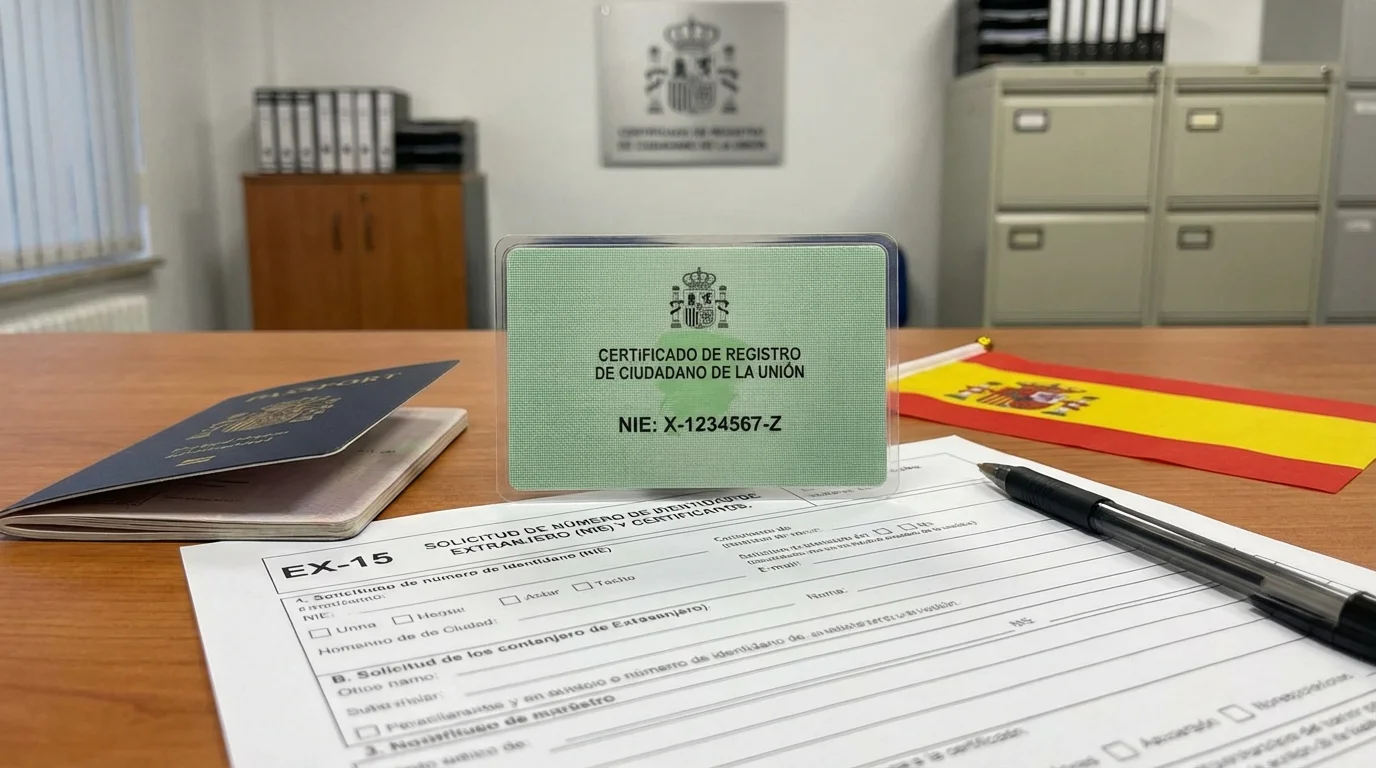
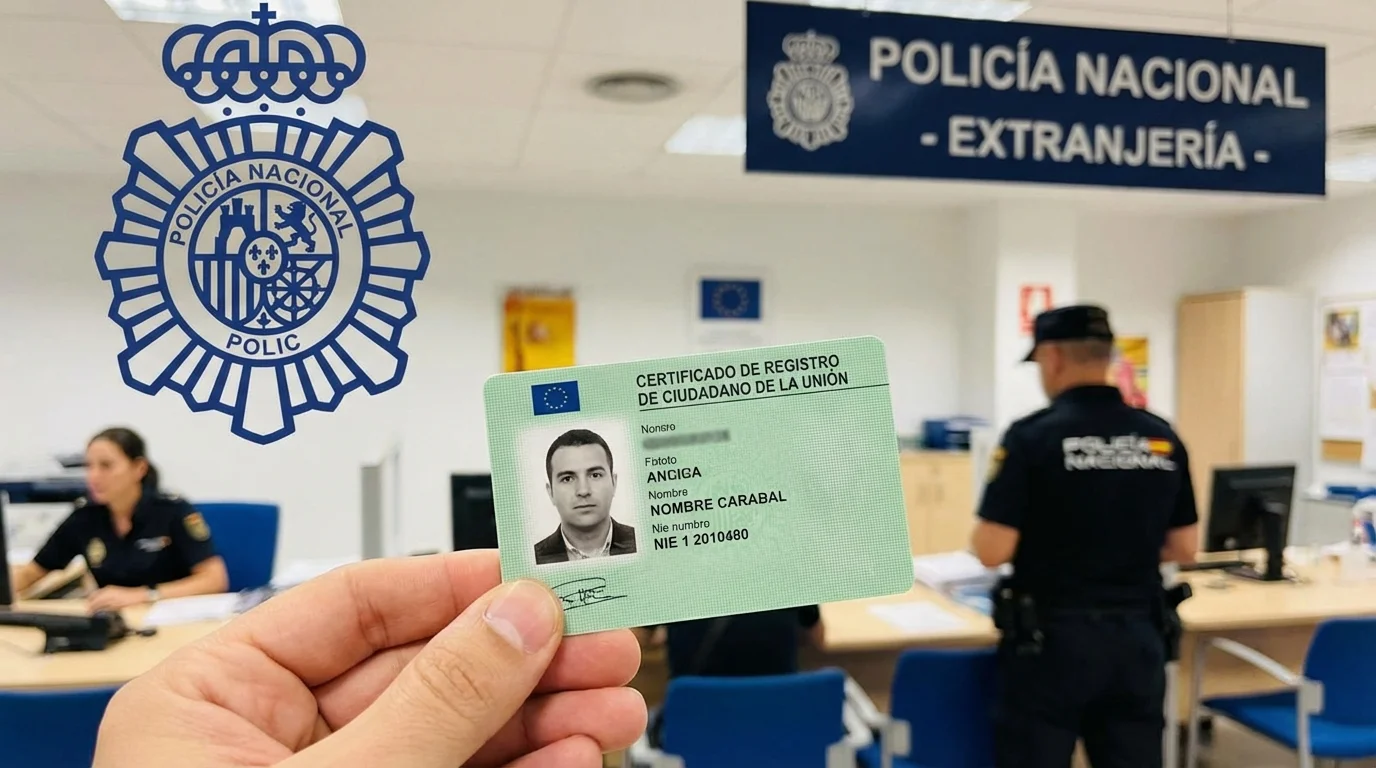
As an EU citizen you must apply for the Certificado de Registro de Ciudadano de la Unión — the green residencia card — if you stay in Spain for more than 90 days. The application is made at the Policía Nacional, and a certificado de empadronamiento issued within the last three months is mandatory.
Tarjeta sanitaria (healthcare card)
You need the certificate to apply for the SIP card (tarjeta sanitaria) in the Comunitat Valenciana or the equivalent healthcare card in other regions. Without it you only receive emergency care via your European Health Insurance Card — not regular GP visits, prescriptions or specialist referrals.
Driving licence exchange
When you exchange your Swedish driving licence for a Spanish one, the DGT (Dirección General de Tráfico) requires a valid certificado de empadronamiento. The process takes 4–8 weeks and your Swedish licence is retained during processing.
School and nursery
State schools allocate places based on proximity to home. The certificate proves where the child lives and determines which school zone the family belongs to. Without it you cannot even begin the application process.
Other situations
Opening a bank account — some banks require it as proof of address
Taking out insurance — car and home insurance may require it
Voting in local elections — EU citizens can vote locally with a valid empadronamiento
IBI discount — in some municipalities empadronamiento entitles you to reduced property tax
Social benefits and subsidies — municipal support requires it
Property purchase — the notary may request it at the escritura
Do you have a property on Costa Blanca and spend more than a few months a year in Spain? Then empadronamiento is in practice necessary for everyday life to function.
Properties
Explore available properties in Costa Blanca
Browse current homes in the area and compare locations, price levels and property types at your own pace.
There are two routes: a personal visit to the ayuntamiento or a digital application via the sede electrónica (the municipality's electronic office). The process differs depending on whether you are registering for the first time (alta) or requesting a new extract of an existing registration.
First registration (alta)
For a first registration you need to visit the ayuntamiento in person in most municipalities. Bring:
Valid passport (original + copy) — a Swedish driving licence is not sufficient
NIE certificate (original + copy) — not always mandatory but strongly recommended
Proof of address — rental contract, escritura (deed of sale) or nota simple (registry extract)
Hoja padronal — the form available at the office or downloadable from the municipality's website
Owner's consent — if you live with another person: written permission + copy of owner's ID
The official checks your documents, registers you and gives you a certificado — usually at the same visit. The whole process takes 15–30 minutes.
Requesting a new extract (if already registered)
Because the certificate is only valid for three months you need to request new extracts regularly. You can do this:
In person: Go to the ayuntamiento, ask for a certificado de empadronamiento, show your ID. You receive it immediately.
Digitally via sede electrónica: More and more municipalities offer digital handling. You log in with a Spanish digital certificate (certificado digital), Cl@ve PIN or Cl@ve Permanente. In municipalities such as Madrid, Barcelona and Alicante you can download the certificate as a PDF directly. The service is free.
By phone (some municipalities): Torrevieja and several other municipalities offer telephone booking for time-saving visits.
Note
Important about validity: If you have a booked appointment at the Policía Nacional for a residencia application in four months' time, do not collect the certificate now. It will have expired before your visit. Collect the certificate no more than 2–3 weeks before your scheduled government appointment. The Policía Nacional rejects certificates older than three months — without exception.
What does it cost?
Registering in the padrón and receiving a certificado is free in the vast majority of municipalities. Some smaller municipalities charge a nominal fee of 1–2 euros for printing, but this is uncommon. Digital extracts via the sede electrónica are always free of charge.
How often do you need to renew the certificate?
Here is an important distinction that many Swedes miss: the registration in the padrón does not need to be renewed — it is permanent for EU citizens. But the certificate (the document) has a validity period of three months.
In practice this means:
You register in the padrón once. That is sufficient.
Every time an authority wants to see your certificado de empadronamiento it must have been issued within the last three months.
You do not need to "renew" your registration — you only need to request a new extract when required.
Exception: non-EU citizens
Non-EU citizens without permanent residency must confirm their registration every two years (renovación padronal). If you miss that confirmation the municipality risks automatically deregistering you at the next review. As a Swedish EU citizen this rule does not apply — your registration is permanent.
Change of address within the same municipality
If you move within the same municipality you make a modificación — an address change in the padrón. You need to visit the ayuntamiento with new proof of address (rental contract or escritura). Your old registration is updated, and you can request a new certificate with the new address immediately.
How do you deregister? (Baja del padrón)
Baja del padrón — deregistration — is relevant in two situations: you are leaving Spain permanently or you are moving to another municipality.
Moving to another municipality in Spain
If you move from, for example, Torrevieja to Alicante you do not need to deregister manually. When you make a new alta (new registration) in your new municipality, the new municipality automatically notifies your old municipality within the first ten days of the following month. Deregistration takes place without you having to do anything.
Leaving Spain permanently
If you move back to Sweden or to another country you must actively apply for baja. This is done in writing at your ayuntamiento — either in person or via a representative with power of attorney. You need to provide your new address abroad.
Not deregistering rarely has immediate consequences, but it can cause problems in the long run:
You may continue to be counted as tax resident in Spain
The municipality may send municipal fees to your old address
At a future property purchase, dual registration may create bureaucratic complications
Automatic deregistration
Municipalities carry out regular reviews of their padrón register. If a person has not updated their registration for several years and there is no evidence that the person still lives there (no bills, no rental contract), the municipality may initiate a deregistration process. You normally receive a letter with the opportunity to object before the deregistration takes place.
What problems can arise — and how do you resolve them?
The landlord refuses to cooperate
Some landlords — particularly those with informal rental contracts — do not want the tenant to register at the address. Legally they cannot stop you. Empadronamiento is your legal right as a resident, regardless of what the landlord thinks.
If the landlord refuses to give written consent you can contact the ayuntamiento and request a verificación domiciliaria — a home visit where an official verifies that you actually live at the address. This substitutes for the landlord's consent. The process takes longer (1–4 weeks in most municipalities) but it works.
The certificate has expired
Not a problem in itself — your registration remains in place. Go to the ayuntamiento or use the sede electrónica and request a new extract. It takes 10–15 minutes at a personal visit.
You have lost the certificate
Same solution: request a new one. There is no unique original document — the certificate is an extract from the database and can be printed as many times as needed.
Long waiting time for cita previa
In popular municipalities such as Torrevieja the waiting time for appointments can be 2–4 weeks during high season (September–November and January–March). Plan ahead and book early — particularly if you have a government appointment booked that requires a fresh certificate.
You have moved but not deregistered
If you register in a new municipality you are automatically deregistered from the old one. But if you have left Spain without making a baja, your old municipality may contact you at the next review. The simplest solution is to contact the municipality by email or telephone and request a baja retrospectively.
Frequently asked questions about padrón and empadronamiento
Contact
Interested?
Get in touch and we'll guide you forward — whether you're just starting out or ready to buy.
Last updated: April 2026. The process and document requirements may vary by municipality — contact us for current information about your specific municipality.
Decision support
Frequently asked questions
Vad kostar det att få ett certificado de empadronamiento i Spanien?
Att registrera sig i padrón och få ett certificado de empadronamiento är gratis i de allra flesta kommuner i Spanien. Vissa mindre kommuner kan ta ut en symbolisk avgift på 1-2 euro för att skriva ut certifikatet, men det är ovanligt.
Den digitala versionen via sede electrónica är alltid kostnadsfri.
Kan jag få certificado de empadronamiento online i Spanien?
Ja, många kommuner erbjuder digital hantering via sin sede electrónica (elektroniska kontor). Du behöver ett spanskt digitalt certifikat (certificado digital), Cl@ve PIN eller Cl@ve Permanente för att logga in.
Stora kommuner som Madrid, Barcelona och Alicante har fullt digitala system där du kan ladda ner certifikatet som PDF direkt. Mindre kommuner kräver ofta fortfarande personligt besök.
Vad är skillnaden mellan volante och certificado de empadronamiento?
Volante de empadronamiento är ett informellt utdrag som visar din adress och utfärdas direkt på plats — det räcker för vardagliga ärenden som SIM-kort eller skolinskrivning. Certificado de empadronamiento är det formella, stämplade och signerade intyget som krävs vid myndighetsärenden som residencia-ansökan, körkortsbyte eller ärenden hos Policía Nacional.
Ett certificado fungerar alltid istället för en volante, men inte tvärtom.
Hur länge är ett certificado de empadronamiento giltigt?
Själva registreringen i padrón har ingen giltighetstid — den är permanent för EU-medborgare. Men pappret (certificado de empadronamiento) anses giltigt i tre månader från utfärdandedatum.
Efter tre månader kräver myndigheter att du begär ett nytt, nydaterat certifikat. Din registrering förblir aktiv hela tiden — du behöver bara ett nytt utdrag.
Förlorar jag min padrón-registrering om jag lämnar Spanien tillfälligt?
Nej, som EU-medborgare förlorar du inte din registrering vid tillfällig frånvaro. Registreringen är permanent så länge du inte aktivt avregistrerar dig (baja) eller flyttar till en annan kommun.
Icke-EU-medborgare utan permanent uppehållstillstånd måste dock bekräfta sin registrering vartannat år — annars riskerar de automatisk avregistrering vid kommunens granskning.