
Buying Guides
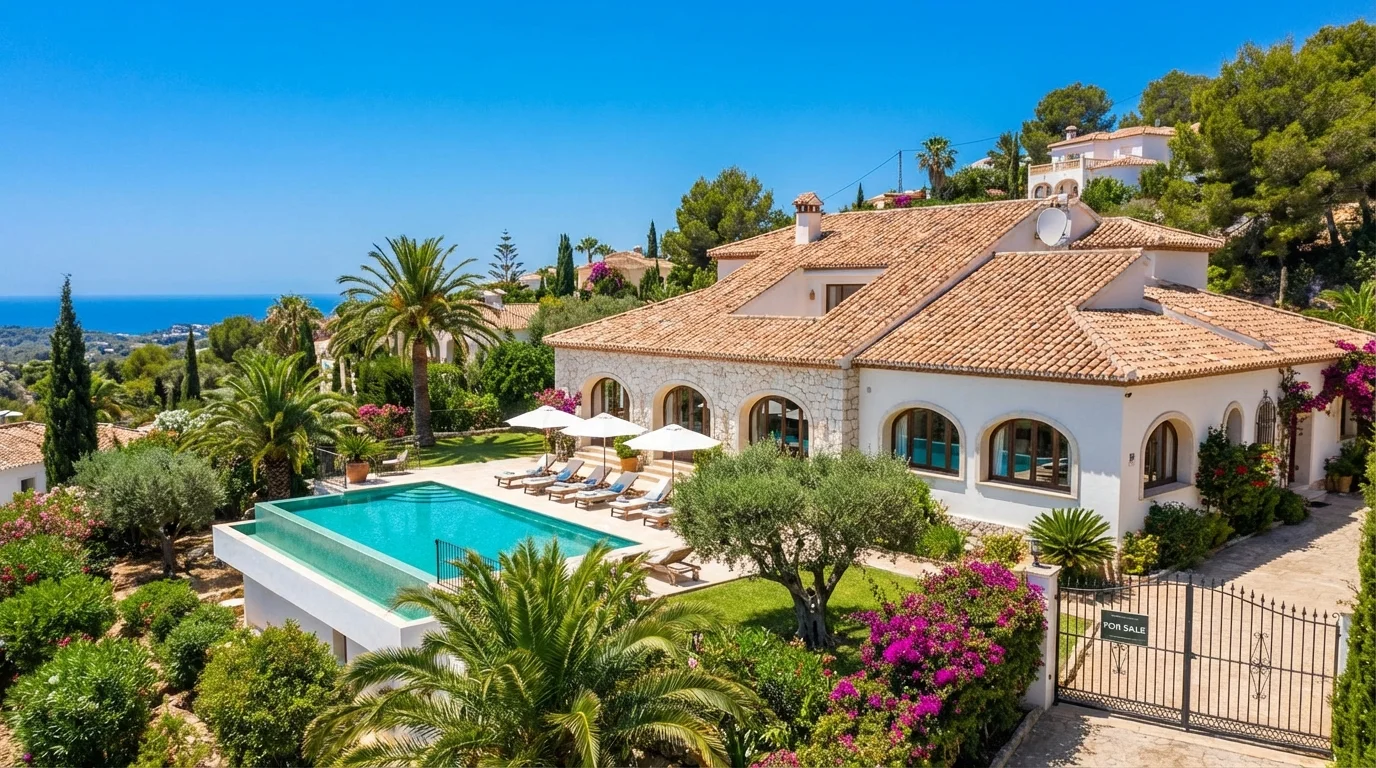
Villas for sale in Spain – prices, running costs and financing 2026
Find your dream villa in Spain: prices by region, types of villas, running costs and what to think about. Complete guide for Swedish buyers.
19 min
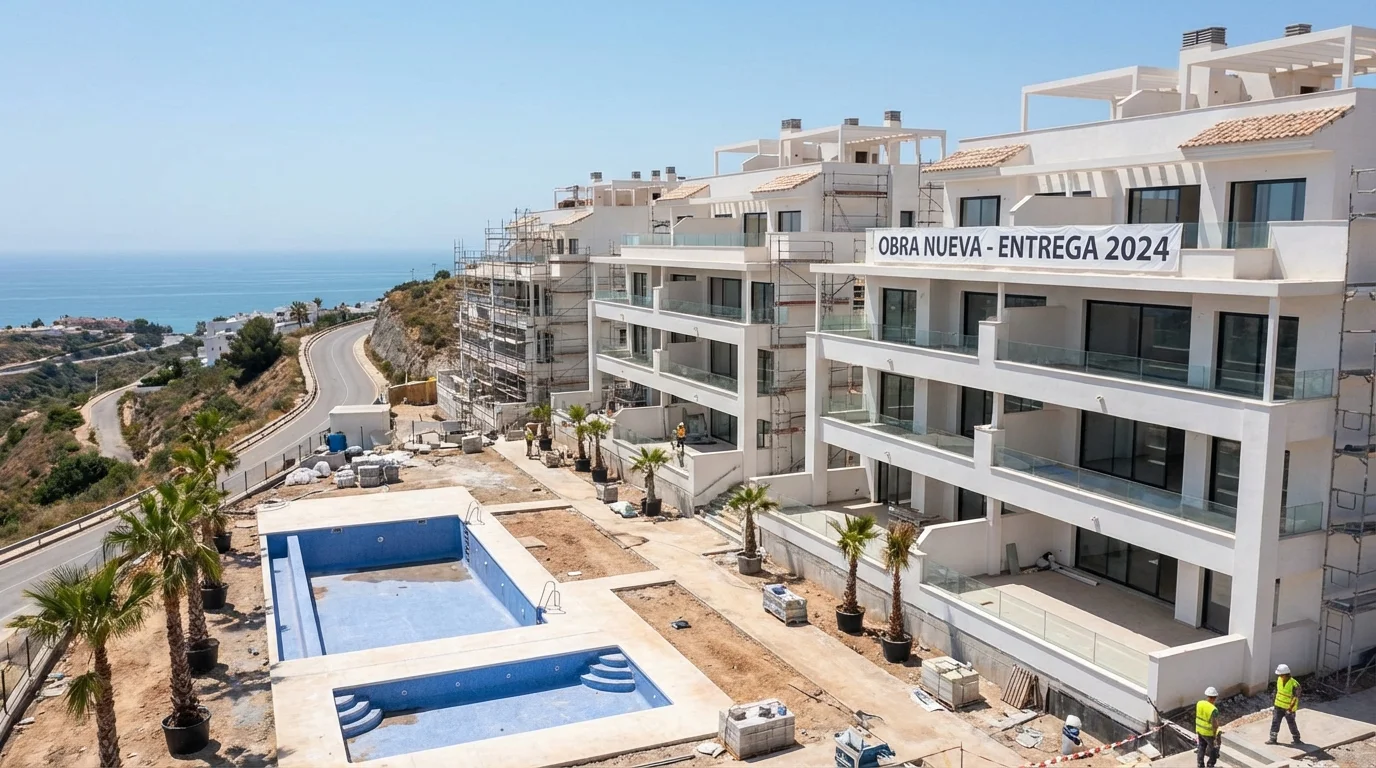
Complete guide to new builds in Spain: prices, payment plans, guarantees, VAT vs transfer tax and what to consider as a Swedish buyer of new-build property.
A new-build property in Spain costs on average 10–20% more per square metre than a second-hand one, but you get modern energy efficiency, a 10-year construction guarantee and the opportunity to choose your own layout and materials. You pay 10% VAT (IVA) instead of transfer tax (ITP), and all your stage payments during construction are protected by a bank guarantee under Spanish law.
New construction — or obra nueva as it is called in Spanish — has exploded in popularity along Spain's Mediterranean coast in recent years. Prices for new homes rose by 9.7% in the third quarter of 2025 and demand from foreign buyers remains high. But buying new differs substantially from buying second-hand: the payment plan spans 18–36 months, the taxes look different and there are specific checks you must make before you sign.
In this guide we walk through the entire process step by step — from what new construction actually means, via payment plans and taxes, to the guarantees you have as a buyer and the pitfalls to avoid.
The concept of new construction (obra nueva) in Spain covers three different buying scenarios:
Off-plan (sobre plano) — You buy based on drawings and 3D renderings before construction has started or while it is underway. You pay in stages during the construction period, typically 18–36 months. This gives the lowest price but means you cannot see the finished product.
Under construction (en construcción) — Building is under way and you can often visit the construction site. You buy in mid-process and get a shorter wait, typically 6–18 months.
Ready to move in (llave en mano) — The property is completed and ready to move into. You pay as with a normal purchase but still get new-build benefits such as the construction guarantee and VAT instead of ITP, provided it is the first transfer from the developer.
All three variants count as primera entrega (first transfer) and are taxed with VAT instead of transfer tax. It is the legal distinction that determines this — not the age of the property.
Information
Good to know: A property owned by the developer and never sold counts as new construction regardless of age. But if the developer has rented out the property for more than two years before the sale, it counts as second-hand and is taxed with ITP instead of VAT.
Prices for new-build properties are generally higher per square metre than second-hand, but the difference varies considerably between regions.
New build vs second-hand by region (€/m²)
New 2,500–3,500 · second-hand 2,000–2,800 · difference +15–25%
New 1,500–2,200 · second-hand 1,200–1,700 · difference +20–30%
New 3,500–8,000 · second-hand 3,000–6,000 · difference +15–30%
New 3,000–5,000 · second-hand 2,500–4,000 · difference +15–25%
Source: idealista 2025, INE Housing Price Index Q3 2025, Engel & Völkers 2026
The higher cost per square metre is partly offset by avoiding renovation costs, getting lower energy bills (modern building standards require better insulation and more efficient systems) and having full construction guarantees. If you buy off-plan at an early stage — often called fase 1 — you can also secure a launch price that is 5–20% below market value at completion.
But never assume a price increase is guaranteed. The market can turn, and off-plan purchases always carry a degree of price risk.
Properties
Explore available properties in costa-blanca
Browse current homes in the area and compare locations, price levels and property types at your own pace.
One of the major differences from second-hand properties is that you do not pay everything at once. Payment is made in stages linked to construction progress.
You sign a reservation agreement and pay 3,000–10,000 euros (depending on the property price). The property is taken off the market, normally for 30 days. The reservation fee is generally non-refundable but is deducted from the final price.
Within 30–60 days the binding private purchase agreement is signed. You pay a deposit of around 10–30% of the purchase price (minus the reservation fee). The contract specifies the property, the price, the payment plan, the delivery date and what happens in the event of delays.
During construction you pay a further 10–35% split across milestones — foundations complete, frame erected, roof fitted, interior finishing. The exact distribution varies between developers. Some request just one interim payment, others four or five.
When the property is complete and has received its habitation licence (Licencia de Primera Ocupación) you go to the notary to sign the title deed (escritura). Here you pay the remaining 30–60% of the purchase price plus VAT and stamp duty.
Stage payment (example 300,000 €)
Reservation
~2% · 6,000 €
Locks the property during review.
Contract signing
20% · 60,000 €
Binding private purchase contract.
Construction milestones (3×)
20% · 60,000 €
Linked to construction progress.
Final payment at notary
58% · 174,000 €
After habitation licence and completion.
Total purchase price
300,000 €
100% of the price — taxes extra (approx 13–15% total).
Note: In addition to the purchase price, taxes and fees of approximately 13–15% apply — see the tax section below.
Note
Important: You need to have around 40–45% of the total amount (purchase price plus taxes) in your own equity before the final payment. Mortgages in Spain are not released until completion — the bank therefore does not finance the stage payments during construction. Plan your liquidity carefully.
The tax structure is the single most important difference between buying new and second-hand in Spain. Understand it and you can budget correctly and avoid unpleasant surprises.
Tax on 300,000 € — new vs second-hand
VAT is a national tax of 10% that applies throughout Spain (exception: the Canary Islands have 6.5% IGIC). Stamp duty (AJD — Actos Jurídicos Documentados) varies between regions, however. In the Valencia region, which includes large parts of Costa Blanca, AJD is 1.4% since June 2026 (previously 1.5%). In Andalusia (Costa del Sol) it is 1.2% and in Madrid 0.75%.
Note: You never pay both VAT and ITP on the same purchase. It is one or the other, and this is determined by whether the property is sold as a first transfer from the developer (VAT) or as a second-hand sale (ITP).
Costs above the purchase price (typical)
Notary fee
600–1,500 €
Land registry
400–1,000 €
Legal fees
1,500–5,000 €
Often around 1% of the price.
Bank valuation (mortgage)
300–500 €
Total above price
~13–15%
Including taxes as per section above.
Tip
Tip: In the Valencia region, AJD was reduced to 0.1% for primary residence purchases in 2025 — check with your solicitor whether the exemption still applies at the time of your purchase. Such regional discounts can save thousands of euros.
Spanish law provides a robust safety net for buyers of new-build properties. This is one of the major advantages compared to buying second-hand.
All stage payments you make during construction must be protected by individual bank guarantees under Law 20/2015. If the developer fails to deliver — for whatever reason — you can claim back the entire amount paid plus statutory interest directly from the guaranteeing bank.
Important to know:
Spain's building law (Ley 38/1999 — Ley de Ordenación de la Edificación) provides three levels of guarantee:
Construction guarantee under Spanish law
Minor defects: cracks, uneven floors, fitting of doors and similar.
Damp, leaks, sound insulation not meeting promised standards.
Foundations, load-bearing walls, roof frame and other structural defects.
The developer is required to take out a ten-year structural insurance policy (seguro decenal). Ask your solicitor to verify this insurance exists before you sign the purchase contract.
The developer must obtain a habitation licence from the municipality before you can move in. Without this you cannot connect electricity and water through the regular network. If the developer cannot deliver the habitation licence by the agreed date you are generally entitled to cancel the purchase and get your money back via the bank guarantee.
Buying a new build can feel safer than second-hand — after all, everything is new. But there are pitfalls that require careful scrutiny.
Research which projects the developer has completed previously. Have they delivered on time? Are there complaints from previous buyers? Google the company name plus "opiniones" or "quejas". Check that the company is registered in the Companies Register (Registro Mercantil) and that there are no pending insolvency proceedings.
This verifies that the municipality has granted planning permission for the specific project. Without planning permission the bank guarantees are invalid and your money is unprotected. Your solicitor should request a copy of the planning permission and verify that it corresponds to the plans you have been shown.
Never pay a single euro without first having received an individual bank guarantee document. Check that the guarantee is issued by a recognised Spanish bank, that it covers the exact amount you are paying and that it remains valid until the property is delivered. Have your solicitor verify every guarantee document.
This document lists exactly which materials, brands and quality levels are included — floors, kitchen, bathrooms, windows, air conditioning, solar panels and more. Make sure it is attached to the purchase contract. If the developer substitutes materials during construction without your approval you have the right to object.
Compare the marketed floor areas with the legal areas in the contract. Marketing materials may include terraces, storage areas and communal spaces that make the stated area appear larger. The usable floor area (superficie útil) stated in the contract is what you can rely on.
New builds on Costa BlancaNew development is concentrated in the regions where demand from foreign buyers is strongest.
Orihuela Costa, the Torrevieja area, Villamartín and Punta Prima have a large supply of new-build apartments and townhouses. Prices for a modern two-bedroom apartment with a shared pool start at around 180,000–250,000 euros. Villas and townhouses from 280,000 euros. The area has the largest Swedish buyer group in Spain.
Mar Menor, Mazarrón and Condado de Alhama offer Spain's most affordable new construction. Modern apartments with a pool from 140,000 euros, villas with a private pool from 250,000 euros. Sharp price increases in recent years — up to 15–20% annually on new builds — but still 20–30% cheaper than Costa Blanca.
Estepona, Mijas, Fuengirola and Benahavís have an active new-build market in higher price segments. Apartments from 300,000 euros, villas from 600,000 euros and above. The Marbella area is at the top with 8,000–12,000 euros per square metre for new builds.
Around Alicante city and northwards towards Jávea there is a growing supply of new builds, particularly modern apartment complexes with sea views. Price levels sit between southern Costa Blanca and Costa del Sol.
Properties
Explore available properties in costa-del-sol
Browse current homes in the area and compare locations, price levels and property types at your own pace.
Here is a complete overview of the process, tailored specifically for Swedish buyers.
1. Get a NIE number. Spanish tax ID required for all property transactions. Apply via the Spanish consulate in Stockholm or directly in Spain.
2. Open a Spanish bank account. You need an account at a Spanish bank for stage payments, taxes and future running costs. CaixaBank, BBVA and Sabadell offer accounts for non-residents.
3. Engage an independent solicitor. A Spanish lawyer (abogado) who represents you — not the developer. The solicitor's role is to review planning permission, bank guarantees, contracts and all legal documents. Budget: 1–1.5% of the purchase price.
4. Find the right project. Research several developers, compare projects, visit showrooms and already completed projects by the same developer.
5. Reservation. Sign the reservation agreement and pay 3,000–10,000 euros. Make sure your solicitor has reviewed the terms first.
6. Legal review. Your solicitor checks: planning permission, validity of bank guarantees, memoria de calidades, contract terms, delivery dates and penalty clauses for delays.
7. Private purchase contract. Sign the binding contract and pay the deposit (10–30%). Make sure you receive a bank guarantee for the amount.
8. Stage payments during construction. Pay according to the agreed plan. Require a bank guarantee for each payment and keep all receipts.
9. Final inspection (snagging). When construction is complete you carry out a thorough walkthrough of the property — check surface finishes, appliances, windows, doors, plumbing and electrics. Document all defects in a so-called snagging list. The developer is required to rectify the defects before or shortly after handover.
10. Final payment and key handover. At the notary (notario) you sign the title deed, pay the remaining purchase price, VAT, stamp duty and notary fees. You receive the keys and the property is registered in your name.
11. After the purchase. Set up electricity, water and internet in your name. Register the property in the cadastral register. Set up direct debit for property tax (IBI), refuse collection and community fees.
Tip
Tip: Change all the locks immediately after taking possession. During construction a large number of tradespeople and visitors have had access to key copies. It costs 200–400 euros and gives peace of mind.
Contact
We help Swedish buyers find the right new-build project — with price overviews, developer reviews and legal guidance throughout the entire process. Tell us what you are looking for and we will get back to you within 24 hours.
Book free consultationDecision support
Vid köp av nyproducerad bostad betalar du 10 % moms (IVA) på köpeskillingen plus stämpelskatt (AJD) på 0,5–1,5 % beroende på region. I Valencia-regionen är AJD 1,4 % (sedan juni 2026), i Madrid 0,75 % och i Andalusien 1,2 %.
Totalt landar skatterna på 11–12 % av priset. Till skillnad från begagnade bostäder betalar du alltså inte överlåtelseskatt (ITP).
Du betalar i etapper under byggtiden. Först en reservation på 3 000–10 000 euro, sedan 10–30 % vid kontraktsskrivning, därefter delbetalningar kopplade till byggmilstolpar (grund, stomme, tak) på totalt 20–35 %, och slutligen resterande 30–60 % vid nyckellämning hos notarie.
Alla delbetalningar ska skyddas av bankgaranti enligt spansk lag.
En bankgaranti (aval bancario) är ett lagstadgat skydd för alla dina delbetalningar under byggtiden. Om byggherren inte levererar bostaden — exempelvis vid konkurs eller orimliga förseningar — kan du kräva tillbaka hela det inbetalda beloppet plus ränta direkt från banken som utfärdat garantin.
Enligt Lag 20/2015 måste byggherren tillhandahålla individuella garantidokument för varje betalning.
Spansk lag ger dig tre nivåer av bygggaranti: 1 år för ytfinish och mindre defekter, 3 år för problem som påverkar boendekvaliteten (till exempel fukt och vattenläckor) och 10 år för strukturella brister i bärande konstruktion. Byggherren är skyldig att teckna en tioårig försäkring (seguro decenal) som täcker strukturella defekter.
Dessa garantier regleras av Spaniens bygglag (Ley 38/1999).
Det beror på perspektivet. Kvadratmeterpriset för nyproduktion är ofta 10–20 % högre än för begagnade bostäder i samma område.
Skattetrycket vid köp är också något högre — IVA 10 % plus AJD 1–1,5 % jämfört med enbart ITP 6–10 % för begagnat. Men du slipper renoveringskostnader, får moderna energieffektiva system, lägre driftskostnader och 10 års bygggaranti.
Om du köper off-plan tidigt i ett projekt kan du dessutom säkra ett pris som ligger 5–20 % under marknadsvärdet vid färdigställande.
Sources
Find your dream villa in Spain: prices by region, types of villas, running costs and what to think about. Complete guide for Swedish buyers.
Cheap houses in Spain from 80,000 €: prices on Costa Blanca, Costa Cálida, Torrevieja and Mazarrón — hidden costs, risks and tips for bargains in 2026.
Buying a house in Torrevieja: prices by area, purchase process, taxes, NIE and mortgages — practical guide for Swedes who want to live on Costa Blanca 2026.