

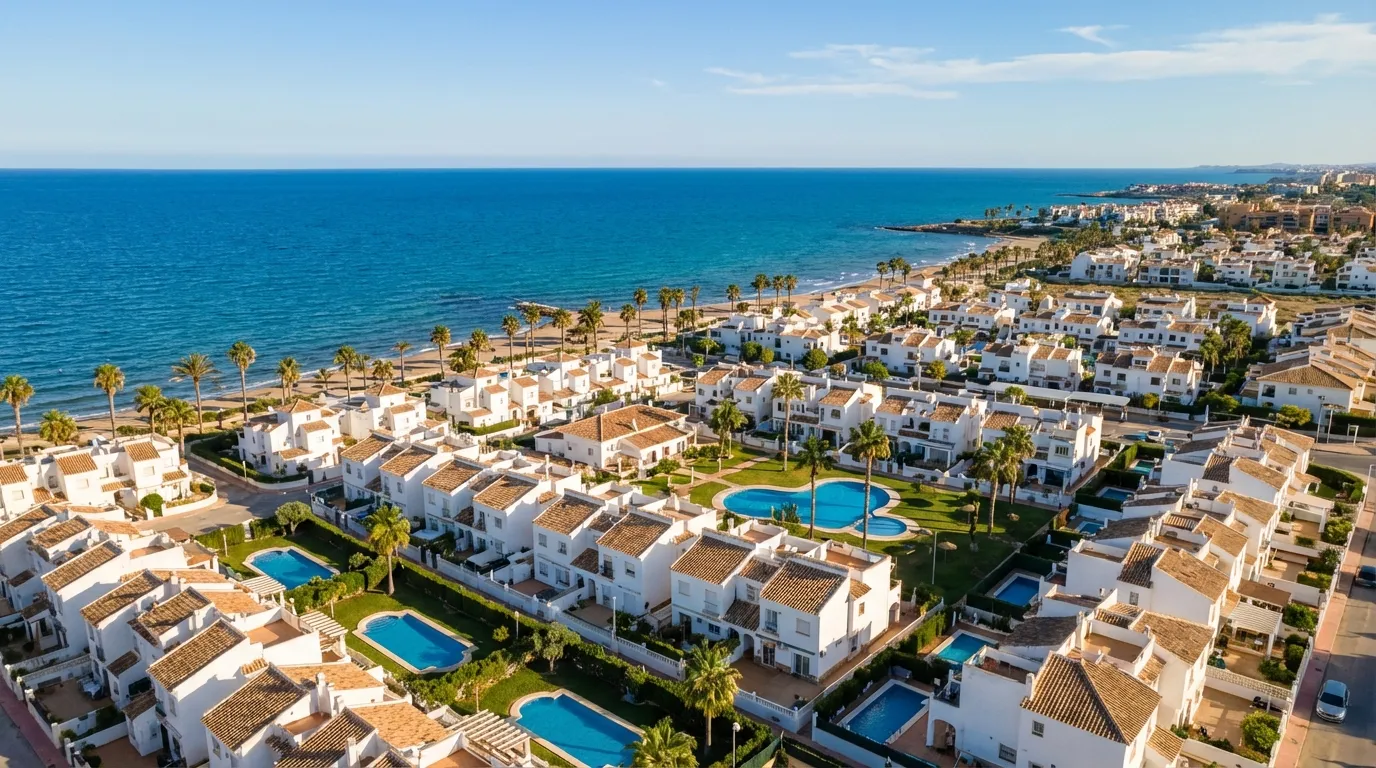
Area Guides
Orihuela Costa – Complete Guide for Swedish Buyers 2026
Everything you need to know about Orihuela Costa on Costa Blanca: areas, property prices, climate, beach life and tips for buying property in southern Spain.
16 min
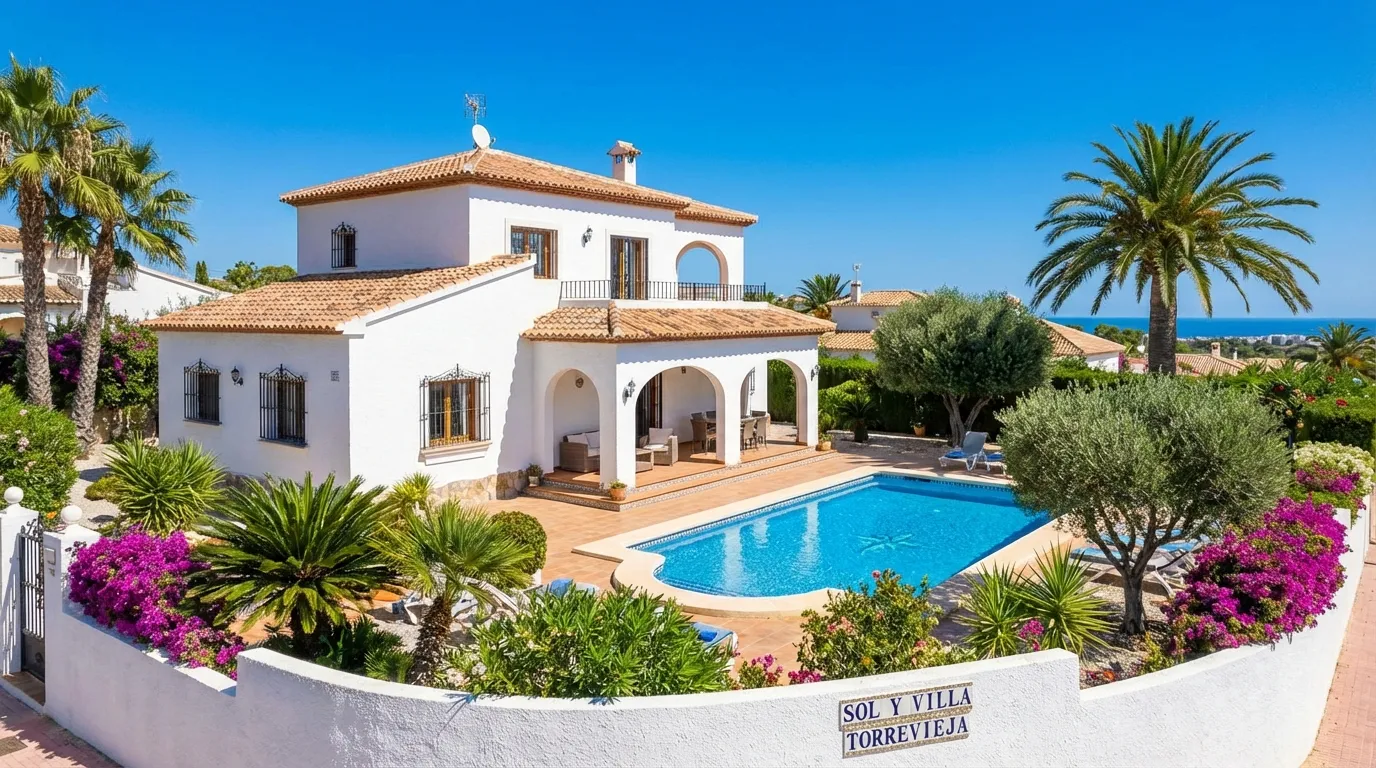
Buying a house in Torrevieja: prices by area, purchase process, taxes, NIE and mortgages — practical guide for Swedes who want to live on Costa Blanca 2026.
Buying a house in Torrevieja is one of the smartest choices for Swedish buyers who want a property by the Mediterranean. The city offers a price level that is still below northern Costa Blanca, a genuinely Spanish community with full infrastructure year-round, and over 300 sunny days per year. The average price per square metre is around €2,700 for apartments and €2,635 for villas, with entry prices from €85,000 for a smaller apartment. The process normally takes four to eight weeks and the total purchase costs on top of the price come to 10–13 percent. In this guide we cover everything — from prices and areas to the step-by-step process, taxes, mortgages and the most common mistakes Swedish buyers make.
Tip
Torrevieja is particularly popular among Scandinavians thanks to the mild climate, low cost of living and an established Swedish community. The WHO has highlighted the climate in the area as beneficial for people with rheumatism and respiratory problems.
Prices in Torrevieja vary considerably depending on area, property type and condition. During 2026 the market has shown stable price development with annual growth of approximately 4.3 percent — a sustainable increase driven by infrastructure investments rather than speculation. Here is an overview of what you can expect to pay in the most popular areas.
Price overview
| Area | Apartment | Villa | Townhouse |
|---|---|---|---|
| Centro (city centre) | €115,000–330,000 | — | — |
| Playa del Cura | €90,000–270,000 | — | — |
| La Mata | €85,000–240,000 | — | €160,000–280,000 |
| Playa de los Locos | €95,000–220,000 | €200,000–400,000 | €170,000–300,000 |
| Los Balcones / Los Altos | €100,000–200,000 | €250,000–500,000+ | €180,000–350,000 |
| Punta Prima | €120,000–300,000 | €300,000–600,000 | €200,000–380,000 |
Centro and Playa del Cura are the neighbourhoods with highest demand thanks to their proximity to the beach, amenities and restaurants. Here apartments dominate, and prices per square metre are around €2,460. If you want a studio, prices start from €55,000.
Torrevieja as a whole has an average price of €2,719 per square metre for apartments — considerably lower than northern Costa Blanca where towns like Jávea and Moraira can be €3,500–5,000 per square metre.
La Mata in northern Torrevieja offers the best ratio of beach quality to price. The beach is over two kilometres long, has Blue Flag certification and is surrounded by natural sand dunes. Despite superior beach quality, prices are 15–20 percent below central Torrevieja. The area attracts buyers who prioritise peace and natural experiences over city buzz — perfect if you plan to live here year-round.
Punta Prima represents Torrevieja's most modern residential area, with resort-style new-build apartments featuring glazed terraces, solariums and infinity pools. Prices per square metre are €2,713 with an annual price increase of 7.6 percent — the strongest in the municipality. The area attracts remote workers, young families and investors.
If you buy for rental you can expect an average rental yield of 6.7 percent in Torrevieja. Studios give the highest yield at 9.5 percent with an average monthly rent of €650. A two-bedroom apartment generates approximately €850 per month with 6.5 percent yield. Compared to most European markets these are competitive figures.
Information
Summer occupancy for short-term rental is 60–75 percent, while winter occupancy stays at 40–50 percent thanks to the established expat community that lives here year-round.
Buying property in Spain differs markedly from the Swedish property market. In Sweden we have strictly regulated estate agents, mandatory surveys and a transparent market with access to historical sale prices. Spain works differently, and it is important to understand the process before you enter it.
The NIE number (Número de Identidad de Extranjero) is your foreign identification number in Spain and absolutely essential to be able to complete a property purchase. Without a NIE you cannot buy property, open a bank account or sign an electricity contract.
You can apply either at the Policía Nacional in Spain, where it can often be completed the same day to within three weeks, or via the Spanish embassy in Stockholm. Bring your passport, completed form EX-15 and a copy of the purchase contract or a certificate from the estate agent showing that you plan to buy.
Note
Apply for NIE well in advance! Processing time varies and can be up to three weeks during high season. Without NIE the entire purchase process stops.
With your NIE in hand you can open a bank account at a Spanish bank — CaixaBank, Sabadell, BBVA and Santander all have branches in Torrevieja with multilingual staff. The process normally takes one working day. You need the account to pay taxes, deposit and running costs such as electricity and water.
Non-residents pay higher account fees than Spanish citizens, and the bank will require documentation about where the money comes from (anti-money-laundering law). Have transfer receipts and bank statements to hand.
Hire a Spanish property lawyer (abogado inmobiliario) who has experience helping foreign buyers. The lawyer checks the land registry, identifies debts and legal obstacles, reviews the contract and represents you at the purchase. The cost is normally €1,200–3,000 or 0.5–1 percent of the purchase price.
A gestor (administrative handler) can be worth hiring to handle the NIE application, utility transfers and municipal registrations. Cost: €300–600.
Tip
In Sweden estate agents are regulated and licensed. In Spain anyone can become a property agent without training or a licence. Always choose an established agency with experience of Nordic buyers.
When you have found your dream property a reservation agreement (reserva) is normally signed with a deposit of €3,000–6,000. The agreement takes the property off the market for one to two weeks while the documents are checked. Note that the deposit is usually non-refundable if you pull out.
Unlike Sweden, there is no mandatory survey in Spain. As a Swedish buyer you should absolutely order an independent technical survey of older properties, especially buildings from before 1980. The cost is €800–2,500 depending on size — an investment that can save you hundreds of thousands of kronor.
Your lawyer requests a Nota Simple from the land registry, which costs approximately €10–15, showing who owns the property, any mortgages, easements and other restrictions. Additionally checked are:
The formal purchase contract (Contrato de Arras) is normally drawn up before a notary or lawyer. Here you pay 10 percent of the purchase price as a deposit. The contract specifies the final price, completion date (usually one to two months ahead) and consequences if either party pulls out:
If you need financing you should have advance approval (pre-approval) from the bank before you sign the contract. More about mortgages for Swedish buyers further down in the article.
On the completion date the buyer, seller and notary meet to sign the public deed of purchase (Escritura Pública). The notary's role in Spain is more extensive than in Sweden — they read out the entire document aloud, verify identities and witness the signatures.
You pay the remaining purchase price by banker's draft and receive the keys. The notary's office sends the documents to the land registry for official registration, which takes one to two months.
After completion there remains:
Properties
Explore available properties in Torrevieja
This is one of the most important points for Swedish buyers to understand. The total purchase costs on top of the price come to 10–13 percent. Here is a complete breakdown:
When buying a resale property you pay 9 percent Impuesto de Transmisiones Patrimoniales (ITP) in the Valencia region since June 2026 (previously 10 percent). The tax is calculated on the higher of the purchase price and the official cadastral value (valor catastral). It is not worth trying to state a lower price in the contract — the tax authority makes its own assessment.
When buying a new build you instead pay 10 percent VAT (IVA) plus 1.4 percent stamp duty (AJD) since June 2026. If the property becomes your permanent home, stamp duty can be reduced to 0.1 percent.
Notary fees are set by law and cannot be negotiated. The exact amount depends on the purchase price and the length of the document.
The property registry charges a fee for registering the change of ownership. The amount depends on the cadastral value.
The cost varies depending on complexity. Some lawyers charge a fixed fee, others charge 0.5–1 percent of the purchase price.
Optional, but recommended for handling the NIE application, utility transfers and administrative paperwork.
Purchase costs — example €150,000
Purchase price
€150,000
ITP (9%)
€13,500
Notary
€750
Land registry
€400
Lawyer
€1,800
Gestor
€400
Total
€166,850
approx. 11.2% on top of purchase price in this example.
That means you need approximately €16,850 (11.2 percent) on top of the purchase price itself. If you also take a mortgage and need a 30–40 percent deposit, you need to have at least €62,000–77,000 in liquid funds for a property at €150,000.
Note
Think about the ongoing costs! In addition to the purchase you pay annual property tax (IBI) of €200–600, non-resident income tax (IRNR) of approximately €800 per year, and community fees of €400–4,000 per year depending on property type and amenities.
Yes, Spanish banks offer mortgages to non-residents, but the terms differ markedly from Swedish mortgages. Here is what you need to know.
As a non-resident you can borrow a maximum of 60–70 percent of the property's value (LTV). That means a deposit of 30–40 percent, considerably more than the 15 percent standard in Sweden. Add 10–13 percent in purchase costs and you need to have at least 40–53 percent of the purchase price in own funds.
Fixed rates for non-residents are currently 2.9–4.9 percent. Variable rates start at around 3.5 percent, based on Euribor — currently around 2.1 percent — plus the bank's margin. The maximum term is 20–25 years, and the loan must be repaid by age 70–75 at the latest.
Spanish banks require extensive documentation from foreign borrowers:
All documents must be translated into Spanish by an authorised translator and sometimes apostilled.
If you earn in Swedish kronor but pay the mortgage in euros you are exposed to currency risk throughout the entire loan period. Over the past five years the SEK/EUR rate has varied enough to create a difference of €1,700+ per year on a monthly payment of €1,200. Consider fixed-rate agreements and specialised currency services offering forward contracts to lock in the exchange rate for up to two years.
Tip
Apply for advance approval from the bank before you start looking for a property. The process takes 1–2 weeks and gives you a clear picture of your purchasing power. Banks like CaixaBank, Sabadell, BBVA and Santander all have branches in Torrevieja with experience of foreign borrowers.
The choice of area depends on what you are looking for. Here is a summary:
For permanent living: La Mata offers fantastic beach quality, a calm atmosphere and an authentic Spanish daily life at more reasonable prices. The nature park with flamingos and walking trails makes it perfect for retirees and families.
For rental investment: Centro and Playa del Cura generate the highest occupancy year-round. Everything is within walking distance of the beach and tourists flock there regardless of season.
For modern standards: Punta Prima has the newest properties with a resort feel, glazed terraces and infinity pools. Prices are higher but the rate of price increase is the strongest.
For space and peace: Los Balcones and Los Altos are situated a little inland by the famous pink salt lakes. Here you find detached villas with pools and panoramic views, perfect if you want your own house with a garden.
Compared to Orihuela Costa: The neighbouring municipality Orihuela Costa offers new builds and golf courses but has 15–20 percent higher living costs and a more tourist-focused character. Torrevieja gives you a genuine Spanish city with full infrastructure year-round.
Not hiring an independent lawyer is the most expensive mistake you can make. Unpaid community fees of €10,000+, illegal extensions at risk of demolition, or disputed ownership — all of this is discovered by a lawyer but easily missed by an inexperienced buyer.
In Sweden estate agents are licensed and regulated. In Spain there are no such requirements. Some agents are extremely competent and reliable, others lack basic knowledge. Always do your own research and let the lawyer review everything.
Many Swedish buyers budget only for the purchase price and are surprised by the 10–13 percent added in taxes and fees. Plan your entire budget including all costs before you start searching.
Extensions, pools and renovations without planning permission are common in Spain. It can lead to fines, demolition orders and problems at future sale. Always let the lawyer verify that everything is legal.
Swedish buyers often expect the same transparency and standards as at home — professional surveys, complete history and regulated processes. Spain works differently. Adjust your expectations, but compensate by hiring the right professional help.
Buying in euros with a Swedish income means a constant currency risk. Plan for exchange rate fluctuations and consider spreading your currency purchases over time or using forward contracts.
Torrevieja differs from pure tourist resorts by being a full-scale Spanish city with 80,000+ inhabitants, a hospital, schools, shops and year-round services. That means your investment does not depend solely on tourism — there is a stable local market.
Compared to Orihuela Costa, Torrevieja has lower prices and living costs but fewer new-build properties. Compared to northern Costa Blanca (Jávea, Moraira, Dénia), Torrevieja is 30–50 percent lower in price but offers a different type of living — more urban character and less village character.
Alicante-Elche airport is approximately 40 minutes away with direct flights from Stockholm, Gothenburg and Malmö, making Torrevieja one of the most accessible destinations in Spain for Swedish buyers.
Typical timeline
NIE application
1 day – 3 weeks
Open bank account
1 working day
Find property and reserve
1–4 weeks
Legal review
1–2 weeks
Contrato de Arras (purchase contract)
1 day
Mortgage process (if applicable)
4–8 weeks
Notary signature and completion
1 day
Property registration
1–2 months
Total time (excl. registration)
4–8 weeks
Approximate range when everything runs smoothly.
Tip
The fastest way to shorten the process is to apply for a NIE and open a bank account before your property search. That way you avoid waiting on bureaucracy when you find your dream home.
Torrevieja suits those who want an affordable property by the Mediterranean in a genuinely Spanish community with full services year-round. With average prices of €2,700 per square metre, stable price growth of 4.3 percent and a rental yield of almost 7 percent, it is hard to find better conditions on Costa Blanca.
The key to a successful purchase is thorough preparation: get your NIE in good time, hire a good lawyer, understand all costs and don't expect the Spanish market to work like the Swedish one. If you do that, you have all the conditions for a safe and successful property purchase in Torrevieja.
Contact
Get in touch and we'll guide you forward — whether you're just starting out or ready to buy.
Contact usDecision support
Priserna varierar beroende pa omrade och fastighetstyp. En lagenhet i centrum kostar fran 85 000 euro, medan en villa med pool i Los Balcones borjar runt 250 000 euro.
Genomsnittspriset per kvadratmeter ar cirka 2 700 euro for lagenheter och 2 635 euro for villor (2026).
Ja, ett NIE-nummer (Numero de Identidad de Extranjero) ar obligatoriskt for alla utlandska kopare i Spanien. Du kan ansoka via spanska polisen i Torrevieja eller genom spanska konsulatet i Stockholm.
Handlaggningstiden ar normalt 1-3 veckor.
Fran det att du hittar ratt bostad till att du har nycklarna tar processen vanligtvis 4-8 veckor. Tidsramen inkluderar juridisk granskning, NIE-ansokan, bankarenden och notarieunderskrift.
Rakna med 10-13 procent i tillkommande kostnader. Det inkluderar overforigsskatt (ITP) pa 9 procent for begagnade bostader (sedan juni 2026), notariearvode (600-900 euro), lagfartsregistrering (cirka 400 euro) och advokatarvode (1 200-3 000 euro).
Ja, spanska banker erbjuder bolan till utlandska kopare. Som icke-resident kan du lana upp till 60-70 procent av fastighetens varde.
Ranta for fast ranta ligger runt 2,9-4,9 procent och loptiden ar maximalt 20-25 ar.
Sources

Los Balcones, Alicante

Lago Jardín II, Alicante

San Luis, Alicante

Centro, Alicante

Centro, Alicante

Centro, Alicante
Local expertise
Everything you need to know about Orihuela Costa on Costa Blanca: areas, property prices, climate, beach life and tips for buying property in southern Spain.
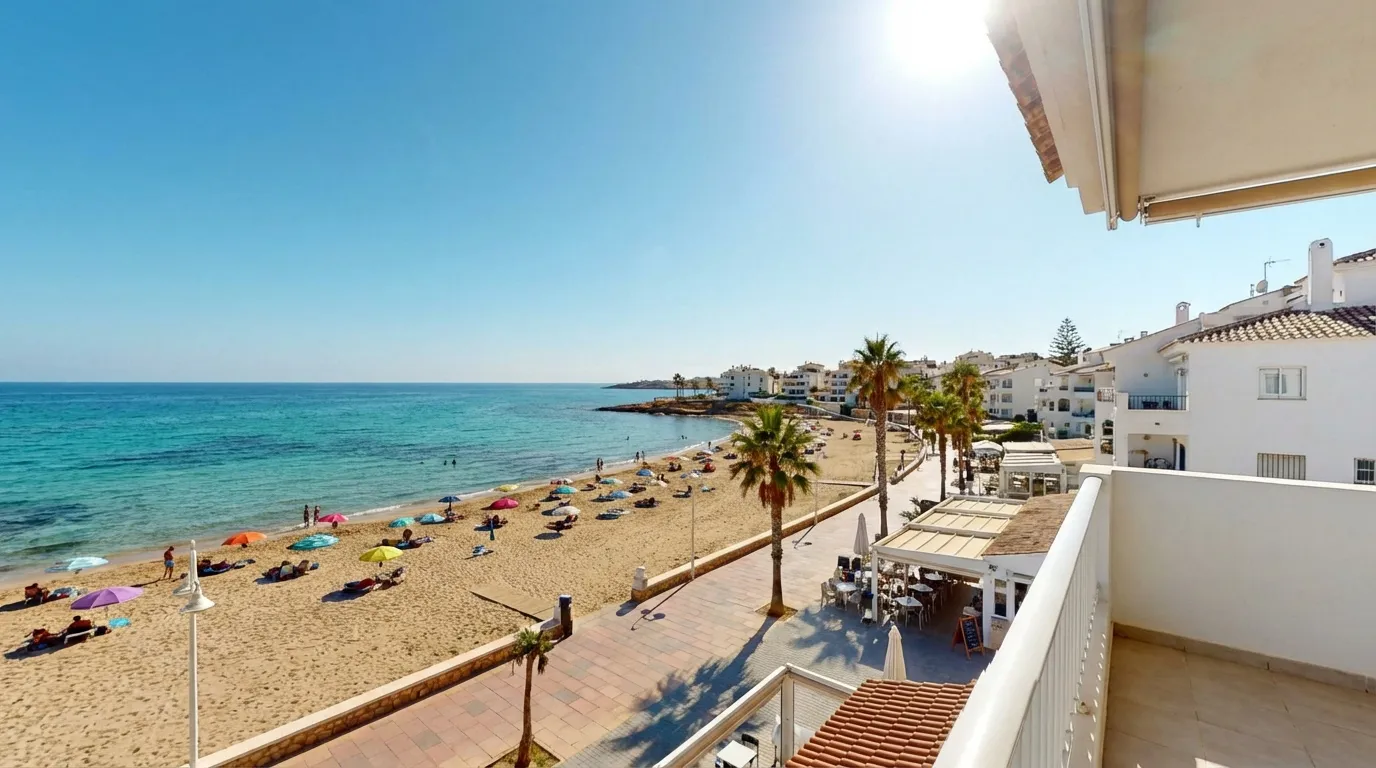
Everything you need to know about Playa Flamenca on Costa Blanca — beaches, property prices, amenities and lifestyle. An honest guide from Swedish estate agents who know the area.
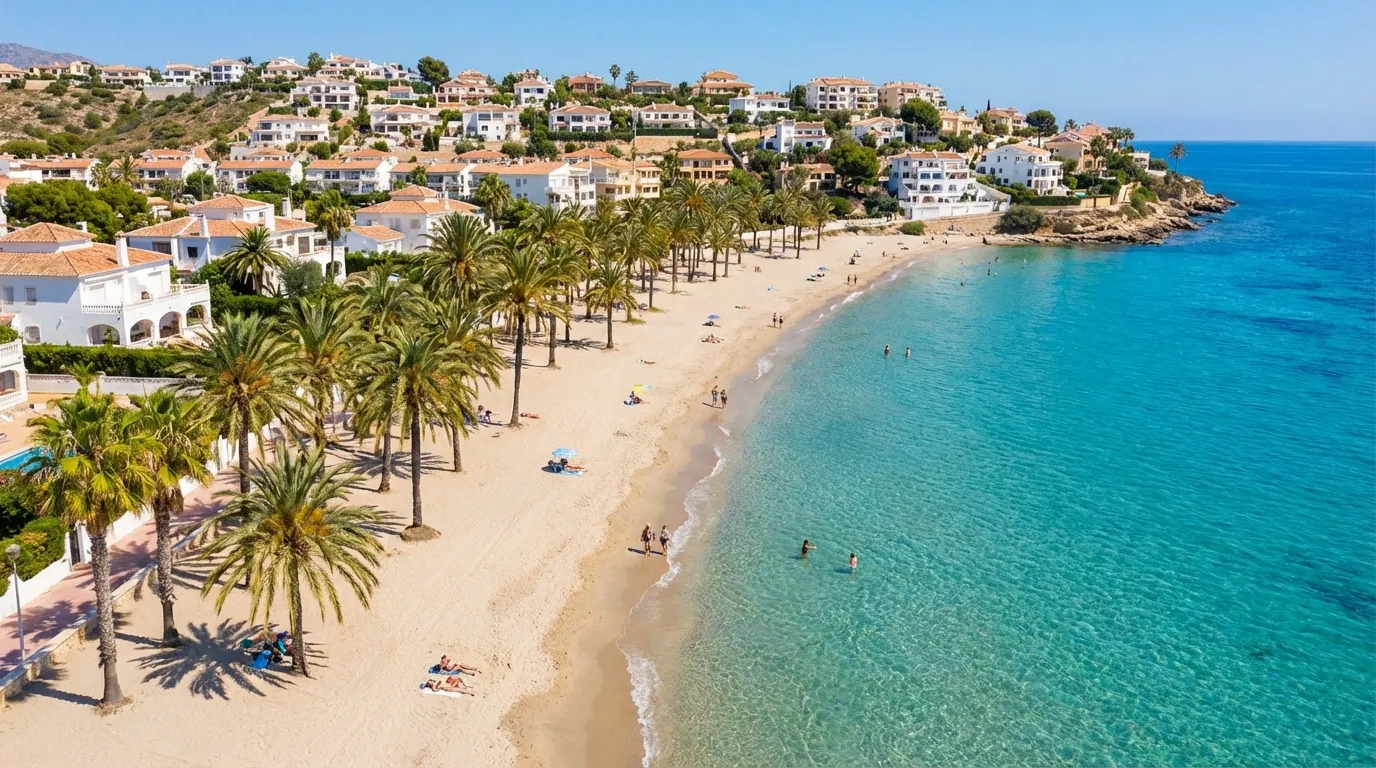
Property in Mil Palmeras: prices, beaches, services and what you should know before buying in this coastal resort on the southern Costa Blanca — for Swedish buyers.