
Buying Guides
Cheap Houses in Spain for Sale 2026 – Where Do You Find the Best Prices?
Cheap houses in Spain from 80,000 €: prices on Costa Blanca, Costa Cálida, Torrevieja and Mazarrón — hidden costs, risks and tips for bargains in 2026.
15 min
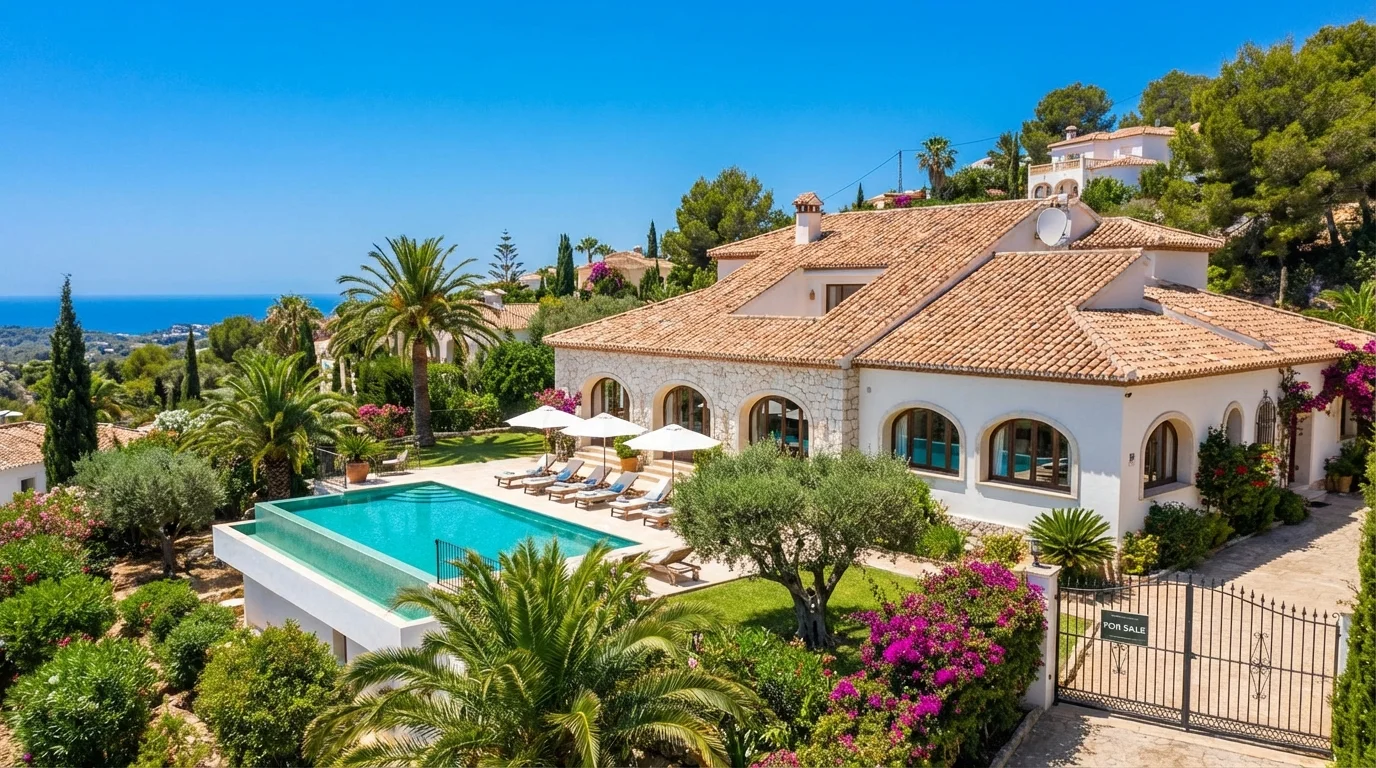
Find your dream villa in Spain: prices by region, types of villas, running costs and what to think about. Complete guide for Swedish buyers.
A detached villa with a private pool on Costa Cálida starts from 250,000 euros. On southern Costa Blanca — in areas such as Orihuela Costa and Ciudad Quesada — villas with three bedrooms, a garden and pool typically cost 350,000–600,000 euros. Costa del Sol is more expensive: the average price for houses reached 3,554 euros per square metre in early 2026, an increase of just over 6% compared to 2025. And on the Balearic Islands — Mallorca and Ibiza — you need to budget at least 800,000 euros for a villa with sea views.
But price is only half the picture. Owning a villa in Spain means a pool that needs maintaining, a garden that needs watering, property tax, insurance and electricity bills that can come as a surprise. This guide gives you an honest overview: what types of villas exist, what they cost in each region, what ongoing expenses to budget for, and what you must check legally before you sign the purchase contract.
Spain offers a wide range of villa types. Which one suits you depends on your budget, lifestyle and how much maintenance you want to take on.
The classic choice for foreign buyers. A detached villa stands on its own plot, has its own garden and almost always a private pool. Living space ranges from a compact 100 m² to a luxurious 400+ m², with plots from 400 m² up to 2,000 m² or more. Most have 3–6 bedrooms, several bathrooms and large terraces. The downside: all maintenance — pool, garden, roof, facade — is your responsibility.
Semi-detached and terraced house variants share one or more walls with neighbours. You get slightly less space and plot, but also a lower price and often access to a communal pool. Prices are typically 20–35% lower than detached villas in the same area. Popular in urbanizaciones along Costa Blanca and Costa Cálida.
Four homes sharing a block corner, common in Orihuela Costa, Ciudad Quesada and the Torrevieja area. They offer a compromise between a villa and an apartment: a private patio, a rooftop solarium and a communal pool. Prices from 170,000 euros.
Traditional rural estates with larger land areas, often with olive groves, fruit trees or agricultural land. Most common in the inland areas of Andalusia, Valencia and Murcia. A finca offers peace and space, but can be isolated and often requires more renovation work. Always check the land classification — on rústico land (rural land), strict restrictions apply for building permits and extensions.
Newly produced villas with energy-efficient systems, modern floor plans, large glazed sections and often solar panels. They are sometimes sold off-plan, which can mean a lower price but means you are buying something that does not yet exist. New builds cost approximately 15% more per square metre than second-hand villas, but you avoid renovation costs and receive construction guarantees.
Information
Good to know: In Spanish terminology the word chalé is often used for villa. A chalé adosado is a terraced house, a chalé pareado is a semi-detached house and a chalé independiente is a detached villa. Understanding these terms allows you to search more effectively on Spanish property portals such as Idealista and Fotocasa.
Prices vary enormously between regions. Here is a comparison of the most popular coastal areas for Swedish villa buyers.
Villa prices by coast (indicative)
~1,273–1,776 €/m²
Typical villa price 250,000–700,000 €. Annual price increase often +10–15%.
~2,300–3,150 €/m²
Typical villa price 300,000–900,000 €. Annual increase often +12–15%.
~2,500–4,500 €/m²
Typical villa price 500,000–1,500,000+ €. Often +10–13% per year.
~3,554 €/m²
Typical villa price 500,000–3,000,000+ €. Often +6–10% per year.
~3,522+ €/m²
Typical villa price 800,000–3,000,000+ €. Often +14–15% per year.
Source: Engel & Völkers 2026, Investropa 2026, Fine & Country Q3 2025, AP Properties Spain 2026
The Murcia region is the most affordable coastal region for villa buyers. The average listed price for detached villas and fincas is around 280,000 euros, with a price per square metre of approximately 1,273 euros. Towns such as Mazarrón, Torre-Pacheco and Fuente Álamo offer modern newly built villas with pools from 220,000–350,000 euros. The downside: infrastructure is less developed than on Costa Blanca and the Scandinavian community is smaller.
Orihuela Costa and the Torrevieja area have the largest Scandinavian presence in Spain. The average price in Orihuela Costa stands at 3,150 euros per square metre with an annual increase of 12–13%. A villa with three bedrooms, pool and garden here typically costs 350,000–600,000 euros. In Ciudad Quesada and Rojales you can often find something slightly cheaper — villas with pools from 250,000 euros.
Jávea, Moraira, Calpe and Altea target a more exclusive market. Prices per square metre range from 2,500–4,500 euros, and a sea-view villa with a pool rarely starts below 500,000 euros. The area attracts buyers seeking tranquillity, natural beauty and golf courses rather than lively expat communities.
Marbella tops the list at 5,485 euros per square metre, with Benahavís close behind at 5,425 euros per square metre. A detached villa with pool in Estepona or Mijas typically costs 600,000–1,500,000 euros. It is no longer a "cheap" market, but it offers strong infrastructure, international schools and a high quality of life.
Properties
Explore available properties in costa-blanca
Browse current homes in the area and compare locations, price levels and property types at your own pace.
If you want the most villa for your money, you should look beyond the most established tourist areas.
Costa Cálida is clearly number one. Mazarrón, Torre-Pacheco and Roldán offer newly built semi-detached villas with a private pool from 180,000 euros and detached villas from 250,000 euros. The region has seen the strongest price increase in Spain — up to 20% on new builds during 2024 — but is still 30–40% below southern Costa Blanca.
Southern Costa Blanca, away from the coast. Towns such as Algorfa, Catral, Daya Nueva and San Fulgencio are 10–15 kilometres from the beach but have considerably lower prices. A villa with a pool that costs 400,000 euros in Orihuela Costa can go for 280,000–320,000 euros here.
Inland Alicante province. If you want a finca with land you will find them in La Romana, Pinoso and the Aspe area from 150,000–300,000 euros. Here you exchange the beach for the mountains — but get enormously more space.
Tip
Tip: Newly built semi-detached villas in the Murcia region often offer the best balance of price, quality and modern amenities. You get a pool, solarium, energy-efficient construction and a construction guarantee — at half the price of a detached villa in the same area.
This is the question many buyers miss. Running costs for a villa are 2–3 times higher than for an apartment. Here is a realistic annual budget based on a detached 3-bedroom villa with pool and garden.
Villa running costs — typical annual range
IBI
1,000–3,000 €
Rubbish collection
200–350 €
Community fee
0–1,500 €
depends on urbanización
Pool
1,200–2,400 €
chemicals + service
Garden
1,000–3,000 €
Electricity & water
1,500–4,000 €
Insurance
500–1,500 €
Maintenance
500–2,000 €
AC, painting, etc.
Total
6,000–18,000 €
example in the guide
Source: Vista Mundo 2025, Valencia Property 2026, Virtoproperty
A private pool costs 800–2,400 euros per year to run. That includes weekly cleaning (60–120 euros/month if you hire help), chemicals (100–300 euros/year) and the pump's electricity cost. Regular servicing of filter and pump systems comes on top. A saltwater pool has lower chemical costs but a higher installation cost.
A gardener costs 80–250 euros per month depending on the plot size. Irrigation during the summer heat can add 500–1,500 euros per year in water costs. The alternative: maintain the garden yourself, but expect it to take considerable hours every week during the summer half of the year.
Spanish electricity prices have risen sharply. A villa with air conditioning in summer, a pool pump and a water heater can easily use 150–300 euros per month during peak season. Solar panels reduce the cost significantly — and also provide a 50% reduction on IBI in many municipalities for five years.
Note
Warning: If you buy a villa as a holiday home and only stay there a couple of months per year, you still need to pay fixed costs throughout the year — IBI, insurance, base fees for electricity and water, community charges and pool maintenance. Budget for at least 3,000–5,000 euros per year even with minimal use. Consider hiring a property management company for 100–250 euros per month that pays bills, carries out inspections and airs the property.
This is one of the most important questions you need to ask yourself. The answer depends entirely on your life situation, budget and how much time you want to spend on maintenance.
Villa — advantages and disadvantages
Apartment — advantages and disadvantages
Rule of thumb: If you are going to live in Spain full-time or half the year, and have a family or pets, a villa is often worth the extra cost. If you are buying a holiday home that you visit for 4–8 weeks per year, an apartment with a communal pool makes more financial sense.
Buying a villa in Spain requires thorough legal scrutiny. The risks are greater than with apartment purchases — villas have more land, more extensions and more history.
Check that the villa has a valid occupancy licence (Licencia de Primera Ocupación or Cédula de Habitabilidad). Without this you cannot legally enter into electricity and water contracts. Newly built villas must have a final construction certificate (Certificado Final de Obra) and an occupancy licence issued by the municipality. For older villas, your lawyer should verify that the document exists or that a new one can be obtained.
This is one of the most common pitfalls when buying a villa in Spain. Many villa owners have built a pool, carport, outdoor kitchen or glazed terrace without a building permit (licencia de obra). An unregistered pool does not exist in the bank's valuation and can lead to fines or demolition orders.
Always check: That the pool is registered in the land registry and the cadastral register. That any extensions appear in the Nota Simple. If unregistered buildings have been in place for over 6–8 years they can in some cases be legalised, but this requires an architect's certificate and the municipality's approval.
Compare the registered plot area in the title deed with what actually exists on the ground. It is not uncommon for plot boundaries on paper to differ from reality. Request an up-to-date cadastral map and compare it with the Nota Simple. If there are discrepancies — find out why before you sign.
Unpaid community fees, property tax (IBI), water and electricity bills can in Spain follow the property, not the owner. Your lawyer should request a debt-free certificate from the community/urbanización and check the payment history for IBI and other charges.
Engage an independent building surveyor (perito) to check the roof, walls, plumbing, electrical system and pool condition. Cost: 300–600 euros for a villa. This is a small investment that can reveal hidden problems worth tens of thousands of euros.
Tip
Tip: Always ask to see the latest minutes (actas) from the urbanización or community association. They can reveal planned fee increases, disputes between neighbours or planned construction projects in the area that could affect your villa.
Many Swedish buyers pay cash, but a mortgage from a Spanish bank is absolutely possible — and sometimes financially smart.
As a Swedish citizen and EU citizen you can apply for a mortgage at major Spanish banks such as Santander, BBVA, CaixaBank (via HolaBank), Sabadell and Bankinter. Terms for non-residents in 2026:
Financing — example 400,000 €
Purchase price
400,000 €
Mortgage (65% LTV)
260,000 €
Own capital (35%)
140,000 €
Purchase costs (~12%)
48,000 €
Total own capital required
188,000 €
In the example with the stated assumptions.
With a fixed interest rate of 3.5% and a 20-year term, the monthly loan payment comes to approximately 1,510 euros. Add running costs of 500–1,200 euros per month and you have a more complete picture.
Tip: Engage a mortgage broker who specialises in foreign buyers. They have relationships with the banks' risk departments and can often negotiate better terms than if you approach the bank directly.
Swedes are among the most active foreign buyer groups in Spain, and interest in villas is concentrated in a few main areas.
Orihuela Costa and Ciudad Quesada — by far the most popular. A large Swedish community, Swedish restaurants, Swedish health centres, golf courses. Villa prices range from 250,000 euros in Ciudad Quesada to 600,000+ euros for frontline golf in Las Ramblas or Villamartín.
The Torrevieja area — primarily apartments, but villas are found on the outskirts towards La Siesta, Los Balcones and San Miguel de Salinas. Price level 200,000–450,000 euros.
Mazarrón and Costa Cálida — a growing alternative for Swedes who want more villa for their money. Newly built villas with pools from 220,000 euros. Smaller Scandinavian community but rapid growth.
Jávea and Moraira (Costa Blanca north) — for those seeking a more exclusive environment with luxury villas, an international atmosphere and dramatic mountain landscapes facing the sea. Villas from 500,000 euros and upwards.
Costa del Sol (Mijas, Estepona, Fuengirola) — popular among Swedish families with children in international schools. Higher prices but a broader range of international services.
Villa ownership in Spain
Here is a simplified overview of buying a villa in Spain:
The whole process normally takes 6–12 weeks from reservation to key handover. With a mortgage it can take 8–14 weeks.
Contact
We help Swedish buyers find the right villa in the right area — with a price overview, legal guidance and personal advice. Tell us what you are looking for and we will get back to you within 24 hours.
Book a free consultationDecision support
Priset varierar enormt beroende på region. På Costa Cálida hittar du villor från 250 000 euro, medan Costa Blanca söder börjar kring 300 000–400 000 euro.
Costa del Sol är dyrare med snittpris runt 3 554 euro per kvadratmeter för hus. En fristående villa med pool och trädgård kostar typiskt 350 000–750 000 euro i de populäraste svenska områdena.
Räkna med 6 000–15 000 euro per år beroende på storlek och läge. Fastighetsskatt (IBI) kostar 1 000–3 000 euro, poolunderhåll 1 200–2 400 euro, trädgårdsskötsel 1 000–3 000 euro, el och vatten 1 500–4 000 euro, och försäkring 500–1 500 euro.
Gemensam urbanización-avgift kan tillkomma med 500–1 500 euro.
Kontrollera alltid Nota Simple (fastighetsutdrag) för skulder och inteckningar, att Licencia de Primera Ocupación eller Cédula de Habitabilidad finns, att pool och tillbyggnader har bygglov, att gränser stämmer med katastralregistret, och att det inte finns obetalda communityavgifter eller fastighetsskatt. Anlita en oberoende spansk jurist — det kostar 1 000–1 500 euro men kan spara dig hundratusentals.
Ja, svenska medborgare kan låna i spanska banker. Som EU-medborgare och icke-resident kan du vanligtvis låna 60–70 % av fastighetens värde med en löptid på 20–25 år.
Räntan för icke-residenter ligger 2026 på cirka 2,5–4 % fast ränta. Du behöver NIE-nummer, inkomstbevis, skattedeklaration och kontoutdrag.
Räkna med att ha 40–50 % av köpeskillingen i eget kapital inklusive köpkostnader.
Det beror på din livsstil och budget. Villor erbjuder privat pool, trädgård och mer utrymme — perfekt för familjer eller den som vill bo permanent.
Men driftskostnaderna är 2–3 gånger högre än för en lägenhet, och du ansvarar själv för allt underhåll. Lägenheter har lägre löpande kostnader, enklare att låsa och lämna, och passar bättre som semesterbostad med kort vistelse.
Hyr en villa en månad innan du köper — det ger en realistisk bild av underhållsarbetet.
Sources
Cheap houses in Spain from 80,000 €: prices on Costa Blanca, Costa Cálida, Torrevieja and Mazarrón — hidden costs, risks and tips for bargains in 2026.
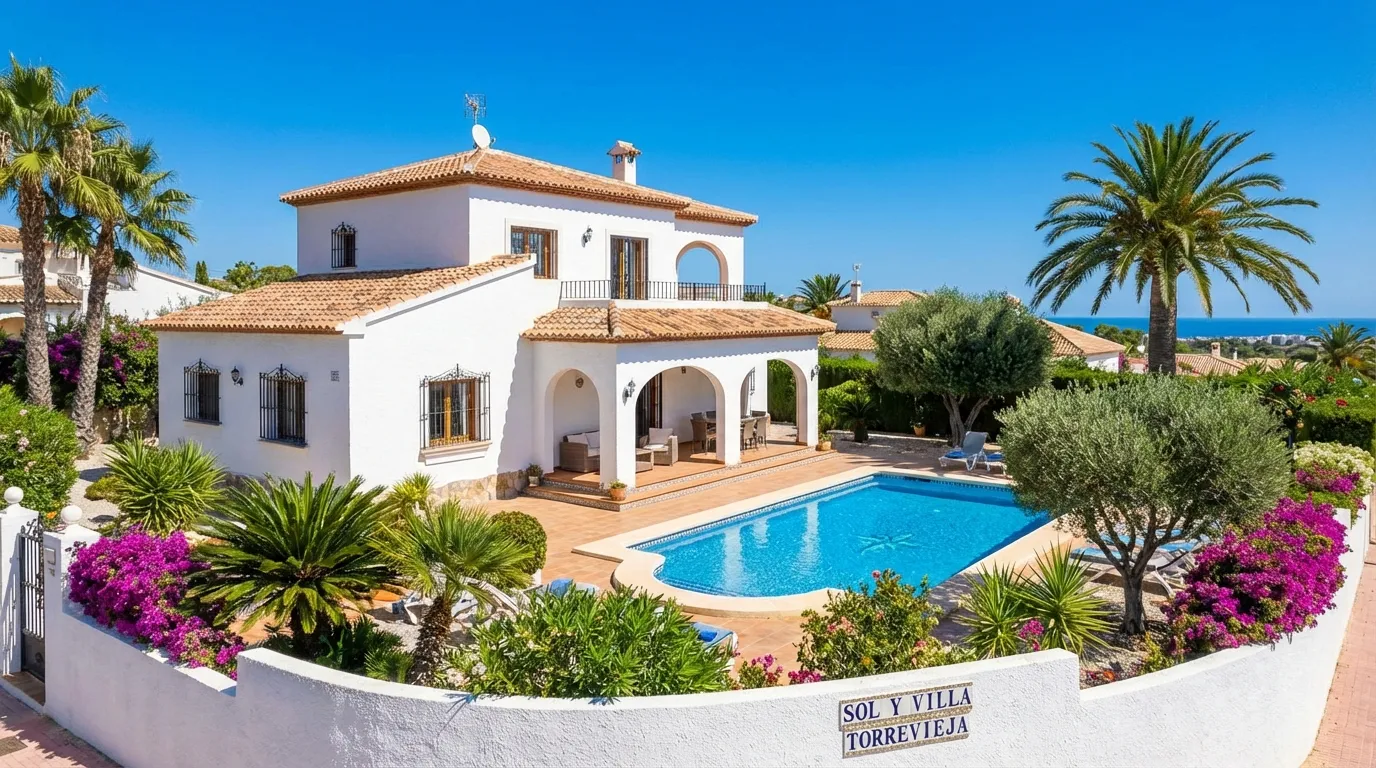
Buying a house in Torrevieja: prices by area, purchase process, taxes, NIE and mortgages — practical guide for Swedes who want to live on Costa Blanca 2026.
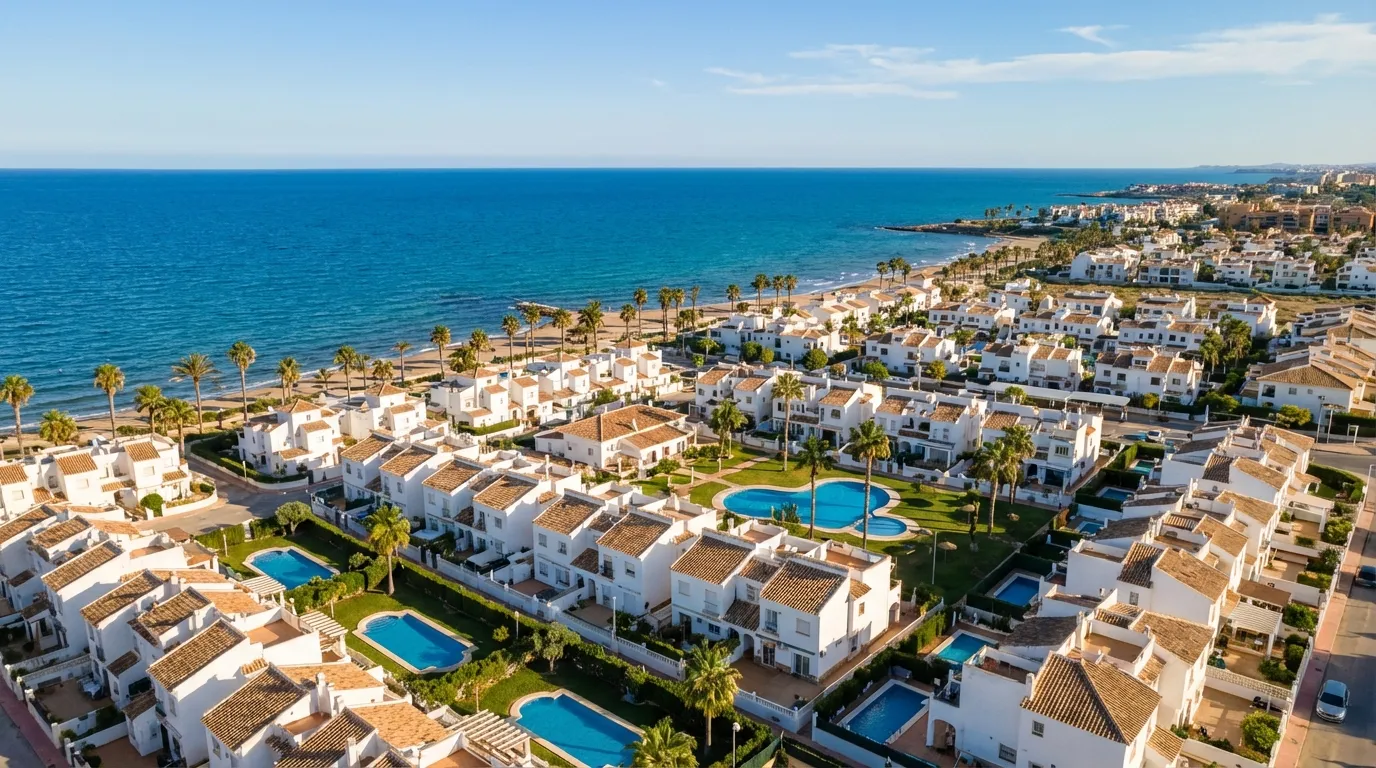
Everything you need to know about Orihuela Costa on Costa Blanca: areas, property prices, climate, beach life and tips for buying property in southern Spain.