

Finance & Law
Tax in Spain – Guide for Swedish Property Owners 2026
Complete tax guide for Swedes with property in Spain: IBI, IRNR, wealth tax, capital gains and the double taxation agreement. Updated 2026.
16 min
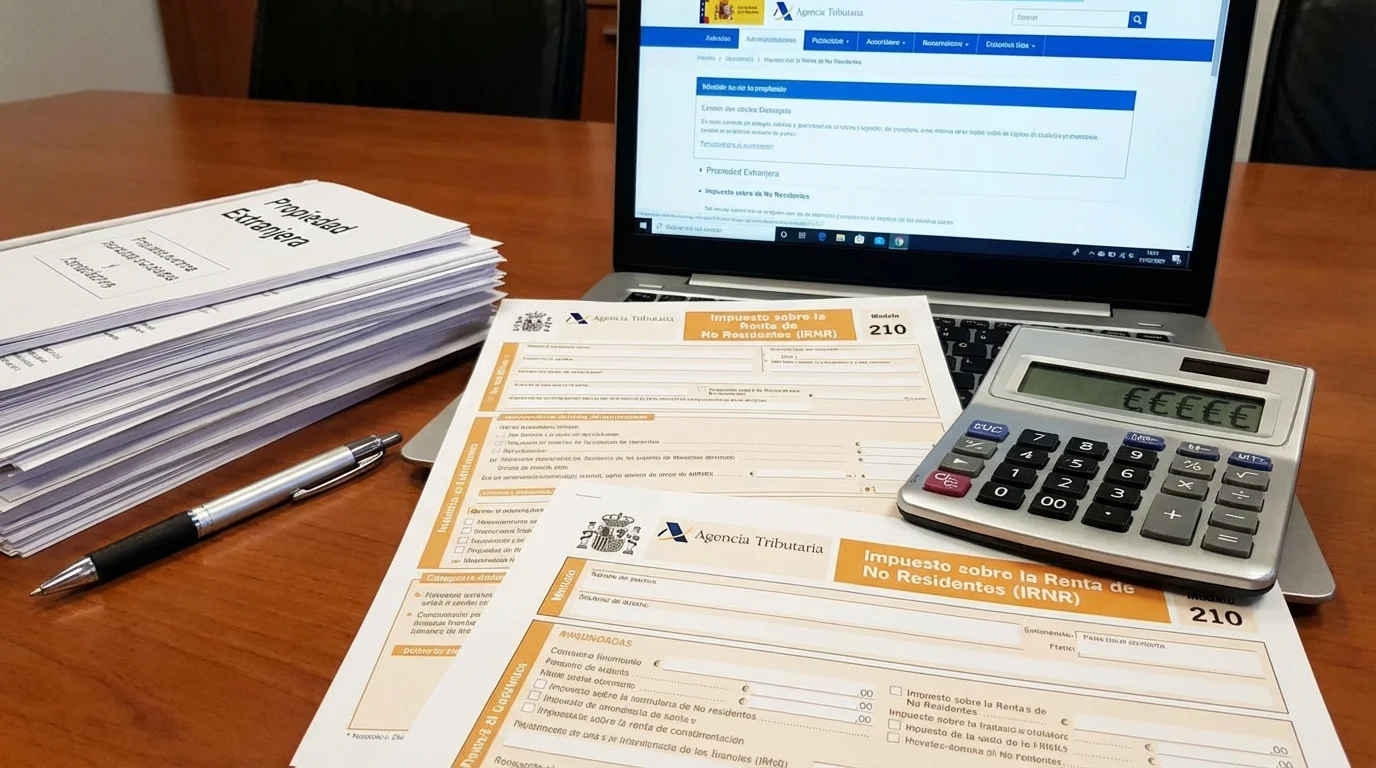
Complete guide to tax for non-residents with a property in Spain: IRNR, Modelo 210, imputed income and how to file your return as a Swede.
Do you own a property in Spain but live in Sweden? Then every year you pay IRNR (Impuesto sobre la Renta de No Residentes) — Spain's income tax for non-residents. The tax is filed via Modelo 210 and applies even if you never let out the property, because Spain calculates a notional income (renta imputada) simply for owning it. For a typical apartment this amounts to 100–400 euros per year.
In addition to IRNR you pay the municipal property tax (IBI), and if your Spanish assets exceed 700,000 euros per person, wealth tax may also apply. There is also a double taxation treaty between Sweden and Spain that prevents you from being taxed twice — but you must file returns in both countries.
This guide explains which taxes apply, how to calculate the amounts, how to complete Modelo 210 step by step and which deadlines you absolutely must not miss.
You are classified as a non-resident (no residente) in Spain if you do not meet any of these criteria:
The vast majority of Swedish property owners on the Costa Blanca and Costa del Sol are non-residents — they own a holiday property but live and work in Sweden. As a non-resident you are taxed in Spain only on your Spanish income and assets, not on your global income.
Tip
Tip: Tax residence is determined per calendar year. If you are thinking of moving permanently to Spain you should plan the timing carefully — crossing the 183-day threshold mid-year can trigger full tax residency in Spain. Consult a tax adviser before making the move.
Here is a summary of all taxes that may become relevant:
Taxes that commonly arise for non-residents
100–400 €/year
All non-resident owners who do not let out — Modelo 210.
19% (EU/EEA, net)
When you let out — same form but different calculation.
200–1,500 €/year
Municipal property tax — all owners.
0.2–3.5%
When net assets in Spain exceed approx 700,000 € — Modelo 714.
1.7–3.5%
Assets above 3 M€ — Modelo 718.
19% (typically)
Non-resident — Modelo 210. See also tax on sale.
In this article we focus on IRNR (the first two rows) and wealth tax — taxes that specifically affect non-residents. Read our guide on IBI and annual property costs for a deep dive into the municipal property tax, and our guide on tax on sale if you are planning to sell.
This surprises many Swedish property owners: Spain taxes you on a notional income simply for owning the property, even if it stands empty all year. This is called renta imputada (imputed income) and is governed by the IRNR tax.
The calculation is done in three steps:
Step 1 — Establish the cadastral value (valor catastral)
You can find the cadastral value on your IBI bill or via the Catastro portal (catastro.meh.es). It is normally 30–50% of market value.
Step 2 — Calculate the notional income
Most municipalities on Costa Blanca have revised their cadastral values relatively recently, so 1.1% is the most common rate.
Step 3 — Apply the tax rate
A Swedish family owns an apartment in Torrevieja with a cadastral value (valor catastral) of 60,000 euros. The value was updated in 2019.
Another example: A villa in Marbella with a cadastral value of 250,000 euros (updated 2016).
Information
Joint ownership: If you own the property jointly with your partner (50/50), each of you files your share separately on your own Modelo 210. In the Torrevieja apartment example above, each owner pays 62.70 euros. Both need their own NIE number.
Modelo 210 for imputed income (non-let property) must be filed by 31 December of the year following the tax year. This means the 2025 tax year is filed by 31 December 2026, and the 2026 tax year by 31 December 2027.
You can file the return as early as 1 January of the following year — so there is a full year to act.
If you let out your Spanish property — whether long-term letting or short-term via Airbnb — the tax rules change significantly.
As a Swede (EU citizen) you pay 19% tax on your net rental income. You can deduct direct costs linked to the letting:
Calculation example: You let out your Costa Blanca apartment during the summer months and receive 8,000 euros in rental income. Your deductible costs amount to 3,200 euros. Tax: (8,000 – 3,200) × 19% = 912 euros.
If you come from a country outside the EU/EEA stricter rules apply. The tax rate is 24% and you may not deduct any costs — the tax is calculated on the full gross rent.
If you only let out for part of the year you pay:
You file them on separate Modelo 210 forms.
Unlike imputed income, rental income must be filed quarterly:
Quarterly deadlines for rental income (Modelo 210)
Q1
20 April
Period January–March.
Q2
20 July
Period April–June.
Q3
20 October
Period July–September.
Q4
20 January (following year)
Period October–December.
If you miss a quarterly deadline, a surcharge is automatically added. If you have rental income we strongly recommend engaging a gestor to handle the returns on an ongoing basis.
Note
NB — Tourist licence required: Since 2024, the Comunidad Valenciana (including all of Costa Blanca) requires you to have a registered tourist licence to legally let out short-term. Letting without a licence can result in fines of 10,000–600,000 euros. Check the rules in your municipality before you start letting.
Properties
Explore available properties in costa-blanca
Browse current homes in the area and compare locations, price levels and property types at your own pace.
Modelo 210 is the form you use to declare and pay IRNR. Here we walk you through how to do it.
You can complete the form in two ways:
Option 1 — Yourself via the Agencia Tributaria website
Option 2 — Via a gestor or asesor fiscal
Most Swedish property owners engage a gestor to handle the entire process. The cost is typically 50–150 euros per return, depending on complexity. The gestor needs:
Spain levies wealth tax on non-residents' Spanish assets that exceed 700,000 euros per person. The tax is filed via Modelo 714.
Most Swedish holiday home owners fall below the threshold — an apartment for 200,000–300,000 euros does not trigger wealth tax. But if you own a more expensive villa, several properties or have large assets in Spanish bank accounts you may exceed the threshold.
The calculation is based on the net value of your Spanish assets (market value minus debts in Spain).
Wealth tax — national rates on net assets above 700,000 €
Up to 167,129 €
0.2%
of taxable net above the threshold
167,129 – 334,253 €
0.3%
334,253 – 668,500 €
0.5%
668,500 – 1,337,000 €
0.9%
1,337,000 – 2,673,999 €
1.3%
2,673,999 – 5,347,998 €
1.7%
5,347,998 – 10,695,996 €
2.1%
Above 10,695,996 €
3.5%
Note: Regional variations may apply. Madrid gives a 100% rebate on wealth tax, while the Valencia region (Costa Blanca) applies the national rates.
Since 2023 there is also a national solidarity tax (Impuesto Temporal de Solidaridad de Grandes Fortunas) that applies to net assets above 3,000,000 euros at rates of 1.7–3.5%. It was introduced to equalise differences between regions such as Madrid (no wealth tax) and other regions. The tax is filed via Modelo 718.
In practice the solidarity tax only affects a small number of Swedish property owners with very high asset values in Spain.
Here we summarise all important dates in one place:
Tax calendar — non-residents (overview)
IRNR imputed income (tax year 2025)
31 Dec 2026
Modelo 210.
IRNR rental income Q1
20 April
Modelo 210.
IRNR rental income Q2
20 July
Modelo 210.
IRNR rental income Q3
20 Oct
Modelo 210.
IRNR rental income Q4
20 Jan (next year)
Modelo 210.
Wealth tax
June–July
Same window as IRPF · Modelo 714.
IBI (Alicante province)
Aug–Oct
Municipal/SUMA.
Capital gain on sale
Within 4 months
From sale · Modelo 210.
Set calendar reminders — especially for the quarterly returns if you let out. If you miss deadlines, surcharges start accruing immediately.
Properties
Explore available properties in costa-del-sol
Browse current homes in the area and compare locations, price levels and property types at your own pace.
A representante fiscal is a tax representative in Spain who acts on your behalf with the Agencia Tributaria. Historically all non-residents were required to appoint one, but the rules have changed.
Since Ley 11/2023, EU/EEA citizens (including Sweden) are no longer obliged to appoint a representante fiscal. The Agencia Tributaria can, however, still require one in specific situations — for example in complex tax matters or if the authority cannot reach you.
Even though it is not a legal requirement, most Swedish property owners engage some form of tax adviser:
The advantage of having a gestor is that you avoid navigating the Agencia Tributaria's Spanish-language website, keeping track of deadlines and risking surcharges. Most gestorías on Costa Blanca have experience with Nordic clients and communicate in English.
Tip
Tip: Ask your gestor to set up domiciliación (direct debit) for the tax payments directly from your Spanish bank account. That way the tax is deducted automatically and you will never risk missing a deadline.
Sweden and Spain have a double taxation treaty that allocates taxing rights and prevents you from paying tax on the same income in both countries.
In practice the treaty means you never pay more in total tax than the country with the higher tax rate. But you must actively claim the offset in your Swedish tax return — it does not happen automatically.
As an unlimited taxpayer in Sweden you declare your global income to the Swedish Tax Agency (Skatteverket). This means rental income from Spain must be included in your Swedish return, but you claim offset for the IRNR paid in Spain. The imputed income from Modelo 210 does not normally need to be declared in Sweden — the notional income calculation is a Spanish domestic rule with no equivalent in Swedish tax law.
1. "I don't let it out — so I pay no tax"
Wrong. Even if your property stands empty Spain calculates a notional income that you must declare. Many Swedes have spent years not filing Modelo 210 — and then received back-claims with surcharges.
2. Forgetting to file quarterly when letting
If you let out the property you must file every quarter — not once a year. Miss a quarter and you risk a 5–20% surcharge.
3. Using the wrong percentage for the cadastral value
Check whether your municipality's cadastral values have been updated in the last 10 years. Many people use 2% when it should actually be 1.1% — and pay almost twice as much.
4. Not filing for both owners
If you own the property 50/50 with your partner, each of you must file your own Modelo 210. Otherwise one of you may receive a demand for the full amount.
5. Not keeping receipts when letting
As an EU citizen you can deduct costs against rental income — but only if you can document them with receipts. Keep everything: repair invoices, community fee statements, IBI notices, insurance premiums.
6. Ignoring the wealth tax
If you have bought a more expensive property or several properties in Spain you should check whether you exceed the 700,000-euro threshold. Many people think only of IRNR and forget that wealth tax may also apply.
7. Assuming Spain does not know you own a property
All property purchases are registered in the Registro de la Propiedad and Catastro. The Agencia Tributaria has full visibility of who owns what. Not filing a return is not a strategy — it is only a matter of time before you receive a demand.
Contact
We connect you with experienced tax advisers on Costa Blanca and Costa del Sol who have extensive experience with Nordic property owners. Book a free call and we will help you get started.
Book free consultationLast updated: April 2026. Tax rates and rules may change — always check current figures with the Agencia Tributaria or a qualified asesor fiscal. This guide does not constitute tax advice and is intended as general information.
Decision support
En icke-resident fastighetsägare som inte hyr ut betalar IRNR (imputerad inkomst) via Modelo 210. Skatten beräknas som taxeringsvärdet (valor catastral) × 1,1 % (eller 2 % om värdet inte uppdaterats senaste 10 åren) × 19 % skattesats (EU/EES-medborgare).
I praktiken hamnar beloppet på 100–400 euro per år för en typisk lägenhet. Utöver det betalar du IBI (fastighetsskatt) och eventuell förmögenhetsskatt om dina spanska tillgångar överstiger 700 000 euro.
Modelo 210 är den spanska skattedeklarationen för icke-residenter (IRNR). Om du inte hyr ut lämnar du in den årligen — senast 31 december året efter inkomståret (dvs. 31 december 2027 för inkomstår 2026).
Om du hyr ut ska du deklarera kvartalsvis: Q1 senast 20 april, Q2 senast 20 juli, Q3 senast 20 oktober och Q4 senast 20 januari. Du kan fylla i blanketten på Agencia Tributarias webbplats eller via en gestor/asesor fiscal.
Medborgare i EU/EES-länder (inklusive Sverige) är sedan 2023 inte längre skyldiga att utse en representante fiscal i Spanien. Däremot kan Agencia Tributaria fortfarande kräva det i vissa situationer, exempelvis vid komplexa skatteärenden.
I praktiken anlitar de flesta svenska fastighetsägare en gestor eller asesor fiscal som sköter deklarationer och kontakten med skattemyndigheten — det kostar vanligtvis 150–400 euro per år.
Nej. Sverige och Spanien har ett dubbelbeskattningsavtal som förhindrar att du beskattas dubbelt.
Fastighetsrelaterade inkomster (hyra, kapitalvinst) beskattas primärt i Spanien, men du deklarerar även i Sverige och får avräkning för spansk skatt. Det innebär att du i praktiken aldrig betalar mer skatt totalt än det land som har högst skattesats.
Rådgör med en skatterådgivare för att säkerställa rätt avräkning.
Ja. Om du missar att deklarera och betala IRNR kan Agencia Tributaria utfärda krav (requerimiento) och i förlängningen kvarstad (embargo) på ditt spanska bankkonto och fastighet.
Förseningsavgifter börjar på 5 % och kan stiga till 20 % plus dröjsmålsränta. Skulder preskriberas efter fyra år — men preskriptionen avbryts om myndigheten skickar ett krav.
Det säkraste sättet att undvika problem är att sätta upp deklarationen via en gestor med autogiro.
Sources
Complete tax guide for Swedes with property in Spain: IBI, IRNR, wealth tax, capital gains and the double taxation agreement. Updated 2026.
Everything about IBI and annual costs for property owners in Spain: how the tax is calculated, what you pay per municipality, and how to avoid late payment penalties.

Everything about tax when selling property in Spain: capital gains tax, plusvalía municipal, 3% retention and how to file in both Spain and Sweden.