


Finance & Law
Tax in Spain – Guide for Swedish Property Owners 2026
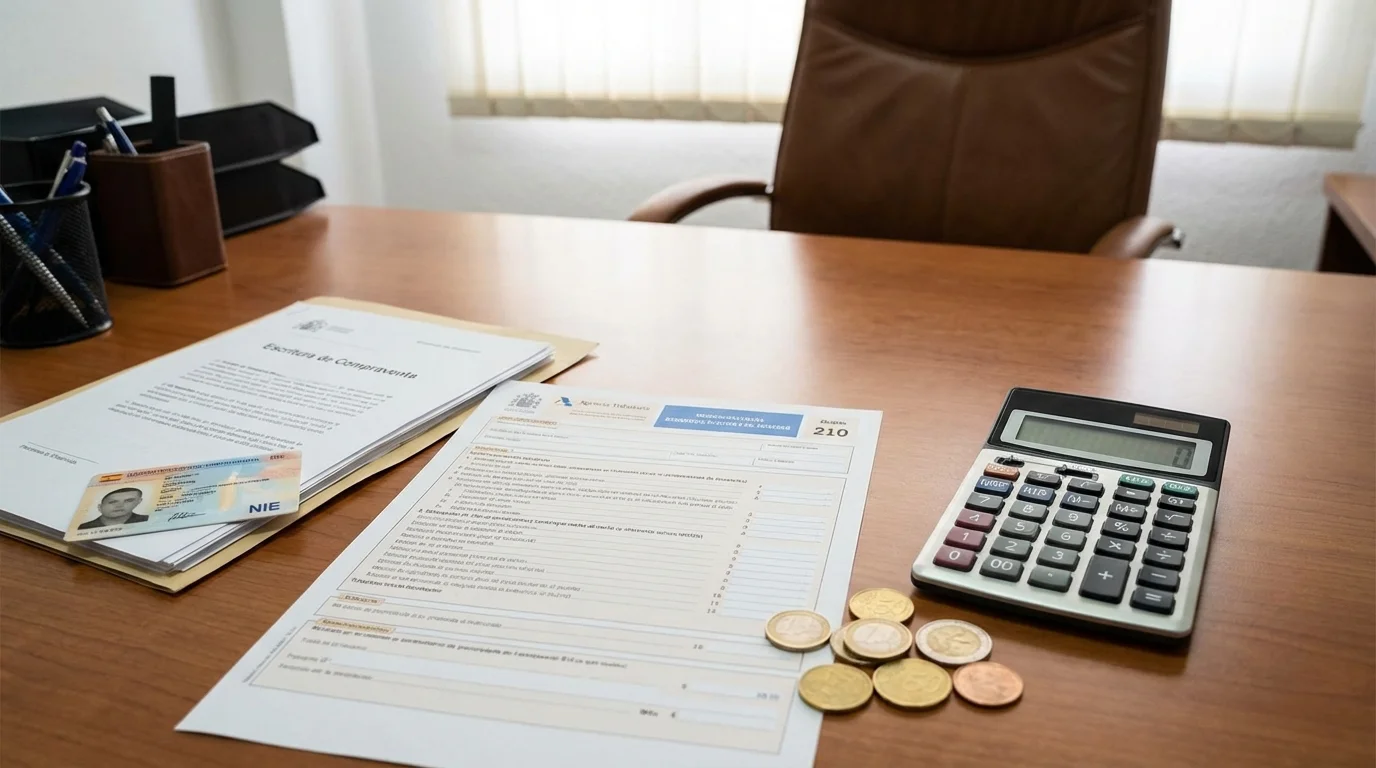
Complete tax guide for Swedes with property in Spain: IBI, IRNR, wealth tax, capital gains and the double taxation agreement. Updated 2026.
16 min
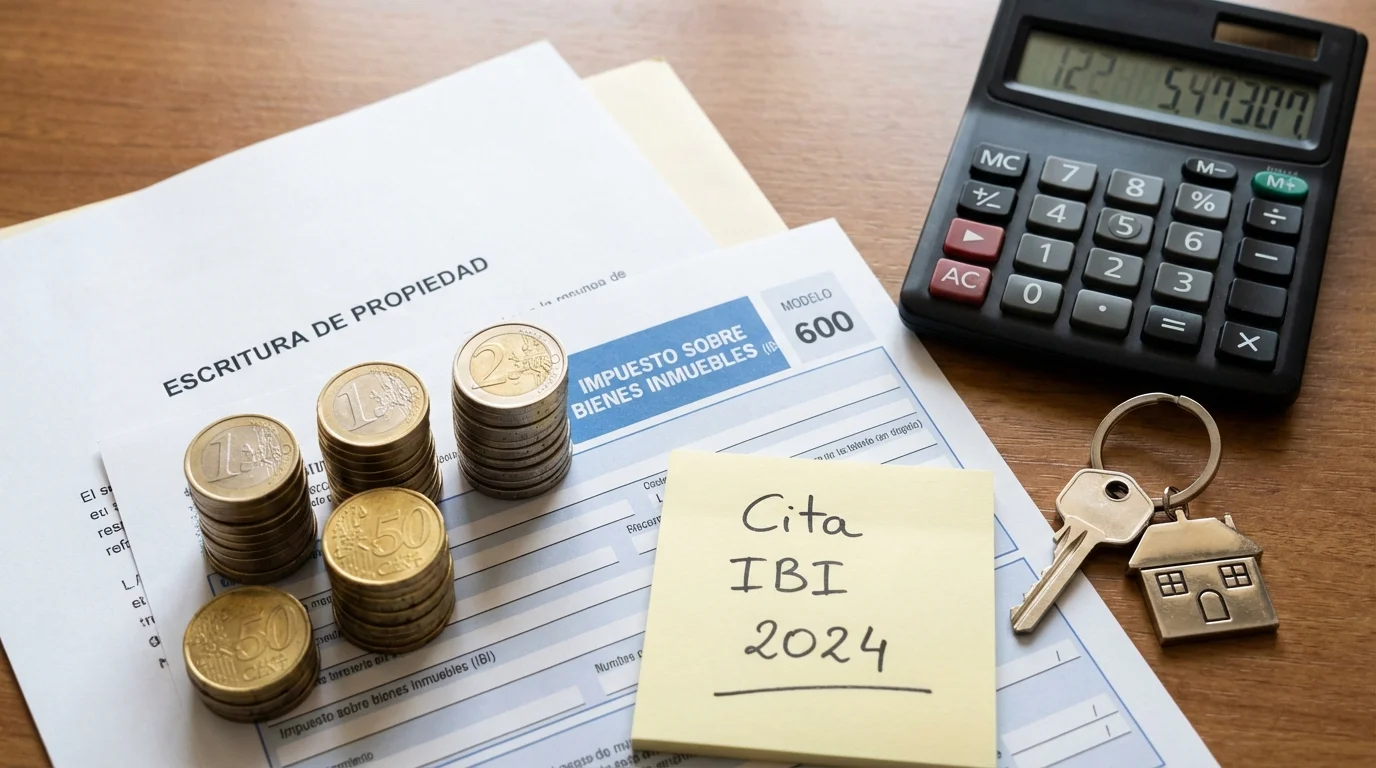
Everything about IBI and annual costs for property owners in Spain: how the tax is calculated, what you pay per municipality, and how to avoid late payment penalties.
If you own property in Spain you pay IBI (Impuesto sobre Bienes Inmuebles) every year — the Spanish property tax. The amount is typically 200–1,500 euros per year depending on the municipality and property type. The tax is calculated by multiplying the municipality's tax rate (0.4–1.1%) by your rateable value (valor catastral), which normally corresponds to 30–50% of the market value.
In addition to IBI there is a waste collection charge (tasa de basuras), community fees, home insurance, and — if you are not a tax resident in Spain — non-resident tax (IRNR). In total you should budget for 2,000–6,000 euros per year in running costs for a typical apartment on the Costa Blanca, depending on the urbanisation and level of services.
This guide goes through exactly how IBI is calculated, what you pay in different municipalities, how to set up direct debit — and what happens if you miss a payment.
IBI (Impuesto sobre Bienes Inmuebles) is Spain's municipal property tax — the closest equivalent to the Swedish property tax. Everyone who owns property in Spain pays it, regardless of nationality, country of residence, or whether the property stands empty.
The legally liable taxpayer is the person who owns the property on 1 January each year. If you sell in March you still pay the full year's IBI — it is not uncommon for buyers and sellers to split the cost in practice, but legally it is the seller's responsibility.
There are two types of IBI:
The vast majority of Swedish property owners in Spain pay IBI Urbana.
The formula is simple:
IBI = Valor catastral × municipality's tax rate
But both variables require some explanation.
The valor catastral is the official rateable value set by Spain's cadastral authority (Catastro). The value is based on objective criteria such as land area, building area, location, age, construction quality, and local infrastructure.
The key thing to understand: the rateable value is normally considerably lower than the market value. An apartment that sells for 180,000 euros may have a rateable value of 50,000–80,000 euros. The difference arises because Catastro revises values at long intervals — typically every 8–10 years — and they rarely keep pace with the market.
Since 2022 there is also a valor de referencia (reference value) that is closer to the market price and is used for purchase taxes, but this is not the same as the valor catastral and does not affect your IBI.
Tip
Tip: Your rateable value (valor catastral) appears on your IBI receipt (recibo de IBI). You need that figure when you file your IRNR declaration (Modelo 210). If you have lost the receipt you can look up the value on the Catastro portal (catastro.meh.es) using your NIE number.
Each municipality determines its own IBI rate within the range permitted by law (0.4–1.1% for urban properties). The rate is set by the town council (Pleno del Ayuntamiento) and can change annually, although most municipalities maintain relatively stable rates.
The differences between municipalities can be large — Torrevieja is at 0.40% while Dénia charges 1.05%. This means identical rateable values can produce two and a half times as much tax depending on where you buy.
Here is an overview of IBI rates and typical amounts in popular municipalities among Swedish property buyers:
IBI per municipality (indicative amounts)
Torrevieja
0.40% (urban)
Typical apartment 150–400 €/year · villa 300–800 €/year.
Orihuela (incl. Orihuela Costa)
0.58%
Typical apartment 300–650 € · villa 500–1,200 €.
Alicante city
0.68%
Typical apartment 400–900 € · villa 700–1,500 €.
Dénia
1.05%
Typical apartment 550–1,100 € · villa 900–2,000 €.
Marbella
0.72%
Typical apartment 450–1,000 € · villa 800–2,500 €.
Fuengirola
0.49%
Typical apartment 250–550 € · villa 500–1,100 €.
Mijas
0.48%
Typical apartment 250–500 € · villa 450–1,000 €.
Benidorm
0.67%
Typical apartment 350–750 € · villa 600–1,400 €.
Source: Respective Ayuntamiento, SUMA, and Catastro, 2025. Amounts vary greatly depending on the rateable value, which in turn depends on size, location, and when the last revision was carried out.
Note that Torrevieja consistently has one of the lowest IBI rates on the entire Costa Blanca — 0.40%, which is the minimum rate under Spanish law. This is one of the reasons the municipality is so popular among foreign buyers wishing to keep running costs low.
Properties
Explore available properties in torrevieja
IBI is paid once a year. There is no national deadline — each municipality sets its own voluntary payment period. In the Alicante province (where Torrevieja, Orihuela Costa, and Benidorm are located), collection is handled by SUMA, which sends out notices and manages payments for all municipalities in the province.
Typical payment periods:
When IBI falls due (approximately)
Torrevieja (via SUMA)
August–October
Orihuela (via SUMA)
August–October
Alicante city (via SUMA)
August–October
Marbella
June–August
Fuengirola
May–July
You do not receive a letter at your Swedish address — SUMA publishes the payment period on suma.es and may send notifications to your Spanish bank.
There are several ways to pay your IBI:
1. Domiciliación bancaria (direct debit) — By far the simplest method, especially if you live outside Spain. You authorise SUMA (in the Alicante province) or your local Ayuntamiento to automatically deduct the amount from your Spanish bank account. Registration is done online via suma.es or at a SUMA office with your NIE number and Spanish bank details. Some municipalities also offer a 5% discount for direct debit.
2. Online payment — Via suma.es (Alicante province) or the municipality's website by card or bank transfer.
3. Bank branch — Pay with your IBI notice (recibo) at CaixaBank, Sabadell, or other major Spanish banks.
4. At the municipal office — Visit the Ayuntamiento or SUMA office in person.
Note
Important for those living abroad: If you do not set up direct debit you risk missing the payment — SUMA does not send reminders abroad. With direct debit (domiciliación) you do not need to track deadlines and avoid late payment penalties. Set it up as soon as you buy your property.
In addition to IBI, all property owners pay a separate waste collection charge — tasa de basuras or tasa de residuos. Since 2025 Spain has introduced a mandatory waste tax in all municipalities with more than 5,000 inhabitants, in line with the EU's waste directive.
The charge varies greatly between municipalities and depends on the calculation method (property type, size, water consumption, or flat rate). Typical costs:
Waste collection charge (tasa de basuras) — approximate annual amounts
Torrevieja
60–120 €
per year
Orihuela
80–150 €
Alicante city
100–200 €
Marbella
150–300 €
Madrid
120–200 €
Source: Respective Ayuntamiento, 2025. Amounts may be adjusted annually.
In some municipalities the waste charge is included on the same notice as IBI — in others it is billed separately. Check with your municipality.
IBI and the waste charge are only part of the running costs that property owners in Spain pay each year. Here is a complete overview:
If you own an apartment or townhouse in an urbanisation you pay monthly to the homeowners' association (comunidad de propietarios). The fee covers shared areas: pool, garden, lift, stairwell lighting, concierge, and any shared insurance.
Typical amounts: 50–250 euros per month depending on the size of the urbanisation and level of services. A simple urbanisation without a pool may cost 40–60 euros per month; a luxury complex with multiple pools, a gym, and a caretaker can reach 200–300 euros.
The community fee is determined annually by the homeowners' association members at a meeting (junta de propietarios). As an owner you have voting rights — even if you live in Sweden. You can give a proxy to a neighbour or representative if you cannot attend.
If you do not live in Spain (are not a tax resident) you pay IRNR (Impuesto sobre la Renta de No Residentes) via Modelo 210. This applies even if you do not rent out the property — Spain then calculates a notional income (renta imputada) based on your rateable value.
Deadline: 31 December of the year after the income year (for non-rented property). Read more in our complete tax guide.
Home insurance is not a legal requirement in Spain (unless you have a mortgage), but it is strongly recommended. A typical home insurance policy for an apartment on the Costa del Sol or Costa Blanca costs 200–500 euros per year depending on size, value, and coverage.
If you have a mortgage, the bank requires you to have home insurance covering at least the building's reconstruction cost.
Annual costs — typical ranges
IBI
200–1,500 €
property tax per year
Waste charge
60–300 €
basura
Community
600–3,000 €
approx. 50–250 €/month
IRNR
100–1,500 €
non-resident
Home insurance
200–500 €
Total apartment
1,500–4,500 €
typical range
Total villa
2,500–7,000 €
typical range
Excluding electricity, water, and gas (80–200 euros per month at normal usage).
Properties
Explore available properties in costa-del-sol
Browse current homes in the area and compare locations, price levels and property types at your own pace.
If you miss the payment deadline a system of escalating surcharges and consequences begins:
Phase 1 — Immediately after the due date: The municipality adds a 5% recargo (surcharge) to the unpaid amount. An IBI bill of 500 euros therefore becomes 525 euros.
Phase 2 — Enforcement decision (3–6 months): When the municipality issues a formal enforcement decision (providencia de apremio) the surcharge rises to 10%, plus late payment interest. Your 500 euros has now become at least 550 euros plus interest.
Phase 3 — Full enforcement: The surcharge rises to 20% plus accumulated late payment interest. An original debt of 500 euros can easily become 700–800 euros or more.
Phase 4 — Seizure: The municipality can place an attachment (embargo) on your property and your Spanish bank account. This means you cannot sell, mortgage, or transfer the property until the debt is settled. Some property owners living abroad only discover their debts when their bank account is suddenly frozen.
The statute of limitations for tax debts in Spain is four years — meaning the municipality can go back four years and claim unpaid taxes with all surcharges.
Note
Important when buying: Your lawyer should always verify that the seller has paid all IBI for the last four years before you sign. Unpaid tax debts can follow the property — not the owner — and become your problem as the new owner.
Yes. Spain has several bonificaciones (discounts) on IBI that can provide significant savings. The discounts vary between municipalities, but the most common are:
Newly built properties can receive up to 50% reduction on IBI for the first years (usually 3–5 years). The discount is applied for with the local Ayuntamiento and applies from the date the property is registered in Catastro.
Families with three or more children can apply for a 30–90% discount on IBI, depending on the municipality and family size category. In Torrevieja a discount is offered for families with a titulo de familia numerosa issued by Spanish authorities.
Installing solar panels or other renewable energy can earn you up to 50% reduction on IBI for a limited period (usually 3–5 years). Some municipalities on the Costa Blanca have introduced this discount to encourage energy efficiency.
Properties with a high energy certificate (A or B) can receive reduced IBI in some municipalities. This discount is relatively new and is not available in all municipalities.
Discounts must be actively applied for — they are not granted automatically. Contact your local Ayuntamiento or a gestor to find out which bonificaciones you can apply for.
If you want to know exactly how much IBI you pay — or will pay — there are several ways:
Your most recent IBI receipt (recibo de IBI): Shows rateable value, tax rate, and final amount. Often stored digitally by your bank if you have direct debit.
SUMA portal (suma.es): In the Alicante province you can log in with your NIE number and see all current and historical tax notices.
Catastro portal (catastro.meh.es): Here you can look up your rateable value using the reference number or NIE.
Your local Ayuntamiento: Visit the tax office (oficina de recaudación) with your NIE and ask for a printout of your most recent IBI notices.
Your gestor or asesor fiscal: A tax adviser can check all your tax obligations — including whether there are outstanding IBI claims from previous owners.
Contact
We help you calculate the total running costs for properties in Spain — IBI, community fees, insurance, and taxes. Book a free call with us.
Book free consultationLast updated: April 2026. Tax rates and amounts may change annually — always verify current figures with your local Ayuntamiento or a qualified asesor fiscal. This guide does not constitute tax advice.
Decision support
IBI kostar vanligtvis 200–1 500 euro per år beroende på kommun och fastighetstyp. Skatten beräknas som taxeringsvärdet (valor catastral) multiplicerat med kommunens skattesats (0,4–1,1 % för stadsfastigheter).
En lägenhet i Torrevieja med taxeringsvärde 50 000 euro och skattesats 0,40 % betalar cirka 200 euro per år, medan samma taxeringsvärde i Dénia med 1,05 % ger 525 euro.
Ja. De flesta kommuner erbjuder domiciliación bancaria.
Du ger kommunen eller skattekontoret (SUMA i Alicante-provinsen) tillstånd att dra beloppet automatiskt från ditt spanska bankkonto. Det är det säkraste sättet att undvika förseningsavgifter, särskilt om du inte bor i Spanien permanent.
Anmälan görs online via suma.es eller på ett SUMA-kontor med ditt NIE-nummer och bankuppgifter.
Ja. IBI är en kommunal skatt som betalas av den som äger fastigheten den 1 januari varje år, oavsett om du bor i Spanien, är icke-resident eller aldrig besöker bostaden.
Utöver IBI måste icke-residenta ägare även deklarera IRNR (icke-resident-skatt) via Modelo 210. Även om fastigheten står tom beräknar Spanien en fiktiv inkomst baserad på taxeringsvärdet.
Missar du betalningsfristen läggs ett påslag (recargo) på 5 % omedelbart. Efter att kommunen skickat ett indrivningsbeslut höjs påslaget till 10 %, och i slutfasen till 20 % plus dröjsmålsränta.
Kommunen kan i värsta fall lägga kvarstad (embargo) på fastigheten och ditt bankkonto. Obetalda skulder registreras på fastigheten och måste regleras innan du kan sälja.
Ja, flera kommuner erbjuder bonificaciones (rabatter) på IBI. Vanliga rabatter inkluderar 50 % reducering för nybyggnationer under de första åren, 30–90 % rabatt för stora familjer (familia numerosa), och upp till 50 % avdrag om du installerar solpaneler eller annan förnybar energi.
Rabatterna varierar mellan kommuner. Kontrollera med ditt lokala Ayuntamiento vilka som gäller där du äger fastighet.
Sources
Complete tax guide for Swedes with property in Spain: IBI, IRNR, wealth tax, capital gains and the double taxation agreement. Updated 2026.
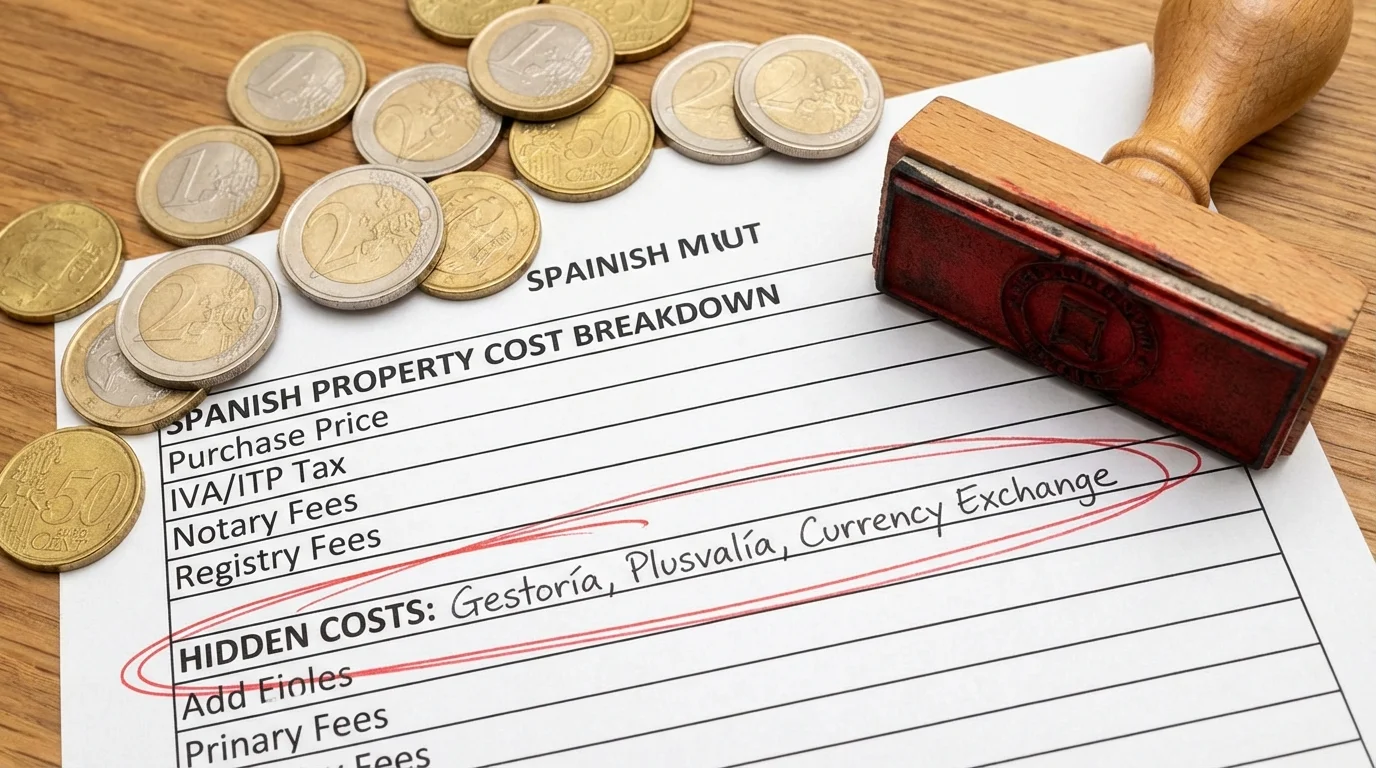
Buying property in Spain costs 10–14% on top of the price: ITP, notary, land registry, lawyer and more. Calculation examples and a region comparison.
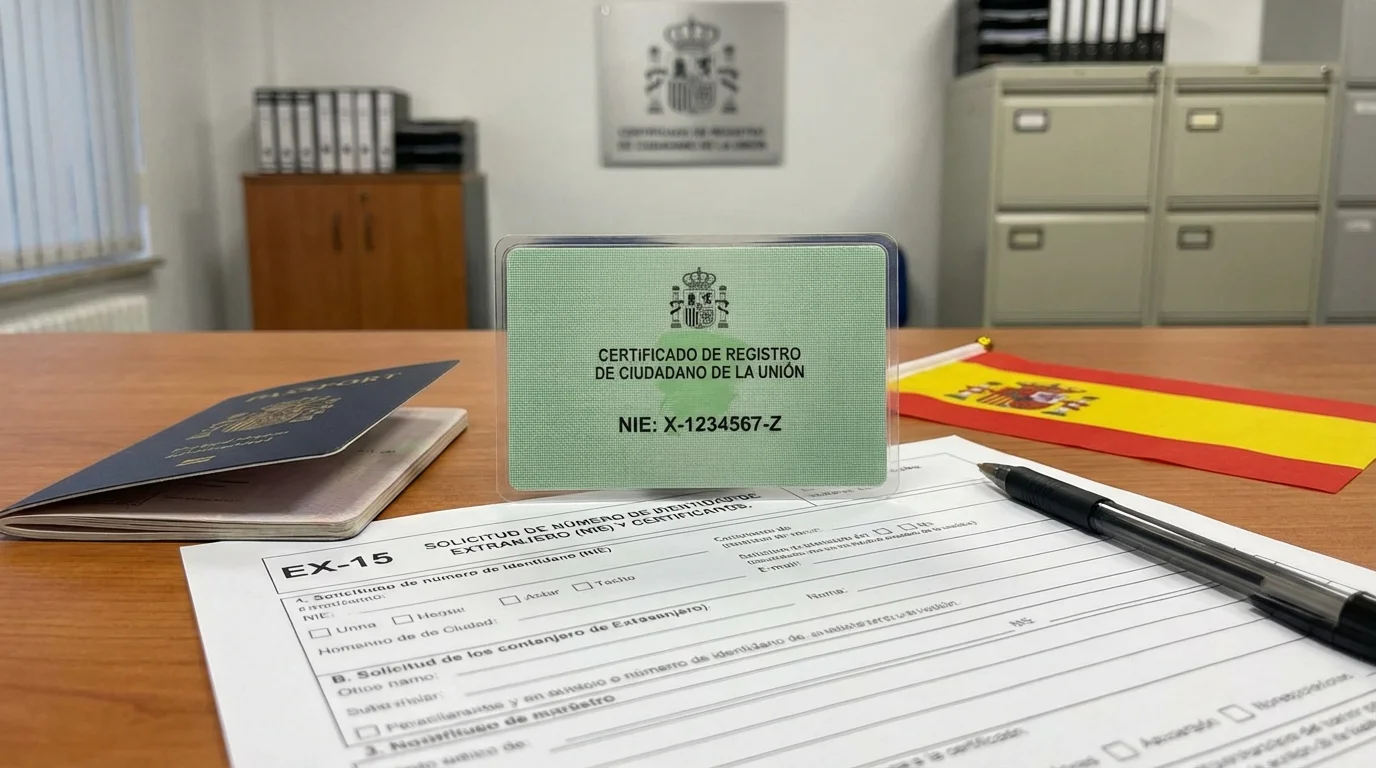
Spanish NIE number 2026: step-by-step guide from Sweden or Spain. EX-15 form, Modelo 790, €9.84 fee, waiting times and NIE/NIF/TIE explained.