


Buying Guides
Cheap Houses in Spain for Sale 2026 – Where Do You Find the Best Prices?
Cheap houses in Spain from 80,000 €: prices on Costa Blanca, Costa Cálida, Torrevieja and Mazarrón — hidden costs, risks and tips for bargains in 2026.
15 min
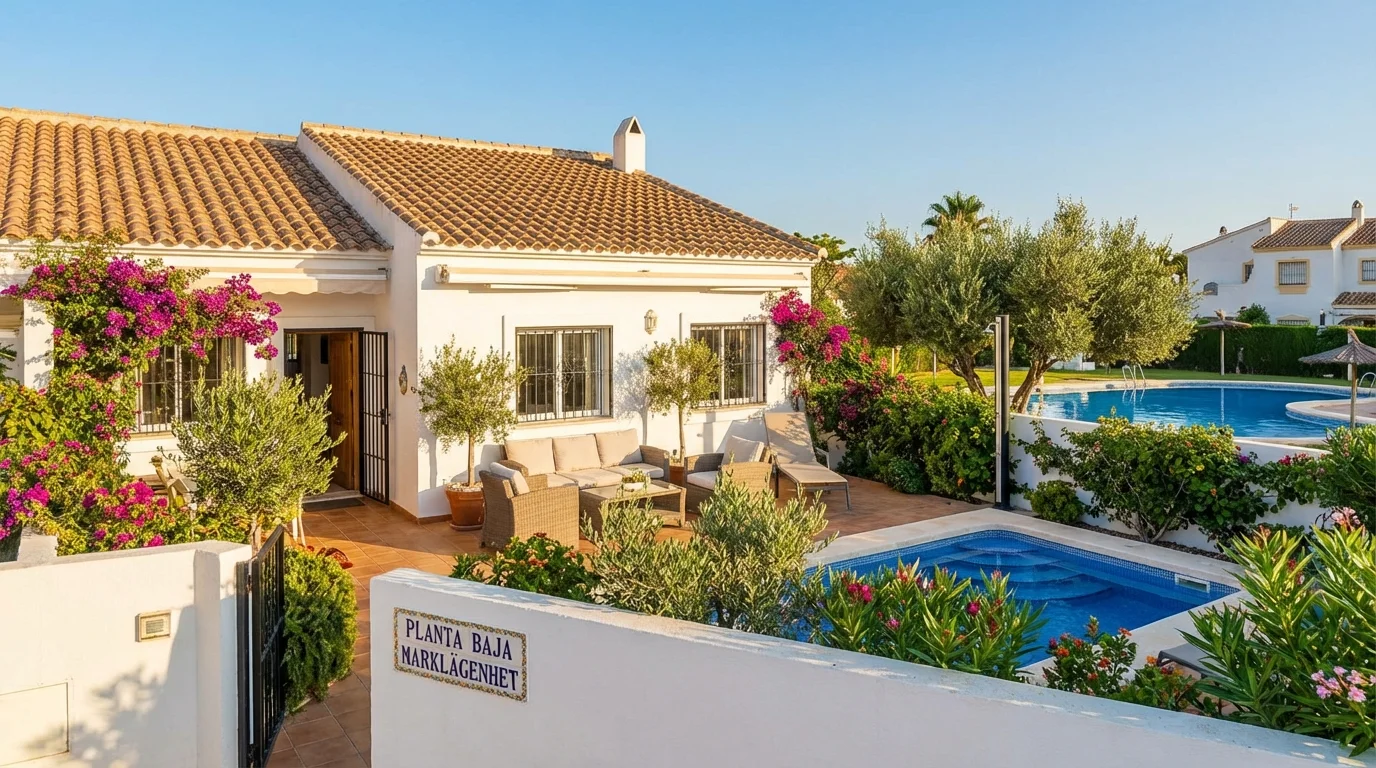
Everything about ground floor apartments (bungalow/planta baja) in Spain: advantages, disadvantages, prices, what to consider and why they are popular among Scandinavians.
A ground floor apartment — or planta baja as it is called in Spanish — is the most common type of property among Scandinavians on the Costa Blanca. You get direct access to a terrace and garden, avoid stairs and effectively live outdoors for eight months of the year. Prices start at around 55,000 euros for older bungalows in Torrevieja and 85,000 euros for new-build, while a modern ground floor apartment with 2 bedrooms and a shared pool in Orihuela Costa costs 140,000–200,000 euros.
But ground floor living has its downsides. Damp, insects, privacy issues and burglary risk are all factors you need to weigh up. Since the DANA flooding in the Valencia region in October 2024 — when 237 people died and thousands of ground floor units suffered water damage — flood risk has become a critical issue for anyone looking at ground floor properties.
In this guide we go through what a ground floor apartment in Spain actually means, what types exist, what they cost, the advantages and disadvantages you need to know, and what to check before you sign the purchase contract.
In Spain a property on the ground floor is called planta baja — regardless of whether it is an apartment in a multi-storey building or a detached bungalow in a low-rise complex. The term ground floor apartment is used loosely among Swedish buyers and can refer to anything from a ground floor flat in central Torrevieja to a villa-style bungalow with a private garden in Ciudad Quesada.
What all ground floor apartments have in common is that you live at ground level with direct outdoor access — unlike apartments on floors 1–3 reached via stairs or a lift. In most urbanizaciones (residential estates) along the coast this means a private terrace or patio of 15–60 square metres, and sometimes an enclosed garden.
The English term ground floor apartment and the Spanish planta baja are synonyms. On property listings on Idealista or Fotocasa you often see the filter "planta baja" or "bungalow bajo" to find these properties.
The range of ground floor apartments in Spain is broader than many people think. Here are the most common types you come across along the coast.
The classic Costa Blanca bungalow — a single-storey home in a low-rise complex with its own entrance, private terrace and often a small enclosed garden. Typically 2 bedrooms, 1–2 bathrooms, 55–80 square metres of living space plus 20–40 square metres of patio. Found in thousands of urbanizaciones from the 1980s onwards.
The bungalow bajo differs from the bungalow alto (the upper floor of the same complex, which instead has a solarium/roof terrace). The ground floor has garden access but less natural light and fewer views.
A standard apartment in a residential building with 3–5 floors, located on the ground floor. Found in cities such as Torrevieja, Alicante and Fuengirola. Often with a small patio (10–20 m²) or direct access to a shared pool. Cheaper per square metre than the same type on a higher floor — property experts estimate that the ground floor is 10–20% cheaper than an apartment on the second floor.
A quad consists of four connected homes that share a communal courtyard or garden. Each unit has its own entrance and a private section of the garden. Quads are popular in Orihuela Costa, Villamartín and Ciudad Quesada — they give the feel of a terraced house but with more green space. Typically 2–3 bedrooms, 70–100 m², often with a solarium.
A two-floor home where the ground floor has the living room, kitchen and terrace, and the lower floor (semisótano) contains bedrooms and an extra bathroom. Provides more living space on a small plot. Popular in new-build along the southern Costa Blanca. Bear in mind that the lower floor can have poorer ventilation and more damp.
Information
Spanish terminology to know: Planta baja = ground floor, bungalow bajo = ground floor bungalow, bungalow alto = upper floor bungalow with solarium, adosado = terraced house, quad = four connected homes, urbanización = residential estate with shared areas. Listings often use "Bj" or "BJ" to indicate the ground floor.
Scandinavian buyers in Spain — particularly retirees and half-year residents — are drawn to ground floor apartments for one simple reason: outdoor living. When you live on the ground floor in southern Spain you effectively live on your terrace. Breakfast, lunch, dinner and evening drinks happen outdoors for 8–10 months a year in a climate with 300+ sunny days.
There is also an accessibility reason. Many Swedish buyers in their 60s and 70s are planning for the next 15–20 years. A home without stairs — or with minimal steps — means you can stay on even if your mobility decreases. Spanish lifts in older apartment buildings are often small and unreliable, and buildings with 3–4 floors and no lift are common in coastal towns.
Finally, ground floor apartments are practical for pets. Direct access to a patio or garden makes morning and evening walks straightforward — something many Swedish dogs appreciate after the transition from a Nordic winter to a Mediterranean climate.
Prices vary considerably depending on type, location and condition. Here is an overview of what to expect in the most popular areas for Scandinavians in 2026.
Indicative price ranges for ground floor apartment / bungalow
Large supply and clear ground floor pricing logic.
Higher average than Torrevieja but strong demand.
Golf and urbanisation — often with pool.
Beachside segment.
Mar Menor and lower entry than many coastal areas.
Higher price level — more premium and international demand.
Sources: Idealista 2026, Engel & Völkers 2026, Alegria Real Estate 2025
An important pricing factor is the ground floor discount. Ground floor apartments in multi-storey buildings are generally 10–20% cheaper per square metre than an equivalent apartment on the second or third floor of the same building. This is because Spanish buyers traditionally prefer higher floors with more light and views. But for foreign buyers — who prioritise terrace and garden — this is an opportunity to get more for their money.
Detached bungalows in urbanizaciones do not have the same price reduction. There, the price is driven more by plot size, condition and proximity to the pool and facilities.
Properties
Explore available properties in torrevieja
The obvious advantage. You step straight out onto your terrace or garden. No lift, no stairs, no shared balcony to share with neighbours. In a climate with 320 sunny days per year, this means your living space effectively increases by the size of your patio.
Perfect for older people, those with mobility issues or families with young children. Being free of stairs in daily life is a luxury that becomes more important with age. Wheelchair, walking frame or pushchair — everything works without obstacles if the property is properly adapted.
As mentioned above: in multi-storey buildings you pay 10–20% less per square metre on the ground floor compared to a higher floor. That makes ground floor apartments a value-for-money option for those who do not prioritise views.
Direct access to a patio or garden makes life with a dog or cat easier. No lift ride in the middle of the night, no grumpy neighbour in the stairwell. Many urbanizaciones on the Costa Blanca are pet-friendly with walkways and green spaces.
Lifts in Spanish apartment complexes from the 1980s and 90s are known for breaking down — and repairs can take weeks. On the ground floor you are unaffected.
Ground floors stay naturally cooler during the hottest summer months thanks to contact with the ground. You can save 20–30% on air conditioning compared to a sun-exposed top floor.
Tip
Tip: If you plan to live half the year in Spain (October to April), a ground floor apartment is an especially good fit. During the winter season you avoid the worst disadvantages (insects, heat) and fully enjoy the benefits (terrace, garden, outdoor living). The summer — when insects and damp are at their worst — you spend in Sweden.
The most serious problem with ground floor apartments in Spain. Ground floors have direct contact with the earth, and combined with inadequate drainage and insulation — common in buildings from the 1970s to 1990s — this can lead to damp problems, condensation and mould. Damp is particularly common during the autumn months (September–November) when humidity rises and night temperatures fall.
Signs to look for: bubbling or peeling wall paint, dark marks along skirting boards, musty smell in wardrobes, condensation on the inside of windows.
Ground floor living means proximity to the ground, and with it come ants, cockroaches, silverfish and sometimes scorpions. Insects get in more easily through gaps in doors and windows on the ground floor. Cockroaches (cucarachas) are a fact of life in southern Spain — they come out of drains and vents, and ground floors are the most exposed. Regular pest control (fumigación) costs 60–120 euros per year and is recommended for all ground floor apartments.
Ground floors are more vulnerable to burglary than higher floors. Windows and patio doors at ground level are physically accessible from the street, garden or courtyard. In Spain approximately 60,000 burglaries were reported in the first half of 2023, and ground floors are overrepresented in the statistics.
The solution: rejas (window bars) are standard on ground floor apartments in Spain and cost 150–400 euros per window. Modern security doors, motion sensors and camera surveillance further reduce the risk. Check that the home insurance covers burglary.
Passers-by can look straight into your home if you lack hedges, fencing or blinds. Particularly in densely built urbanizaciones and along footpaths, the lack of privacy can be intrusive. The solution is celosías (trellis panels), pergola roofs with climbing plants or frosted glass — but budget 500–2,000 euros to sort it out properly.
The DANA disaster on 29 October 2024 brought flood risk into sharp focus. More than a year's normal rainfall fell in eight hours in parts of the Valencia region. Water levels in affected communities reached 1.8 metres and thousands of ground floor units were completely destroyed. Around 358,000 properties in Spain are in so-called zonas de flujo preferente — zones with high flood risk.
Always check the Confederación Hidrográfica maps before buying a ground floor property. A home near a rambla (dry river bed) or in a low-lying area should be avoided entirely regardless of price.
Note
Warning following DANA 2024: Since the flooding, the Spanish government has tightened rules on flood risk information at property purchases. Always request an informe de riesgos (risk report) from your lawyer before buying. Check whether the property is in a flood zone via SNCZI (Sistema Nacional de Cartografía de Zonas Inundables) at miteco.gob.es.
In addition to the standard checks for all property purchases in Spain (Nota Simple, debts, building permits, Cédula de Habitabilidad), there are specific things to investigate for ground floor apartments.
Hire an independent surveyor (perito) to check for damp in walls, floors and ceilings. A damp test costs 150–300 euros and can reveal hidden problems not visible to the naked eye. Pay particular attention to: bathrooms and kitchen (pipe connections), exterior walls against the ground, wardrobes and storage areas without ventilation.
Check that the property has working drainage around the foundations. In older buildings proper drainage systems are sometimes absent, leading to water accumulation during heavy rain. Ask the community manager whether there have been any water ingress incidents in the ground floor units.
Request a risk report (informe de riesgos) showing whether the property is in a flood zone. Check the SNCZI maps (Sistema Nacional de Cartografía de Zonas Inundables). If the property is in a risk zone, check that insurance is in place and what it covers.
Check the homeowners' association (comunidad de propietarios) rules for ground floor units. Some associations prohibit glazing of terraces, restrict pet sizes or have restrictions on garden maintenance. Ask to read the association's bylaws (estatutos) and the most recent annual general meeting minutes (actas).
Check the existing security installations: window bars (rejas), security door, alarm, outdoor lighting. If these are absent, budget 1,500–4,000 euros to install basic security equipment.
Check exactly what is private space and what is communal. The homeowners' association bylaws typically specify which areas belong to the ground floor apartment and what is community land. Misunderstandings about terrace and garden areas are one of the most common disputes in Spanish homeowners' associations.
Ground floor compared to floor 2–3
Rule of thumb: Choose ground floor if you prioritise outdoor living, accessibility and pets. Choose an upper floor if you prioritise views, light, security and lower maintenance. And if you want the best of both worlds — look at a bungalow alto with a solarium, which gives you private outdoor space on the roof without the ground floor's disadvantages.
Properties
Explore available properties in orihuela-costa
The supply of ground floor apartments in Spain is greatest along the southern Costa Blanca and Costa Cálida, where low-rise urbanizaciones dominate. Here are the best areas for Scandinavians.
Torrevieja has the widest range of ground floor apartments across all price ranges — from older bungalows for 55,000 euros to modern new-builds for 250,000 euros. La Mata north of Torrevieja offers a calmer environment with beach access and a nature reserve. The average price in the Torrevieja area is 2,327 euros per square metre, but ground floor apartments generally come in below the average.
Playa Flamenca, La Zenia, Villamartín and Cabo Roig have thousands of bungalow complexes from the 1990s onwards. Here you find modern quads and bungalows with a shared pool, padel court and landscaped gardens. Large Scandinavian community with Swedish restaurants, medical centre and the Scandinavian school in Playa Flamenca.
Ciudad Quesada was built for retirees who want villa-style living at ground floor level. Plenty of detached bungalows with private gardens and sometimes a private pool. Quiet, green and close to golf courses. Prices are 10–15% lower than in Orihuela Costa for equivalent quality.
The fastest-growing alternative for Scandinavians who want new-build ground floor apartments at lower prices. New-build bungalows with 2–3 bedrooms, private garden and shared pool from 150,000 euros. The region had Spain's strongest price growth in 2025 with a 29.6% rise, so the window for low prices is closing.
More expensive but with a broader range of international services, international schools and restaurants. Ground floor apartments on the Costa del Sol start at around 150,000 euros for older properties and 280,000+ euros for new-build. Popular among Swedish families.
Contact
We help Swedish buyers find the right ground floor apartment — bungalow, quad or planta baja — with price overviews, damp surveys and legal guidance. Tell us what you are looking for and we will get back to you within 24 hours.
Book a free consultationDecision support
En marklägenhet (planta baja/bungalow) i Spanien kostar från 55 000 euro för äldre objekt i Torrevieja till 250 000+ euro för nyproducerade bungalows med privat trädgård i Orihuela Costa. I södra Costa Blanca ligger snittpriset för en marklägenhet med 2 sovrum kring 120 000–180 000 euro.
Marklägenheter är generellt 10–20 % billigare per kvadratmeter än motsvarande lägenhet på högre våning i samma komplex, tack vare lägre efterfrågan bland spanska köpare.
Det beror på dina prioriteringar. Marklägenheter ger direkt tillgång till trädgård eller terrass, inga trappor och enklare flytt av möbler — perfekt för äldre eller barnfamiljer.
Nackdelarna är högre risk för fukt, insekter och inbrott. Lägenheter på högre våning har bättre utsikt, mer ljus, färre insekter och bättre säkerhet, men kräver fungerande hiss och saknar trädgård.
Många skandinaver i Spanien föredrar markplan just för utomhuslivets skull.
De vanligaste problemen är fukt och mögel (särskilt i äldre byggnader utan ordentlig dränering), insekter som myror och kackerlackor som lättare tar sig in på markplan, sämre insynsskydd från förbipasserande, och högre inbrottsrisk jämfört med högre våningar. Sedan DANA-översvämningarna i oktober 2024 är även översvämningsrisk en viktig faktor — kontrollera alltid om fastigheten ligger i en översvämningszon innan du köper.
I Spanien används 'planta baja' (markplan) för alla typer av bottenvåningslägenheter. En bungalow är en specifik hustyp — vanligtvis en enplansbostad i ett lågt komplex med egen ingång och terrass.
Bungalows kan vara 'bajo' (markplan med trädgård) eller 'alto' (övervåning med solarium). Andra vanliga markplanstyper är quad (fyra sammanlänkade bostäder runt gemensam trädgård) och duplex planta baja (markplan + källarplan).
Alla räknas som marklägenheter men skiljer sig i planlösning och pris.
Södra Costa Blanca är det populäraste området för marklägenheter bland skandinaver. Torrevieja har störst utbud i alla prisklasser, Orihuela Costa (Playa Flamenca, La Zenia, Villamartín) erbjuder moderna bungalowkomplex med pool, och Ciudad Quesada har gott om villaliknande bungalows med privat trädgård.
I Costa Cálida (Murcia) hittar du nyproducerade marklägenheter till lägre priser, särskilt i Los Alcázares och San Pedro del Pinatar.
Sources

Lago Jardín II, Alicante

Villa Amalia, Alicante

Los Balcones, Alicante

Los Balcones, Alicante

San Luis, Alicante

Golf La Marquesa (Ciudad Quesada), Alicante
Local expertise
Cheap houses in Spain from 80,000 €: prices on Costa Blanca, Costa Cálida, Torrevieja and Mazarrón — hidden costs, risks and tips for bargains in 2026.
Find your dream villa in Spain: prices by region, types of villas, running costs and what to think about. Complete guide for Swedish buyers.
Buying an apartment in Torrevieja: prices by area, new-build vs second-hand, community fees and rental yields — step by step for Swedish buyers 2026.