
Finance & Law
Cost of Buying Property in Spain 2026 – ITP & Fees
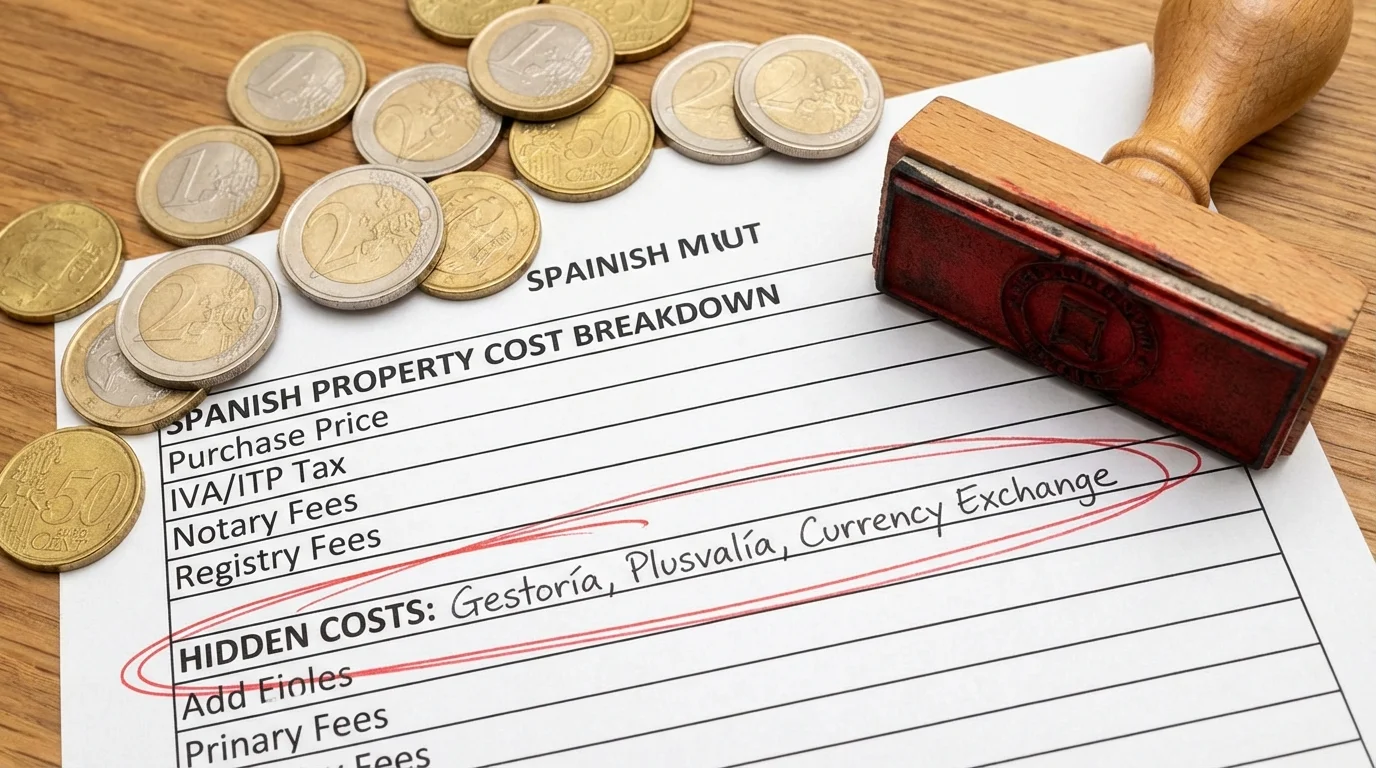
Buying property in Spain costs 10–14% on top of the price: ITP, notary, land registry, lawyer and more. Calculation examples and a region comparison.
22 min
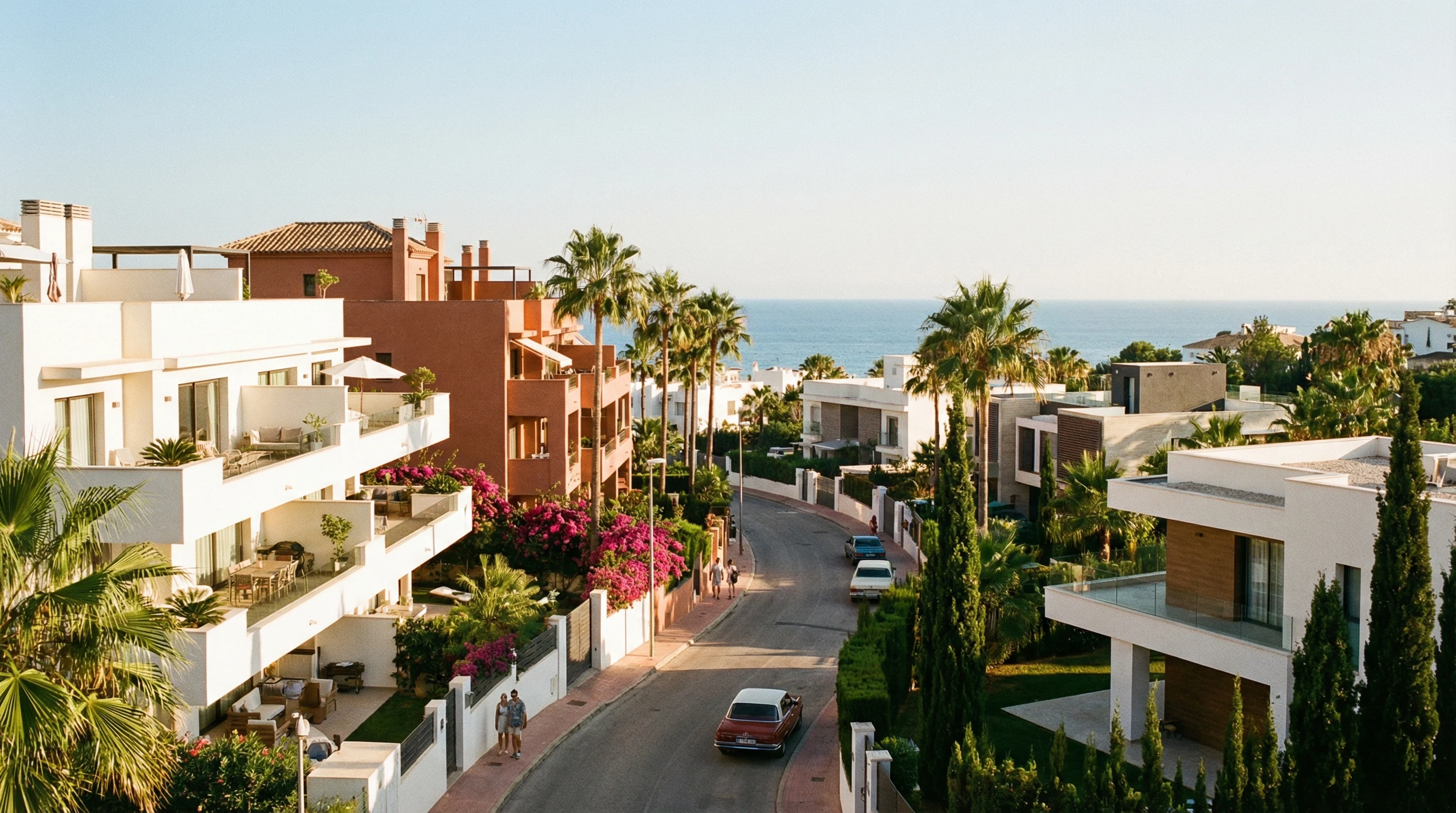
Complete guide to buying a property or apartment in Spain for Swedes: purchase process, taxes, costs, mortgages, regional differences and risks — updated 2026.
Yes — as a Swedish EU citizen you can buy property in Spain (apartment, townhouse or villa) without special permission, but you need among other things a NIE number, a bank account and an independent lawyer who carries out legal due diligence before you commit financially. For most buyers the total budget comes to purchase price plus approximately 10–15 percent in taxes and fees for resale properties, and 10% VAT plus AJD for new builds. The average price for holiday homes in Spain has been around €2,100–2,200 per square metre nationally in official statistics — but the difference between coast, city and inland is extreme. This guide covers the entire purchase, what it costs, how mortgage and deposit fit together, which areas suit different types of buyers, common mistakes and whether 2026 is a reasonable time to enter. For deeper dives, see also our articles on purchase price plus all additional costs, mortgages in Spain and lawyer for property purchase.
If you have already read a general house guide you can see this article as property-wide: the same process applies broadly whether you are buying an apartment, penthouse or townhouse — the differences lie in the association's rules, maintenance cost and how you value location against price.
Tip
Property in this text means all types of owner-occupied apartments, townhouses and villas — not just detached houses. If you have already decided specifically on a house, our step-by-step guide to buying a house in Spain is a good complement.
You have the same fundamental right to own real estate as a Spanish citizen. There is no general Swedish "barrier" and no requirement for permanent residence — many buy as non-residents and use the property for leisure or rent it out according to the rules.
What you do practically need is:
Purchasing via a company is possible but should always be reviewed by tax advisers in both countries before you choose a structure.
NIE is applied for with a passport and a reason (for example intention to buy property). Via the Swedish consulate it often takes several weeks, while an application in Spain can sometimes be booked more quickly — but appointment availability can be a bottleneck during high season. Many buyers let the lawyer or a gestor follow up on the bureaucracy for a separate fee.
The bank account is needed not just for the purchase itself but also to demonstrate money-laundering-controlled flows — banks ask where the funds come from. Allow for annual fees that are higher than in Sweden for simple non-resident accounts.
If you cannot be present personally at completion, a notarised power of attorney (poder) to the lawyer lets them sign the escritura on your behalf — practical but sensitive: only give it to someone you absolutely trust.
The process differs from Sweden: there is no Swedish equivalent to an estate agent licence in the same form, and the notary witnesses the purchase without guaranteeing that the property is legally "clean". That is why a lawyer is almost always necessary, not optional.
A sensible due diligence list includes among other things:
The time required for review is often one to two weeks for standard apartments, longer for large villas or farms with many buildings.
When you find the right property a reservation is often signed with a smaller amount (for example €3,000–6,000) while the lawyer reviews everything. This is followed by the Contrato de Arras with typically 10 percent as a deposit. Under Spanish practice, if the seller fails to deliver you can claim double the deposit back — and you lose the deposit if you as the buyer pull out without contractual grounds.
At escritura the remaining amount is paid by banker's draft and the keys are normally handed over the same day. The purchase tax and registration must then be handled within the prescribed time — this is often managed by the lawyer or gestor.
Plan for empadronamiento if you are going to live there for more than short periods, transfer of electricity/water, insurance and any declaration obligations as a non-resident. If you have bought in an association, notify the administrator of the change of ownership so that fees are charged correctly.
Note
Never sign a reservation or arras before the lawyer has approved the terms. This is where many buyers save a few hundred euros — and risk tens of thousands in hidden defects.
For resale property you pay regional ITP (transfer tax). Rates vary — often approximately 7–10 percent depending on the autonomous region. For new builds you pay 10 percent VAT on residential properties plus AJD (stamp duty) which varies regionally.
Typical items are notary, land registry, lawyer and any gestor. As a guide, the total surcharge often falls in the range of 10–15 percent for resale — the exact level depends on price, region and property type.
Calculation example (resale): purchase price €300,000, ITP 9% (Valencia region since June 2026) gives €27,000 in tax. Add approximately 0.5–1.2% for notary and registration together, plus €1,500–3,500 for a lawyer depending on complexity — and you are already up to tens of thousands of euros above the price. That is why buyers who "only" have exactly ten percent extra in their budget often get a brutal surprise at the final bill.
See the table below for indicative price levels per coastal area (rounded ranges — always confirm against current listings):
Price overview
| Area | Apartment | Villa | Townhouse |
|---|---|---|---|
| Costa Blanca South (e.g. Torrevieja) | €90,000–220,000 | €250,000–650,000 | €160,000–380,000 |
| Alicante city / near suburbs | €150,000–280,000 | €350,000–900,000 | €220,000–450,000 |
| Costa del Sol (e.g. Marbella–Estepona) | €180,000–400,000 | €400,000–2,000,000+ | €280,000–700,000 |
| Costa Cálida (Murcia coast) | €75,000–170,000 | €200,000–450,000 | €130,000–320,000 |
| Canary Islands (major cities) | €130,000–260,000 | €320,000–850,000 | €200,000–500,000 |
Indicative ranges for buyers comparing segments — always verify against market data close to the time of purchase.
IBI (municipal property tax) and, for non-residents who do not rent out, IRNR on a notional taxable base under current rules. The amounts look small per year — but penalty surcharges for missing declarations mean they should be taken seriously.
If you plan rental, you will also need to declare rental income, furnishings, cleaning and periods without guests — calculate net income after taxes and fees before locking in a yield in your calculations.
New builds often come with construction law guarantees, a more modern energy standard and fewer surprises in plumbing — but you pay VAT plus AJD and may need to wait for completion. Resale usually involves ITP instead of VAT and you see exactly what you are buying — but the risk of hidden defects and unauthorised extensions increases with the age of the property.
Many Swedish buyers underestimate how much community life governs daily life in an apartment: pool timetables, facade and roof renovations, and rising fees when there is a maintenance backlog. In a villa you have more freedom — but all repairs fall on you, including pool, pump, heating system and garden.
Price per square metre is a simple way to compare locations, but it hides floor plan, position in the building and view. Two apartments at the same address can have a 20 percent price difference depending on floor and orientation. Use the m² price as a compass — not as the only truth.
Properties
Explore available properties in Costa Blanca
Browse current homes in the area and compare locations, price levels and property types at your own pace.
Budget and sun-seekers who want proximity to an airport and amenities often thrive on southern Costa Blanca — there is a large supply of apartments and townhouses at varying price levels. Explore among other places Torrevieja in our area guide, compare with Alicante (city guide) if you want a university and more urban pulse, or look more closely at Orihuela Costa if you want to combine newer properties with golf and coastal locations.
Lifestyle and premium buyers are often drawn to Costa del Sol (Marbella, Estepona, Mijas) — a higher price level but a broader selection of luxury, golf and international services.
A quieter coast and lower entry point can be found along Costa Cálida and parts of the Almería coast, with the trade-off that the supply of direct flights and Swedish networks may be smaller than around Alicante or Málaga.
The Canary Islands suit those who prioritise consistent winter temperature and acceptable travel time — but remember that the market, weather and services differ between islands and between south and north on the island.
Major cities (Madrid, Barcelona, Valencia, Málaga) suit those who want to combine rental, work or long stays with public transport and cultural life. Price per square metre is generally higher than in holiday resorts, and competition for central apartments can be fierce — but liquidity on resale is often better if the property is well located.
Inland (Castilla-La Mancha, Extremadura, parts of Aragon) sits clearly below coastal areas in official property price statistics per square metre — but rental and resale to tourists is rarely as straightforward as at the coast. Buy inland if you want to live locally or long-term, not if you are counting on rapid value growth driven by foreign demand.
Swedish presence in Spain is measurable: just over 90,000 Swedish citizens were registered as residing in the country at the last available year-end — many of course own property without being permanently registered, but the figure shows the ecosystem of services in place.
Spanish banks often lend up to approximately 60–70 percent of the valuation/value for non-resident EU citizens — which in practice means a 30–40 percent deposit to the bank. To that you add the purchase costs above.
Interest rates are variable or fixed against market references such as Euribor; with a variable rate the payment consists of margin plus reference rate. The reference rate has normalised compared to the years of zero interest — which is directly reflected in the actual mortgage cost for new loans. Currency risk arises if income is in SEK and the loan is in euros — the difference can equate to several monthly payments per year during exchange rate movements.
Documentation is more extensive than many are used to: pay slips, tax returns, employment certificates and account history are standard. Some buyers combine with capital from Sweden (sale of property, savings) to reduce the borrowing need — this can be rational despite a low Swedish mortgage rate, if the purpose is to meet the Spanish bank's loan-to-value requirement.
More details on banks, negotiation and tables can be found in the mortgage guide.
Typical timeline
NIE via consulate
2–6 weeks
NIE in Spain (if you get an appointment)
A few days – 2 weeks
Bank account
1–3 working days
Property search and reservation
2–10 weeks
Due diligence
1–2 weeks
Arras to escritura
4–8 weeks
Spanish mortgage (if applicable)
4–8 weeks
Registration after purchase
1–2 months
Total from "we have found the right property" to keys: often approximately two to three months if everything runs smoothly — longer if the bank or seller drags things out.
Most Swedish buyers start with an apartment — close to services and the airport, and easier to lock up and leave between visits. The purchase process itself is the same as above, but four things deserve extra attention for apartments specifically.
The owners' association (comunidad de propietarios). Every apartment belongs to an association that jointly owns the pool, lifts, garden and façade. The monthly fee varies enormously with the facilities — a simple building without a lift costs a fraction of a gated complex with pools and a gym. Always ask for the latest AGM minutes and a certificate confirming the seller has no debts to the association (certificado de deudas), and ask explicitly about planned special levies (derramas) for roof, façade or lift replacement.
Rental rules. If your numbers depend on short-term letting, check the situation before the arras contract, not after. Several regions require a tourist licence for short-term rentals, some cities have paused new licences entirely, and since 2025 associations also have a stronger right to refuse new tourist letting in the building. Your lawyer can verify both the licence situation in the municipality and what the association's statutes and minutes say.
Position in the building. Floor, lift, orientation and noise from the street or pool area affect both comfort and resale value more than many expect. A ground floor with a terrace and a top floor with a solarium are often priced completely differently in the same building, and a third-floor apartment without a lift is harder to resell the day the stairs feel longer than they did at the viewing.
New build or resale. Tax-wise the difference is IVA plus AJD versus ITP, as covered in the cost section. For new builds, your advance payments must also be bank-guaranteed or insured — always ask for the guarantee certificate before paying anything beyond the reservation.
Tip
Before signing the arras for an apartment: AGM minutes and the association's finances, a debt-free certificate from the seller, planned derramas, and — if you want to let — the licence situation in the municipality plus the association's statutes. Browse the current selection of apartments for sale.
In Spain it is common for the same office to show many properties — which is convenient, but means you must be clear about who represents whom. Always ask for written terms for the reservation and make sure your lawyer receives the documents before you commit.
Negotiating the price is possible, but the culture differs: aggressive northern European negotiation can sometimes close doors rather than open them. Combine friendliness with clarity — and let the figures (comparable properties, time on the market, condition) do the work.
Spanish properties often have different insulation, acoustics and plumbing from Swedish new builds. It is rarely "wrong" by local standards — but it can feel unfamiliar. A technical survey (€300–700) can be money well spent if the property is more than 15–20 years old.
Stop or pause if you discover incomplete planning permissions, contradictory area figures between the listing and the register, or if the seller is pressing you to sign the same day without a lawyer. Legitimate sellers almost always accept a short legal review period.
The same applies if financing is not secured: do not sign arras if the bank is only "sounding positive" without a written commitment tailored to that specific property.
Information
Swedes often rank highly among foreign buyers along the Mediterranean — but the volume of foreign transactions also means that the estate agent market is highly competitive. That is an advantage for the supply, but a risk if you do not filter out overly quick commitments.
There is no universal answer — the timing depends on your horizon, financing and whether you are comparing with the opportunity cost (renting, another city, Swedish property).
At the macro level Spanish property prices have shown rising trends in many coastal areas since the pandemic, while financing costs are higher than a few years ago when Euribor was negative. For you as a long-term owner (10+ years), timing is less sensitive than for someone who plans to turn the property within three years.
That does not mean "all prices always go up". Local bubbles can arise in segments such as new builds in areas with simultaneously large supply, and interest-rate-sensitive buyers can push down demand in more expensive segments even if sun and sea remain.
A pragmatic way to think:
Portals like Idealista and Fotocasa provide large samples — filter by area, size and condition, and compare at least ten to fifteen properties before interpreting the average. Also look at days on the market: properties that have been sitting a long time may be mispriced — or have hidden problems that you should let the lawyer explain.
Remember that seasonal variation affects both supply and price negotiation. High season provides more viewings but also more competition. Low season can offer a calmer pace and more time for review — but fewer properties that exactly match the desired beachfront profile.
Properties
Explore available properties in Spanien
Browse current homes in the area and compare locations, price levels and property types at your own pace.
Contact
We help Swedish buyers navigate areas, properties and practical steps — without stress. Book a free call and we will sort out what is reasonable for your specific budget.
Book a free consultationLast updated: April 2026. Taxes, interest rates and market prices change — ask for current figures before you decide. If you have specific questions about a property, the right answer is almost always: let an independent lawyer working locally give written confirmation before you sign.
Decision support
Ja, vissa svenska banker lånar mot utlandsetablering, men villkoren skiljer sig kraftigt från ett vanligt svenskt bostadslån. Många svenskar väljer i stället bolån i Spanien där banken tar säkerhet i fastigheten.
Jämför alltid ränta, uppläggningsavgift, valutarisk och kontantinsatskrav. Läs mer i vår guide om bolån i Spanien.
Efter reservation (ofta 3 000–6 000 euro) följer arras-kontraktet med cirka 10 procent av köpeskillingen. Har du bolån i Spanien behöver du dessutom 30–40 procent kontantinsats till banken, plus 10–15 procent till skatter och avgifter.
Planera därför med minst 40–55 procent i egna medel av det totala budgetbehovet.
ITP är överlåtelseskatt på begagnade bostäder och varierar per region (ofta 7–10 procent). IVA (moms) gäller nyproduktion och är 10 procent för vanliga bostäder, plus regional stämpelskatt AJD.
Fel bedömning här kan förstöra hela budgeten — be din advokat bekräfta vilket som gäller just ditt objekt.
Praktiskt ja. Du behöver NIE-nummer för konto och köp, och banken används till handpenning, bankcheck vid notarien och löpande avgifter.
Öppna konto tidigt — utan det blir betalflödet vid arras och escritura långsamt och stressigt.
Det beror på budget, underhåll och livsstil. Lägenheter i bostadsrättsförening (comunidad) ger delad underhållskostnad men månadsavgift och styreljebeslut.
Villor ger mer integritet men högre drift och tydligare behov av teknisk besiktning. Många börjar med lägenhet nära service och flygplats, och byter upp när de lärt känna området.
Sources

Lago Jardín II, Alicante

Los Balcones, Alicante

San Luis, Alicante

San Agustín

Centro, Alicante

Centro, Alicante
Local expertise
Buying property in Spain costs 10–14% on top of the price: ITP, notary, land registry, lawyer and more. Calculation examples and a region comparison.
Complete guide to mortgages in Spain: which banks lend to Swedes, current rates, down payment requirements and how the application process works.
Do you need a lawyer when buying property in Spain? What does an abogado do, what does it cost, and how do you choose the right one? Guide for Swedish buyers.