

Finance & Law
Tax in Spain – Guide for Swedish Property Owners 2026
Complete tax guide for Swedes with property in Spain: IBI, IRNR, wealth tax, capital gains and the double taxation agreement. Updated 2026.
16 min
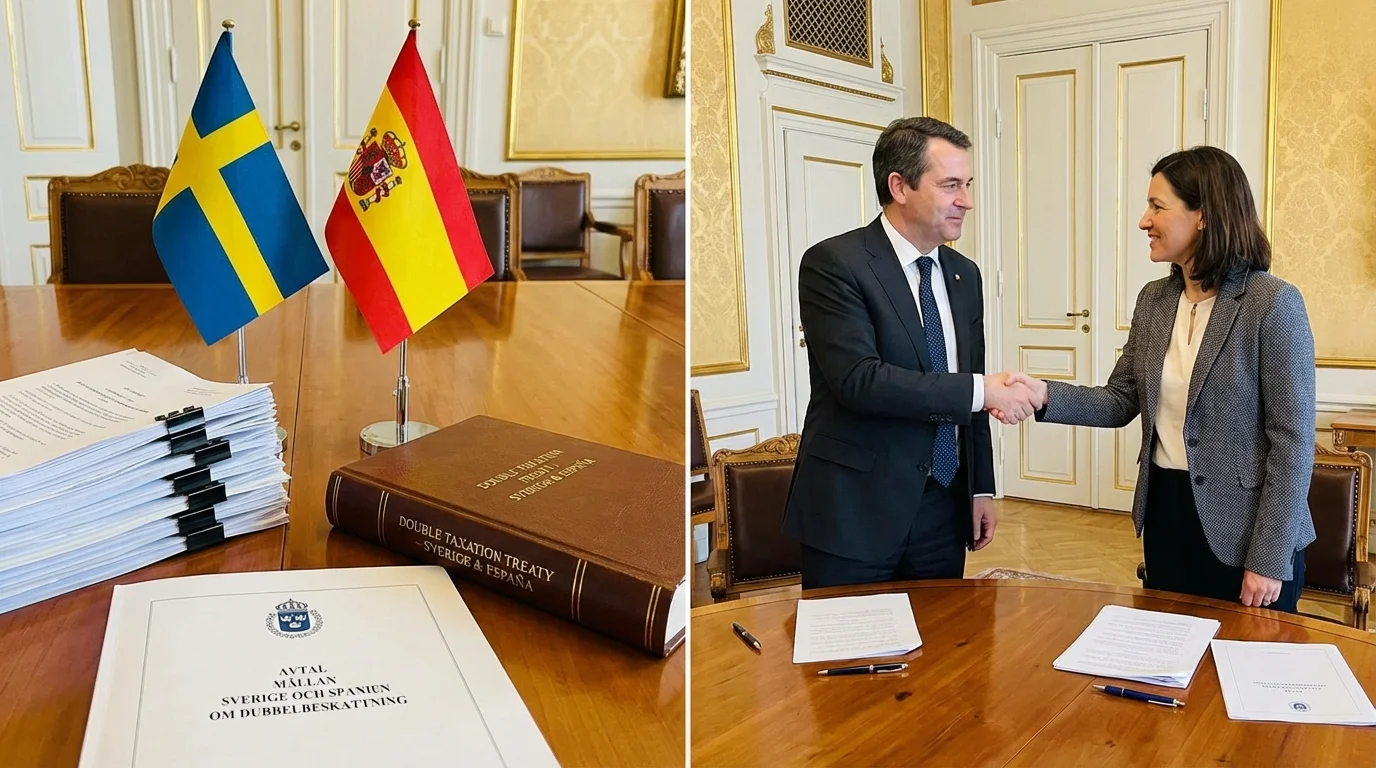
Sweden–Spain double taxation treaty (1977:75): rental income 19% in Spain, credit in Sweden. SINK 22.5% on pensions, Modelo 210 and SKV 2703 explained.
If you own property in Spain and are liable to tax in Sweden you risk being taxed in both countries — on rental income, capital gains on sale and even on your pension. The double taxation treaty between Sweden and Spain (ordinance 1977:75) prevents this by allocating taxing rights and giving you the right to a tax credit. In practice this means you should never pay more total tax than what the higher-taxing country charges.
The treaty was signed in 1976 and is still in force, with protocol amendments. It covers income tax, capital gains tax and wealth tax — and it directly affects how you declare your Spanish property in Sweden, and vice versa.
This guide covers which income is taxed where, how the credit method works in practice, which forms you need — and the most common mistakes Swedes make.
Key takeaways
- The treaty (ordinance 1977:75) allocates taxing rights: you never pay more in total than what the higher-taxing country charges
- Rental income is taxed at 19% net in Spain (Modelo 210), with a credit given in Sweden via form SKV 2703
- Capital gain on sale: 19% in Spain, the buyer withholds 3% as an advance; in Sweden 22% effective tax with a credit
- Pension: SINK 22.5% in Sweden (from 2026, lowered to 20% from 2027) plus Spanish IRPF with a credit
- The 183-day rule is not optional: Spain and Sweden automatically exchange tax data via CRS
The double taxation treaty (Spanish: Convenio para evitar la doble imposición) is a bilateral tax agreement that regulates which state has the right to tax which income. The purpose is simple: you should not have to pay full tax in two countries on the same income.
The treaty between Sweden and Spain is based on the OECD model convention and was signed on 16 June 1976. It entered into force in 1977 and has since been supplemented by an amending protocol. In Swedish law it can be found in ordinance (1977:75) on the double taxation treaty between Sweden and Spain.
The treaty applies to:
Information
Important to understand: The treaty can never expand taxing rights — it can only limit them. If neither Sweden nor Spain has the right to tax a certain income under its domestic legislation, the treaty does not change that. But if both countries want to tax the same income, the treaty decides who has priority and how the other state should provide a credit.
The treaty allocates taxing rights between Sweden and Spain for all income types. Here is an overview of the most important categories for Swedish property owners in Spain:
How the treaty allocates taxation (simplified overview)
Tax in Spain (19% net EU/EEA) and often in Sweden if you are subject to unlimited tax liability — claim a credit in Sweden.
Tax in Spain for non-residents (often 19%) and in Sweden if subject to unlimited tax liability — credit in Sweden.
Modelo 210 in Spain. Sweden normally does not tax the same notional income — no double taxation in practice.
Taxed in both countries in many cases — SINK in Sweden and IRPF in Spain with credit under the treaty.
Where the work is performed often determines taxing rights — credit depending on situation.
May apply in Spain above the threshold — Sweden has had no corresponding tax since 2007.
The practical consequence: most Swedish property owners who live in Sweden pay tax in Spain first (where the property is located), and then claim a credit in their Swedish tax return.
If you rent out your Spanish home, the rental income is taxed in Spain regardless of where you live. As an EU/EEA national you are taxed at 19% on the net income — that is after deductions for costs such as community fees, insurance, repairs, IBI and mortgage interest.
The return is filed via Modelo 210 with the Agencia Tributaria. Since 2025 all rental income can be declared in a single annual submission (deadline: 20 January of the year after the income year), instead of the previous quarterly reporting.
If you own a property that you do not rent out, Spain still calculates a notional income (renta imputada): the rateable value × 1.1% (or 2% if the rateable value has not been revised in the past 10 years), taxed at 19% for EU/EEA nationals. This typically amounts to 100–300 euros per year.
If you are subject to unlimited tax liability in Sweden (live or have material connections there), you must declare rental income in your Swedish income tax return. The income is taxed as capital income (30%) for private letting of your own home, with a standard deduction of 40,000 kronor plus 20% of the rental income.
The Spanish tax you have already paid is credited against the Swedish tax — so you only pay the difference in Sweden, if the Swedish tax is higher.
Tip
Tip: Keep all receipts and documents from your Spanish tax return (Modelo 210). You will need them to substantiate the credit in your Swedish tax return. Skatteverket may request documentation showing exactly how much Spanish tax you paid and on what income.
If you sell a property in Spain as a non-resident, the capital gain is taxed at 19%. The gain is calculated as the difference between the sale price and the original acquisition cost (including purchase costs such as taxes, notary fees and solicitor fees).
On the sale, the buyer is required to withhold 3% of the purchase price (retención) and pay it directly to the Spanish tax authorities as an advance payment on your capital gains tax. If the actual tax is less than 3%, you can claim a refund of the difference via Modelo 210 within four months of the sale.
In addition to the national capital gains tax there is plusvalía municipal — a municipal tax based on the increase in the land's rateable value during your period of ownership. The amount varies between municipalities but typically amounts to 500–3,000 euros for a property on the Costa Blanca.
If you are subject to unlimited tax liability in Sweden, the capital gain must also be declared here. In Sweden capital gains on foreign property are taxed as capital income at an effective rate of 22% (30% tax on 22/30 of the gain).
You claim a credit for the Spanish tax (19%) via form SKV 2703. Since the Swedish effective rate (22%) is higher than the Spanish rate (19%), you pay the difference — approximately 3 percentage points — to Skatteverket in practice.
Read more about all taxes on sale in our complete guide on tax when selling Spanish property.
Properties
Explore available properties in costa-blanca
Browse current homes in the area and compare locations, price levels and property types at your own pace.
Pension taxation is one of the most complex areas of the double taxation treaty — and the one that affects the most Swedish pensioners on Costa del Sol and the Costa Blanca.
If you are tax resident in Spain (spend more than 183 days per calendar year there or have your economic centre there), you are subject to unlimited tax liability in Spain. This means Spain taxes all your income, including your Swedish pension.
At the same time Sweden has the right to tax pension paid from here. Sweden levies SINK (Special Income Tax for Non-Residents) at 22.5% from 1 January 2026, with a further reduction to 20% from 2027.
The double taxation treaty places on Spain (as the state of residence) the obligation to eliminate double taxation. In practice this means that in your Spanish tax return (Modelo 100) you can credit the SINK you paid in Sweden against the Spanish tax on the same pension.
Spain's income tax for residents is progressive:
IRPF — progressive rates (reference)
Up to €12,450
19%
Income bracket 1 (average)
€12,451–20,200
24%
Income bracket 2
€20,201–35,200
30%
Income bracket 3
€35,201–60,000
37%
Income bracket 4
€60,001–300,000
45%
Income bracket 5
Over €300,000
47%
Income bracket 6
Regional tax rates vary — the figures are national average rates.
If your Swedish pension is taxed at SINK 22.5% and the Spanish marginal tax on the same amount is 30%, you pay the difference (7.5%) in Spain. You never pay double — but you always pay the higher of the two tax rates.
Note
Warning: the 183-day rule. If you spend more than 183 days in a calendar year in Spain you are considered tax resident there — regardless of whether you have registered or not. Spain now automatically exchanges information with Sweden via CRS (Common Reporting Standard), which means the Spanish tax authority knows about your Swedish bank accounts, pension payments and income. "Forgetting" to file a tax return in Spain is not an option.
Your tax residence determines which country is your "state of residence" and which is the "source state" — and that in turn determines which rules in the treaty apply.
You are tax resident in Sweden if you:
You are tax resident in Spain if you:
If both countries consider you to be resident with them, the conflict is resolved by the treaty's tie-breaker rules (Article 4): permanent home, personal and economic ties, length of stay, and as a last resort nationality.
Always declare property income in Spain (the source state). If you are subject to unlimited tax liability in Sweden, report the same income in your Swedish tax return. If you are resident in Spain, your global income (including your Swedish pension) is included in your Spanish tax return (Modelo 100).
In the state of residence you claim a credit for the tax paid in the source state. In Sweden you do this via form SKV 2703 (Credit for foreign tax). In Spain the credit is applied directly in the return (box for deducción por doble imposición internacional).
The credit method is the technique used by the treaty between Sweden and Spain to eliminate double taxation. Here is how it works:
The principle: The tax you have paid in the source state (e.g. Spain) can be deducted against the tax in the state of residence (e.g. Sweden) — but never more than what the state of residence levies on the same income.
Example — rental income:
You rent out your apartment in Torrevieja and earn €10,000 in net rent per year.
Limitation: The credit can never exceed the Swedish tax on the income. If the Spanish tax is higher than the Swedish tax, you can only credit up to the Swedish tax — the difference "disappears". In practice this rarely happens for standard income, but it can arise with plusvalía municipal and other Spanish additional taxes.
Where do you file?
Rental of Spanish property (resident in Sweden)
Yes in both countries
Spain: Modelo 210. Sweden: INK1 + SKV 2703.
Spanish property not rented out (resident in Sweden)
Yes in Spain, no in Sweden
Spain: Modelo 210 (imputed rent).
Sale of Spanish property (resident in Sweden)
Yes in both countries
Spain: Modelo 210. Sweden: K6 + SKV 2703.
Swedish pension (resident in Spain)
Yes in both countries
Spain: Modelo 100. Sweden: SINK return.
Wealth tax (resident in Sweden, assets over €700,000)
Yes in Spain, no in Sweden
Spain: Modelo 714.
Many Swedes with property in Spain make unnecessary and sometimes costly errors. Here are the most common ones:
The most common mistake of all. Even if you do not rent out your property you must declare imputed rent via Modelo 210 every year. Many Swedish owners are unaware of this requirement and only discover it during an audit or on sale, when unpaid taxes with interest and penalties can amount to thousands of euros.
You pay 19% tax in Spain on your rental income and then declare the same income in Sweden — but forget to complete form SKV 2703 for the credit. Result: you pay full tax in both countries. The credit does not happen automatically — you must actively claim it.
Spain and Sweden now automatically exchange information. If you spend more than 183 days in Spain without filing as a resident there, you risk tax surcharges and back-tax assessments. It does not help that you "only" have a winter residence or that you are "not registered" in Spain.
The credit method requires you to know which state is your state of residence and which is the source state. If you confuse them — for example by claiming a credit in the wrong country — you can end up in a situation where no credit is given at all.
On a sale many people forget plusvalía municipal — the municipal tax that cannot be credited in Sweden and thus becomes a pure additional cost.
Contact
Navigating tax rules in two countries can be complicated. We can connect you with qualified tax advisers who understand both the Swedish and Spanish systems. Book a free call.
Book a free consultationLast updated: April 2026. The double taxation treaty and tax rates can change — always check current rules with Skatteverket and the Agencia Tributaria or a qualified tax adviser. This guide does not constitute tax advice and does not replace professional advice tailored to your specific situation.
Decision support
Ja, om du är obegränsat skattskyldig i Sverige ska du deklarera alla inkomster globalt, inklusive hyresinkomster, fiktiv inkomst (imputerad hyra) och kapitalvinst från din spanska fastighet. Du redovisar inkomsterna i din svenska inkomstdeklaration och begär avräkning för den skatt du redan betalat i Spanien via blankett SKV 2703.
Avräkningen innebär att du normalt inte betalar skatt två gånger på samma inkomst.
I praktiken nej, men du kan behöva deklarera i båda länderna. Sverige tar ut SINK (22,5 % från 2026) på pension som betalas till utomlands bosatta.
Spanien beskattar dig också som skatteresident på din globala inkomst. Dubbelbeskattningsavtalet ger dig rätt att avräkna den svenska skatten mot den spanska, så du betalar aldrig mer än den högsta skattesatsen av de två.
Kontakta en skatterådgivare med kunskap i båda länderna för att säkerställa korrekt hantering.
SINK (Särskild Inkomstskatt för utomlands bosatta) är en svensk källskatt på 22,5 % (från 1 januari 2026, sänks till 20 % från 2027) som tas ut på pension och liknande ersättningar från Sverige till personer bosatta utomlands. Om du bor i Spanien och tar ut svensk pension dras SINK automatiskt.
Du kan sedan begära avräkning i din spanska deklaration för den SINK du betalat, enligt dubbelbeskattningsavtalet.
Du fyller i blankett SKV 2703 (Avräkning av utländsk skatt) och bifogar den till din svenska inkomstdeklaration. På blanketten anger du vilken inkomst det gäller, hur mycket skatt du betalat i Spanien och vilken artikel i dubbelbeskattningsavtalet som ger rätt till avräkning.
Avräkningen begränsas till den svenska skatten på samma inkomst, du kan alltså inte få tillbaka mer svensk skatt än vad du faktiskt ska betala.
Ja, avtalet mellan Sverige och Spanien täcker även förmögenhetsskatt (Impuesto sobre el Patrimonio). Spanien tar ut förmögenhetsskatt på nettotillgångar över cirka 700 000 euro (fribelopp varierar per region).
Eftersom Sverige avskaffade förmögenhetsskatten 2007 uppstår normalt ingen dubbelbeskattning, men avtalet reglerar att Spanien har beskattningsrätt för fastigheter belägna i Spanien. Icke-residenta ägare med spanska tillgångar över 700 000 euro ska deklarera via Modelo 714.
Sources
Complete tax guide for Swedes with property in Spain: IBI, IRNR, wealth tax, capital gains and the double taxation agreement. Updated 2026.
Everything about IBI and annual costs for property owners in Spain: how the tax is calculated, what you pay per municipality, and how to avoid late payment penalties.

Everything about tax when selling property in Spain: capital gains tax, plusvalía municipal, 3% retention and how to file in both Spain and Sweden.