


Moving & Living
Residencia in Spain – Documents, Timeline and NIE vs Padrón 2026
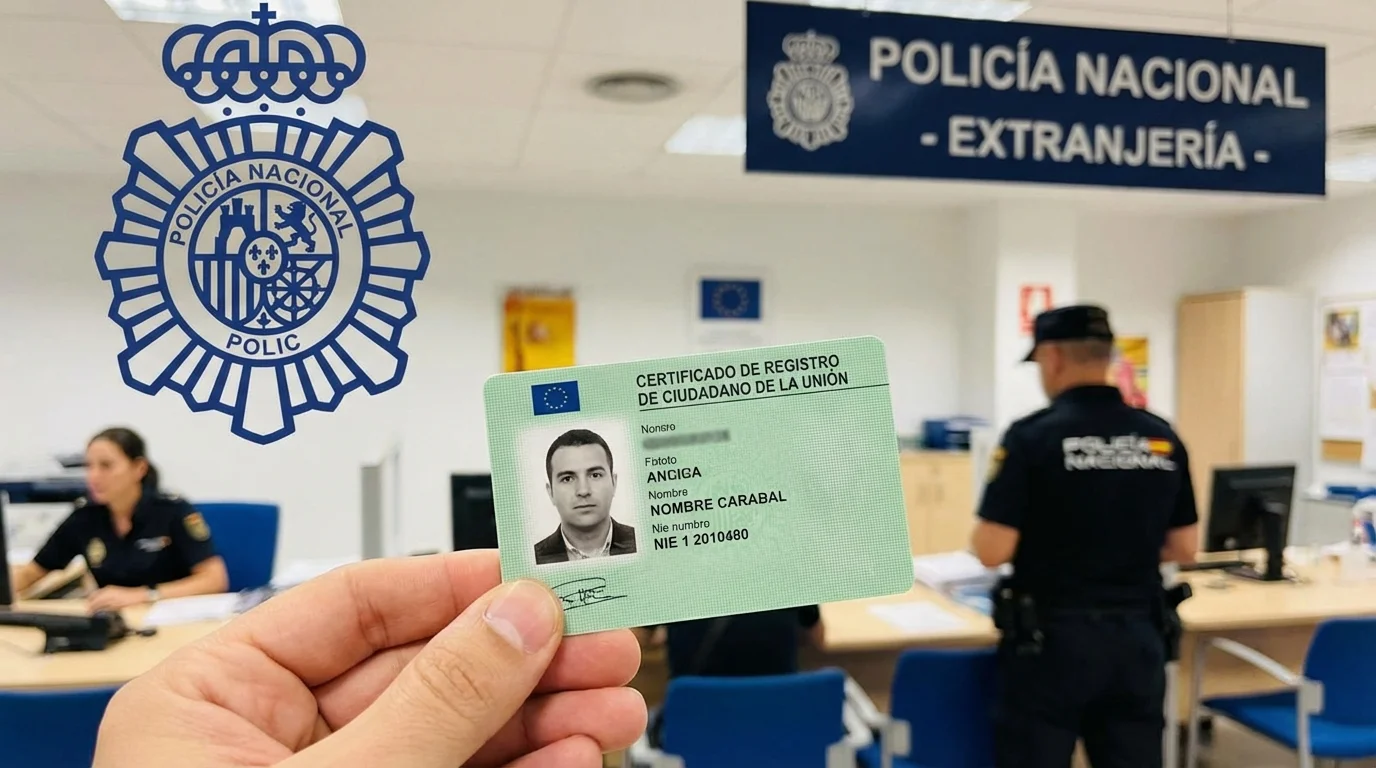
Complete guide to residencia in Spain: requirements, documents, application and what it means for your taxes. Step-by-step for Swedish citizens.
16 min

Guide to the Digital Nomad Visa in Spain: who can apply, income requirements, documents, tax implications and what Swedish remote workers should bear in mind.
The Digital Nomad Visa in Spain is essentially a visa for third-country nationals who want to live in Spain and work remotely for employers or clients outside the country. For you as a Swedish national the most important answer is simpler: you normally do not need this visa at all, since you already have EU rights to live and work in Spain. It is still a relevant topic, because many Swedes search for "digital nomad visa Spain" when trying to understand whether they can move there with a Swedish job, their own limited company or freelance assignments.
The practical side is this: the visa is based on clear document requirements, private health insurance, proof of remote work and economic levels linked to Spain's minimum wage. The model itself was introduced through the Start-up Act that came into force on 23 December 2022. The visa can be valid for up to one year, and after that it is possible to apply for a residence permit period of up to three years with the possibility of a two-year extension. In this guide we cover who the visa is for, which requirements tend to be decisive, how the tax situation works at a high level and the pitfalls Swedes often miss.
The digital nomad visa is primarily for you if you are a non-EU/EEA national and already work remotely. The Spanish law describes the target group as third-country nationals who work or carry out professional activity remotely using a computer, telecommunications and other digital tools.
In practice three profiles tend to be most common:
The law also states that applicants must be qualified. That normally means a degree, further education or at least three years of relevant professional experience. This is an important point. Many people think the visa is designed for "anyone with a laptop", but that is not the case.
For Swedish nationals the picture is different. The visa is written for third-country nationals, not for EU nationals. As a Swede you are therefore effectively comparing two different tracks: the formal digital nomad track for non-EU nationals and the EU track with residencia, NIE and potentially a special tax regime. That is where many people confuse the rules.
Information
Short version for Swedes: If you only have Swedish citizenship and want to live in Spain with a remote job, you normally do not need a digital nomad visa. What you usually need to understand instead is residencia, tax, health insurance and how to prove your means of support.
This is where the details determine whether an application goes smoothly or stalls immediately.
First, the company or group you work for must have had genuine and continuous operations for at least one year. Second, you must be able to show that the relationship already exists. If you are employed you normally need to demonstrate at least three months of employment prior to the application. If you are a consultant or freelancer the same timeline applies to the client relationship: at least three months back, plus agreements showing that the work will continue remotely.
Third, the work must genuinely be compatible with a remote arrangement. That sounds obvious, but some applications fail here. If your job in practice requires being present with a client, local sales or ongoing work in Spain, it becomes harder to justify precisely this visa.
The law itself does not set a fixed euro amount in the article, but refers to economic thresholds linked to the SMI, the Spanish minimum wage. In practice this has for a sole applicant often meant a requirement of around 200 percent of the SMI, that is over 2,800 euros per month based on the levels used in the 2025–2026 guidance and existing regulatory practice. Higher levels apply if you have a partner or children.
My experience is that the smart approach is not to aim exactly at the threshold. If you are only marginally above the minimum requirement the application becomes more sensitive if exchange rates, bonuses or irregular invoices look weak on paper. If you have uneven income it is better to be able to show twelve stable months than three strong ones.
Yes, but only to a limited extent if you are applying on a professional basis. The law states that professional activity may include work for companies in Spain, but no more than 20 percent of total activity. That is one of the most practical rules to be aware of. If you start building up a clear Spanish client base you drift away from the nomad arrangement.
It varies somewhat between consulates and individual cases, but these documents tend to form the core:
The criminal record requirement is also strict. You need to show that you have no record in Spain and in the countries where you have lived during the past two years. In addition a personal declaration covering the past five years must be submitted.
Tip
Practical tip: Start with the documents that take the longest: criminal record certificates, apostilles and translations. That is almost always where the timeline breaks down, not with the form itself.
There are two main routes. Either you apply from abroad via a Spanish consulate, or you apply from within Spain if you are already there legally. The visa gives the right to live and work remotely in Spain for its period of validity, up to one year. If you want to stay longer you can apply for a residence permit for international remote work for up to three years, and that can then be extended by two years at a time. After five years the path towards permanent residency opens.
It sounds straightforward. In reality the process is more administrative than difficult.
A typical timeline tends to look like this:
The TIE part is often forgotten. When the permit has a validity of more than six months you normally need to obtain the foreigner's ID card after approval. At the same time it is good to know that the passport during the first six months can be sufficient as a basis for registration with social security in some of these categories, before the NIE is in place.
Official processing times can look fast on paper. That does not mean your life is sorted after two weeks. What takes time for most people is the document hunt, appointment bookings and getting everything to fit together between your home country's and Spain's systems. Realistically I think you should budget 1–3 months for a well-prepared case and longer if translations, insurance or tax arrangements are not ready.
What tends to sink otherwise strong applications is rarely the main requirement. It is often small things: an employer's letter that does not explicitly state that remote work is permitted, an insurance letter that does not show full coverage in Spain, or bank documentation where the income looks uneven even though the finances are actually sound. If you want to reduce the risk of requests for additional information, each document should answer a concrete question: who pays you, how long the relationship has existed, where the work is performed and that you can genuinely support yourself once you live in Spain.
Alicante, Torrevieja and Orihuela Costa are common areas for Swedes who want to live close to an airport, good internet and lower housing costs than in Barcelona or Málaga. For those who can actually use the visa, it is often simpler to land in a city where the everyday logistics work from day one.
Properties
Explore available properties in Alicante
This is the part that attracts the most people, and the part where the most misinformation circulates.
The key point is that Spain's special impatriate regime, often called the Beckham Rule, became more accessible after the Start-up Act. For qualifying individuals who move to Spain to work remotely it can mean 24 percent tax on employment income up to 600,000 euros and 47 percent on the amount above that. At the same time the barrier for prior tax residency was lowered from ten years to five years.
That is good. But it is not the same as "all nomads get 24 percent tax".
First you need to distinguish between two questions:
If you spend more than 183 days in a calendar year in Spain you normally become tax resident there, unless a special regime applies. That means the tax question becomes real quite quickly. For Swedes this is especially important, because you often have remaining ties to Sweden: a salary from a Swedish company, dividends from your own limited company, pension or capital income.
The other thing you need to know is that freelancers and the self-employed often end up in more interpretation-sensitive situations than regular employees. Some arrangements work well; others quickly become complicated when social security, invoicing and permanent establishment come into play. If you are a Swedish consultant with your own company, you should not make decisions based solely on a TikTok video about "24 percent tax in Spain".
Note
The tax angle clearly stated: The visa can be attractive, but the tax is not automatic and not always as favourable as it sounds. For Swedes with their own company or mixed income sources, this is a point where you almost always benefit from getting advice before the move, not after.
For Swedish readers the most important point is often to choose the right path from the outset.
If you are a Swedish national you normally do not need a digital nomad visa. You can live in Spain under EU rules and instead focus on residencia, NIE, registration and a sustainable tax arrangement. The administrative fee for EU residencia is around 12 euros, which is a completely different level to a full visa application with insurance, translations and more documentation.
That does not mean everything becomes straightforward. Three things tend to cause problems even for Swedes:
You can absolutely sort everything out yourself, but Spanish administration is rarely fast by Swedish standards. That applies whether you go via the digital nomad visa or the EU track. Health insurance, empadronamiento, TIE or residencia, a bank account and a tax number often need to be sorted in the right order.
For the visa track, comprehensive private insurance is normally required. For Swedish EU citizens it can sometimes instead be a matter of an S1 certificate, employment-based entitlement or a private solution depending on the situation. What causes problems is when people assume "I'm Swedish, so healthcare will sort itself out." It will not on paper, and then you have problems long before you have finished unpacking.
If you have a Swedish limited company and plan to continue working through it while living in Spain it sounds simple. But in practice questions arise about where the work is deemed to have been performed, where social security contributions should be paid and whether the business risks acquiring Spanish tax ties. This is a typical example of where the digital nomad visa does not solve everything just because it exists.
The housing question also quickly becomes relevant. Many people who initially think "I'll test it for a few months" end up staying longer. Then the question moves from visa to everyday life: area, schools, healthcare, commuting and whether it is better to rent or buy. In Alicante a normal two-bedroom apartment is often still below the equivalent in Barcelona, and in areas like Torrevieja or Orihuela Costa you often get more property for your money.
Properties
Explore available properties in Torrevieja
This section is important, because the digital nomad visa is often promoted as a universal solution. It is not.
The visa is often the wrong route if:
It can also be the wrong route if you fundamentally do not want more bureaucracy. Because even when the law looks clear on paper, everyday life is often full of practical small things: translations, local bookings, documents with the wrong date, insurance terms that are not accepted and consulates that want to see documentation in a particular order.
For Swedes there is also a more fundamental question: is it really the visa you need, or do you just need to understand how to legally and tax-efficiently set up a life in Spain with a job that already works? Often the latter is the real question.
Yes, for the right person. If you are a third-country national, work steadily on a remote basis, have your documents in order and want to live in Spain for longer than a couple of months, this is a serious and useful route. A one-year visa followed by a three-year permit, the possibility of a two-year extension and a clear legal framework makes it significantly better than living on a tourist arrangement.
For Swedish readers the conclusion is more measured. The search term is relevant, but the visa is rarely your solution. Your real checklist is usually residencia, tax, healthcare and how you want to live once the remote life in Spain moves from a trial period to everyday reality. Start there. It saves both time and wrong turns.
Contact
We help Swedes with the next steps in Spain, whether you are just comparing areas or want to understand how life works practically on the ground.
Book a free consultationLast updated: April 2026. Rules, income levels and regulatory practice can change. Always verify current requirements before applying or moving.
Decision support
Normalt nej. Visumet är utformat för tredjelandsmedborgare, medan svenska medborgare redan har EU-rätt att bo och arbeta i Spanien.
För en svensk handlar frågan därför oftast inte om själva visumet utan om residencia, skatt, sjukförsäkring och hur distansjobbet ska struktureras praktiskt.
Grundnivån brukar knytas till 200 procent av Spaniens minimilön, vilket i praktiken har landat runt drygt 2 800 euro i månaden för ensam sökande utifrån de nivåer som använts i 2025-2026 års tillämpning. Har du partner eller barn höjs kravet.
Ligger du precis på gränsen är det klokt att ha extra marginal i underlagen.
Själva visumet kan gälla i upp till ett år. Om du vill stanna längre går det att söka uppehållstillstånd för internationellt distansarbete på upp till tre år, och det kan sedan förlängas med två år i taget.
På sikt kan det leda vidare mot permanent uppehållsrätt efter fem år.
I visumspåret är svaret i praktiken ja, eftersom du måste kunna visa att vården är täckt. För svenskar som använder EU-spåret kan det se annorlunda ut beroende på arbete, S1-intyg eller annan socialförsäkringslösning.
Just sjukvårdsdelen är en vanlig källa till förseningar, så den ska vara klar tidigt i processen.
Nej. 24 procent är kopplat till Spaniens särskilda impatriatregim och gäller inte automatiskt bara för att du får bo i Spanien. Dessutom finns villkor om tidigare skatteresidens och upplägget fungerar tydligast för vissa anställningssituationer.
För frilansare och svenska bolagsägare kan utfallet vara mer osäkert än många tror.
Sources
Complete guide to residencia in Spain: requirements, documents, application and what it means for your taxes. Step-by-step for Swedish citizens.
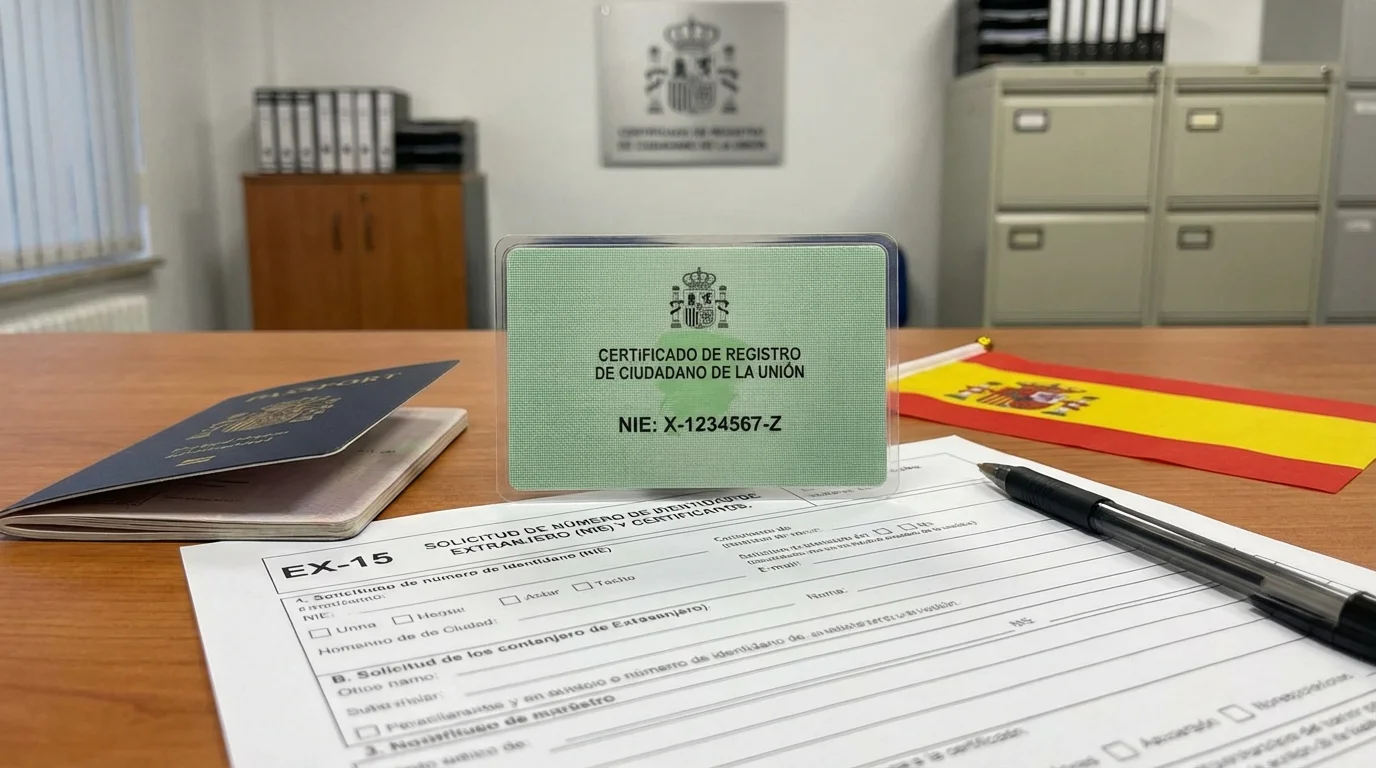
Spanish NIE number 2026: step-by-step guide from Sweden or Spain. EX-15 form, Modelo 790, €9.84 fee, waiting times and NIE/NIF/TIE explained.

Complete tax guide for Swedes with property in Spain: IBI, IRNR, wealth tax, capital gains and the double taxation agreement. Updated 2026.