


Area Guides
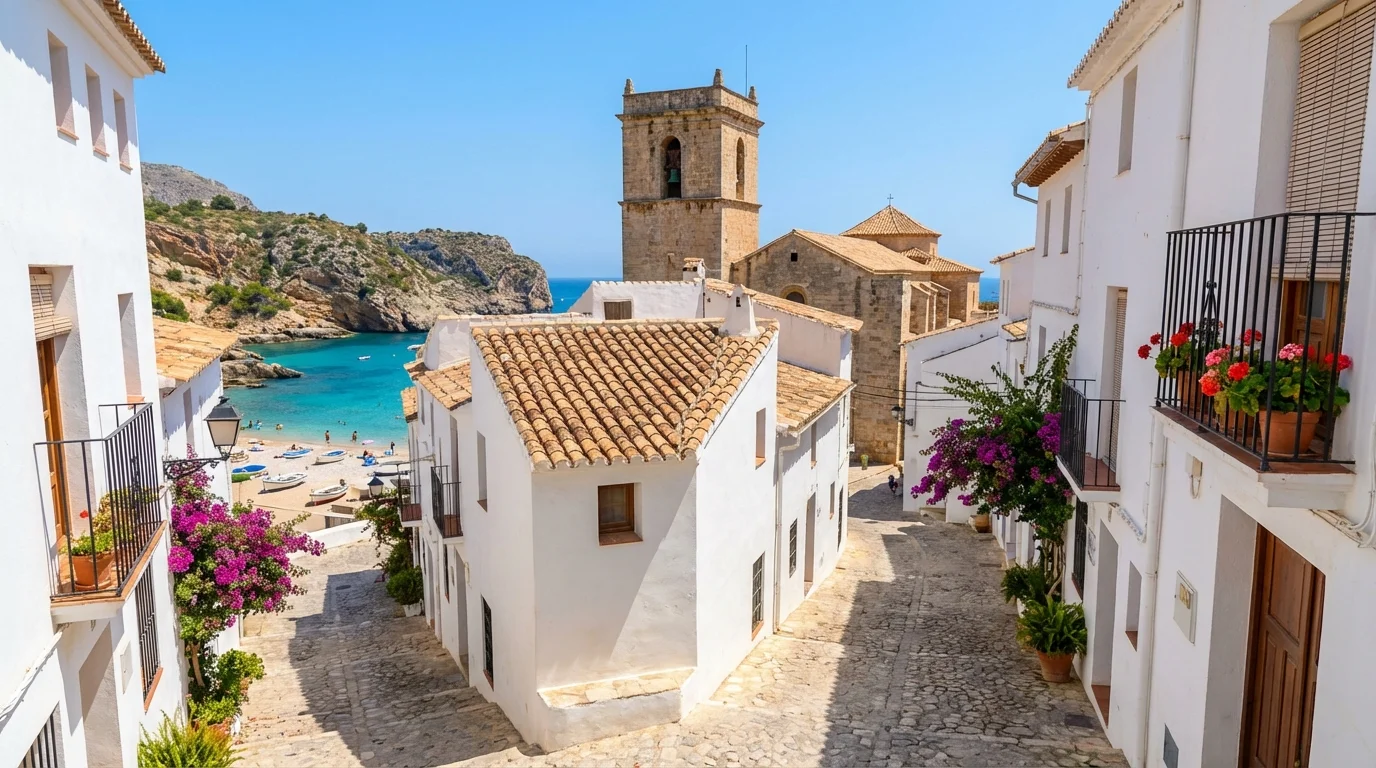
Benissa – Charming Hill Town with Coastline 2026
Complete guide to Benissa on the Costa Blanca: charming old town, hidden coves, property prices and why this is an alternative to Moraira and Calpe.
15 min
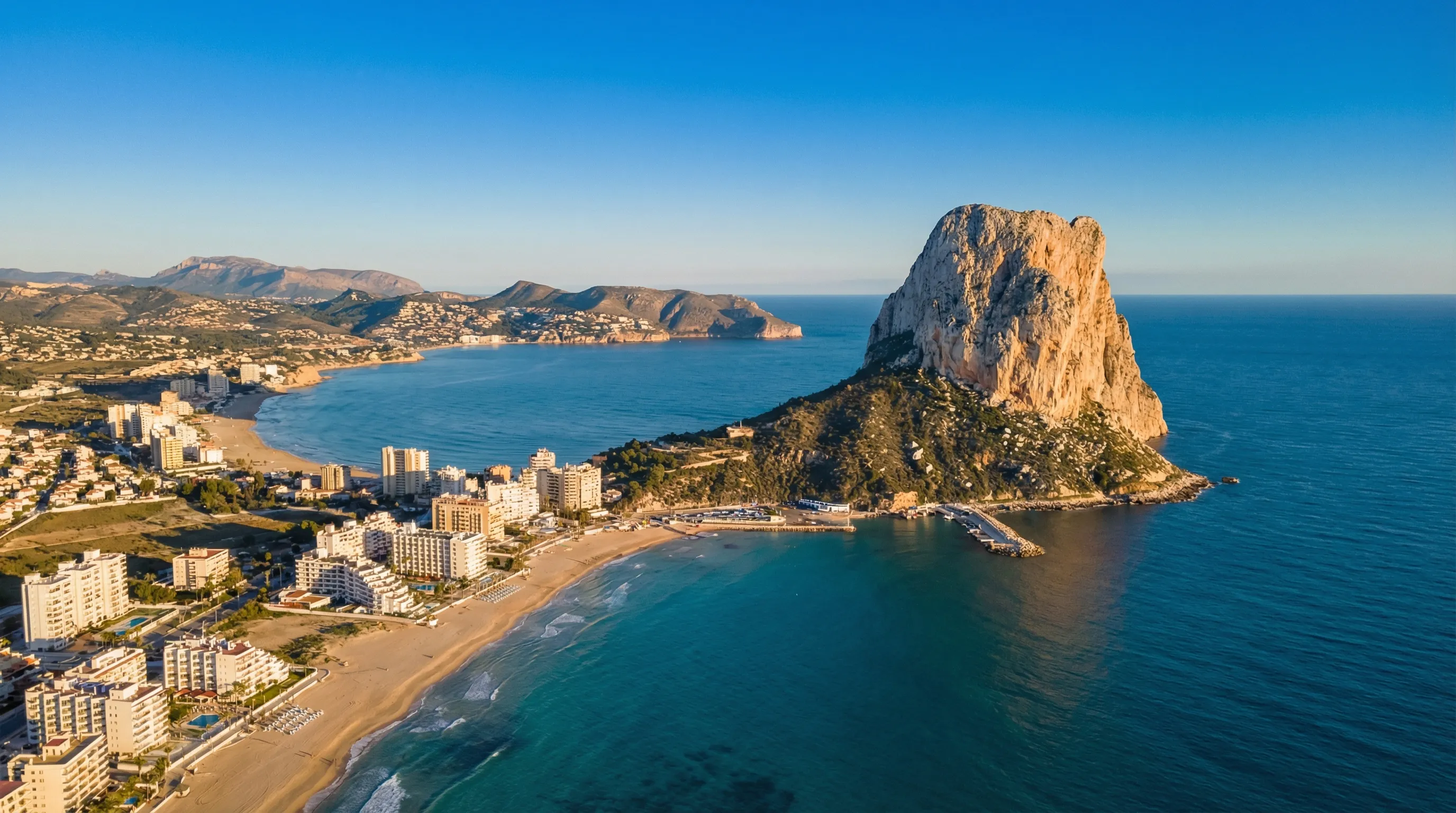
Complete guide to Calpe: Peñón de Ifach, beaches, property prices, the salt lake with flamingos and why it is one of Costa Blanca's most iconic towns.
Calpe is the town on northern Costa Blanca that appears on every other postcard — and that is down to one thing: Peñón de Ifach, the 332-metre limestone rock that rises straight out of the Mediterranean and divides the coastline into two wide sandy beaches. But Calpe is more than an iconic silhouette. The municipality has just over 27,600 inhabitants, two Blue Flag beaches, a salt lagoon with flamingos in the middle of town, a charming old town on the hill and a property range stretching from apartments around 150,000 euros to seafront villas in the millions.
The average property price in Calpe is around 3,200–3,900 euros per square metre, placing the town in the mid-range on northern Costa Blanca — cheaper than Moraira and Jávea, but more expensive than Benissa village and the inland towns. What makes Calpe unique is the combination of urban infrastructure, international atmosphere, spectacular nature and seafront living — all within walking distance.
In this guide I cover everything you need to know as a Swedish buyer: the beaches, Peñón de Ifach, the salt lake, property prices by area, the old town, climate, pros, cons and how Calpe compares to the neighbouring towns of Altea, Moraira and Benissa.
Calpe (officially Calp in Valencian) is on northern Costa Blanca in the province of Alicante, roughly halfway between Alicante city and Valencia city. The municipality borders Benissa to the north and Altea to the south, with the Bernia mountain range as a dramatic backdrop.
The distance to Alicante-Elche airport is approximately 80 kilometres — about an hour's drive via the toll-free AP-7 motorway. From Valencia airport it is around 120 kilometres. Calpe also has a TRAM station on the Alicante–Dénia line, but it is mainly useful for day trips rather than daily commuting.
Calpe itself is a compact town where most things are reachable on foot or by bicycle. From the town centre to the beach is just a few minutes' walk, and from one beach side (Arenal-Bol) to the other (La Fossa) takes 15–20 minutes to walk around the rock. That is one of Calpe's greatest advantages compared with many other coastal towns: you do not strictly need a car for everyday life.
Peñón de Ifach is a 332-metre limestone rock connected to the mainland by a narrow isthmus — after Gibraltar the most iconic landmark on Spain's Mediterranean coast. The rock was declared a nature park (Parque Natural del Peñón de Ifach) in 1987 and is one of the smallest yet most visited nature reserves in Europe.
The path to the summit is 2.2 kilometres long and rated moderate. The first 800 metres pass through a botanical garden with information signs about local flora — over 300 plant species grow here, several of them endemic. Then you reach the tunnel, blasted in 1918 to give access to the north face of the rock.
After the tunnel the character changes. The path becomes steeper with exposed rocky sections where you use your hands in places. It is not dangerous if you are in reasonable shape and have good shoes, but it is not a stroll either. Winds near the top can be strong.
The view from the summit is one of the most spectacular on the entire Costa Blanca. On clear days you can see from Ibiza to the north-east to Benidorm's skyscrapers to the south, with the salt lake, beaches and mountains as a panorama below.
Tip
The hike requires advance booking via the Generalitat Valenciana website (reservas.gva.es). The number of visitors is limited to 300 per day to protect the environment. Book at least a week ahead during high season (April–October). Start early in the morning to avoid the heat and get the best light for photography.
Peñón de Ifach is home to around thirty bird species, including rock dove, kestrel and yellow-legged gull. The endemic plant Silene de Ifach (Silene hifacensis) is found only here and on Ibiza — it is one of Europe's most endangered plant species. In spring the rock blooms in yellow and purple, and in late summer you can see migratory birds resting here on their way south.
Peñón de Ifach divides Calpe's coastline into two main beaches that are mirror images of each other — both wide, sandy and with full beach services. In addition there are two smaller coves offering more sheltered bathing.
Arenal-Bol lies to the south of Peñón de Ifach and is the beach most people associate with Calpe. The beach is approximately 1.2 kilometres long with fine golden sand, a shallow seabed and a wide promenade (Paseo Marítimo) lined with restaurants, cafés and ice cream parlours.
The beach has Blue Flag status, lifeguards in high season, toilets, showers, sun lounger and umbrella hire and several chiringuitos (beach bars). The water is calm and shallow, making it ideal for families. From the beach you also have the iconic view of Peñón de Ifach rising to the north.
Properties along Arenal-Bol are among Calpe's most expensive, with apartment prices of 4,000–5,200 euros per square metre for seafront units.
La Fossa lies to the north of the rock and is slightly quieter than Arenal-Bol, especially outside high season. The beach is around 900 metres long with similar sand quality and beach services. Here the view is different — you look south towards the rock instead of north, and the evening sun sets over Sierra de Bernia to the west.
La Fossa is popular among international residents, and that shows in the beach bar menus, which are often multilingual. Property price levels are comparable to Arenal-Bol, slightly higher for first-line seafront positions.
Cantal Roig is a small, sheltered cove right next to Calpe's fishing harbour. The water is shallow and still thanks to the harbour's breakwater, making it an excellent choice for families with young children. Some of Calpe's best fish restaurants are also here — you can literally eat freshly grilled fish with your feet almost in the water.
North of La Fossa, near the border with Benissa, lies Les Bassetes — a rocky cove with crystal-clear water and rich marine life. The area is popular for snorkelling and diving, with posidonia meadows (seagrass beds) that shelter fish species you do not see on the larger beaches. There is a small marina and a diving school here.
Information
Calpe's beaches regularly receive the Blue Flag award for water quality, safety and accessibility. Arenal-Bol and La Fossa are among the best-rated beaches on northern Costa Blanca. During high season (July–August) they can get busy — arrive before 10:00 or after 17:00 to find a spot.
In the middle of Calpe, just a few hundred metres from the beach and the central neighbourhoods, lies Las Salinas — a saltwater lagoon of around 41 hectares that is one of Costa Blanca's most surprising natural experiences. Salt has been harvested here since Roman times, and the lagoon is today a protected nature area.
The most famous feature is the flamingo colony. Up to a hundred flamingos can be seen in the lake, especially during autumn and winter when they rest during migration. It is one of the few places in Europe where you can observe flamingos against an urban backdrop — the salt lake is literally wedged between residential areas and a shopping centre.
Las Salinas is also home to stilts, herons, ducks and other wading birds. There is a signposted walk around the lagoon with viewing platforms, information boards and benches. The walk takes about 30–40 minutes and is completely flat — accessible for wheelchair users and pushchairs.
Tip
The best time to see flamingos is early morning or late afternoon, October to February. Bring binoculars — the birds often stay at the far end of the lake. Parking is available at the Centro Comercial Ifach next to the lagoon.
Calpe's property market is broad — from simpler apartments on the outskirts to luxury apartments with a seafront position. The average price per square metre is 3,200–3,900 euros depending on area and source, with a price increase of around 5–8% over the past year.
Price overview
| Area | Apartment | Villa | Townhouse |
|---|---|---|---|
| Arenal-Bol/Cantal Roig (seafront) | 250,000–450,000 € | — | — |
| La Fossa (seafront apartment) | 220,000–400,000 € | — | — |
| Town centre (apartment) | 150,000–280,000 € | — | — |
| Oltamar/Cucarres (inland) | 120,000–200,000 € | 250,000–450,000 € | 180,000–300,000 € |
| Villa with sea views | — | 400,000–900,000 € | — |
| Luxury villa (new build) | — | 800,000–2,000,000+ € | — |
Seafront apartments in Arenal-Bol and the Playas area command the highest prices per square metre — up to 5,200 euros. More affordable areas such as Oltamar and Cucarres, a few minutes' drive from the beach, average around 3,200 euros per square metre — still with access to all infrastructure.
Expect 10–14% in additional costs on top of the purchase price: transfer tax (ITP, 9% in the Valencia region for resale since June 2026), notary fees, land registry and legal fees. For new build, 10% VAT (IVA) applies instead of ITP.
Properties
Explore available properties in Calpe
Calpe has a Mediterranean climate with over 320 sunny days a year. It is one of the climates that makes Costa Blanca so attractive to northern European buyers.
Temperatures through the year:
Rainfall falls mainly in autumn, with October as the wettest month. Annual precipitation is low — around 350–400 mm. Be aware of the DANA phenomenon (gota fría) — sudden, heavy rainstorms in autumn that can cause flooding in low-lying areas. It does not happen every year but it is something to be aware of.
Calpe is one of the most international communities in all of Spain. According to INE's latest data (2024), 53% of registered residents are foreign nationals — making Calpe the only municipality in Spain with over 20,000 inhabitants where foreign nationals are in the majority. If persons born abroad are counted, the figure rises to 56%.
The largest foreign groups are British (still a significant group despite Brexit), Germans, Dutch, Belgians, French and Scandinavians. In recent years the number of Ukrainian and Russian residents has also increased markedly. In summer the population increases considerably with tourists and seasonal residents.
For Swedish buyers this means that Calpe has a well-established international infrastructure: multilingual services at banks, medical centres, dining clubs, estate agents and restaurants. It is easy to get by in English, but Spanish is of course an advantage for deeper integration.
The downside is that Calpe lacks the genuinely Spanish village character that places like Benissa village offer. In high season it can feel more like an international beach resort than a Spanish coastal town.
Calpe's old town (casco antiguo) sits on the hill behind the harbour, a little way from the beaches. Like many coastal communities on Costa Blanca, the village was deliberately built inland and up high — to protect against pirates and raiders from North Africa.
The historic centre is a labyrinth of narrow, cobbled streets with white-painted façades, decorated staircases (the colourful Escalera del Mediterráneo is a popular photo spot) and small squares with outdoor dining. Torre de la Peça, a defensive tower from the 15th century that formed part of the town walls, stands in the centre and is one of Calpe's most important historic monuments.
Other sights in the old town include:
The old town is lively with both residents and visitors, especially in the evenings when restaurants bring their tables out onto the streets. It is not as monumental as Benissa's medieval village or as photogenic as Altea's white old town with its blue church dome — but it has its own charm and character.
Calpe is above all a fishing town, and the best restaurants reflect that. The fishing harbour is active and delivers the daily catch directly to restaurants.
Fish restaurants and seafood places at the harbour: Along the Cantal Roig cove and harbour there are half a dozen fish restaurants serving arroz a banda (the local rice dish with fish broth), suquet de peix (fish stew), gambas rojas (red prawns from Calpe) and freshly grilled fish by weight. These are not tourist traps — local Spaniards eat here on Sundays.
Calle Gabriel Miró: The old town's food street with a wide range from tapas and pintxos to more refined dinners. In summer everything is served outdoors.
International range: Calpe's international population is reflected in the restaurant scene. You will find Indian, Chinese, British pubs, Italian trattorias and Scandinavian cafés without difficulty. For Swedish buyers who miss a certain cuisine from home, the range is broader than in most smaller towns.
Markets: Calpe's weekly market is held on Saturdays in the town centre with local products — fruit, vegetables, olive oil, sausages, cheese and honey. On Wednesdays there is a larger market with also clothes and household items.
Advantages:
Disadvantages:
Note
Calpe has some areas of older buildings from the 1970s and 80s that are showing their age. Always inspect a property thoroughly and hire an independent surveyor (perito) before buying. In particular check plumbing, electrical installations and any damp problems — renovation costs can quickly eat up a "cheap" purchase price.
The four towns lie in a row along northern Costa Blanca, all within 15–20 minutes' drive of each other. But they offer very different living experiences.
Calpe is the most urban and international of the four — a town with almost 28,000 inhabitants, wide sandy beaches, full infrastructure and an iconic landmark. More than half of the population is foreign. Calpe suits you if you want beach-side town life with everything within walking distance.
Altea is the artistic neighbour — a bohemian coastal town with a photogenic white old town, an art university and a more exclusive, creative atmosphere. Prices are slightly higher than in Calpe (3,500–4,200 euros per square metre), the beaches are pebble rather than sand, and the pace is quieter. Altea suits you if you seek culture and aesthetics rather than beach life.
Moraira is the exclusive, quieter coast — a small town with a marina, Michelin-level restaurants and a Belgian-and-Dutch-dominated expat community. Property prices are the highest in the region (average price around 4,700 euros per square metre). Moraira suits you if you seek tranquillity, high quality and are prepared to pay for it.
Benissa is the affordable alternative — a medieval inland village with spectacular rocky coves and the lowest prices in the village part (apartments from 120,000 euros). Benissa lacks Calpe's wide sandy beaches and town life, but offers the most genuinely Spanish village environment of the four. A car is essential.
For Swedish buyers looking for beach-side living with urban infrastructure, Calpe is the most balanced choice. If you want lower prices and a Spanish village character, look at Benissa. If you want exclusivity, choose Moraira. If you want culture and aesthetics, choose Altea.
Properties
Explore available properties in Costa Blanca
Browse current homes in the area and compare locations, price levels and property types at your own pace.
Contact
We help Swedish buyers find the right property on northern Costa Blanca — from seafront apartments at Arenal-Bol to villas with sea views and mountain panoramas. Tell us what you are looking for and we will come back with a selection that matches your wishes.
Book free consultationLast updated: April 2026. Prices and regulations can change — contact us for current information.
Decision support
Alicante-Elche flygplats ligger cirka 80 kilometer från Calpe. Med bil tar resan ungefär en timme via AP-7 motorvägen.
Det finns även ALSA-bussar från flygplatsen med flera avgångar per dag. Från Sverige flyger SAS, Norwegian och Ryanair direkt till Alicante på 3,5-4 timmar.
Calpe ligger i mellansegmentet på norra Costa Blanca. Genomsnittspriset är cirka 3 200-3 900 euro per kvadratmeter beroende på källa och område.
Det är billigare än Moraira och Jávea men dyrare än Benissa pueblo och La Nucia. Strandnära lägenheter vid Arenal-Bol och La Fossa är dyrast, medan områden som Oltamar och Cucarres är mer prisvärda.
Ja, vandringen till toppen av Peñón de Ifach är öppen för allmänheten men kräver förbokning via Generalitat Valencianas hemsida (reservas.gva.es). Stigen är 2,2 kilometer lång och tar 1,5-2 timmar tur och retur.
Den första halvan är enkel, men efter tunneln (byggd 1918) blir den brantare med klippiga partier. Utsikten från toppen på 332 meter är en av Costa Blancas mest spektakulära.
Calpes två huvudstränder är Playa Arenal-Bol (söder om Peñón de Ifach) och Playa La Fossa/Levante (norr om klippan). Båda är breda sandstränder med Blå flagg-status, strandservice och promenadsträck.
Cantal Roig är en mindre familjevik nära hamnen med grunt vatten. Där finns även Cala Les Bassetes, en liten vik nära saltsjön som är perfekt för snorkling.
Ja, Las Salinas, saltsjön mitt i Calpe, är hem för en koloni flamingos som kan ses året runt, men framför allt under höst och vinter när de rastar under sin migration. Saltsjön är ett skyddat naturområde med utsiktsplatser och informationsskyltar.
Det är ett av få ställen i Europa där du kan se flamingos med en stadsmiljö som bakgrund.
Sources

Serrallonga, Alicante

Altea Hills, Alicante

Racó Del Galeno, Alicante

La Fustera, Alicante

Rincón De Loix, Alicante

Racó Del Galeno, Alicante
Local expertise
Complete guide to Benissa on the Costa Blanca: charming old town, hidden coves, property prices and why this is an alternative to Moraira and Calpe.
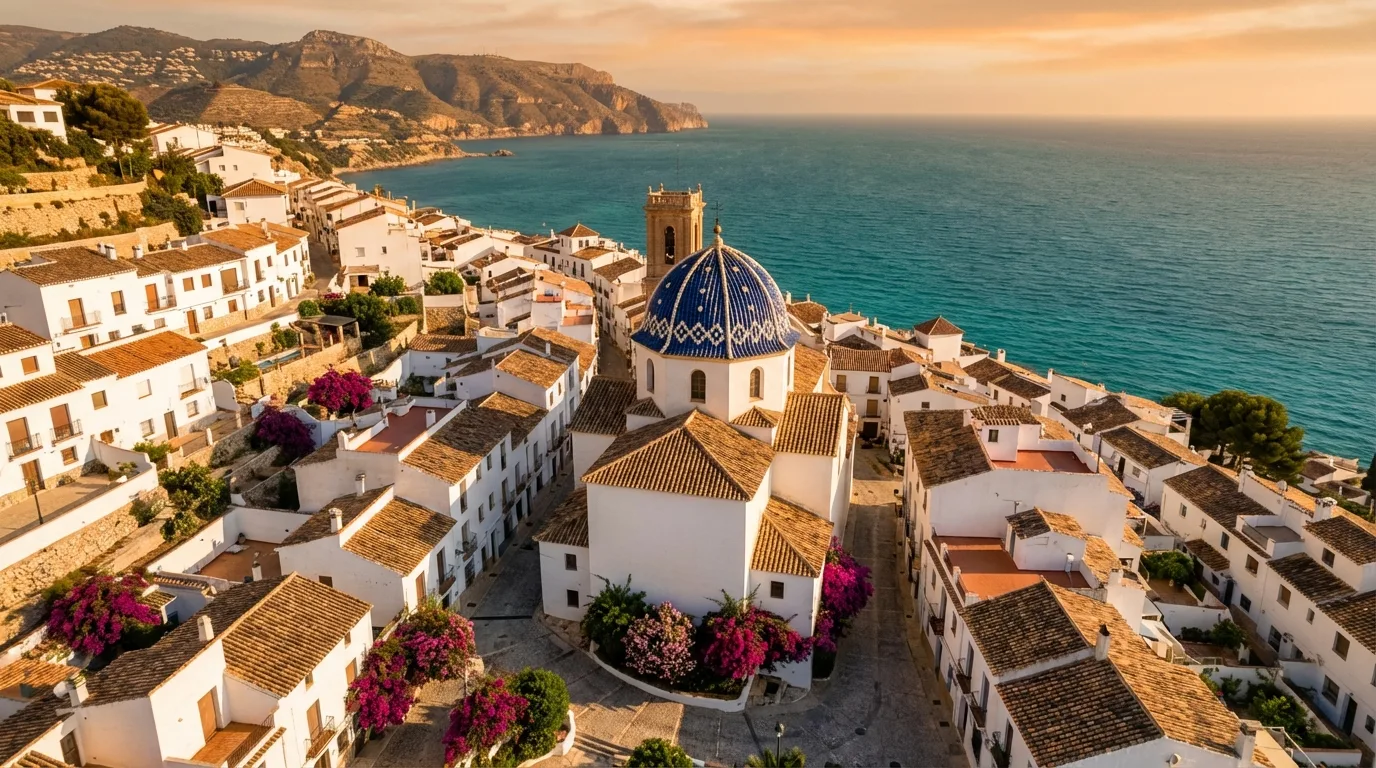
Complete guide to Altea: the white artists' town with its blue church dome, charming lanes, property prices, and why it is called the jewel of the Costa Blanca.
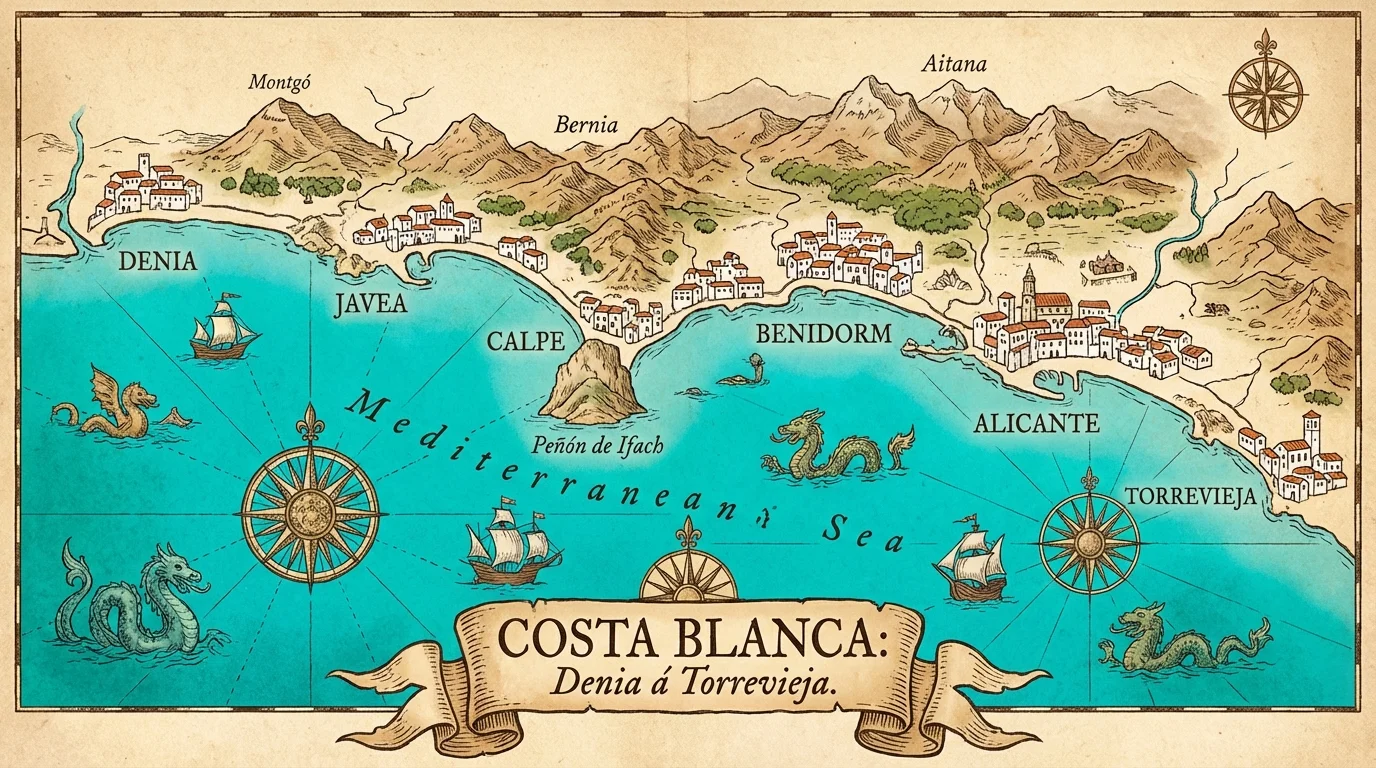
Overview of the Costa Blanca: towns and areas from Dénia to Pilar de la Horadada — map, distances, prices and tips for Swedish buyers 2026.