
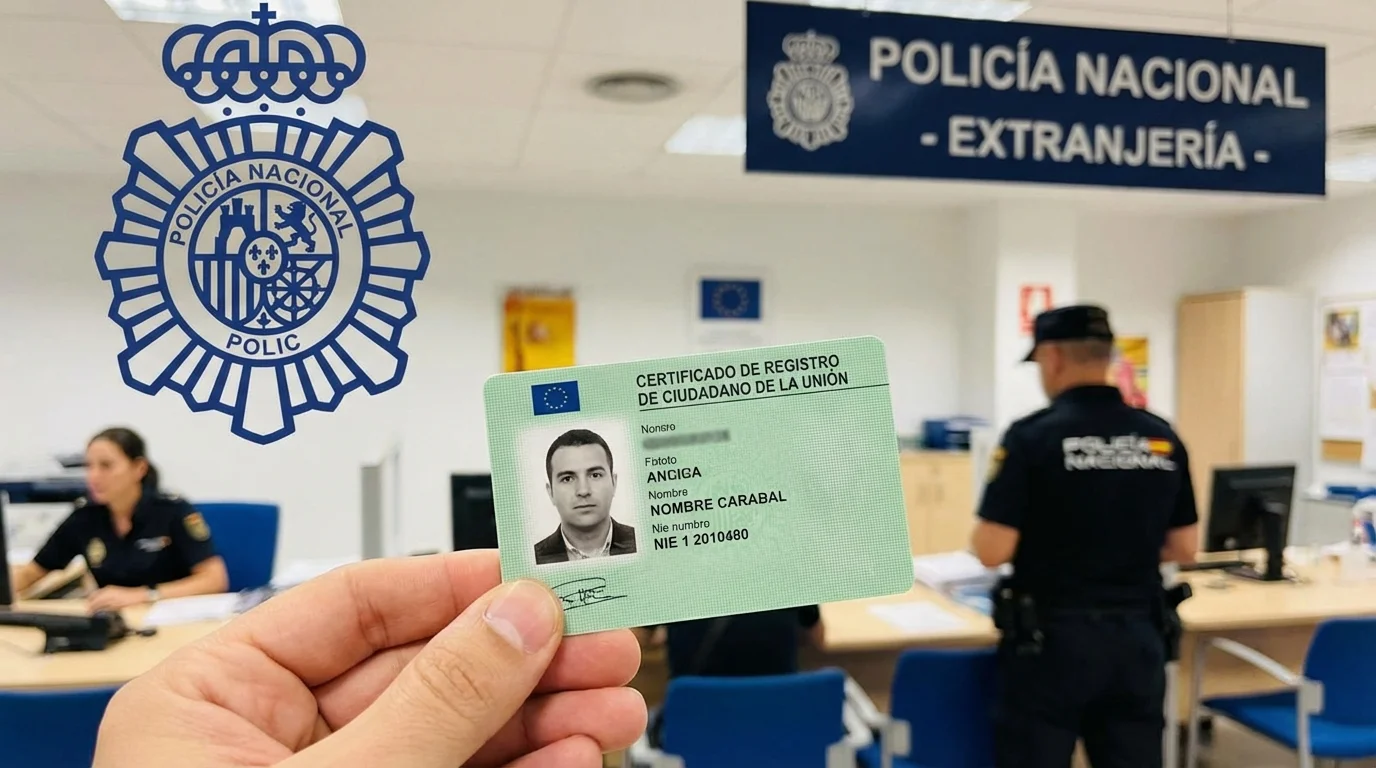
Moving & Living
Residencia in Spain – Documents, Timeline and NIE vs Padrón 2026
Complete guide to residencia in Spain: requirements, documents, application and what it means for your taxes. Step-by-step for Swedish citizens.
16 min
Buying a car in Spain 2026: used cars 10–20% cheaper than Sweden, re-registration €700–1,500. Licences, insurance and traffic rules for residents.
Do you need a car in Spain? The short answer: yes, almost always — if you live outside the largest cities. Public transport along the coasts is limited and a car gives you the freedom to reach beaches, mountain villages and supermarkets without depending on bus timetables. But should you buy a car locally or bring your Swedish one? And what does it actually cost?
Buying a second-hand car directly in Spain is in most cases simpler and cheaper than re-registering a Swedish car. Prices for used cars are 10–20% lower than in Sweden, and you avoid a re-registration process that costs 700–1,500 euros and takes 4–8 weeks. But there are situations where it pays to bring your car — particularly if you own a relatively new car you want to keep.
In this guide we go through both options step by step: how to buy second-hand in Spain, how to re-register a Swedish car, what applies for driving licences and insurance, and traffic rules that differ from Sweden.
Key takeaways
- Second-hand cars in Spain cost on average 10–20% less than in Sweden for comparable models
- Re-registering a Swedish car costs €700–1,500 in total and takes 4–8 weeks. Buy second-hand if your car is older than 5 years or worth under €10,000
- As a resident you have 60 days to re-register the car with Spanish plates from the date you received your residencia
- The blood-alcohol limit is 0.5 (0.3 for new drivers) and Spain has a 12-point penalty system. Lose them all and you must redo the entire licence process
- Since 2021, 30 km/h is the default in built-up areas on single-lane streets without a sign
The first decision you need to make. Here is an honest comparison:
Overview
Rule of thumb: Is your Swedish car older than 5 years or worth less than 10,000 euros? Sell it in Sweden and buy second-hand in Spain. Is it newer and in good condition? Then it may be worth bringing it.
Buying a used car in Spain is similar to the process in Sweden, but there are important differences — particularly around documentation and inspection.
The biggest platforms for used cars in Spain:
In coastal areas such as Torrevieja and Alicante there are also local car dealers targeting Scandinavian customers who speak English or even Swedish.
Before going ahead with a used car, always check these points:
1. Informe de vehículo (vehicle report)
Order an informe de vehículo from the DGT (Dirección General de Tráfico) via their website or a gestoría. The report costs 8–9 euros and shows:
Never buy a car without first checking this report. A car with outstanding debts (embargos) can be seized — even if you bought it in good faith.
2. ITV (Inspección Técnica de Vehículos)
ITV is Spain's equivalent of the Swedish vehicle inspection (besiktning). Check that the car has a valid ITV — this is shown by a sticker on the windscreen and the ITV card. The rules:
ITV intervals (passenger car)
0–4 years
No ITV
Standard for a passenger car.
4–10 years
Every two years
Older than 10 years
Every year
An ITV inspection costs 40–60 euros depending on the region. If the car fails its ITV at the first attempt you normally have 2 months to remedy the deficiencies and have a re-inspection at a reduced price.
3. Mileage
Tampered mileage is unfortunately more common in Spain than in Sweden. Check that the odometer reading matches the service history and ITV records (the mileage is noted at each inspection).
Note
Warning: Never buy a car that lacks a valid ITV, has an unclear ownership history or where the seller refuses to show the Informe de vehículo. Always ask to see the physical ITV card (tarjeta de inspección técnica) and compare it with the windscreen sticker.
Step 1: Negotiate the price. Bargains are more common in Spain — negotiating is expected. Expect to be able to knock 5–15% off private seller prices.
Step 2: Sign a purchase contract. Use a contrato de compraventa (purchase contract). Standard templates are available on the DGT website. The contract must include: both parties' NIE/DNI, the car's details (matrícula, chassis number), price and date.
Step 3: Pay ITP (transfer tax). When buying a used car you pay ITP (Impuesto de Transmisiones Patrimoniales). Cars count as movable property, so the rate is lower than for property purchases. It varies by region, and older cars often pay a flat fee instead of a percentage:
ITP on used cars (general rate by region)
Valencia region
6 %
Costa Blanca · 8 % for newer or larger cars
Murcia
4 %
Costa Cálida
Andalusia
4 %
Costa del Sol · 8 % above 15 fiscal hp
Catalonia
5 %
cars 10 years or older: normally no tax
The rate depends on the car's age and engine. In the Valencia region you pay a flat fee instead of a percentage if the car is more than 5 years old and worth under 20,000 euros: 120–280 euros for cars aged 5–12 years and 40–140 euros for cars over 12 years, depending on engine size. Cars up to 5 years old with more than 2,000 cc, as well as cars worth 20,000 euros or more, are instead taxed at 8%. Murcia charges a flat 0–75 euros for cars older than 12 years, Andalusia raises the rate to 8% for cars above 15 fiscal horsepower, and in Catalonia you normally pay nothing at all for cars 10 years or older (except classic cars and cars with a list price of 40,000 euros or more). The percentage is calculated on the car's valor fiscal (tax value), not the purchase price. The tax value is based on the Ministry of Finance's annual value tables and is often lower than the market price for older cars.
Step 4: Transfer ownership. Complete a transferencia at the DGT (online via their Sede Electrónica or via a gestoría). The fee is 55.70 euros. You need: purchase contract, ITP receipt, both parties' ID, valid ITV and the car's permiso de circulación (registration document).
Step 5: Take out insurance. The car must be insured before you drive away. See the insurance section below.
Tip
Tip: Engage a gestoría (administrative agency) for the ownership transfer. They handle all the paperwork for 100–200 euros and you avoid queuing at the DGT. Many gestorías in coastal areas speak English. Ask your estate agent or network for recommendations.
If you have decided to bring your Swedish car, the following applies: as a resident in Spain you have 60 days from the registration date of your residencia to re-register the car to Spanish plates. The process is called matriculación and involves several steps.
1. Obtain a NIE number and residencia You must be a registered resident in Spain. Without residencia you cannot re-register the car. Read our guide on residencia for that process.
2. Book and complete an ITV inspection Your Swedish car must pass a Spanish ITV inspection. Book an appointment at an ITV station (available in most towns). The inspection checks the same points as Swedish vehicle inspection plus that the car meets Spanish requirements. Common issues for Swedish cars:
Cost: 40–60 euros.
3. Pay registration tax (Impuesto de Matriculación) The registration tax is based on the car's CO2 emissions:
Registration tax (Impuesto de Matriculación)
0–120 g/km
0 %
121–160 g/km
4.75 %
161–200 g/km
9.75 %
Over 200 g/km
14.75 %
The tax is calculated on the car's market value in Spain (not what you paid in Sweden). Cars with low emissions — electric cars, hybrids and efficient small cars — can therefore be registered tax-free.
4. Apply for Spanish plates Submit your application to the Jefatura Provincial de Tráfico with: passport, NIE, residencia certificate, Swedish registration document, ITV approval, proof of paid registration tax, insurance certificate and customs declaration (if applicable). You are assigned a Spanish registration number and receive new plates.
5. Notify the Swedish Transport Agency De-register the car in Sweden via the Swedish Transport Agency website. You need the Spanish registration document as supporting evidence.
Typical items for re-registration
ITV inspection
40–60 €
Registration tax
0–2,000+ €
0–14.75% of the car's value depending on CO₂.
DGT fee
99.77 €
New plates
30–50 €
Gestoría
200–400 €
Optional but often worth it.
Total (low emissions)
approx. 400–600 €
Total (average)
approx. 700–1,500 €
Information
Did you know? If you are moving to Spain permanently and the car has been registered in your name in Sweden for at least 12 months, under certain conditions you can import it duty-free and without registration tax (exención por traslado de residencia). You must apply to the Agencia Tributaria within 60 days of registering your residencia and prove the car was used for at least 6 months. This can save thousands of euros — but the requirements are strict and the documentation must be complete. Engage a gestoría experienced in this.
As an EU citizen with a Swedish driving licence you are entitled to drive in Spain without exchanging your licence. But there are nuances that are important to know.
Your Swedish driving licence is valid throughout the EU. You do not need to do a canje (exchange) as long as the licence has not expired. However, the DGT strongly recommends that you register your licence in the Spanish system, particularly if you:
The registration (canje voluntario) is done at the Jefatura de Tráfico and costs approximately 30 euros. You need: your Swedish driving licence, NIE, residencia certificate, a medical certificate (certificado médico) from an authorised CRC centre (Centro de Reconocimiento de Conductores) costing 20–40 euros, and a passport photo.
Spanish driving licences are renewed at the following intervals:
Renewal requires a medical certificate (vision, reaction time, health) and costs 40–60 euros in total including the medical examination.
Spain has a points system with 12 starting points (8 for new drivers). Violations deduct points — if you lose all 12 you lose your licence and must retake the theory test and practical test. Serious violations costing the most points:
Car insurance (seguro de automóvil) is compulsory in Spain. There are three main levels:
The absolute minimum — equivalent to Swedish compulsory motor insurance. Covers damage you cause to others, but not your own car. Costs 200–400 euros/year.
The most popular level among residents in Spain. Includes third party liability plus:
Costs 350–600 euros/year. Recommended for most cars.
Equivalent to Swedish comprehensive insurance. Covers everything including damage to your own car in an accident, regardless of fault. Available with or without excess (franquicia). Costs 500–900 euros/year.
Worth it for cars up to 5 years old or worth more than 15,000 euros.
Properties
Explore available properties in Costa Blanca
Browse current homes in the area and compare locations, price levels and property types at your own pace.
Spanish traffic rules are broadly similar to Swedish ones, but there are important differences you should know to avoid fines.
Speed limits — quick overview
Spain 20–50 km/h
Since 2021: 30 km/h is often the standard on single-lane streets without a sign. Sweden: 30–50 km/h.
90 km/h
Spain: 90 km/h. Sweden: 70–90 km/h depending on road.
120 km/h
Spain: 120 km/h on autopista. Sweden: 110–120 km/h.
Since 2021 the standard speed limit in built-up areas on single-lane streets in Spain is 30 km/h. This surprises many Swedes who expect 50 km/h. Signs show the applicable limit — but if there is no sign, 30 km/h applies in built-up areas.
Spain has 0.5 per mille as the limit (0.3 for new drivers with less than 2 years' experience and professional drivers). This is higher than Sweden's 0.2 per mille — but do not make the mistake of drinking more freely. Fines at 0.5–1.0 per mille: 500–1,000 euros plus 4–6 points.
Same basic rule as in Sweden: vehicles inside the roundabout have priority. But in practice many Spanish drivers stay in the outer lane all the way round the roundabout, which creates chaos. Be extra alert and signal clearly when exiting.
Total ban on holding a mobile phone while driving — even at a red light or in stationary traffic. Fine: 200 euros and 6 points. Hands-free is permitted but wired headsets are not recommended by the DGT.
Yellow markings (vado permanente) at garages and gates mean no parking at any time. The car can be towed without warning — cost: 100–200 euros plus a daily storage fee.
Parking rules follow a colour system that quickly becomes logical:
Markings for on-street parking
Blue line
Pay and display (ORA)
Often max 2 h. App or machine. Approx. 0.50–2.50 €/hour.
Green line
Resident zone
Cheaper/free with tarjeta de residente; visitors same as blue zone.
White line
Free parking
Free unless otherwise indicated — rare in city centres.
Yellow line
No parking
Never permitted.
Yellow zigzag
Loading zone
Short stop for loading — often max approx. 30 min.
In towns such as Torrevieja and along the entire Costa Blanca the blue zones are extended during the summer months (June–September) and charges can be increased. Many shopping centres and supermarkets have free parking.
Parking fines in Spain are 40–200 euros. If you pay within 20 days of issue you get a 50% discount on most fines.
Spain has been gradually reducing the number of toll roads. Since 2021–2023 several major motorways (AP-7 along the Mediterranean coast, AP-4 Seville–Cádiz) have become toll-free.
Short stretches: 2–5 euros. Longer stretches (e.g. Barcelona–Zaragoza): 15–25 euros one way.
The toll-free alternatives — autovías (marked A-) — have the same speed limit (120 km/h) and are often just as good as the old toll roads. Along the Costa Blanca you will in practice never need to pay a road toll.
Running costs for a car are generally lower in Spain than in Sweden. Here is a realistic budget:
Budget per year (excluding fuel)
Insurance
350–600 €
terceros ampliado
IVTM
60–150 €
road tax
ITV
40–60 €
every two years/annually depending on age
Servicing
300–600 €
Total
750–1,410 €
excl. fuel
Each municipality sets its own road tax based on the car's engine power (caballos fiscales). Typical annual amounts:
IVTM (indicative per year)
Up to 8 hp
25–60 €
small car
8–12 hp
65–130 €
mid-range
12–16 hp
135–270 €
larger car
Over 16 hp
170–400 €
large/luxury
IVTM is generally paid once a year, normally in spring. Many municipalities offer direct debit with a 5% discount.
Fuel prices in Spain are below the European average but vary:
The cheapest option is to fill up at supermarket petrol stations (Carrefour, Alcampo, BonÀrea) and at smaller chains such as Ballenoil and Plenoil. Use the Gasall app or the website geoportalgasolineras.es (Ministerio para la Transición Ecológica) to find the cheapest stations in your area.
Electric cars are growing rapidly in Spain. Charging infrastructure has improved significantly in 2024–2026 but is still unevenly distributed — better in cities and along motorways, sparser in rural areas and smaller coastal towns. Electric cars are exempt from registration tax and have reduced or waived IVTM in many municipalities. Home charging via solar panels (common in Spain) further reduces running costs.
Contact
Get in touch and we'll guide you forward — whether you're just starting out or ready to buy.
Contact usLast updated: April 2026. Prices, fees and rules may change — contact us for current information.
Decision support
Som turist kan du köra obegränsat med svenska skyltar. Men blir du resident (bor i Spanien mer än 183 dagar per år) har du 60 dagar på dig att omregistrera bilen till spanska skyltar, räknat från det datum du registrerade din residencia.
Kör du med svenska skyltar efter 60-dagarsfristen riskerar du böter på 200-500 euro vid trafikkontroll och bilen kan beslagtas.
Nej, inte omedelbart. Ditt svenska körkort gäller i Spanien som EU-medborgare.
Men vid förnyelse (svenskt körkort gäller i 10 år) måste du förnya i Spanien om du är resident. DGT rekommenderar att du registrerar ditt körkort i deras system (canje) för att underlätta vid kontroller och vid eventuella prickar.
Processen kostar cirka 30 euro och görs vid din lokala Jefatura de Tráfico.
Räkna med totalt 700-1 500 euro beroende på bilens ålder och värde. De största posterna är registreringsskatt (Impuesto de Matriculación, 0-14,75 % av bilens värde baserat på CO2-utsläpp), ITV-besiktning (40-60 euro), nya spanska skyltar (30-50 euro) och gestoría-avgift om du anlitar ombud (200-400 euro).
Bilar äldre än 10 år med låga utsläpp slipper ofta registreringsskatten helt.
I de flesta fall är det billigare och enklare att köpa en begagnad bil direkt i Spanien. Omregistrering av en svensk bil kostar 700-1 500 euro i avgifter, kräver ITV-besiktning och tar 4-8 veckor.
En begagnad bil i Spanien har redan spanska skyltar, spansk försäkring och ITV. Priserna på begagnade bilar är dessutom 10-20 % lägre i Spanien jämfört med Sverige för likvärdiga modeller.
Minst trafikförsäkring (seguro a terceros) krävs enligt lag, men för de flesta rekommenderas terceros ampliado som även täcker stöld, brand och glasskador. Helförsäkring (todo riesgo) lönar sig för bilar under 5 år.
Kostnaden varierar mellan 300 och 900 euro per år beroende på försäkringstyp, bilens ålder och förarens historik. Jämför priser på Rastreator.com eller Acierto.com.
Sources
Complete guide to residencia in Spain: requirements, documents, application and what it means for your taxes. Step-by-step for Swedish citizens.
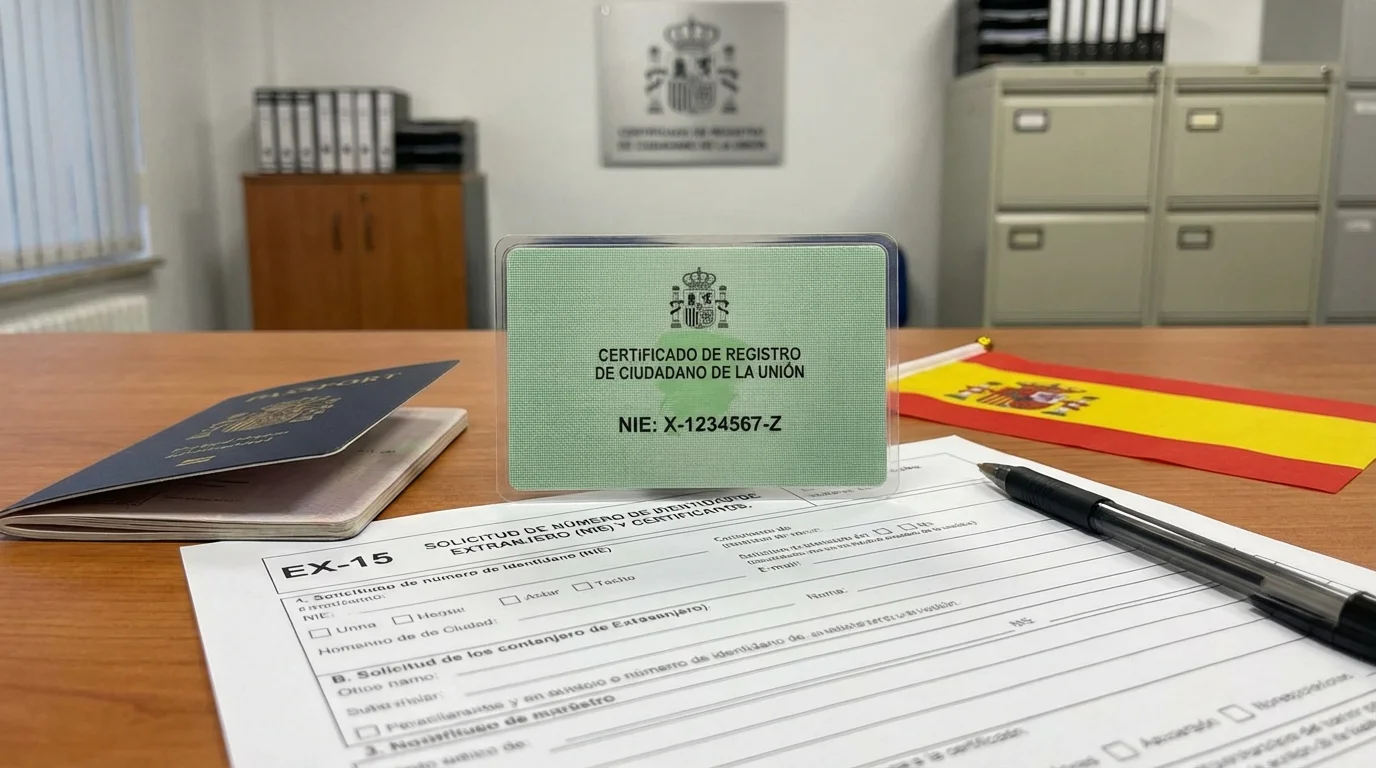
Spanish NIE number 2026: step-by-step guide from Sweden or Spain. EX-15 form, Modelo 790, €9.84 fee, waiting times and NIE/NIF/TIE explained.
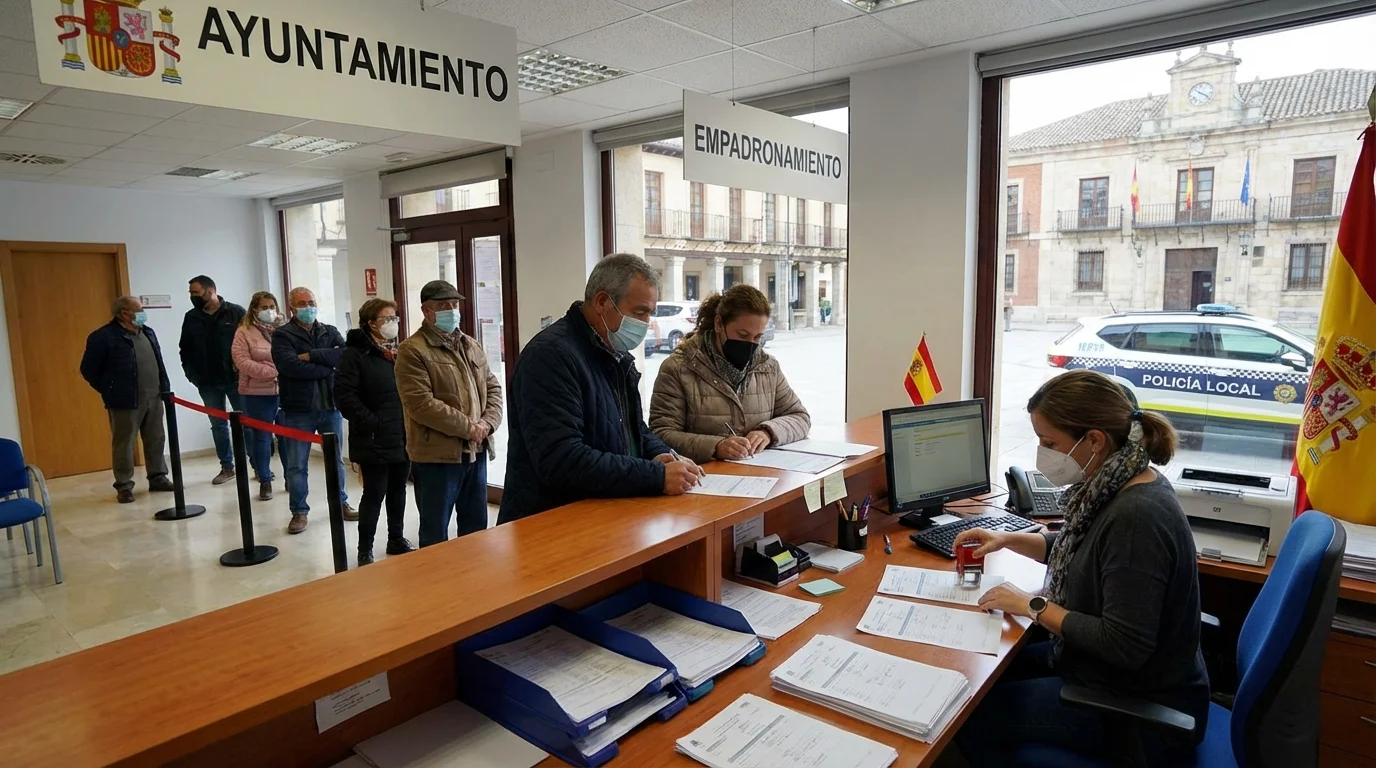
Everything about empadronamiento in Spain: why you need to register, how to do it, what documents are required and what it gives you as a Swedish resident.