
Finance & Law
Lawyer for Property Purchase in Spain – Do You Need One? 2026
Do you need a lawyer when buying property in Spain? What does an abogado do, what does it cost, and how do you choose the right one? Guide for Swedish buyers.
15 min
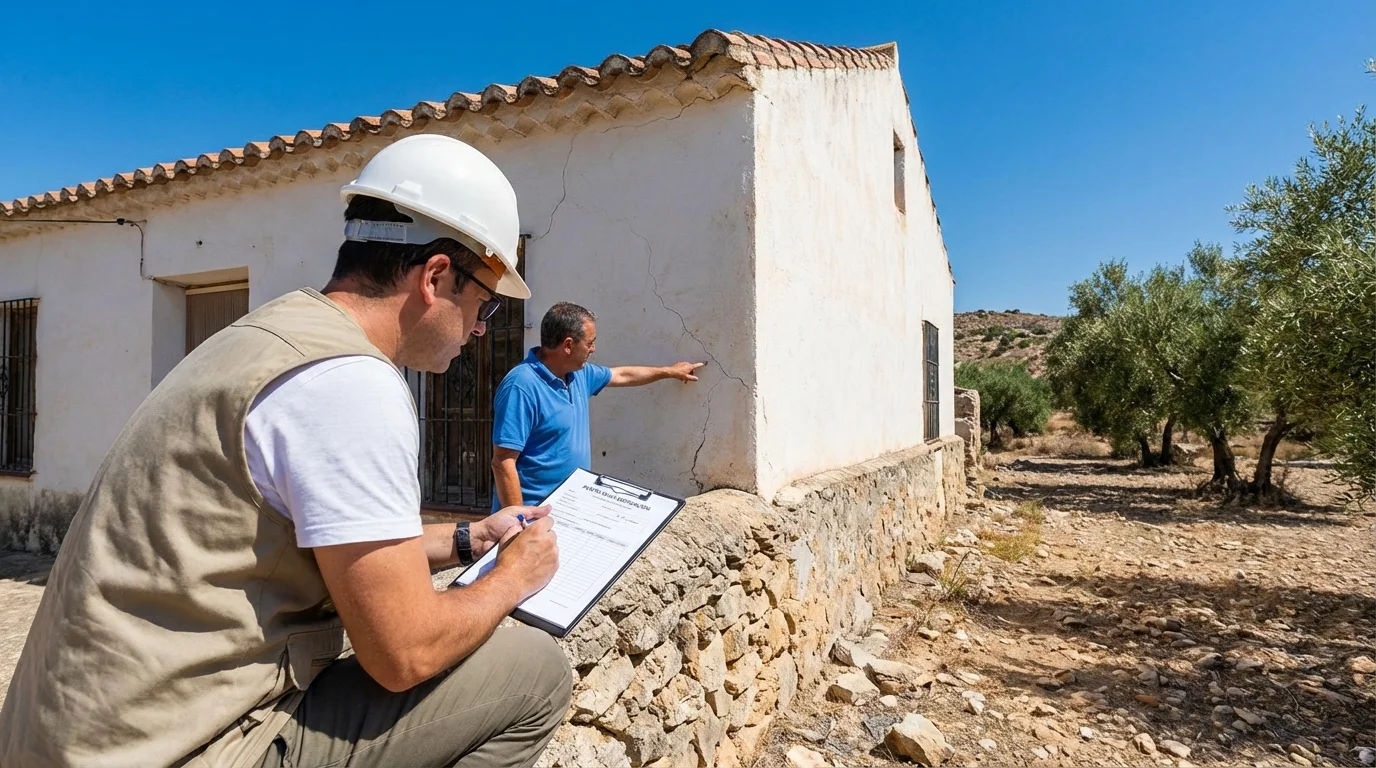
Do you need a survey when buying a property in Spain? What is included, what does it cost, and what problems are found most often? Guide for Swedish buyers.
A technical survey of a property before purchase is not mandatory in Spain — but it is one of the smartest decisions you can make as a Swedish buyer. A survey costs 300–1,000 euros depending on the property type and reveals problems such as damp, structural damage, defective electrics and illegal extensions — things that can cost you tens of thousands of euros after completion.
The difference from Sweden is crucial: in Spain there is no statutory obligation to investigate written into law in the same way, and the seller has limited liability for hidden defects. The principle of caveat emptor applies — it is you as the buyer who carries the risk. A survey gives you negotiating power, protection and documented grounds on which to base your decision.
In this guide we go through what a survey in Spain actually entails, what it costs, what problems are found most often, and how the process differs from a Swedish property survey.
A survey (inspección técnica) is a physical examination of the property's technical condition, carried out by a qualified technician — usually an arquitecto técnico or arquitecto. The technician inspects the structure, the installations and the property's general condition, and compiles their findings into a written report (informe técnico).
The report describes the property's condition point by point: structure, roof, façade, electrics, plumbing, damp, drainage and energy performance. Serious defects are flagged with recommended actions and estimated costs. The report gives you concrete grounds to negotiate the price, demand repairs or in the worst case withdraw from the purchase before you have signed the arras contract.
The survey normally takes 2–4 hours on site, depending on the size of the property. A villa with pool and garden requires more time than an apartment. The report is delivered within 3–7 working days.
Information
Good to know: A survey and a tasación (bank valuation) are not the same thing. The tasación is done by the bank to assess market value — it does not check technical condition. A tasación never replaces a survey. If you take out a mortgage in Spain you automatically get a tasación, but you need to order the survey separately.
No. There is no legal requirement to carry out a technical survey before a property purchase in Spain. Neither the notary, the land registry nor the local council requires it. The survey is entirely voluntary and paid for by the buyer.
The mandatory energy certificate (certificado de eficiencia energética), required since 2013, is not a survey — it only assesses energy performance and emissions. It says nothing about the condition of the structure, plumbing or electrics.
There is however a mandatory building inspection that applies to owners of older properties: the ITE (Inspección Técnica de Edificios). Buildings older than 45–50 years — depending on the municipality — must undergo an ITE every ten years. The ITE checks the structure, façade, roof, installations and accessibility. But the ITE is carried out at the property owner's expense and concerns the entire building — not your specific apartment. If the building has an approved ITE it only means the building is structurally stable as a whole, not that your property is free of damp or electrical faults.
The fact that a survey is not mandatory does not make it unimportant. On the contrary — the fact that Spanish law does not protect the buyer in the same way as Swedish law makes the survey all the more important. In Spain you have only six months after the escritura to claim hidden defects (vicios ocultos), compared with ten years in Sweden. Without a survey you lack documentation.
Note
Warning: Estate agents in Spain sometimes advise against a survey with the argument that "it isn't needed" or that it could "frighten the seller". That is not true. A serious seller has nothing to hide, and a survey protects you — not the agent. The agent's interest is for the deal to go through; your interest is to know what you are buying.
A full technical survey covers all critical systems in the property. Here is what the surveyor examines, point by point.
The surveyor checks the condition of the foundations, load-bearing walls, columns and floor slabs. In Spain reinforced concrete is the most common construction type — and chlorides from sea air can cause corrosion in the reinforcement bars, particularly in coastal properties on Costa Blanca. Cracks in load-bearing walls are classified by severity: hairline cracks are normal (thermal movement), but diagonal cracks over 2 mm can indicate subsidence or seismic impact.
The electrical installation is reviewed: fuse board, earthing, number of circuits, cable type and capacity. Many older Spanish properties (built before 2002) have electrical installations that do not meet the current REBT regulations (Reglamento Electrotécnico de Baja Tensión). Updating the entire electrical installation in a two-bedroom apartment costs 2,000–4,000 euros — a cost that should be negotiated into the price if the survey reveals deficiencies.
Pipes, water pressure, drainage and the hot water heater are checked. In properties built before the 1980s galvanised steel pipes that rust from the inside are still found. The surveyor checks water flow, looks for leaks and assesses the condition of the drainage system. In detached villas the septic tank (fosa séptica) is checked if there is no mains drainage.
Damp is the most common problem in Spanish properties — particularly in ground-floor apartments and older villas without a functioning damp-proof course (barrera antihumedad). The surveyor uses moisture meters to identify capillary rising damp, condensation and penetrating damp. In the Mediterranean climate mould can develop quickly in poorly ventilated spaces, despite the dry summer.
The condition of the roof is assessed: waterproofing membrane, insulation, roof tiles (if applicable) and drainage. Flat roofs — common in Spanish architecture — are particularly susceptible to water penetration. A complete roof renovation on a villa can cost 5,000–15,000 euros depending on the area. Terraces are examined for cracks in the waterproofing membrane and inadequate drainage.
If the property has a pool, the surveyor checks the pool construction, pump and filter system, tiles, drainage channels and electrical safety around the pool area. A pool with a leak can cost 3,000–8,000 euros to repair. Retaining walls, garages and outdoor storage are also included.
Termites (termitas) are a growing problem in southern Spain. They attack wood in roof structures, door and window frames and floor joists. The damage is rarely visible from the outside — termites eat from the inside out. On Costa del Sol and in the Levante region a separate termite inspection is recommended for villas with timber structures. A termite treatment costs 1,500–4,000 euros depending on the extent of the infestation.
The cost depends on the property type, size and the scope of the survey:
Survey cost — typical levels
300–500 €
Structure, electrics, plumbing and damp in focus.
500–800 €
Same as above plus roof, pool and outdoor areas.
800–1,200 €
Complete report and often a separate termite inspection.
250–400 €
Surface finishes, installations and deviations from drawings.
A RICS-certified survey (British standard) generally costs 50–100 euros more but is delivered in English with internationally recognised methodology.
Compared with the purchase price the survey cost is negligible — under 0.5 % of the price for most properties. Compared with what an undiscovered damp problem or structural issue costs to remedy (often 5,000–30,000 euros) it is one of the best investments you make. See our complete overview of all costs when buying property in Spain.
Properties
Explore available properties in Costa Blanca
Browse current homes in the area and compare locations, price levels and property types at your own pace.
In Spain there are three types of professional who carry out technical surveys:
The most common surveyor in Spain. An arquitecto técnico has a three-year technical higher education degree focused on building technology and is registered with their regional Colegio Oficial de Aparejadores. They have practical experience of construction and installations — not just design. Always check that your surveyor has a valid colegiado number.
A fully qualified architect with a five-year university degree. Architects can carry out the same type of survey but are generally more expensive. They are more often used for complex properties — for example historic buildings, conversions or properties with suspected structural faults.
A surveyor certified by the Royal Institution of Chartered Surveyors (British standard). RICS surveyors are found in the most popular coastal areas of Spain and write the report in English. They follow a standardised methodology familiar to northern European buyers. Particularly suitable if you want a report that Swedish banks or insurance companies can read.
Based on data from survey companies on the Spanish coast, the five most common problems are:
By far the most common finding. Capillary rising damp on the ground floor, condensation in bathrooms without mechanical ventilation and water penetration through cracks in the façade or terrace. Many Spanish properties — particularly those built during the building boom of 1998–2008 — lack a complete damp-proof course in the foundations.
Extensions without planning permission (ampliación sin licencia) are common along the entire coast. A glazed terrace, an extra room or a pool that does not appear on the Catastro drawings represents a legal risk. The local council can demand demolition or refuse to issue a cédula de habitabilidad. The surveyor compares the building against the registered plans and flags discrepancies.
Properties built before 2002 often have electrical installations that cannot handle today's loads — particularly if air conditioning (aire acondicionado) has been installed afterwards without upgrading the main fuse. Missing earthing, undersized cables and old fuse boards without residual current devices are common findings.
Cracks in load-bearing structures are often caused by ground movement, inadequate foundations or seismic activity. South-eastern Spain — including the Murcia region and parts of Alicante province — is seismically active. Minor earthquakes (magnitude 2–4) occur regularly and can cause cracks in structures with weak reinforcement.
Galvanised steel pipes rusting from the inside, polybutylene pipes that crack and inadequate water pressure. In older urbanisations the municipal water pressure can be low, particularly in summer months when the population has multiplied due to tourists.
Tip
Tip: Ask your surveyor for an estimated remediation cost for each deficiency identified. The total cost gives you concrete grounds for negotiation — you can either demand a price reduction or ask the seller to remedy the problems before the escritura.
The differences are greater than most Swedish buyers realise. Here are the most important:
Property survey: Sweden compared with Spain
The most important difference: in Sweden you have ten years to claim hidden defects against the seller. In Spain you have six months — and the burden of proof lies with you. A survey report is your only documented evidence of the property's condition at the time of purchase.
There are two types of "survey" when buying property in Spain, and they complement each other:
What we have described so far: a physical examination of the property's structure and installations. Carried out by an arquitecto técnico or similar. Answers the question: Is the property in good technical condition?
An examination of the property's legal status. Carried out by your solicitor (abogado). The solicitor checks:
A legal survey answers the question: Is it legally safe to buy the property?
You need both. A property can be structurally faultless but have unregistered mortgages, and vice versa. The solicitor handles the legal aspects, the surveyor handles the technical ones.
Properties
Explore available properties in Costa del Sol
Browse current homes in the area and compare locations, price levels and property types at your own pace.
Follow these steps to get the maximum benefit from your survey:
Contact
We can recommend independent, English-speaking surveyors on the Costa Blanca and Costa del Sol. Book a free video meeting and we will help you plan the survey — no commitment.
Book free consultationLast updated: March 2026. Prices and regulations may change — contact us for current information.
Decision support
Nej, det finns inget lagkrav på att genomföra en teknisk besiktning innan du köper bostad i Spanien. Besiktning är frivilligt men starkt rekommenderat, särskilt för äldre fastigheter och villor.
Spanien tillämpar caveat emptor: köparen ansvarar själv för att undersöka fastigheten. Utan besiktning riskerar du att missa fukt, strukturella skador eller olagliga tillbyggnader som kan kosta tiotusentals euro att åtgärda.
En teknisk besiktning i Spanien kostar normalt 300–500 euro för en lägenhet och 500–1 000 euro för en villa eller finca. Priset varierar beroende på fastighetens storlek, ålder och komplexitet.
En RICS-certifierad besiktning kostar ofta 50–100 euro mer men följer internationell standard. Jämfört med köpeskillingen är besiktningen försumbar, under 0,1 % av priset.
I Spanien utförs tekniska besiktningar av en arquitecto técnico (teknisk arkitekt, även kallad aparejador) eller en arquitecto (arkitekt). Båda är legitimerade yrkesgrupper registrerade hos sitt regionala colegio profesional.
Internationella köpare anlitar ofta RICS-certifierade besiktningsmän (Chartered Surveyors) som skriver rapporten på engelska och följer brittisk standard.
En tasación (värdering) görs av banken för att säkerställa att fastighetens marknadsvärde täcker lånebeloppet, den skyddar bankens intressen. En besiktning (inspección técnica) är en fysisk granskning av fastighetens skick (konstruktion, el, VVS, fukt, tak och grund) som skyddar köparens intressen.
Tasación kontrollerar inte tekniskt skick och ersätter aldrig en besiktning.
De vanligaste problemen är fukt och mögel (särskilt i markplans- och källarlägenheter utan fuktspärr), bristfällig elanläggning som inte uppfyller dagens regler, olagliga tillbyggnader utan bygglov, sprickor i bärande konstruktion orsakade av sättningar eller jordbävningsrörelser, och läckande rör av föråldrad galvaniserad stål. På Costa Blanca och Costa del Sol är termitangrepp ett tilltagande problem i villor med träkonstruktioner.
Sources
Do you need a lawyer when buying property in Spain? What does an abogado do, what does it cost, and how do you choose the right one? Guide for Swedish buyers.

Buying property in Spain costs 10–14% on top of the price: ITP, notary, land registry, lawyer and more. Calculation examples and a region comparison.
Everything about the escritura when buying property in Spain: what the document contains, the notary process, costs and common pitfalls for Swedish buyers.