
Finance & Law
Cost of Buying Property in Spain 2026 – ITP & Fees
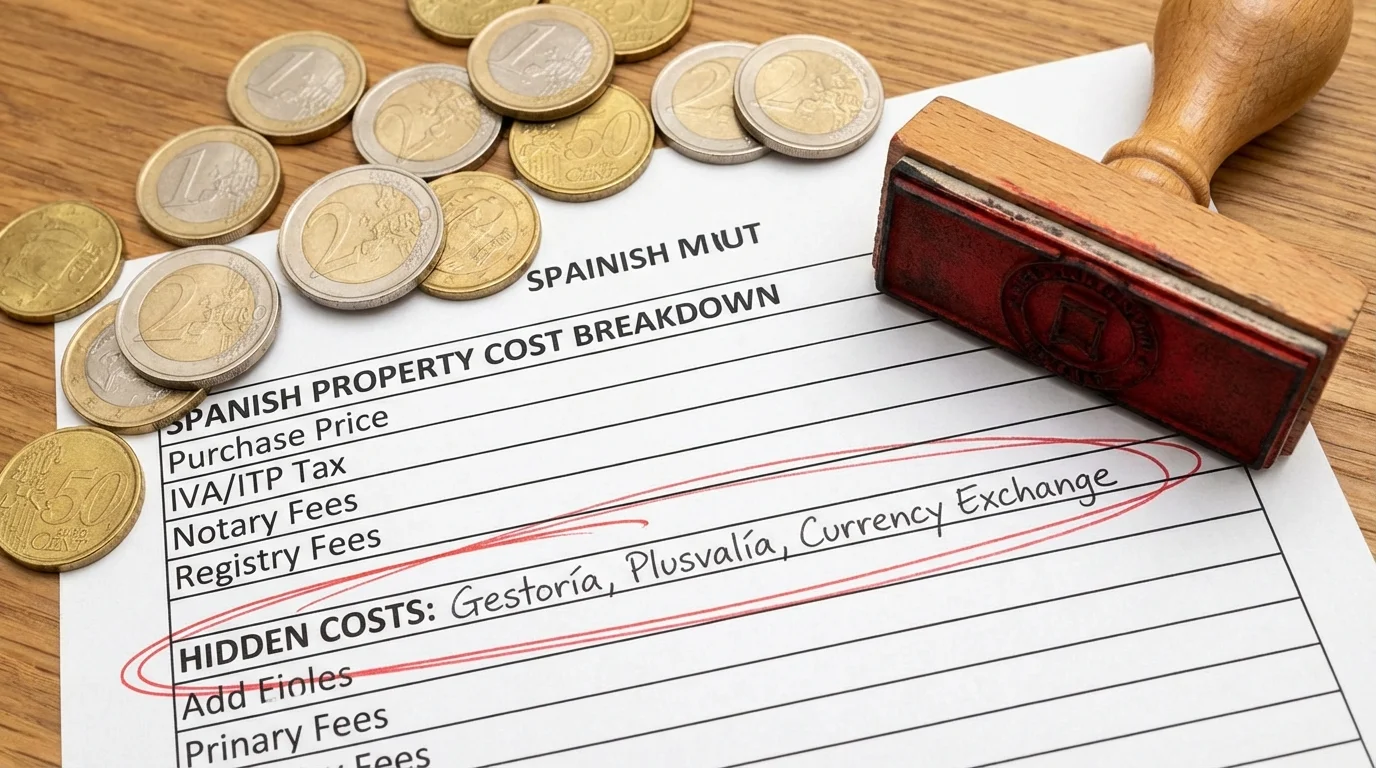
Buying property in Spain costs 10–14% on top of the price: ITP, notary, land registry, lawyer and more. Calculation examples and a region comparison.
22 min
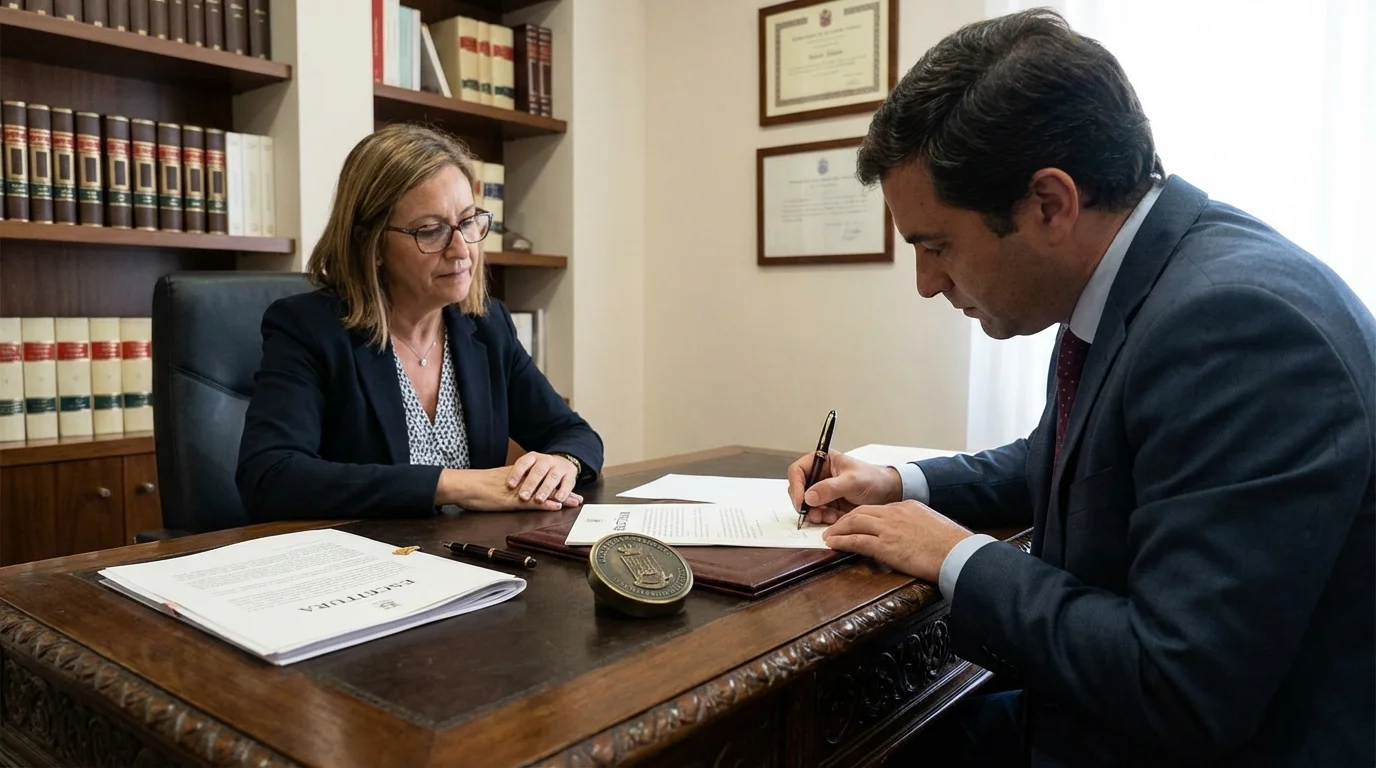
Everything about the escritura when buying property in Spain: what the document contains, the notary process, costs and common pitfalls for Swedish buyers.
An escritura pública de compraventa is the official purchase deed when buying property in Spain — the document that makes you the legal owner of your home. Without an escritura there is no legal proof of ownership, no registration in the land registry and no protection against future claims. It is Spain's equivalent of Swedish deed of title and purchase contract combined in a single document, drawn up and certified by a state notary.
The process differs substantially from a Swedish property purchase. In Sweden you sign a contract through the estate agent, the title is registered automatically and you receive a document from the land register. In Spain you (or your authorised representative) sit physically with a notary who reads the entire deed aloud, verifies that the property is free of debts and encumbrances, and ensures the money reaches the right account — often all on the same day.
This guide explains step by step what an escritura is, what it contains, how signing day works, what it costs and what problems to watch out for. We also cover how you can sign remotely via power of attorney if you cannot be in Spain.
An escritura pública de compraventa is a public deed that formalises the transfer of a property from seller to buyer. The deed is drawn up by a notario público — a state-appointed lawyer acting as an impartial third party — and signed by both parties in the notary's presence.
The escritura has three critical legal functions:
The notary always retains the original protocol in their archive. You as buyer receive a copia autorizada — an authorised copy with the same legal value as the original. The protocol is archived indefinitely, which means a new copy can always be obtained if yours is lost.
Information
Worth knowing: In Sweden the purchase contract and title deed are separate processes. In Spain everything is combined in the escritura — it functions as purchase contract, transfer document and basis for title registration all in one document. That makes it the single most important document in the entire buying process.
Many Swedish buyers confuse the two agreements in a Spanish property transaction. They serve completely different purposes:
Contrato de arras (deposit contract) is a private preliminary agreement that you and the seller sign — often with the help of a solicitor or estate agent — weeks or months before the purchase is completed. It reserves the property for you while legal due diligence is underway. The deposit is normally 10% of the purchase price.
Escritura (public purchase deed) is the final document signed before a notary that formalises the actual transfer of ownership. It is only at the escritura that you pay the remaining purchase price and receive the keys.
Arras vs escritura — two different stages
Under the typical arras penitenciales, if the buyer withdraws they forfeit the deposit; if the seller pulls out they normally have to pay back double. After the escritura is signed, disputes are handled under different rules — the purchase is formally complete.
The most common type of arras contract is arras penitenciales (cancellation with penalty). If you as buyer withdraw you forfeit the deposit. If the seller withdraws they must repay you double the amount. There are also arras confirmatorias (confirmatory) and arras penales (punitive) which work differently — your solicitor should clarify which type applies.
Note
Important: Never sign an arras contract without an independent solicitor having reviewed it. The solicitor should verify that the property has no debts, that the seller is the genuine owner and that there are no unregistered extensions. Spend €2,000–3,000 on a solicitor now — it can save you tens of thousands in problems later. Read more about all costs in our guide to buying costs in Spain.
The notary is responsible for ensuring the escritura is complete and correct. The document normally includes:
Full names, ID numbers (DNI for Spaniards, NIE or passport number for foreigners), address and marital status for both buyer and seller. If you are buying through an authorised representative (poder) the details of both the principal and the representative are stated along with the date and notary of the power of attorney.
Exact address, area (according to measurement and according to the cadastre/land registry), number of rooms, associated storage and parking space, boundaries with adjacent properties, registration number in the Registro de la Propiedad and cadastral reference. If there are discrepancies between the registered area and the actual area, these must be noted.
Ownership history (título), any encumbrances — mortgages (hipotecas), easements, attachments or liens — and a certificate that community fees to the owners' association (comunidad de propietarios) are paid.
Purchase price, payment method (bank cheque or bank transfer), any division into deposit and final payment, and details of any mortgage being taken out simultaneously.
Which taxes apply (ITP for resale property, IVA plus AJD for new construction) and who is responsible for each cost. Normally the buyer pays transfer tax and registration, while the seller is responsible for plusvalía municipal (municipal capital gains tax).
Energy certificate (certificado de eficiencia energética), certificate from the comunidad confirming fees are paid, receipt of the most recent IBI payment (property tax), and nota simple from the land registry. All these attachments are annexed to the escritura.
Signing day — el día de la firma — is the most intensive moment of the entire buying process. Here is how it typically goes in practice:
Your solicitor or gestoría has spent the past few weeks gathering all documents: an updated nota simple from the Registro de la Propiedad, IBI receipt, comunidad certificate, energy certificate and any mortgage documents. The notary has received the draft escritura (minuta) in advance and reviewed it.
The whole process usually takes 45–90 minutes. If you are simultaneously signing a mortgage deed (escritura de hipoteca) it takes longer — allow an additional 30–60 minutes.
Tip
Tip: Ask your solicitor to negotiate for the notary to send the draft escritura (minuta) at least 3–5 working days in advance. That gives you and your solicitor time to review every detail before signing day. Discovering a mistake at the notary's table — with the seller, estate agent and bank representative present — is stressful and can delay the whole transaction.
The notary sends an electronic copy of the escritura to the Registro de la Propiedad on the same day. Your gestoría or solicitor then takes care of:
The costs associated with the escritura are regulated by law and in practice the same at all notaries in Spain. Here is an overview based on a property worth €200,000:
Escritura — typical fees (example property €200,000)
Notary fee
€600–1,200
Typically around 0.2–0.5% of the purchase price (arancel).
Registro de la Propiedad
€400–700
Title registration.
Gestoría
€300–600
Tax payment and registration matters.
Total (approximate)
€1,300–2,500
Excluding ITP/IVA and other purchase taxes.
The notary fee is calculated according to a regulated scale (arancel) based on the declared value of the property. Notaries are permitted to give up to a 10% discount, but in practice the difference between notaries is minimal. Competition is about service and availability, not price.
The buyer has the right to choose the notary — exercise that right. A notary who speaks English or Swedish (yes, they exist in popular coastal areas) makes signing day considerably smoother.
In addition to the administrative costs above, purchase taxes apply — transfer tax ITP (6–10% depending on the region) for resale property, or VAT IVA (10%) plus stamp duty AJD for new construction. These taxes are not part of the escritura cost itself but are paid in connection with it.
Properties
Explore available properties in costa-blanca
Browse current homes in the area and compare locations, price levels and property types at your own pace.
After signing, the escritura must be registered in the Registro de la Propiedad — the Spanish land registry — for your ownership to be protected against third parties.
Registration is technically not compulsory in Spain. You become the owner at the point of signing the escritura. But without registration you lack:
In practice all buyers register their escritura. Not doing so would be like buying a car without registering it — you own it, but you cannot prove it to the outside world.
The whole process typically takes 4–8 weeks from signing day. During that time you have full ownership and are living in the property — what is being registered is the formal protection.
Yes. If you cannot be physically present in Spain you can grant a power of attorney — poder notarial — to your solicitor or other representative who signs the escritura on your behalf.
There are two types, and the difference is crucial:
There are three options:
1. With a notary in Spain — Simplest and cheapest (€60–150). Requires you to travel to Spain once to sign the power of attorney, but you are spared from being there for the escritura signing.
2. At a Spanish consulate in your home country — The consul acts as a Spanish notary. The advantage is that the document is in Spanish and no apostille is needed. The disadvantage is that consulate appointment slots are often limited — book well in advance. The Spanish Embassy in Stockholm and consulates offer this service.
3. With a notary in Sweden — You sign with a Swedish notarius publicus (or in the Nordic context often a solicitor with notarial authority). The document must then:
Allow €150–300 and 2–4 weeks if you are creating the power of attorney abroad. Check that the power of attorney states the correct property, the correct price and the correct powers — a mistake means you have to redo the process.
Most transactions go smoothly, but here are the most common issues we see among Swedish buyers — and how to avoid them:
The land registry and the cadastre (tax authority) can have different figures for the property area. It is not uncommon for an extension — for example an enclosed terrace or extra room — to never have been registered. The property description in the escritura should match reality. If there are discrepancies these should be rectified before you sign, otherwise you may inherit the problem.
Unpaid comunidad fees, unpaid IBI debts or remaining mortgages can transfer to the new owner. The notary checks the nota simple, but your solicitor should carry out a more thorough review — including requesting a debt certificate from the comunidad and the tax authority.
Sometimes the seller only owns a share of the property (co-ownership), or there is an inheritance dispute. All owners must sign the escritura for the transfer to be valid. Check the nota simple carefully — it lists all registered owners.
Spain has historically had problems with buildings constructed without planning permission. If part of the property lacks a building permit (licencia de obra) the local authority can in theory demand demolition. Verify that everything included in the purchase is shown on the registered plan (plano catastral).
It used to be common to state a lower price in the escritura than the actual price ("dinero negro"). This is illegal and carries the risk of fines, higher tax on a future sale and problems with mortgages. Always insist that the real price is stated in the escritura.
Note
Warning: Never agree to part of the purchase price being paid "off the books" outside the escritura. The tax authorities (Agencia Tributaria and Hacienda) routinely check whether the declared price deviates significantly from market value. The consequences — fines, additional tax, legal complications — fall on you as the buyer.
Relax — there is no need to panic. The notary who drew up the escritura archives the original protocol indefinitely. Here is what to do:
Contact the notary office where you signed and request a new copia autorizada. You need to be able to identify yourself (NIE, passport) and provide the property's address or registration number. The cost is a fraction of the original fee — normally €50–150 for an authorised copy.
Spanish notaries are required to transfer their archives. If your notary has retired, moved offices or passed away, the archive has been transferred to a successor or to the regional notarial chamber (Colegio Notarial). Contact the chamber in your province — they can locate the correct archive.
If you quickly need proof of ownership you can request a nota simple informativa from the Registro de la Propiedad. It shows the registered owner, encumbrances and property description. A nota simple is often available online within 24–48 hours and costs under €10. It does not replace the escritura legally, but works for most administrative purposes.
There are two types of copies:
Always request a copia autorizada if you need the copy for legal or administrative matters. A copia simple is fine if you simply want a reference copy at home.
Are you reading this guide in connection with a planned purchase on the Costa Blanca or Costa del Sol? Our advisers can help you navigate the entire process — from the first viewing to signing at the notary's office.
Contact
We guide you through the entire process — from the first viewing to signing at the notary's office. Book a free call with one of our advisers and we will go through your questions about the escritura, power of attorney and registration.
Book a free consultationLast updated: April 2026. Legal rules and fees can change — always verify current information with your solicitor or gestor before completing a purchase. This guide does not constitute legal advice.
Decision support
En escritura (escritura pública de compraventa) är det officiella köpebrevet som upprättas och undertecknas inför en spansk notarie vid ett fastighetsköp. Dokumentet bekräftar att äganderätten övergår från säljare till köpare och innehåller uppgifter om parterna, fastigheten, priset, betalningsvillkor och eventuella belastningar.
Escrituran är den enda handling som kan registreras i det spanska fastighetsregistret (Registro de la Propiedad) och utgör ditt juridiska ägandebevis.
Notarieavgiften ligger normalt på 600–1 200 euro beroende på köpeskillingen, som tumregel 0,2–0,5 % av fastighetens värde. Utöver det tillkommer registreringsavgift hos Registro de la Propiedad (400–700 euro) och gestoría-arvode för att hantera registreringen (300–600 euro).
Totalt bör du räkna med 1 300–2 500 euro i administrativa kostnader kopplade till escrituran. Avgifterna är reglerade i lag och i princip lika hos alla notarier.
Ja, genom att ge en fullmakt (poder notarial) till din advokat eller annan representant. Fullmakten måste vara en poder especial som anger vilken specifik fastighet och vilket maximalt pris den gäller för.
Du kan upprätta fullmakten hos ett spanskt konsulat (då behövs ingen apostille) eller hos en notarie i Sverige (då krävs Haag-apostille och auktoriserad översättning till spanska). Räkna med 150–300 euro för fullmakten om den upprättas utomlands.
Contrato de arras är ett privat förhandsavtal där köparen betalar en handpenning (normalt 10 % av priset) och parterna förbinder sig att genomföra affären. Escrituran är det slutgiltiga, offentliga köpebrevet som undertecknas inför notarie och formaliserar ägandeövergången.
Arras-kontraktet skrivs veckor eller månader innan escrituran, det reserverar fastigheten medan juridisk granskning pågår. Drar köparen sig ur förlorar hen handpenningen; drar säljaren sig ur ska hen betala tillbaka dubbla handpenningen.
Kontakta den notarie som upprättade escrituran och begär en ny copia autorizada (auktoriserad kopia). Du behöver uppge personnummer (NIE eller pass) och kunna identifiera fastigheten.
Notarien är skyldig att arkivera originalprotokollet på obestämd tid. Har notariekontoret stängt har arkivet överförts till nästa notarie eller till den regionala notariekammaren (Colegio Notarial).
Du kan även begära en nota simple från Registro de la Propiedad som interimsbevis, ofta tillgänglig inom 24–48 timmar online.
Sources
Buying property in Spain costs 10–14% on top of the price: ITP, notary, land registry, lawyer and more. Calculation examples and a region comparison.
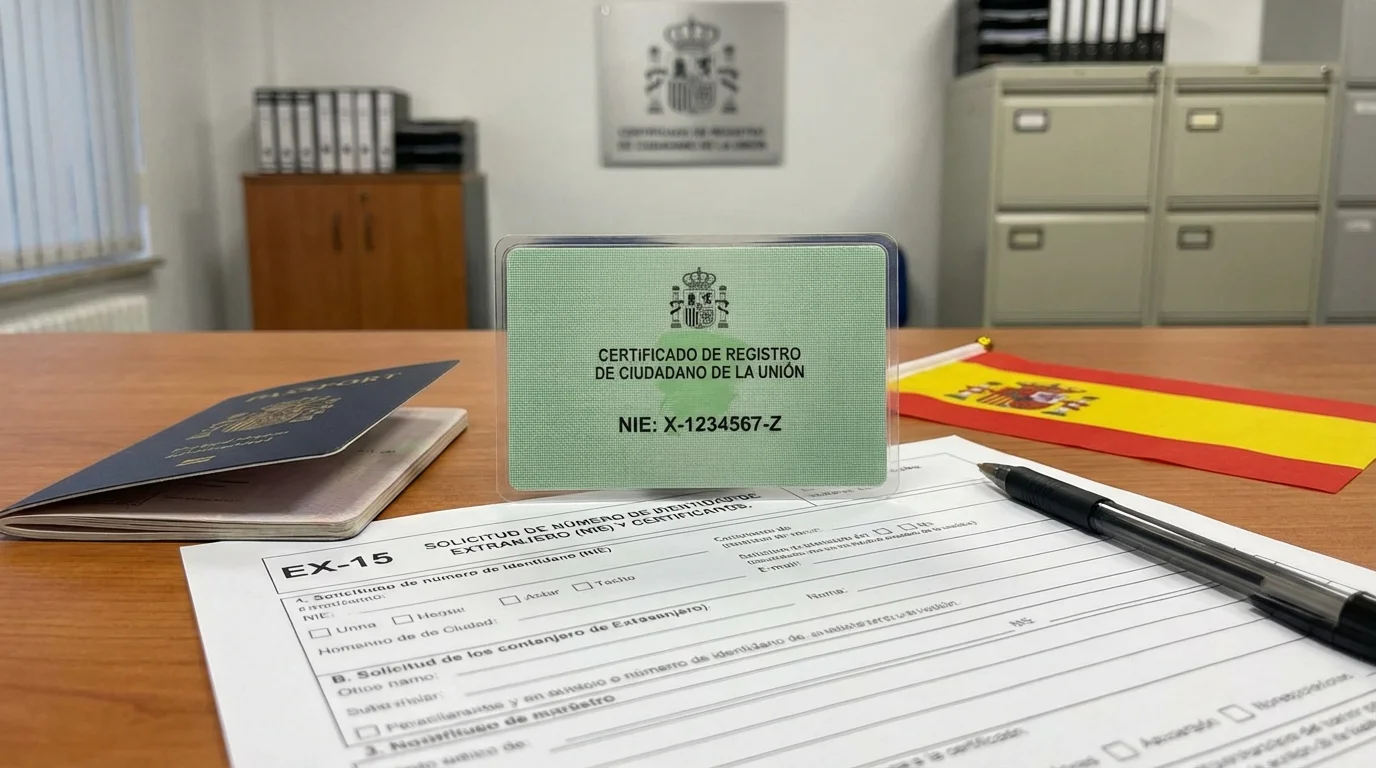
Spanish NIE number 2026: step-by-step guide from Sweden or Spain. EX-15 form, Modelo 790, €9.84 fee, waiting times and NIE/NIF/TIE explained.
Complete guide to mortgages in Spain: which banks lend to Swedes, current rates, down payment requirements and how the application process works.