

Area Guides
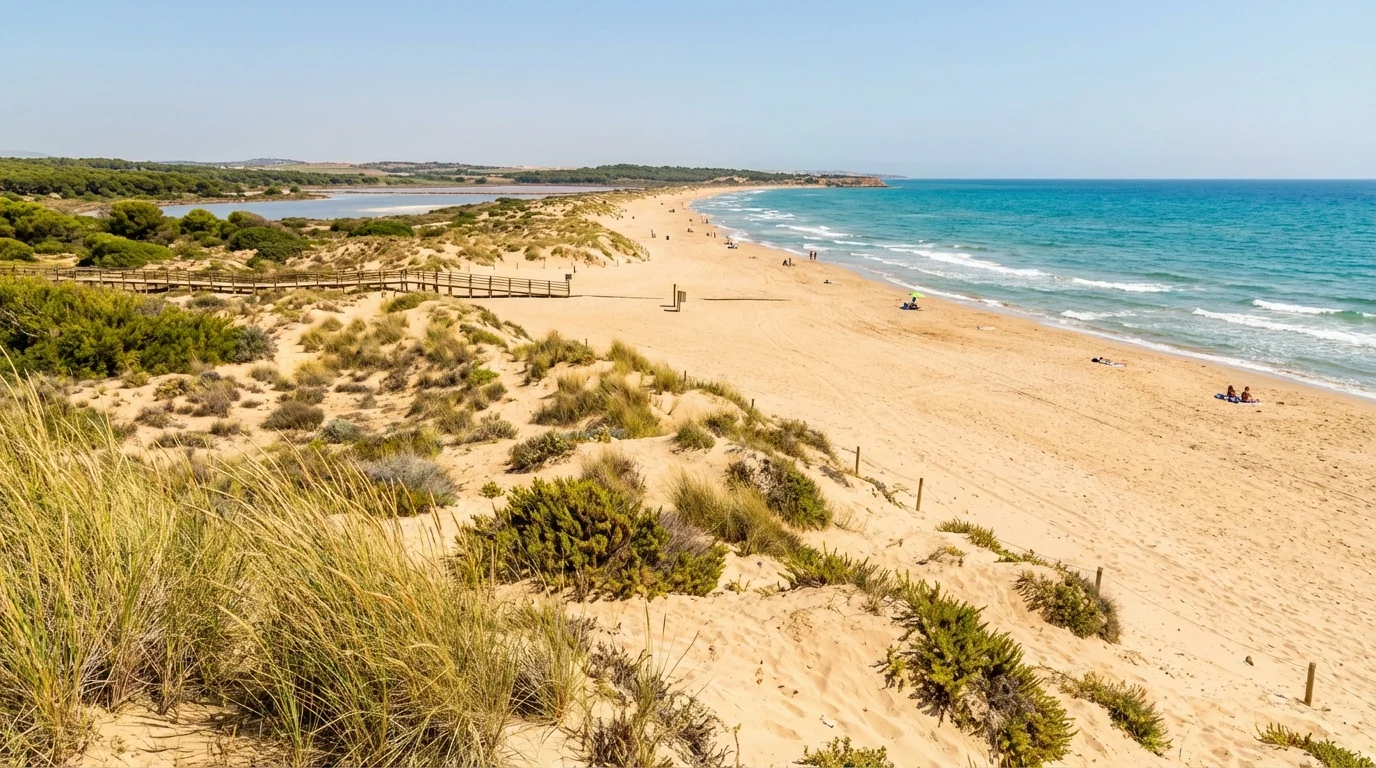
La Mata Torrevieja – beach, prices and guide 2026
La Mata near Torrevieja: 2.3 km sandy beach, prices €2,600–2,750/m², nature reserve with flamingos. Honest guide for buyers on the Costa Blanca.
16 min
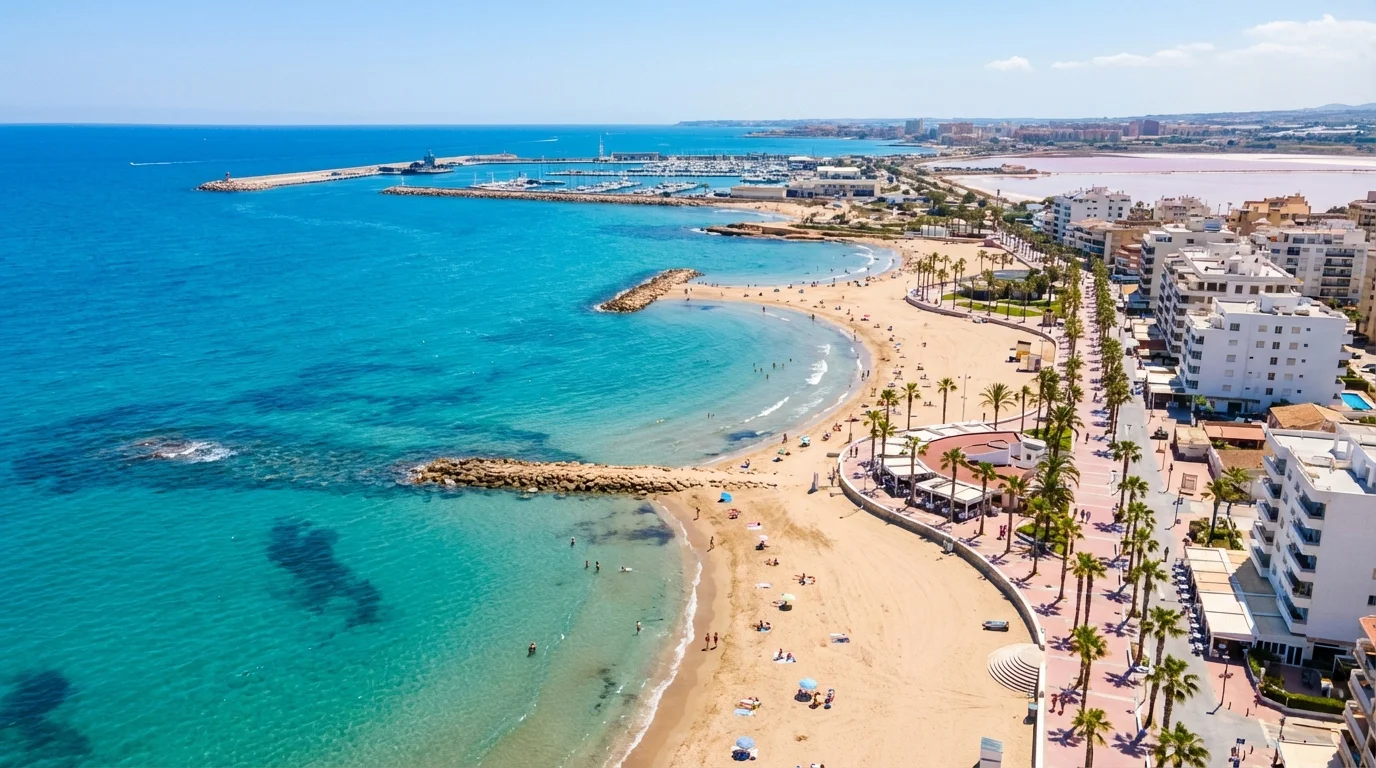
All beaches in Torrevieja: Playa del Cura, La Mata, Los Locos, Cabo Cervera and more. Facilities, Blue Flag status and tips for Swedish visitors.
Torrevieja has nine named beaches and coves along its 20 kilometres of coastline, of which six hold Blue Flag certification for 2025. The offering ranges from the 2.5-kilometre-long Playa de La Mata in the north to the wild Cala Ferris in the south — and in between you find everything from family-friendly wide sandy beaches with water parks to secluded rocky coves with snorkelling opportunities. Water temperatures range from 18 to 26 degrees from May to October, and with over 300 sunny days per year, beach life is a central part of daily life here.
This guide covers every beach in the municipality of Torrevieja: size, sand type, facilities, who it suits best and what you find nearby. If you are considering buying property in Torrevieja, proximity to the right beach is often a decisive factor — and price differences between beach locations can be significant.
Here is an overview of all the main beaches, from north to south along the coast:
| Beach | Length | Blue Flag | Best for |
|---|---|---|---|
| Playa de La Mata | 2,500 m | Yes | Families, walking, peace |
| Playa de los Locos | 700 m | Yes | Urban life, restaurants |
| Playa del Cura | 375 m | Yes | Central location, tourism |
| Playa del Acequión | 400 m | No | Harbour feel, evening walks |
| Playa de los Náufragos | 325 m | Yes | Families with children |
| Cabo Cervera | 100 m | Yes | Snorkelling, peace |
| Cala Piteras | 123 m | Yes | Snorkelling, nature |
| Cala Ferris | 200 m | No | Seclusion, nature |
| Cala del Moro | ~80 m | No | Seclusion |
Playa de La Mata is Torrevieja's longest beach at 2,500 metres and up to 30 metres wide — a total of almost 127,000 square metres of sand. It is a wide, golden sandy beach with shallow water that slopes gently into the sea, making it particularly safe for families with children and inexperienced swimmers.
Facilities and certifications:
The beach is divided into three sections — Pueblo (closest to the village), Europeos (middle) and Dulce (furthest south). The promenade is lined with chiringuitos, cafés and restaurants. Behind the beach there are natural sand dunes with vegetation instead of tower blocks — a rarity on Costa Blanca.
Who is it for? Families with children, couples who want space, those who enjoy walking, and anyone seeking a beach without the crowds that characterise more central Torrevieja. In winter you can walk almost alone along the entire 2.5-kilometre stretch.
Drawbacks: In July and August it fills up, especially at weekends. Parking is free but has limited capacity during peak season — arrive before 10 am. The bus from Torrevieja town centre costs approximately €1.50 but runs infrequently in winter.
For more on the area, read our complete La Mata guide.
Playa de los Locos stretches 700 metres along the northern part of Torrevieja's urban beach zone. The name comes from a former sanatorium that was nearby — nothing to worry about today. The beach has fine golden sand that is raked daily, and an urban character with restaurants, bars and apartment buildings directly behind the shoreline.
Facilities:
This is a beach where you combine swimming with urban life. The range of nearby restaurants is broad: El Tiburón for fish and seafood, La Boca for Spanish-Mediterranean fusion, Timo for Italian and Bar Restaurante Tintero for authentic tapas. Chiringuito de Paco serves grilled fish directly at beach level.
Torrevieja municipality has approved a major renovation project for Los Locos beach with an improved walkway and better connection to the Punta Margalla promenade. The works were tendered in 2025 with an estimated completion date of 2026–2027.
Who is it for? Those who want an urban beach with restaurants within walking distance. Popular among both tourists and permanent residents.
Drawbacks: Narrower than many other beaches (10–25 metres depending on section), which means it gets crowded faster. Tidal variations and sand movement affect the width.
Playa del Cura is Torrevieja's most central beach — 375 metres long and 27 metres wide, right in the heart of the city's beach district. This is the beach you reach if you walk straight down from the town centre, and therefore also the most touristy. Fine golden sand, Blue Flag certification and ISO 9001/14001 certifications.
Facilities:
The promenade Paseo de los Marineros along Playa del Cura is Torrevieja's most walked stretch. Here restaurants, bars, ice cream parlours and shops are densely packed. In the evenings the promenade fills with people strolling, eating tapas outdoors and enjoying the sunset.
Who is it for? Tourists and those who want everything within walking distance: food, shopping, entertainment. If you live centrally in Torrevieja, this is "your" beach.
Drawbacks: The most packed beach in the municipality during summer. Little space, lots of people. Not the place for you if you are seeking peace and quiet in July–August. Parking in the centre is limited and paid car parks are common.
Properties
Explore available properties in torrevieja
Playa del Acequión is located in the southern part of Torrevieja's town centre, near the harbour and the fish market. The beach is approximately 400 metres long with fine sand and a calm, local atmosphere. It lacks Blue Flag certification but is well maintained and popular among permanent residents.
Facilities:
The proximity to the harbour gives evening walks here a special charm — you can walk from the beach along the harbour arm and watch boats and fishermen. The restaurant and bar scene is more local than at Playa del Cura.
Who is it for? Permanent residents who want to avoid the tourist beaches. Couples who appreciate harbour atmosphere and local character.
Drawbacks: Less well known and therefore with fewer facilities than the Blue Flag-certified beaches. Proximity to the harbour means the water is sometimes cloudier than at other beaches.
Playa de los Náufragos ("Shipwreck Beach") in the San Roque neighbourhood is Torrevieja's best family beach. At 325 metres long and up to 77 metres wide at its widest points, it is surprisingly spacious — a total of approximately 22,400 square metres. The name comes from historical shipwrecks that were once visible off the coast.
Facilities:
What makes Náufragos particularly suitable for families is the very shallow bottom profile. The water is shallow far out from the shoreline, so children can splash safely. The beach can accommodate up to 7,000 visitors per day during peak season — and still feel spacious thanks to its width.
Who is it for? Families with children, especially with younger children. Also good for older visitors who appreciate accessibility features and a broad range of services.
Drawbacks: A popular beach that draws large crowds in July–August. Parking options are limited, especially at weekends.
Tip
Playa de los Náufragos is the safest choice for families with children in Torrevieja. The water park, the shallow bottom and the Blue Flag certification make it the obvious first choice. Arrive early on summer mornings for better space.
Cabo Cervera is a small gem — just 100 metres long and 25 metres wide — wedged between rock formations on Torrevieja's southern coast. Despite its size, the beach holds Blue Flag certification and offers crystal-clear water with excellent visibility for snorkelling.
The beach has historical significance: Cabo Cervera is considered to be the site of the original settlement that later became Torrevieja. The cliffs and headland surrounding the cove create a sheltered, intimate swimming environment that is markedly different from the large sandy beaches.
Facilities:
Who is it for? Snorkellers, couples seeking a smaller and quieter beach, and those who appreciate clear water and rocky landscape over long sandy stretches.
Drawbacks: Very small area — fills up quickly during peak season. Limited parking.
Cala Piteras is 123 metres long and 15 metres wide and has achieved Blue Flag certification thanks to its unique ecological significance. The cove is home to one of the most important Posidonia seagrass fields in the southern province of Alicante — an underwater ecosystem that is home to seahorses, crabs, octopuses and a wide variety of fish species.
Certifications:
The shallow, calm water and the rich biodiversity make Cala Piteras Torrevieja's best snorkelling spot. Visibility is often excellent, and you can see marine life directly from the surface.
Who is it for? Snorkelling enthusiasts, nature lovers and those seeking a different beach experience beyond sun and sand.
Drawbacks: Small area (only 1,860 square metres) that naturally limits visitor capacity. Facilities are basic — bring your own food and water.
Cala Ferris is Torrevieja's most famous "hidden gem" — a 200-metre-long cove at the south-western tip of the municipality's coastline. There are no showers, no kiosks and no sun lounger hire. Instead you get natural sand dunes, palm trees framing the cove, crystal-clear water and a feeling of being far from everything — despite being within Torrevieja's municipal boundaries.
The cove is surrounded by rock formations and green vegetation, creating a tropical atmosphere that is unexpected for the Mediterranean. The water is shallow, clear and excellent for snorkelling.
Facilities: None. Bring everything you need — food, water, sun protection, towel.
Who is it for? Couples and groups of friends seeking seclusion and nature. Photographers who want to capture Torrevieja's most "Instagram-worthy" cove. Snorkellers who prefer an unspoilt environment.
Drawbacks: No facilities whatsoever. You need a car to get here — parking is available along the road with a short walk down to the cove. Not suitable if you need toilets, showers or lifeguards.
Note
Cala Ferris and other undisturbed coves have no lifeguards or facilities. Always check water and weather conditions before entering the sea, and avoid snorkelling alone when currents are stronger. The flag system found on certified beaches does not exist here.
In addition to the larger beaches there are a number of smaller coves along the coast between Punta Prima and Torrevieja's harbour:
These coves generally lack commercial facilities. Plan with your own food and water.
| You are looking for... | Choose this beach |
|---|---|
| Family with small children | Playa de los Náufragos (shallow, wide, water park) |
| Central location and restaurants | Playa del Cura or Playa de los Locos |
| Longest beach, most space | Playa de La Mata (2,500 m) |
| Snorkelling and marine life | Cala Piteras or Cala Ferris |
| Peace and seclusion | Cala Ferris or Cala del Moro |
| Disability-accessible | Playa de los Náufragos, Playa del Cura or Los Locos |
| Harbour feel and local character | Playa del Acequión |
| Nature and dunes | Playa de La Mata (northern section) |
Information
During peak season (July–August) the more central beaches can become overwhelmingly crowded. If you live in Torrevieja, the smartest approach is to have a favourite beach for peak season (La Mata or Cala Ferris) and one for the rest of the year (somewhere central). Many permanent residents do exactly this.
Torrevieja's coastal waters follow the Mediterranean's general temperature pattern, but with slightly warmer temperatures than northern Costa Blanca thanks to the southerly location.
Water temperature by month (approximate values):
| Month | Water temp | Air temp (avg) | Swimmable? |
|---|---|---|---|
| January | 14°C | 12°C | No |
| March | 14°C | 15°C | For the brave |
| May | 18°C | 22°C | Yes, pleasant |
| June | 22°C | 26°C | Yes |
| July | 25°C | 29°C | Perfect |
| August | 26°C | 30°C | Perfect |
| September | 24°C | 27°C | Yes |
| October | 21°C | 22°C | Yes |
| December | 16°C | 13°C | No |
The best swimming season is May to October. Peak season (July–August) has the warmest water but also the most people. The shoulder season in May–June and September–October offers the best of both worlds: pleasant swimming water, warm weather and considerably fewer people on the beaches.
In winter most permanent residents use the beaches for walks rather than swimming. With daytime temperatures of 15–18 degrees it is still pleasant to be outdoors — which is one of the reasons Torrevieja is popular as a winter destination for Scandinavians.
Parking is one of the most common frustrations in coastal towns — and Torrevieja is no exception.
Playa de La Mata: Free parking near the beach, but limited capacity. During peak season: arrive before 10 am.
Playa de los Locos and Playa del Cura: Centrally located with street parking (both free and paid). Paid parking is common near Cura. Expect to drive around for a while in July–August.
Playa de los Náufragos: Street parking in the San Roque area. Easier to find a space than at Playa del Cura but still crowded on peak days.
Cala Ferris: Roadside parking with a short walk down. Limited capacity but also fewer visitors.
Tip: Disabled parking is available near all Blue Flag beaches, within 50–100 metres of the beach entrances. The bus from the town centre to La Mata costs approximately €1.50 — a good option during peak season.
Yes, at all the larger beaches. The concentration varies:
Best restaurant selection: Playa de los Locos and Playa del Cura have the most options, from beach-level chiringuitos to full-scale restaurants with sea views along the promenade. Expect €8–15 for a simple lunch dish at a chiringuito and €15–35 for dinner at a restaurant.
Playa de La Mata: The promenade has several chiringuitos and restaurants, including Chiringuito Juanito and Vela Beach La Mata. Good selection without being overwhelming.
Playa de los Náufragos: Restaurants and bars along the promenade with sea views.
Peripheral beaches (Cala Ferris, Cala Piteras, Cabo Cervera): Minimal or no offering directly at the beach. Bring your own or eat at the nearest urbanisation before or after your beach visit.
Chiringuitos are generally open from May to September. In winter the selection is much more limited, but year-round restaurants are found along the more central promenades.
Torrevieja's beaches offer basic water sports rather than advanced extreme sports:
For more advanced diving and sailing there are providers in the broader Costa Blanca area, but Torrevieja itself is primarily a swimming resort rather than a water sports destination.
Proximity to the beach is one of the most important price factors in Torrevieja. Generally: the closer to the beach, the higher the price — but the differences also depend on which beach it is.
Approximate price levels (resale market, 2025/2026):
Beachfront normally means "within 500 metres of the beach." Go 1–2 kilometres inland and prices drop by 15–25 per cent, but you lose walking distance to the sea.
Properties
Explore available properties in torrevieja
The flag system: All Blue Flag beaches use colour flags to indicate water conditions. Green flag means it is safe to swim. Yellow flag means caution (waves, currents). Red flag means no swimming. Always follow the lifeguards' instructions.
Peak season vs off-season: The difference is dramatic. In July, Playa del Cura can have thousands of visitors on 375 metres of beach. In October you can have virtually the same beach to yourself. Plan accordingly.
Sun protection: The Mediterranean sun is strong, particularly from June to September. SPF 50 is standard, and a parasol is not a luxury but a necessity in the middle of the day.
DANA risk in autumn: Torrevieja, like all of Costa Blanca, can be affected by DANA weather (heavy rainfall events) from September to November. This rarely directly affects beach life but can cause flooding in urban areas. Keep an eye on weather forecasts during the autumn months.
Contact
We help you find the right beach location based on your budget and lifestyle. Book a free call — we speak Swedish and know all the areas.
Book free consultationDecision support
Torrevieja har cirka 20 kilometer kustlinje med nio namngivna stränder och vikar. De mest kända är Playa del Cura, Playa de los Locos, Playa de los Náufragos, Playa de La Mata, Cabo Cervera och Cala Ferris.
Sex av stränderna har Blå Flagg-certifiering för 2025, vilket gör Torrevieja till en av de mest premierade strandkommunerna på Costa Blanca.
Playa de los Náufragos är den bästa familjestranden i Torrevieja. Den är 325 meter lång, upp till 77 meter bred och har en mycket grund vattenentré som är säker för barn.
Stranden har dessutom en liten vattenpark, lekplatser, livvakter under sommarsäsongen och hyr ut solstolar och parasoll. Blå Flagg-certifiering garanterar hög vattenkvalitet och säkerhet.
För 2025 har sex stränder i Torrevieja Blå Flagg-certifiering: Playa del Cura, Playa de los Locos, Playa de los Náufragos, Cabo Cervera, Cala Piteras och Playa de La Mata (Torre La Mata Sur). Certifieringen garanterar hög vattenkvalitet, säkerhetsinfrastruktur med livvakter, tillgänglighetsanpassning och miljöskydd.
Bästa badsäsongen är från maj till oktober, då vattentemperaturen ligger mellan 18 och 26 grader. Juli och augusti har varmast vatten men också mest trångt på stränderna.
För balansen mellan behagligt badvatten och färre människor är maj till juni och september till oktober ideala, med 22 till 25 graders vattentemperatur och lugnare atmosfär.
De bästa snorkelplatserna är Cala Piteras och Cala Ferris. Cala Piteras har ett av södra Alicante-provinsens största Posidonia-sjögräsfält med sjöhästar, krabbor och bläckfiskar i kristallklart vatten.
Cala Ferris erbjuder klart vatten och klippformationer med rikt marint liv. Sikten kan nå 20 till 25 meter under gynnsamma förhållanden.
Sources

Los Balcones, Alicante

Lago Jardín II, Alicante

San Luis, Alicante

Centro, Alicante

Centro, Alicante

Centro, Alicante
Local expertise
La Mata near Torrevieja: 2.3 km sandy beach, prices €2,600–2,750/m², nature reserve with flamingos. Honest guide for buyers on the Costa Blanca.
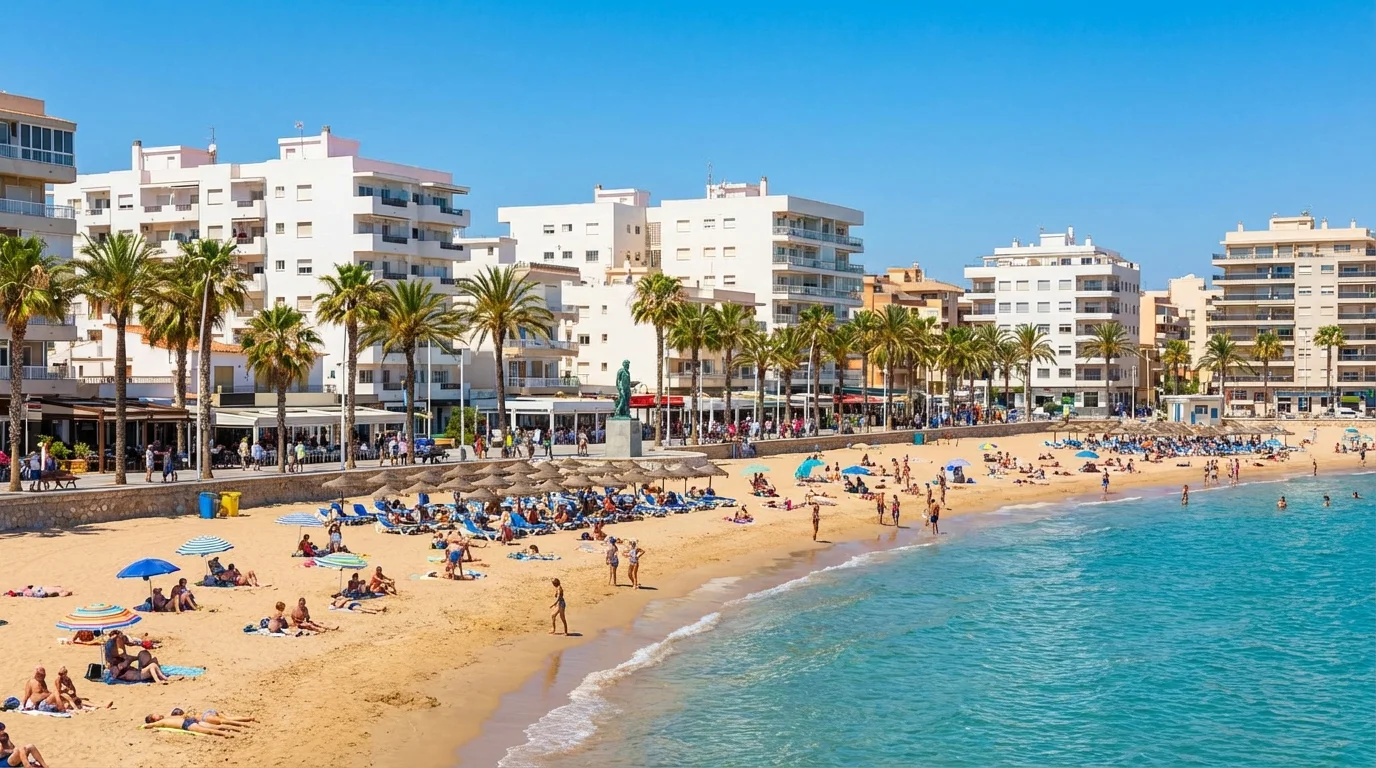
Everything about Playa del Cura in Torrevieja: beach life, property prices, restaurants, promenade and tips for buying property at Torrevieja's central beach.
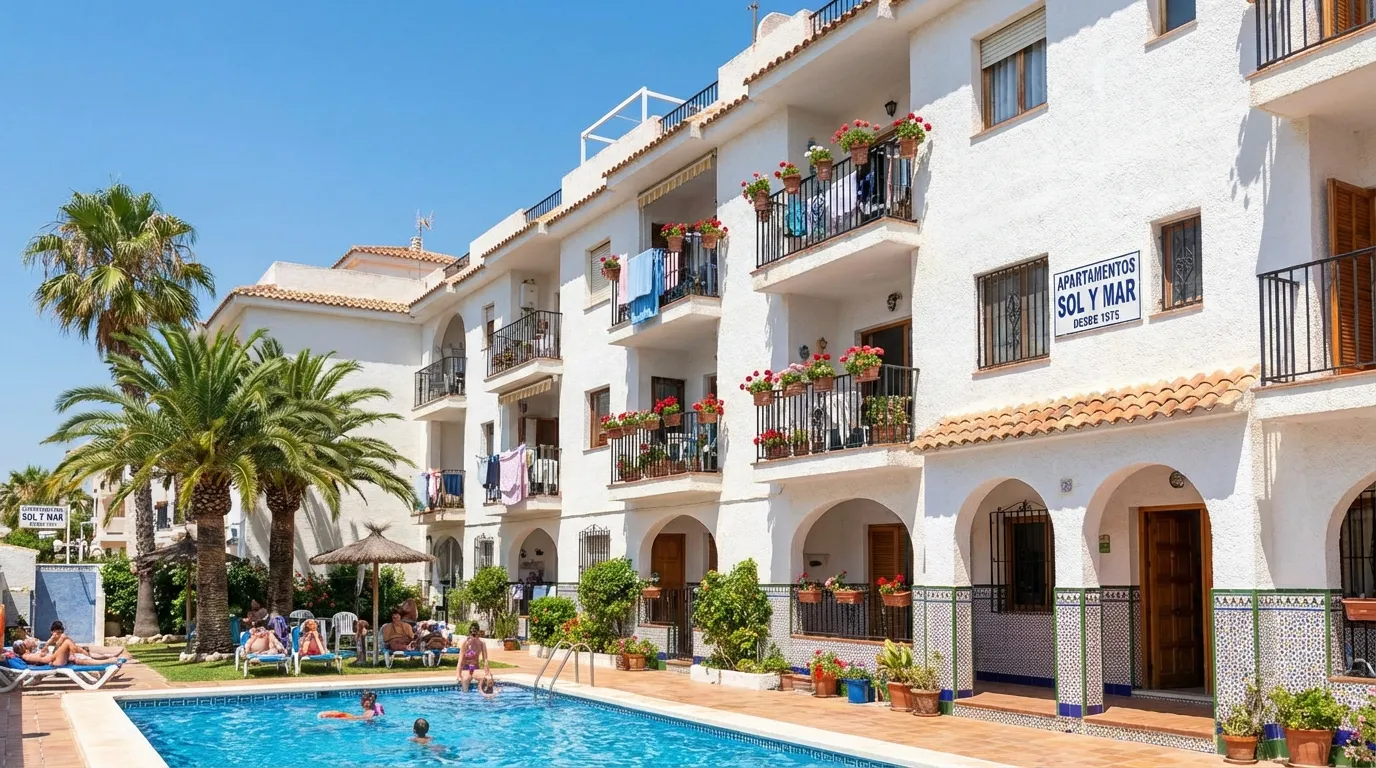
Cheap apartments in Torrevieja from 65,000 €: prices in Centro, La Mata, La Siesta and Los Balcones — hidden costs, risks and tips for bargains in 2026.