

Area Guides
Mil Palmeras – Guide to Property and Life at the Palm Beach 2026
Property in Mil Palmeras: prices, beaches, services and what you should know before buying in this coastal resort on the southern Costa Blanca — for Swedish buyers.
13 min
Complete guide to Pilar de la Horadada: family-friendly living, beaches, property prices and why the municipality is one of Costa Blanca's best-kept alternatives.
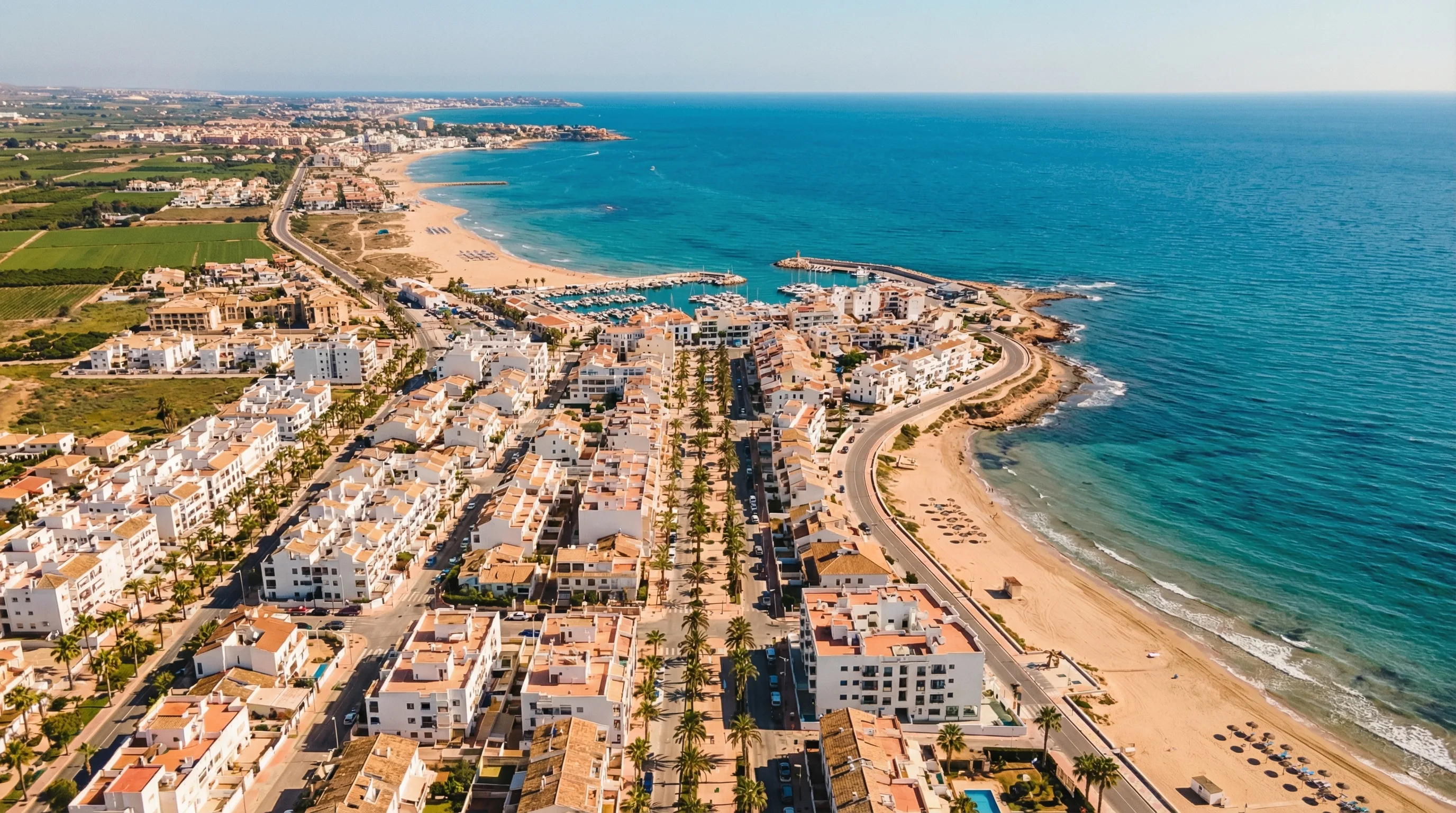
Pilar de la Horadada is the municipality on southern Costa Blanca that most often ends up in the shadow of its neighbours Torrevieja and Orihuela Costa — and that is precisely what makes it interesting. With 23,844 registered residents, six Blue Flag-certified beaches and an average price per square metre of 2,665 euros for second-hand properties, the municipality offers a rare combination: genuinely Spanish town life in Pilar pueblo, beachside living in Torre de la Horadada and Mil Palmeras, and prices that still sit below those of the more heavily marketed coastal resorts to the north. If you are looking for a place to actually live — not just holiday in — Pilar de la Horadada deserves your attention. This guide takes you through everything from the property market and beaches to schools, climate and everyday life.
Tip
Pilar de la Horadada sits on the border between the province of Alicante and the Region of Murcia. This gives you access to two airports: Alicante-Elche (65 km, 45–55 min) and Murcia-Corvera (40 km, 30–35 min). Direct flights from Stockholm and Gothenburg serve both.
Pilar de la Horadada is the southernmost municipality in the province of Alicante and belongs to the comarca of Vega Baja del Segura. The municipality borders Orihuela to the north and the Region of Murcia (San Pedro del Pinatar) to the south. The Mediterranean forms the entire eastern boundary with a coastline of just over 4 kilometres.
The municipality consists of three distinct parts: Pilar pueblo (the main town, 5 km inland), Torre de la Horadada (a historic coastal town with a marina) and Mil Palmeras (a modern beach resort). There is also the urbanisation of Pinar de Campoverde situated between the town centre and the coast.
By car you reach it via the AP-7 motorway or the N-332 national road. From Alicante-Elche airport it is approximately 65 km south (45–55 minutes' drive), and from Murcia-Corvera airport around 40 km (30–35 minutes). This makes Pilar de la Horadada one of the few municipalities on Costa Blanca with reasonable access to two international airports.
Local buses run regularly between Pilar pueblo, Torre de la Horadada, Mil Palmeras and onwards to Torrevieja, but in practice a car is almost essential if you want to move around freely.
This is the crucial question that many property buyers miss. Pilar de la Horadada is not a homogeneous place — it is three quite different environments under the same municipal roof.
Pilar pueblo lies 5 kilometres from the coast and is a genuine small Spanish town with around 12,000 residents. Here you find everything a small town needs: supermarkets, banks, pharmacies, a health centre, schools, restaurants, a sports centre and a lively Friday market. The town centre has narrow streets, square cafés and a relaxed atmosphere that does not change with the seasons.
This is the place for you if you want to live in Spain on Spanish terms. Prices are lower than at the coast and you get more property per euro. The downside is obvious: you do not have the sea on your doorstep.
Torre de la Horadada takes its name from the medieval watchtower (Torre Vigía) that still guards the shoreline. It is the most "Spanish" of the coastal towns, with a small marina, fish restaurants, the lively Pueblo Latino square and a permanent population that keeps the town active year-round. The beaches El Conde, El Puerto and Jesuitas all hold Blue Flag certification.
Torre suits you if you want beachside living with genuine Spanish character — not a resort feel. Social life revolves around the harbour and the squares, and in winter it is more active here than in Mil Palmeras.
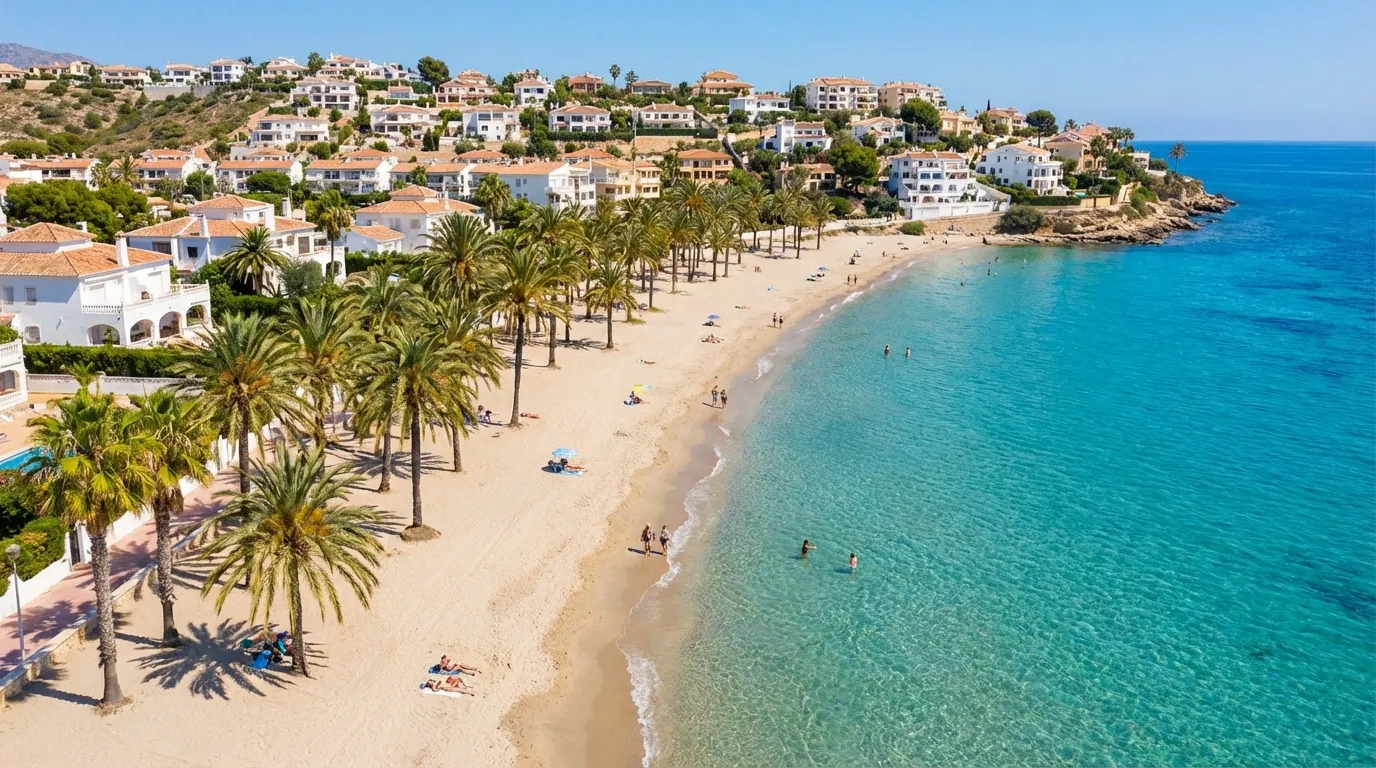
Mil Palmeras is the newer, more international part of the municipality. The town is known for its palm-lined sandy beach with Blue Flag status and has grown into a popular base for Scandinavian and northern European buyers. New developments are of high quality with communal pools, modern kitchens and energy-efficient solutions.
Mil Palmeras suits beach lovers and holiday residents, but the permanent population is only around 900 people, which means winters are noticeably quieter. If you are planning year-round living it may be worth considering Torre de la Horadada instead.
Information
Pinar de Campoverde, located midway between Pilar pueblo and the coast, offers villas and townhouses in a quiet woodland setting at lower prices. The urbanisation has an international community and its own facilities but is 3–4 km from the nearest beach. An affordable option for villa buyers.
The property market in the municipality has shown a clear upward trend. In February 2026 the average price per square metre stood at 2,665 euros for second-hand properties, an increase of 0.54 per cent compared to the previous month and 1.5 per cent on a quarterly basis. However, price levels vary considerably depending on whether you buy at the coast or in the main town.
| Area | Type | Price range (euros) | Approx price/m² |
|---|---|---|---|
| Pilar pueblo | 2–3 bed apartment | 90,000 – 160,000 | 1,400 – 1,800 |
| Pilar pueblo | Villa/townhouse | 150,000 – 300,000 | 1,200 – 1,600 |
| Torre de la Horadada | 2–3 bed apartment | 160,000 – 300,000 | 2,400 – 3,200 |
| Mil Palmeras | 2–3 bed apartment | 180,000 – 400,000 | 2,800 – 3,800 |
| Mil Palmeras | New build | 250,000 – 450,000 | 3,200 – 4,200 |
| Pinar de Campoverde | Villa with pool | 200,000 – 400,000 | 1,500 – 2,200 |
The average property price in the municipality as a whole is around 339,000 euros, but the range is wide — from simpler apartments in Pilar pueblo at around 90,000 euros to luxury villas by the coast at over 900,000 euros.
Pilar de la Horadada sits price-wise between Torrevieja (lower average price, larger supply of simpler apartments) and Orihuela Costa (similar level at the coast, more expensive at the top end). The major advantage is that Pilar pueblo offers genuine residential property prices for year-round living — not tourist-resort-inflated levels.
Properties
Explore available properties in pilar-de-la-horadada
The municipality's coastline stretches just over 4 kilometres and encompasses six beaches that have all been awarded Blue Flag status in 2026. This makes Pilar de la Horadada one of the municipalities in Spain with the highest proportion of Blue Flag beaches relative to the length of its coastline.
Wide sandy beach lined with palm trees with shallow water and soft sandy bottom — ideal for families with children. Sun loungers, showers, beach bars (chiringuitos) in summer, accessible ramps and lifeguards during high season.
Borders Mil Palmeras to the south. Quieter and less developed with fine sand and crystal-clear water. Popular with locals and those who prefer a more peaceful beach experience.
Located at the foot of the medieval watchtower in Torre de la Horadada. Fine sandy beach with good facilities and close to the harbour restaurants.
Small beach next to the marina in Torre de la Horadada, sheltered from waves. Good for young children and snorkelling enthusiasts.
Sandy beach north of Torre de la Horadada with calm water and fewer visitors. A favourite among local residents.
A series of small rocky coves south of Torre de la Horadada. Perfect for those who want to get away from the larger beaches and enjoy seclusion. The rock formations create natural pools that are exciting for children to explore.
Note
Despite all six beaches holding Blue Flag certification, be aware that sea currents can be strong at Rocamar and at beach ends on windy days. Always follow the flag markings set up by lifeguards.
Pilar de la Horadada has a semi-arid Mediterranean climate with mild winters and warm summers. The annual average temperature is 18.1 degrees and the municipality records an estimated over 300 sunny days per year.
| Month | Min (°C) | Max (°C) | Sea temp (°C) | Sun hours |
|---|---|---|---|---|
| January | 6 | 16 | 14 | 6–7 hrs/day |
| April | 10 | 22 | 16 | 8–9 hrs/day |
| July | 21 | 30 | 25 | 10–11 hrs/day |
| October | 14 | 25 | 22 | 7–8 hrs/day |
Rainfall is concentrated in autumn, primarily September–November, but the total number of rainy days per year usually stays below 30. Annual average precipitation is 319 mm, making the area one of Europe's driest.
The sea breezes (the so-called levante) mean the temperature rarely feels stifling despite high maximum readings. Winters are mild — daytime temperatures rarely drop below 15 degrees, and it is perfectly possible to sit at an outdoor café terrace in December wearing just a fleece.
Pilar de la Horadada had 23,844 registered residents in January 2024. The population has grown steadily at an average of 1.7 per cent per year since 2020, and the municipality welcomed 493 new residents in the past year alone.
The demographic composition reflects the municipality's dual character. Pilar pueblo has a predominantly Spanish population rooted in agriculture and local business, while the coastal towns of Torre de la Horadada and Mil Palmeras have a high proportion of foreign residents — primarily Britons, Germans, Belgians, Dutch and Scandinavians.
It is estimated that around 2,500 Swedish residents live in the municipality and surrounding area, including Torre de la Horadada and Mil Palmeras, making it one of the larger Swedish communities on southern Costa Blanca. Social life among Scandinavians revolves around the coastal promenade, the restaurants and the communal pool areas of the residential communities.
Population density stands at 306 residents per km², but this conceals the actual distribution: the main town is relatively densely built while the coastal strip has a lower permanent population but high visitor pressure in summer.
Pilar de la Horadada stands out among Costa Blanca municipalities as a genuinely family-friendly option. It is not just about the beaches being shallow — it is about the municipality functioning as a real place to live with children.
Pilar pueblo has several state and semi-private schools (colegios concertados) as well as municipal nurseries. The language of instruction is Spanish and Valencian, but children learn quickly. International schools such as El Limonar International School and Newton College are within commuting distance for families who prefer English-medium education.
The municipality has a well-equipped health centre (centro de salud) with multilingual staff and private clinics in the area. For specialist care and hospital visits you go to Hospital Universitario de Torrevieja (20 min) or the hospitals in San Javier and Cartagena on the Murcia side.
Parks, sports facilities and sports clubs are available in Pilar pueblo. Padel has exploded in popularity and there are several courts. Along the coast children can play in the shallow water, and at the Rocamar cliffs there are natural pools that are perfect for children to explore.
The municipality has festivals almost every month. The largest are the Fiestas de la Virgen del Pilar in October (a multi-day celebration with parades, music and fireworks), the Three Kings parade in January, Semana Santa (Holy Week) and the summer beach festivals. Children are a central part of all celebrations — there are fairground rides, workshops and activities at all of them.
Properties
Explore available properties in pilar-de-la-horadada
This question comes up frequently because the areas border each other. Orihuela Costa begins directly north of Mil Palmeras (Dehesa de Campoamor) and extends northward towards Torrevieja. Both have beachside living and international residents, but their character differs considerably.
Pilar vs Orihuela Costa
In summary: Pilar de la Horadada suits you if you want to integrate into Spanish community life and have beach access without living in a tourist resort. Orihuela Costa suits you if you prioritise beach proximity, golf and an established international expat life.
Southern Costa Blanca is one of Europe's densest concentrations of golf. From Pilar de la Horadada you can reach several well-known courses:
There are also golf academies and driving ranges in the area for those who want to learn the game.
Pilar de la Horadada has a lively Friday market in the town centre offering fresh fruit, vegetables, olives, cheeses, flowers, clothing and household goods. There is also a Tuesday market day with more focus on food. Torre de la Horadada has a summer market and occasional craft markets during high season.
The food scene in the municipality is surprisingly varied:
The proximity to the sea provides access to genuinely fresh fish and seafood. Gambas rojas (red king prawns) from the local waters are a delicacy not to be missed.
Several factors point towards continued positive development:
At the same time the usual caution flags apply: the Spanish property market has cyclical patterns and historical appreciation does not guarantee future returns. Buy primarily a home you want to use — any appreciation is a bonus, not a guarantee.
Contact
Our team knows the municipality inside and out and speaks your language. Book a free video consultation — no obligation.
Book free consultationDecision support
Pilar de la Horadada hade 23 844 registrerade invånare i januari 2024 enligt INE. Kommunen växer stadigt med ungefär 1,7 procent per år.
En betydande andel av befolkningen är utländska medborgare, framför allt britter, tyskar och skandinaver som bor i kustorterna Torre de la Horadada och Mil Palmeras.
Från Alicante-Elche flygplats till Pilar de la Horadada centrum är det cirka 65 km, ungefär 45-55 minuters körning via AP-7. Du kan också flyga till Murcia-Corvera flygplats som ligger 40 km bort, cirka 30-35 minuters bilresa.
Från Stockholm och Göteborg finns direktflyg till bägge flygplatserna.
Pilar de la Horadada har sex stränder med Blå Flagg-certifiering: Las Higuericas, El Puerto, El Conde, Jesuitas, Playa de Rocamar och Mil Palmeras. Totalt sträcker sig kommunens kustlinje över drygt 4 kilometer med varierad natur, från breda sandstränder till små klippvikar.
Ja, kommunen är mycket barnvänlig. Det finns flera offentliga och halvprivata skolor, förskolor, sportklubbar och välskötta parker.
Stränderna är grunda och trygga. Pilar pueblo har ett genuint spanskt stadsliv med fredagsmarknad, fester och restauranger, vilket gör det lättare att integreras jämfört med rena turistorter.
Absolut. Till skillnad från många rena kustorter på Costa Blanca har Pilar de la Horadada en aktiv spansk kärnbefolkning som bor kvar året runt.
Kommunen erbjuder vårdcentral, apotek, skolor, stormarknader, banker och restauranger som håller öppet även vintertid. För sjukhusbesök åker du till Torrevieja, 20 minuter bort.
Sources

Lo Monte, Alicante

Pilar De La Horadada, Alicante

Pilar De La Horadada, Alicante

Torre De La Horadada, Alicante

Torre De La Horadada, Alicante

pueblo, Alicante
Property in Mil Palmeras: prices, beaches, services and what you should know before buying in this coastal resort on the southern Costa Blanca — for Swedish buyers.
Everything you need to know about Orihuela Costa on Costa Blanca: areas, property prices, climate, beach life and tips for buying property in southern Spain.
Complete guide to Benidorm: Levante and Poniente beaches, old town, property prices and why there is more beneath the surface than most people think.