


Buying Guides
Buying Property in Spain 2026 – Apartments, Houses, NIE & Mortgages
Complete guide to buying a property or apartment in Spain for Swedes: purchase process, taxes, costs, mortgages, regional differences and risks — updated 2026.
19 min
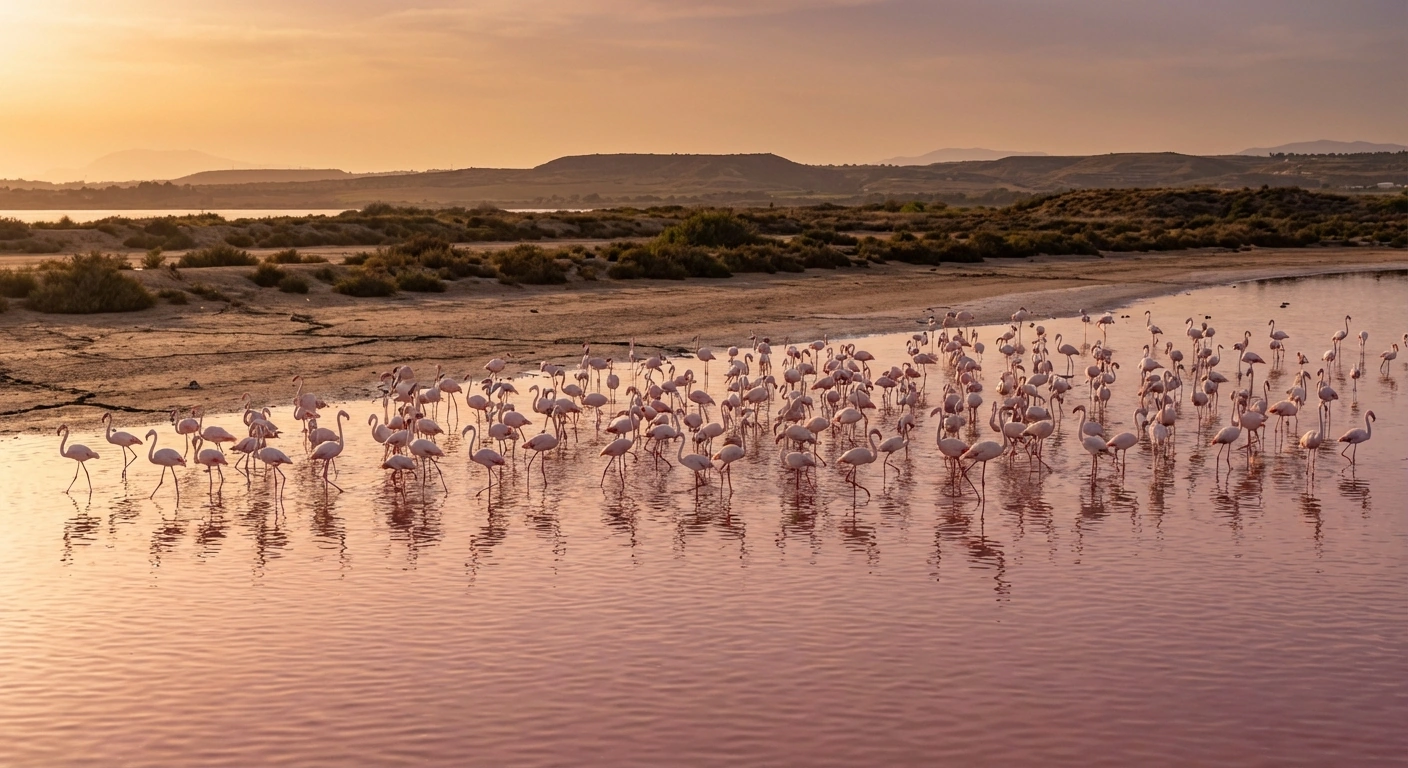
Laguna Rosa Torrevieja: why the pink lake is pink (Dunaliella salina algae), 2,000 flamingos, 3,700 ha nature park. Visiting tips and swimming rules.
Laguna Rosa in Torrevieja is real — but not in the way many people think. The lake can take on a distinctly pink hue thanks to extreme salinity, the microalgae Dunaliella salina and other salt-tolerant organisms, but the colour varies greatly with light, wind and season. It is not a permanently neon-pink lake. It is a living salt lake within a protected nature park, and sometimes it looks spectacular, sometimes quite understated.
What matters for you as a visitor or property buyer comes down to two things. First, Laguna Rosa is part of the Parque Natural de las Lagunas de La Mata y Torrevieja, a wetland area covering 3,700 hectares of which 2,100 hectares is water. Second, this is an area where natural values, birdlife and salt production take precedence over swimming and "Instagram access". This guide gives you an honest picture of why the lake is pink, when it is worth visiting, where you actually see the most, what is prohibited, and how this affects daily life if you are considering living near the lake.
Key takeaways
- The colour is created by the microalgae Dunaliella salina in extremely salty water, not a chemical discharge or "magic mud"
- Parque Natural de las Lagunas: 3,700 ha, of which 2,100 ha is water
- Up to 2,000 flamingos at La Mata and 3,000 black-necked grebes during migration periods
- Swimming is prohibited in the lagoons; the shoreline zones are sensitive and protected
- Late afternoon in spring/early summer gives the best chance of a clear pink hue
The short answer is that the water is extremely salty. In the lagoons, the brine can reach up to 300 mS/cm, a level at which ordinary aquatic plants cannot survive. In that environment, the microalgae Dunaliella salina thrives instead, producing large amounts of beta-carotene. This is the same pigment family that gives carrots their orange colour. When the concentration is high and the light falls at the right angle, the water takes on that pink-red colour that has made the place famous.
It does not stop at the algae. The park also highlights Artemia salina, a small salt-tolerant crustacean that is central to the food chain and feeds on the same type of micro-organisms. It is the interplay between salinity, microalgae, small invertebrates and light that creates the effect — not a chemical discharge and not "magic mud" either.
Information
Did you know? The Generalitat Valenciana describes Dunaliella salina as one of the most important reasons for the red-pink colour of the lagoons. The colour comes from high concentrations of beta-carotene, not from pollution.
This is also why people are often surprised. Photos online are almost always taken when conditions are perfect: low evening sun, calm water and a dry period. If you arrive in the middle of the day after wind or rain, the lake can look more beige, purple or grey-pink than rose-tinted. That does not mean you are in the wrong place. It just means nature does not follow a colour filter.
Laguna Rosa is not a standalone attraction but one half of the nature park Parque Natural de las Lagunas de La Mata y Torrevieja. The park is located in Vega Baja del Segura and stretches across parts of Torrevieja, Guardamar del Segura, Los Montesinos and Rojales. Together with El Hondo and the salt flats of Santa Pola, the area forms an internationally important wetland triangle in southern Alicante.
The park itself covers 3,700 hectares. Of this, 2,100 hectares is open water. Laguna de Torrevieja accounts for approximately 1,400 hectares and Laguna de La Mata for approximately 700 hectares. The two lagoons are connected via a system that also has a link to the sea through El Acequión. This means the area functions as a connected salt-lake environment and still has a strong connection to the salt extraction that has shaped Torrevieja for generations.
For those moving between La Mata and central Torrevieja, this is important to understand. The lakes are not just pretty backdrops. They shape the landscape, the views, the birdlife and why certain parts of the municipality feel more open and natural than others.
Yes, and this is a large part of the area's real value. The Generalitat Valenciana describes birdlife as the park's most important fauna group and states that the area hosts close to a hundred species. During migration periods, concentrations of up to 2,000 flamingos and around 3,000 black-necked grebes have been recorded.
Flamingos are often associated with the pink lagoon, but in practice they move to wherever they find the best rest and food. The park's own texts emphasise that flamingos primarily feed and rest in the La Mata lagoon, while the entire wetland system is used for migration, wintering and breeding by various species. This means you sometimes see the birds clearly, sometimes only in the far distance, and sometimes barely at all.
From observation points such as La Cigüeñuela, El Zampullín, El Fumarel and La Avoceta you can also spot avocets, stilts, terns, waders and gulls. If you enjoy nature rather than just a photo backdrop, this is almost a greater reason to visit the area than the colour of the water.
Tip
Bring binoculars if you care about birdlife. The lake often looks best to the eye in evening light, but birdwatching works better if you take your time and stand still at an observatory rather than just stopping at the roadside.
This is where many guides become unnecessarily vague. The best experience is normally gained from marked trails and viewpoints in or near the nature park, not by trying to get down to the water's edge. The park itself points to several observation points and trails around the area, including observatories La Cigüeñuela and El Zampullín, as well as El Altillo and the area around El Acequión.
The yellow walking route is the most practical choice if you want to combine landscape views, birdlife and clear access. The park's description says the trail passes most of the ecosystems in the area and provides a panoramic view of the entire park, with stops at El Acequión, La Cigüeñuela, Pinada and El Zampullín. If you want a shorter and simpler nature walk, the vine route can be a good complement. It is 1.5 kilometres long and takes around 40 minutes at a leisurely pace.
In practical terms, three situations tend to work best:
The worst approach is to simply type "pink lake Torrevieja" into your phone, stop at the first available exit and expect a perfect viewing platform. The area is larger, more spread out and more regulated than that.
No. Swimming in the lagoons is prohibited. The park's official visitor recommendation states explicitly that you should not go down to the water's edge because the areas are very sensitive for vegetation and nesting birds, and that swimming in the lagoons is forbidden.
This is perhaps the most common collision between expectation and reality. Many older blog posts and social media posts describe the lagoon as if you can simply step in, float around and rub yourself with mineral-rich mud. That sits poorly with today's reality. The natural value and protected status take precedence over the tourist experience.
Note
Warning: Laguna Rosa is not a free bathing area. The park's rules state that you should stay on marked paths and not go down to the lagoon shores. Those who travel here only to swim are often disappointed.
If you want to live in Orihuela Costa or Torrevieja and are attracted by the proximity to the lake, it is better to see it as a natural environment and scenic resource rather than an alternative to the beach. For swimming, the Mediterranean is still the real winner.
It is better to be straightforward here than romantic. Many people say that the salt, mud and minerals from the area "are good for the skin" or "help the joints". There may well be people who experience relief, but that is not the same as the nature park recommending self-treatment in the lagoon. It does not. On the contrary, it prohibits swimming and urges visitors to stay away from sensitive shoreline zones.
The honest conclusion is therefore simple: the myth of health bathing lives on, but it should not be used as an argument for breaking the rules. If you are looking for serious health treatment, you should base that on medical advice, not travel reels. For most visitors, it is wiser to appreciate the place visually and then swim at an ordinary beach or use facilities where treatment is actually intended to take place.
The best time depends on what you want to get out of it. If the goal is colour and photos, late afternoon to sunset is usually best, especially during dry periods when the water is calm. If the goal is birdlife, morning or quiet hours outside peak season are often better. If the goal is simply a walk, the area works year-round.
There are still some patterns worth knowing. Spring and early summer often provide a good balance between light, temperature and activity in the park. High summer can produce strong colour but also heat, more mosquitoes in certain spots and less inclination to walk longer trails in the midday sun. After rain or wind, the lake often looks less pink. In winter the colour is sometimes weaker, but the area is pleasant if you want to walk without the crowds.
The visitor centre is also conveniently located in the old ranger's house in La Mata, approximately 400 metres from the N-332 at km 64.5, and is open 09.00–14.00 every day, with the exception of certain public holidays. This is useful if you want to start your visit properly rather than wandering between unclear car parks.
If you are coming by car, the easiest starting point is usually the visitor centre or the marked trails on the La Mata side. The park's information states that the centre is located right next to the N-332 and is reached via a paved road. This makes the area considerably easier to visit than many people initially expect.
You can also get there by public transport. According to the park's own information, the Costa Azul bus between Alicante and Cartagena stops approximately 200 metres from the information centre. For those already living in Torrevieja, this means you do not always need a car for a short visit, although a car is still the most convenient option if you want to move between different viewpoints on the same day.
My practical advice is to choose one of two approaches. Either make a short evening visit with a clear starting point and a specific viewing idea. Or set aside two to three hours and walk a marked trail at a relaxed pace. The worst option is a spontaneous roadside stop without a plan — you will easily miss both the best angles and the genuine nature park experience.
Unrealistic expectations. That is almost always the root cause.
The first disappointment is the colour. Many expect an even, strong pink lake in exactly the same shade as the most-shared photos. In reality, Laguna Rosa changes constantly. Some days it is clearly pink. Other days it looks more silver-grey or dusty purple.
The second disappointment is access. You cannot swim, you should not go down to the water's edge, and much of the experience happens from paths, observatories and a distance. This is correct if you respect that it is a nature park, but wrong if you think it is a free amusement park.
The third disappointment involves small things that are almost never mentioned in the marketing: smell from the salt and wetland environment on some days, mosquitoes during periods of still evening air, heat making walks uncomfortable in summer, and the fact that certain viewpoints feel less dramatic than in photos. None of this makes the place bad. But it makes it more real.
Because the lake says quite a lot about how life in Torrevieja actually works. It shows that the city is not just a promenade, high-rises and holiday traffic. There is also a large protected natural area that creates open views, walking environments and a kind of breathing space between the urban districts. For some buyers this is a strong plus, particularly if you enjoy being outdoors year-round.
At the same time, one should not exaggerate the property value of specifically "a view of the pink lake". It is not the same type of premium as a sea view. The lake can be fantastic in the right position and light, but it comes with restrictions, variation and a more niche value. For those who prioritise swimming, restaurants and a seafront promenade, locations near the beach will still carry more weight.
The best way to think about Laguna Rosa from a property perspective is therefore this: it is a plus if you appreciate nature, walking and cycling environments, birdlife and open landscapes. It is less relevant if you practically want classic beach life or plan to rent to guests who are only chasing a photo opportunity.
Properties
Explore available properties in torrevieja
Yes, if you go with the right expectations. Laguna Rosa is worth visiting as a natural experience, an evening walk and part of the broader story of Torrevieja. It is less worth it if you expect a swimmable attraction or constantly strong pink colour.
My advice is to combine the lake with a broader day in the area. Start at the visitor centre, walk a marked trail or the vine route, stop at an observatory, and then finish with dinner in La Mata or central Torrevieja. That way you get both the nature park and the everyday life that makes the place relevant for anyone considering buying property here.
Properties
Explore available properties in la-mata
Contact
We help you weigh up nature, beach location, amenities and budget against each other. Book a free call in Swedish if you want to understand which parts of Torrevieja actually suit your everyday life.
Book a free consultationLast updated: 2026-04-01. Rules and access in the nature park may change — always check current information before visiting the area.
Decision support
Färgen kommer främst från mikroalgen Dunaliella salina, som producerar beta-karoten i extremt salt vatten, och från små salttåliga organismer som Artemia salina. När ljuset ligger rätt kan kombinationen ge Laguna Rosa en tydligt rosa ton.
Efter regn, blåst eller perioder med lägre salthalt ser sjön ofta blekare ut.
Nej. Bad i lagunerna är förbjudet enligt naturparkens besöksregler.
Skälet är inte bara säkerhet utan också att strandzonerna är känsliga för vegetation, fågelliv och återhämtning i ekosystemet. Om du vill bada eller ta lerbad är det bättre att välja platser där det uttryckligen är tillåtet istället för att gå ner i den skyddade lagunen.
Sen eftermiddag och tidig kväll ger ofta den starkaste upplevelsen eftersom solen står lägre och färgen blir lättare att se. Vår, tidig sommar och torra perioder brukar ge bättre chans till tydlig rosa ton än efter regniga veckor.
Men färgen varierar mycket, så även under rätt årstid kan sjön se mer grårosa än knallrosa ut.
Ja, men inte alltid precis där du står. Naturparken är ett viktigt våtmarksområde för fåglar och Generalitat Valenciana uppger att man har räknat upp till 2 000 flamingos vid La Mata och omkring 3 000 svarthalsade doppingar under flyttperioder.
Det betyder inte att du ser stora flockar varje dag, men området är starkt förknippat med fågelliv.
För många ja. Närheten till Laguna Rosa ger promenadstråk, utsikter, fågelliv och en naturupplevelse som skiljer Torrevieja från renodlade strandorter.
Samtidigt bör du väga in nackdelar som lukt vissa dagar, mygg i perioder, begränsad access till själva vattnet och att upplevelsen kan kännas mindre dramatisk än på bilder i sociala medier.
Sources

Lago Jardín II, Alicante

Los Balcones, Alicante

San Luis, Alicante

Centro, Alicante

Centro, Alicante

Centro, Alicante
Local expertise
Complete guide to buying a property or apartment in Spain for Swedes: purchase process, taxes, costs, mortgages, regional differences and risks — updated 2026.
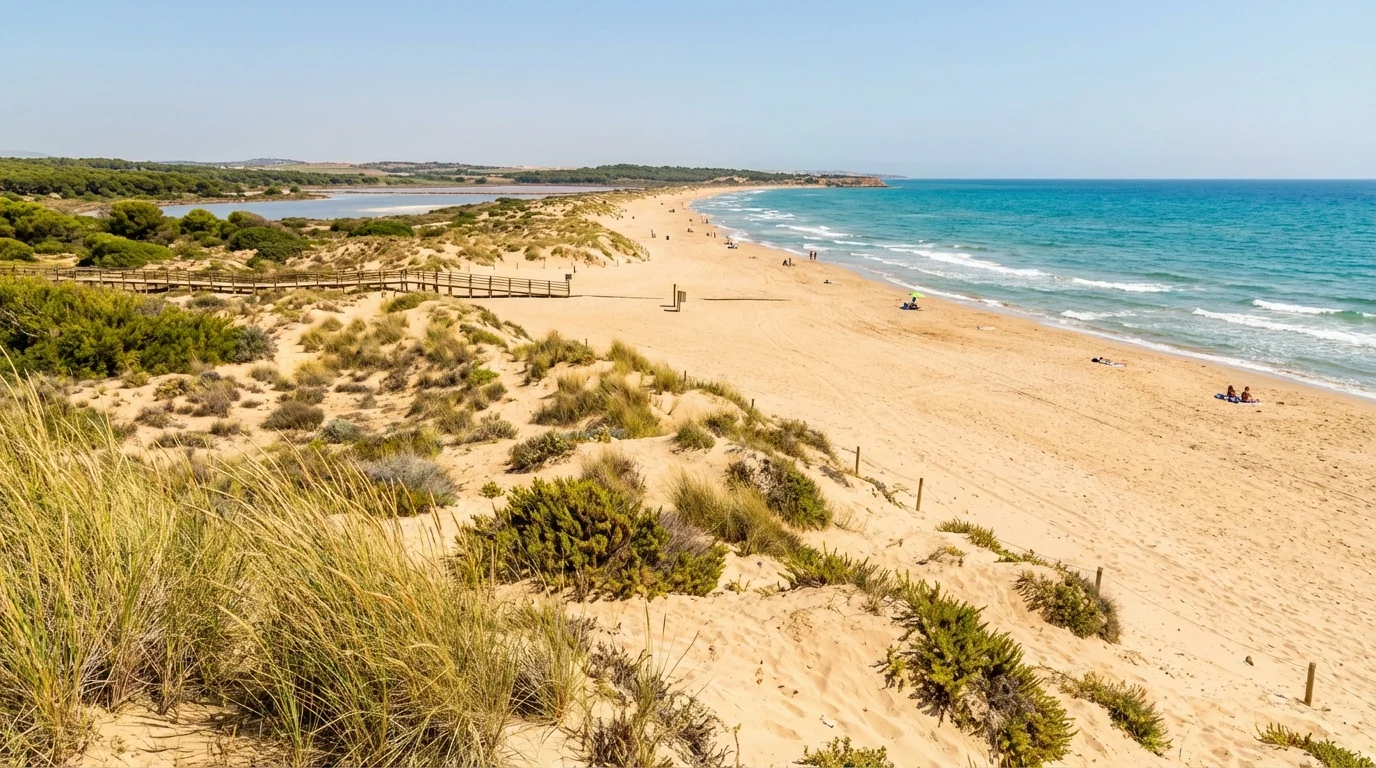
La Mata near Torrevieja: 2.3 km sandy beach, prices €2,600–2,750/m², nature reserve with flamingos. Honest guide for buyers on the Costa Blanca.
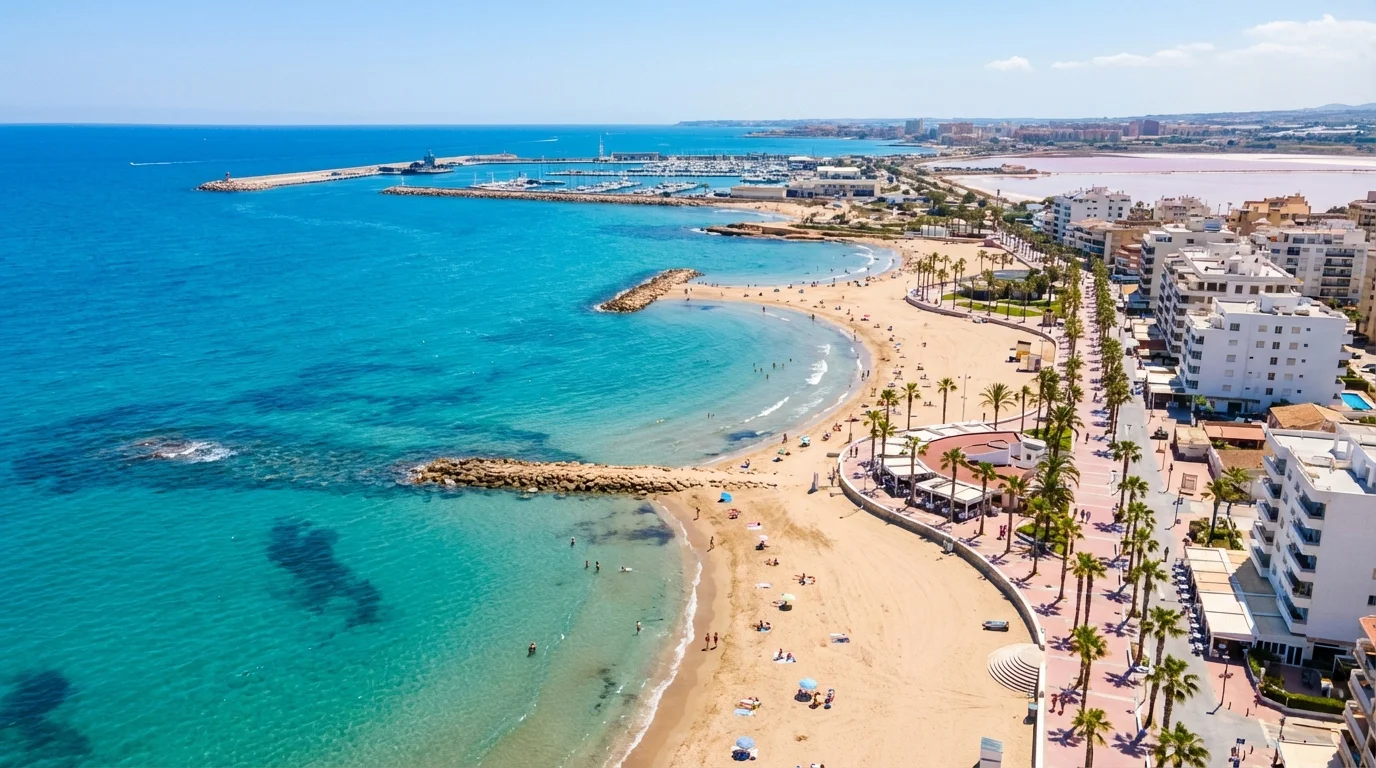
All beaches in Torrevieja: Playa del Cura, La Mata, Los Locos, Cabo Cervera and more. Facilities, Blue Flag status and tips for Swedish visitors.