


Area Guides
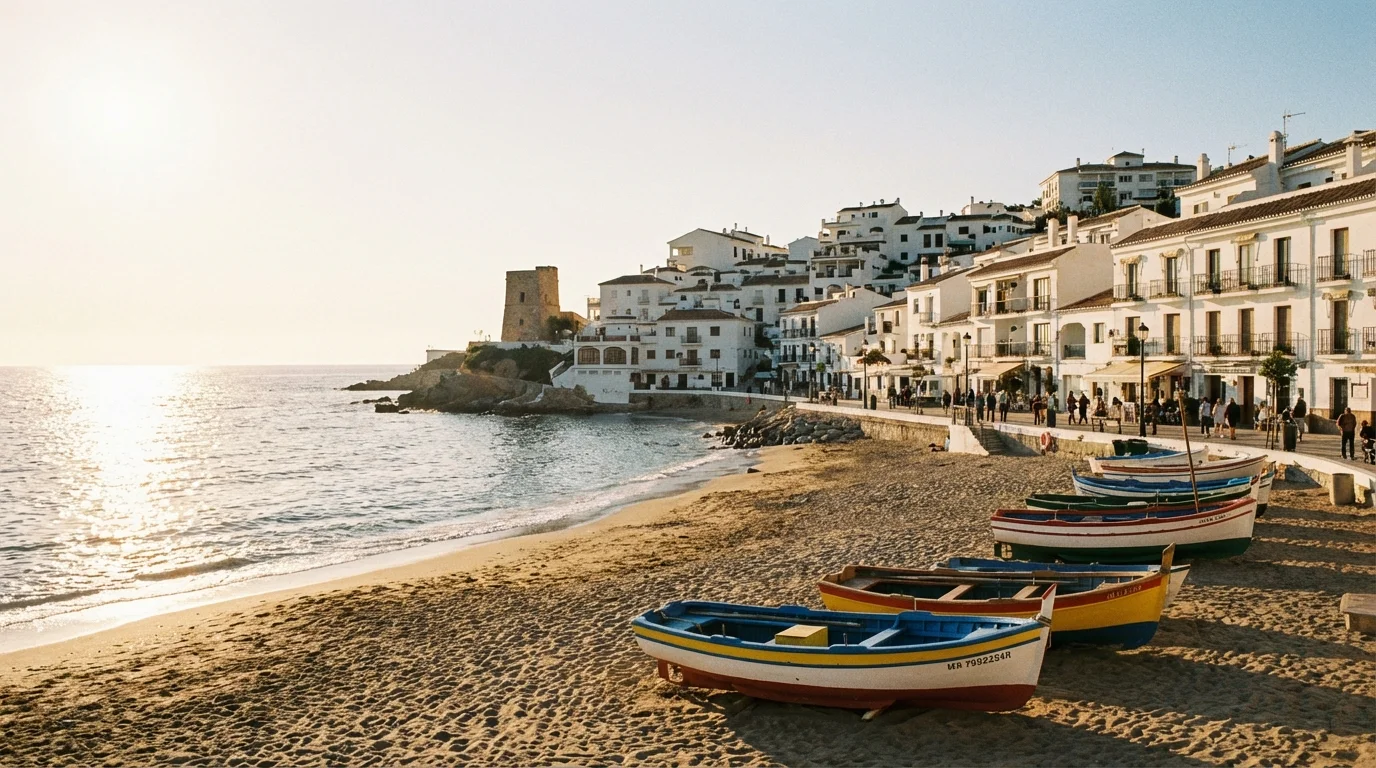
La Cala de Mijas – Charming Coastal Village for Families 2026
Complete guide to La Cala de Mijas on the Costa del Sol: beaches, property prices, restaurants and tips for Swedish buyers seeking charm without the tourist crowds.
19 min
How property prices are developing on Costa del Sol in 2026: area comparison, the drivers behind the price rises and where Swedish buyers should be especially careful.
Property price trends on Costa del Sol in 2026 remain positive, but the market is significantly more selective than it looked two years ago. The short answer is that the western coast still holds the highest pressure, especially in Marbella and Estepona, while Fuengirola, Mijas, Benalmádena and Nerja attract buyers for different reasons: better everyday logic, a lower entry level or clearer scarcity in the older stock. You are therefore not looking at a single Costa del Sol market. You are looking at several markets moving at different speeds.
This shows in the figures. Marbella was around 5,485 euros per square metre at the end of 2025. Estepona was around 4,116 euros per square metre and Mijas around 3,569. Fuengirola was at the same time higher than many expect, around 4,798 euros per square metre in November 2025, after nearly 18% growth in a year. This means Costa del Sol is still rising, but not that everything is equally worth buying.
In this overview I go through which sub-areas are strongest, where new build is pushing up prices, why foreign demand still keeps the market up and where you as a buyer should be extra careful not to pay a premium for the wrong property.
Costa del Sol enters 2026 at a continued high price level, but with greater differences between municipalities and sub-areas than many headlines suggest. Marbella is still the clear premium leader. That is nothing new. What is interesting is that the gap from the rest of the coast is still large, but no longer so large that every property there automatically looks reasonable. When Marbella sits around 5,485 euros per square metre and Mijas around 3,569, you pay roughly 50% more to enter Marbella's broad market. Then the location really must justify the price.
At the same time momentum has been strong in several more "everyday" markets. Fuengirola was around 4,798 euros per square metre in November 2025, up 17.92% compared with December 2024. That says something important: buyers are not just chasing glamour. They are also chasing walkable distances, trains, schools, beach promenades and a simple daily life.
Estepona sits between the two logics. The municipality has become noticeably more expensive but still offers a lower entry level than Marbella in broad segments. That is why many Swedish buyers experience Estepona as "more reasonable", even though the market is no longer cheap in any old sense.
Information
Important nuance: much of the market data at local level is based on asking prices. This makes the figures useful for understanding level, pace and differences between areas, but less precise if you are trying to guess the final price for an individual property.
If you mean strongest in absolute premium the answer is still Marbella. If you mean strongest in the combination of momentum, usability and breadth the answer becomes more mixed. I think you should distinguish between four types of strength.
First you have Marbella, where the price level is still driven by international capital, a strong brand and genuine scarcity in the best micro-locations. This applies especially to parts of the Golden Mile and Nueva Andalucía. But that strength also makes the market less forgiving. The wrong location in the right municipality costs a lot.
Then you have Estepona, where the strength lies in the market still feeling like an upgrade market. Many buyers see Estepona as a step up from family resorts further east, but without going all the way to Marbella's price level. That is why demand holds up even when buyers become more price-conscious.
The third group is Fuengirola and Mijas. Here it is not the same luxury premium driving everything. Here it is daily life. Fuengirola has over 85,600 residents, around 37% foreign residents and a direct train to the airport. Mijas municipality has over 92,000 residents and around 30% foreign residents. Those figures matter. They show that demand does not stand on holiday legs alone.
The fourth group is Benalmádena and Nerja. Those markets are smaller, more distinctive and in some ways more selective. Benalmádena attracts buyers who want a train connection, a marina, healthcare and simple access to Málaga. Nerja attracts buyers who want a smaller scale, stronger charm and less high-rise dominance. Nerja was around 4,432 euros per square metre in 2025 data, which shows that scarcity on the eastern coast also has a price.
In practice this means Marbella is still strongest as a premium market, while Fuengirola and Mijas are often stronger for buyers who are actually going to live with the property for much of the year.
The most useful way to read Costa del Sol is to compare six sub-markets rather than talking about the whole coast as one block.
Price overview
| Area | Apartment | Villa | Townhouse |
|---|---|---|---|
| Marbella | 300,000–700,000 € | 900,000–3,000,000+ € | 450,000–900,000 € |
| Estepona | 220,000–450,000 € | 500,000–1,500,000 € | 320,000–650,000 € |
| Fuengirola | 220,000–500,000 € | 650,000–1,800,000 € | 350,000–700,000 € |
| Mijas | 250,000–500,000 € | 600,000–1,800,000 € | 350,000–700,000 € |
| Benalmádena | 200,000–420,000 € | 550,000–1,600,000 € | 320,000–620,000 € |
| Nerja | 250,000–500,000 € | 700,000–2,000,000+ € | 380,000–750,000 € |
These ranges are broad, of course, but they say something important about the pricing logic. Marbella is the most expensive because the market carries an international premium. Estepona is somewhat cheaper, but often only marginally cheaper in new build close to the beach or golf. Fuengirola is higher than many Swedish buyers expect, especially in areas where the train and the beach coincide. Mijas is split between Mijas Pueblo, Mijas Costa and more resort-like sub-areas. Benalmádena is often more affordable on paper, but topography affects daily life there more than buyers first realise. Nerja is expensive for its size because the supply is smaller and the environment is still perceived as unusually "unspoilt" for Costa del Sol.
This is also where many make a common thinking error. They see that Estepona or Benalmádena is below Marbella and think the market there is automatically cheap. That is the wrong way to read the data. The right question is what you get per euro in the specific sub-area you are looking at. A well-located older property in Fuengirola Centro can be a smarter buy than a newly produced property further out in Estepona, even if the municipal average says something different.
I also think you should consider how "broad" the market is in each area. Fuengirola has a larger local everyday engine than many holiday resorts, which means an adequate property in the right location is often easier for the next buyer to understand. Benalmádena is more uneven. Benalmádena Pueblo, Arroyo de la Miel and the marina are almost three different products in the same municipality. Nerja is even more selective. There a charming object close to the centre or Burriana can be strong, while a property with less good logistics does not get the same pull from the municipality name.
In short: do not just compare municipality against municipality. Compare daily life against daily life. That is often where the best decisions are made.
Properties
Explore available properties in Fuengirola
Yes, often in demand. Not always in value. That is an important difference.
Nationally new-build prices rose by 9.7% in the third quarter of 2025. At the same time several overviews point out that new build along the coast often sits 15 to 25% above comparable resale property. On Costa del Sol this is particularly noticeable in Estepona, western Mijas and parts of the Marbella area where projects sell lifestyle as much as address.
This makes new build attractive for buyers who want energy efficiency, low initial maintenance risk and smoother rental. That is perfectly reasonable. But the high premium also means you have to be harder in your assessment. If ten projects in the same corridor are selling roughly the same floor plan, the same pool area and the same marketing dream, then your specific property does not necessarily have any obvious advantage when you one day want to sell.
On Costa del Sol this is especially visible in Estepona and New Golden Mile, where the building pace is higher than in more built-out sub-markets. In Marbella you more often pay a premium for the address itself. In Estepona you more often pay for the combination of new, nice and "next area up". In Fuengirola and Benalmádena older properties can sometimes win because they are closer to the station, beach and everyday services than the new stock further up in the terrain.
Tip
Practical rule of thumb: better pay a premium for micro-location than for showroom feel. Beach access, walkable daily life, functioning services and documented resale interest hold value better than yet another new phase in an area where much similar supply comes to market at the same time.
There are several reasons, but four stand out most.
The first is that foreign demand is still structural and not just seasonally driven. Fuengirola has around 37% foreign residents. Marbella is around 30%. Mijas is around 30%. When such a large proportion of the resident base is already international, the market becomes less sensitive to local wage growth alone. That sustains demand in good locations.
The second is supply shortage. Spain builds around 100,000 new homes per year, while the estimated need exceeds 200,000. That equation does not show up equally everywhere, but it shows up clearly on the coast where buildable land, planning processes and coastal locations are limited.
The third is the premium coast effect. Costa del Sol has become a product in itself. Not just an area. That matters when you compare with other parts of Spain. Buyers do not just pay for weather, but for airport access, international schools, restaurant offer, golf, healthcare and a social network that is already in place. This applies especially in municipalities like Marbella, Estepona, Fuengirola and Benalmádena.
The fourth is that the interest rate environment does not hit all buyers as hard as headlines sometimes suggest. In the premium segment and across much of the international demand there is more equity and more cash buying than in many Swedish property markets. That does not mean interest rates have no significance. It means higher rates do not automatically cool Costa del Sol as quickly as they cool a more locally financed market.
This is where the market becomes more interesting, because it is not the same question as asking where prices are highest.
The first situation where I think the risk is clearest is secondary premium locations in Marbella. It is easy to pay near-Marbella prices for a property that does not actually have the scarcity or everyday quality needed to sustain its value over time. The municipality name is not always enough. Views, walkability, condition, noise and a genuinely usable floor plan matter more than many want to admit.
The second is new build in Estepona where the project supply is large. Estepona is still strong. That is not the point. The point is that a strong market and an overpriced property can exist at the same time. If the area around you fills with similar projects, resale value can be slower than the glitzy sales launch suggested.
The third is steep or car-dependent locations in Benalmádena and Mijas where the listings sell sea views but daily life becomes more complicated than the buyer imagined. Benalmádena sits around 3,100 euros per square metre at broad municipal level, but that figure says nothing about how much car, hills and logistics accompany certain locations. That matters a great deal for the resale market.
The fourth is buying in Nerja solely for the charm factor without accepting the price level and the market's smaller size. Nerja is attractive precisely because it does not feel as exploited. But that quality costs. If you do not actually value that type of environment you can end up with an expensive purchase in a market that is less liquid than Fuengirola or Estepona.
There is also a more everyday overpayment risk that rarely shows up in market reports: properties that look cheap in absolute euros but become expensive when you factor in everything around them. On Costa del Sol that often involves community charges, garage, storage, pool costs, higher running costs in large complexes and renovation needs not visible in the first set of photos. This applies especially to older apartments near beach promenades where the address is strong but the building is weaker than the listing suggests.
I would therefore be especially careful with three types of property: older seafront apartments that have not been technically updated, new build where you pay full premium before the area is complete and "almost premium" locations where the agent's text leans heavily on proximity to Marbella, Puerto Banús or the sea without the property actually delivering the same usability.
Note
What usually slows first is not the whole market, but the wrong product in the right area. An ordinary property with noise, a weak floor plan or too much project competition becomes difficult long before Costa del Sol as a whole looks weak in the statistics.
Yes, if you buy with the right expectations. No, if you believe the whole of Costa del Sol is still a market where almost anything rises quickly just because it is by the sea.
For long-term buyers there is still good logic here. Marbella works if you prioritise premium, international appeal and scarcity. Estepona works if you want something strong but slightly less maxed out. Fuengirola works if daily life, accessibility and rentability matter a lot. Mijas works if you like the difference between coast and mountain and can choose the right sub-market. Benalmádena works if you want communications, services and a lower entry level than Marbella. Nerja works if you are actively looking for a smaller scale and accept that it costs.
What I would not do in 2026 is buy on the story of "the next hot area" without scrutinising the micro-location. Costa del Sol is too expensive for sloppiness. When the market already sits high, a bad buy is not just an irritation. It becomes an expensive tie-up of capital.
It is also worth being honest about what "good buy" means here. If you are looking for maximum short-term upside there are often cheaper parts of Spain to speculate in. Costa del Sol is better for those who want to combine use, stable demand and relatively high liquidity in good locations. That is a different kind of strength. Less rocket. More resilience.
For Swedish buyers this usually becomes simpler if you start from the right end. First ask how you want to live. Do you want to manage without a car? Then Fuengirola and certain parts of Marbella or Estepona weigh heavily. Do you want quieter premium without the same brand price? Then Estepona or selected parts of Mijas are often more interesting. Do you want charm and a smaller scale, and accept a longer time to the next sale? Then Nerja can be exactly right. When you start there, the price statistics become useful. When you start with the statistics alone, they easily become misleading.
If you want a brief conclusion it is this: the market is still strongest where supply is limited or everyday value is high. That does not apply automatically to every newly produced property near a golf course, and it certainly does not apply to every property that happens to sit in a premium area. Buy carefully and there are still good deals. Buy carelessly and Costa del Sol is one of the easiest places in Spain to overpay.
Properties
Explore available properties in Mijas
Contact
Get in touch and we'll guide you forward — whether you're just starting out or ready to buy.
Contact usLast updated: 2026-04-01. Price levels, interest rate conditions and project supply can change quickly, especially in areas where international buyers dominate demand.
Decision support
Ja, i absoluta prisnivåer är Marbella fortfarande tydlig etta på Costa del Sol. Men det betyder inte att varje delmarknad där är starkast för nya köpare.
En del av uppgången är redan inprisad, och fel objekt i sekundära premiumlägen kan bli dyrt att sälja vidare om marknaden blir mer selektiv.
Ja. Estepona ligger fortfarande tydligt under Marbella i genomsnittligt kvadratmeterpris, men skillnaden krymper i nyproduktion nära stranden och på New Golden Mile.
Du får ofta bättre instegspris i Estepona, men inte alltid bättre värde om projektutbudet runt dig är stort och likartat.
Risken är störst i två lägen: när du köper nyproduktion med hög premie i områden där många liknande projekt kommer ut samtidigt, och när du köper en medioker bostad i ett premiumområde bara för postnumrets skull. Costa del Sol belönar bra mikroläge, inte bara rätt kommunnamn.
För många svenska köpare, ja. Fuengirola och Benalmádena är ofta enklare för vardag tack vare tåg, service, skolor och mer blandad befolkning.
Marbella är starkare som premiummarknad, men vardagslogiken blir inte automatiskt bättre bara för att prisnivån är högre.
Räkna helst med minst fem till sju år om prisutvecklingen ska spela verklig roll i kalkylen. Costa del Sol har stark efterfrågan, men köpkostnader, valuta och nyproduktionspremier kan äta upp en stor del av kortsiktig uppgång.
Ju högre ingångspris, desto viktigare blir tålamod och objektkvalitet.
Sources

Las Chapas, Málaga

Paraiso Alto, Málaga

Paraiso Alto, Málaga

Higueron, Málaga

Higueron, Málaga

Higueron, Málaga
Local expertise
Complete guide to La Cala de Mijas on the Costa del Sol: beaches, property prices, restaurants and tips for Swedish buyers seeking charm without the tourist crowds.

Complete guide to Mijas Pueblo: the white mountain village above Fuengirola with spectacular views, property prices, restaurants and tips for Swedish buyers.
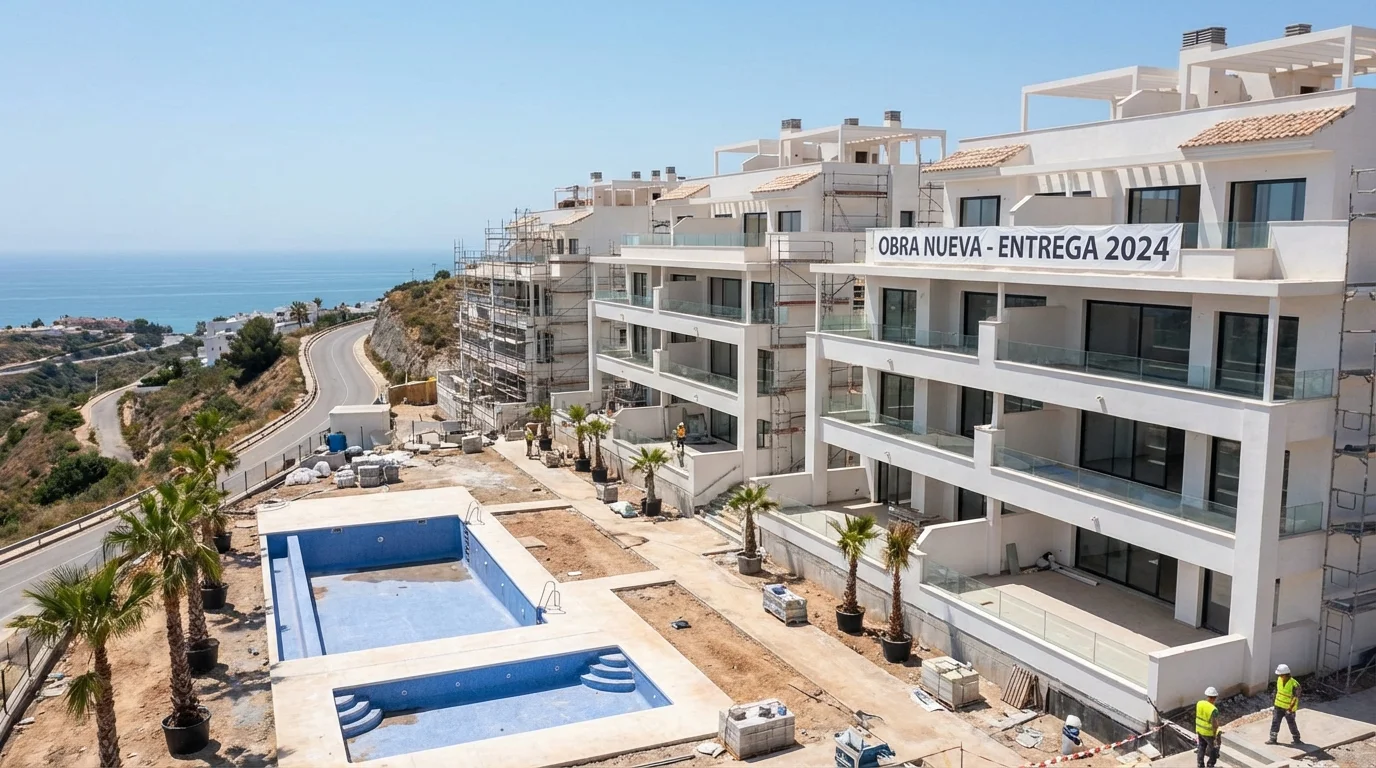
Complete guide to new builds in Spain: prices, payment plans, guarantees, VAT vs transfer tax and what to consider as a Swedish buyer of new-build property.