

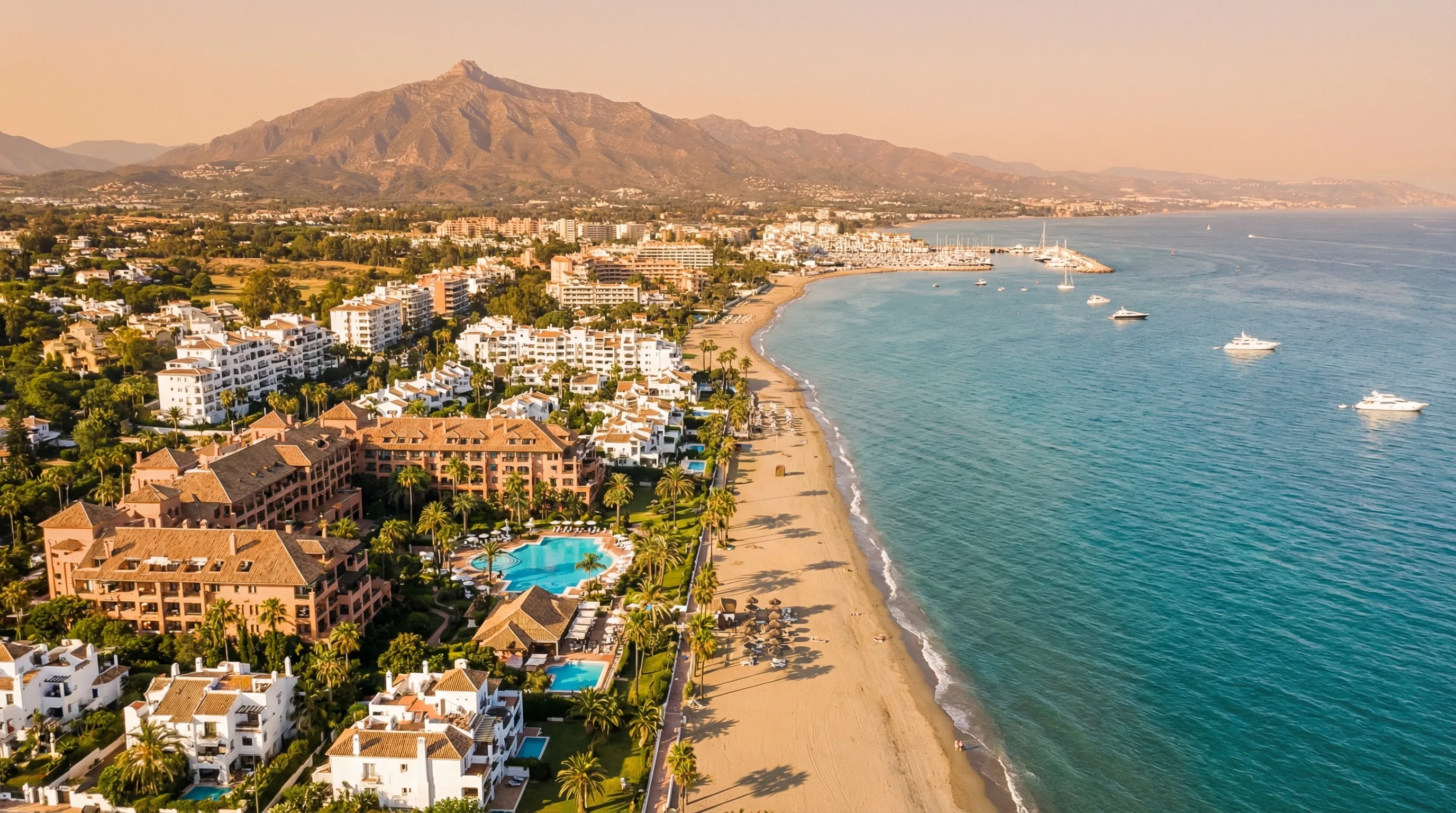
Area Guides
Marbella – Luxury, Lifestyle and Living on the Costa del Sol 2026
Complete guide to Marbella: Golden Mile, Puerto Banús, old town, property prices by area and why Marbella continues to attract international buyers.
19 min
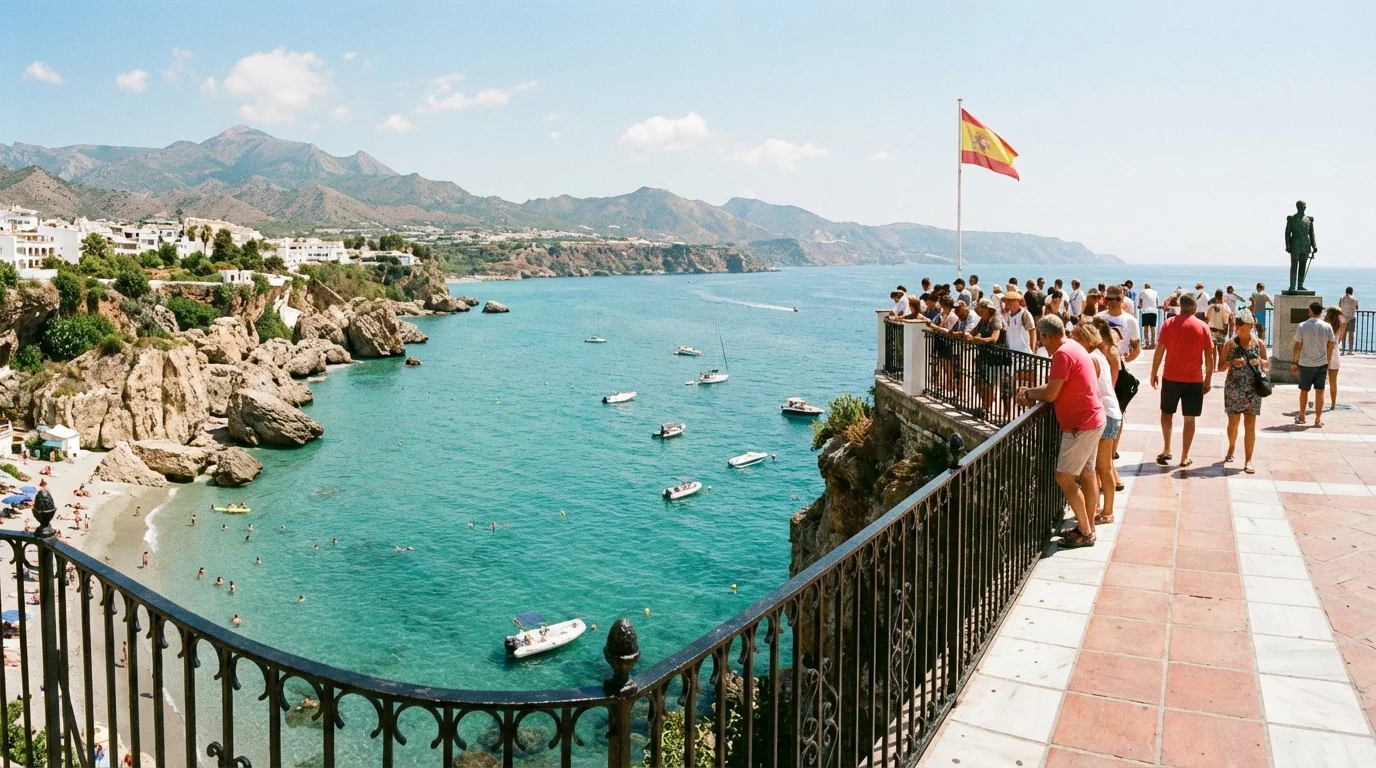
Complete guide to Nerja: Balcón de Europa, Nerja Caves, beaches, property prices and why it is eastern Costa del Sol's most charming town.
Nerja is the most sought-after coastal town on eastern Costa del Sol — a place where whitewashed houses cling to cliffs above turquoise coves, and where a viewpoint that a king named "Europe's Balcony" still takes visitors' breath away 140 years later. The municipality has around 22,300 inhabitants (2025), of whom 34 percent were born outside Spain. The average price per square metre is between 2,800 and 4,100 euros depending on the area, with beachfront Nueva Nerja-Burriana at the top at around 4,400 euros per square metre. The climate provides around 320 sunny days per year and an annual average of 20 degrees Celsius — milder than central Costa del Sol thanks to the Sierra Almijara mountains that shield against northerly winds.
This guide is our most detailed on Nerja. We cover Balcón de Europa, the prehistoric caves, the beaches, property prices by area, the restaurant scene and the magical neighbouring village of Frigiliana — with honest downsides and concrete figures for Swedish buyers.
Nerja is located at the far eastern end of Costa del Sol, in the province of Málaga in Andalusia, wedged between the Sierra Almijara mountains to the north and the Mediterranean to the south. The town marks the boundary where Costa del Sol transitions to Costa Tropical — this means the landscape is dramatic with cliffs, coves and tropical vegetation rather than the long sandy beaches that characterise western Costa del Sol.
Distances worth knowing:
From Sweden there are direct flights to Málaga with SAS, Norwegian and Ryanair from Stockholm Arlanda, Gothenburg Landvetter and seasonally from other airports. The journey takes around four hours. From the airport you take the A-7 motorway east — the last stretch along the coast is one of Spain's most beautiful drives with dramatic views over the Mediterranean.
The ALSA bus connection from Málaga airport to Nerja takes about 1 hour and 15 minutes with departures every hour during high season. There is no train line — but unlike western Costa del Sol where a coastal rail link is being studied, there are no concrete plans for a train to Nerja. A car is practically essential if you live here permanently, even though central Nerja is completely walkable.
Information
Nerja lies on the border between two provinces — Málaga (to the west) and Granada (to the east). Almuñécar, just 22 kilometres away, belongs to the province of Granada. This makes Nerja an excellent base for day trips to both Málaga, Granada and the Alpujarras villages in the Sierra Nevada.
Balcón de Europa is the heart of Nerja and Spain's most photographed viewpoint after the Alhambra. It is a wide promenade that extends onto a cliff in the middle of the town, with a 180-degree panoramic view over the Mediterranean and the dramatic coastal cliffs on both sides. On clear days you can see the African coast from here.
The location has a fascinating history. Originally an Arab watchtower stood here which was converted into a cannon battery — La Batería — during the Napoleonic Wars. The battery was destroyed by British troops in 1812 and the site lay in ruins until the 1880s. On 2 January 1885 Andalusia was struck by a powerful earthquake with its epicentre near Arenas del Rey. King Alfonso XII visited the affected area and stood on this cliff in Nerja. According to local legend, he exclaimed: "Esto es el balcón de Europa" — this is Europe's balcony. A life-size bronze statue of the king stands by the railing today.
Today Balcón de Europa is a pedestrian street lined with ice cream bars, restaurants and street musicians. Every evening locals and tourists gather to watch the sunset — a ritual that never grows old. From the viewpoint, steps lead down to Calahonda beach on one side and Playa del Salón on the other.
What you should know:
Cueva de Nerja — the Nerja Caves — is one of Spain's most important archaeological sites and one of the most visited caves in Europe. They extend almost five kilometres into the mountain and contain 589 prehistoric cave paintings, some of which may be up to 42,000 years old.
On 12 January 1959, five young friends from Maro — Francisco Navas, Miguel and Manuel Muñoz, José Luis Barbero and José Torres — found a narrow opening called "La Mina" while looking for bats. They crawled inside and discovered a system of enormous chambers with stalactites and stalagmites that had lain hidden for thousands of years. The caves were opened to the public as early as 1960.
The most impressive feature is the world's widest naturally formed pillar — a 32-metre high column with a base measuring 13 by 7 metres, formed by a stalactite and stalagmite growing together. It has held the Guinness World Record since 1989. The cave paintings show goats, horses, deer, seals and birds, drawn with red and black pigments. The oldest dating points to around 25,000 BC, but a 2012 study suggested some paintings may be 42,000 years old — potentially created by Neanderthals, not modern humans.
Tip
Every summer, concerts are held inside the caves in one of the chambers that forms a natural amphitheatre with outstanding acoustics. The Cueva de Nerja Festival has included everything from classical music to flamenco. Check the programme on the cave's official website — tickets often sell out quickly.
Nerja's beaches differ markedly from the rest of Costa del Sol. Here you find no kilometres-long sandy stretches — instead the beaches lie in sheltered coves between dramatic rock formations, with crystal-clear water that is more reminiscent of Greece than Spain. This makes them more beautiful but also less accessible.
Burriana is Nerja's most popular beach and the one with the best infrastructure. It lies one kilometre east of the centre, is around 800 metres long and has coarse sand with plenty of space. The water is crystal clear and calm, perfect for snorkelling along the rocks at the eastern end.
This is where you find Ayo's — a legendary chiringuito that has been here since 1969, where the owner cooks enormous paellas on an open fire directly on the beach every day. It is no tourist trap but a genuinely fantastic experience that costs a fraction of what a similar dish costs in Marbella. At the western end is Chiringuito Moreno, more romantically situated with tables at the water's edge.
Calahonda is the small cove that lies directly below Balcón de Europa. You reach it via stairs from the viewpoint — it takes two minutes to walk down, but it feels like stepping into another world. The beach is small (around 120 metres), surrounded by cliffs on both sides, and the water has the turquoise hue that normally requires a flight to the Caribbean. During the summer high season it fills up by ten in the morning.
Maro lies ten minutes by car east of Nerja and is the beach that locals swear by. It is reached via a steep path down through tropical vegetation, and the reward is a small cove surrounded by cliffs and lush greenery. The water is the clearest in the entire area. There are no chiringuitos — bring your own food and water. Kayaks can be hired at the beach to explore the nearby caves and waterfalls along the coast.
Properties
Explore available properties in Nerja
Frigiliana lies six kilometres north in the mountains and has been named Andalusia's most beautiful village by the Spanish tourist board — and after a visit you understand why. The village climbs a mountainside with winding cobblestone streets, whitewashed houses with blue-painted flower pots, and views down to the Mediterranean that make you stop every ten steps.
The village has preserved its Moorish character better than almost anywhere else in Andalusia. The old Moorish quarter — El Barribarto — has streets so narrow you can touch the houses on both sides simultaneously. Ceramic tiles on the walls tell the story of the Moors' last uprising in 1569. The only sugar cane factory (Ingenio) still producing sugar cane syrup in Europe is located here.
The property market in Nerja has risen sharply. The average price rose by 12.7 percent during 2024/2025 and reached 3,788 euros per square metre in August 2025. Prices vary enormously depending on the area and property type, however.
Nueva Nerja-Burriana (beachfront, popular with expats):
Central Nerja (near Balcón de Europa):
Almijara/Parador area (outskirts, quiet):
New builds and the luxury segment:
Nerja is more expensive than Torrox (2,200–2,800 euros per square metre) and Almuñécar (1,800–2,500 euros per square metre), but considerably cheaper than western Costa del Sol: Marbella is at 4,400–5,300 euros per square metre and Estepona at 3,900–4,600 euros per square metre. Given Nerja's charm, beaches and cultural offering, many buyers consider the prices reasonable.
Note
Nerja has strict building regulations that limit new construction — particularly near the coast and within the protected Acantilados de Maro-Cerro Gordo nature reserve. This means supply is limited and prices tend to rise faster than in municipalities with more buildable land. Always check the building permit (licencia de obra) and that the property has a Cédula de Habitabilidad before signing a contract.
Properties
Explore available properties in Nerja
Nerja has one of Spain's most pleasant climates — warmer and drier than northern Europe, but not as extreme as the Andalusian interior. The Sierra Almijara mountains create a natural windbreak that gives Nerja a mild microclimate year-round.
Summer (June–September): The average temperature is 25–28 degrees Celsius with peaks around 32 degrees in August. Sea water reaches 23–25 degrees, perfect for swimming. Nights are pleasant at around 20–22 degrees — you sleep with the window open.
Winter (December–February): The average daytime temperature is 14–17 degrees. January is coldest with overnight minimums of around 8–10 degrees. Snow never occurs on the coast but is often visible on the Sierra Almijara peaks — a surreal sight with palm trees in the foreground and snow-capped mountains in the background.
Spring and autumn: The best seasons. March to May and October to November offer 20–25 degrees, empty beaches and perfect hiking weather.
Torrox, eight kilometres to the west, markets itself as having "Europe's best climate" — and actually has a marginally higher annual average. The difference is negligible, however: Nerja records around 3,460 hours of sunshine per year and 471 millimetres of rainfall, making it drier than Mijas and comparable to Torrox. Winter is milder than in Málaga city thanks to the mountains' windbreak.
Nerja has an unusually international composition for a town of its size. Of the approximately 22,300 inhabitants, 34 percent were born outside Spain. The British community is the largest with around 1,400 registered citizens, followed by Russians, Germans and Scandinavians. The Scandinavian presence is less pronounced here than in Fuengirola or Torrevieja, but there are active Nordic associations and several Scandinavian-owned businesses.
Nerja's restaurant scene is surprisingly varied for a town of 22,000 inhabitants. The focus is on fresh fish and seafood — unsurprising given the small fishing community that still survives at Playa de la Torrecilla, where fishing boats are dragged up onto the sand every morning.
Nerja's food market (Mercado de Nerja) is in the centre near Balcón de Europa and is open daily. Here you buy fresh fish directly from the fishermen, local olives, cheeses and fruit. On Tuesdays a large street market with local produce is held at the Almijara park.
If you are considering eastern Costa del Sol you are likely comparing Nerja with the neighbouring municipalities of Torrox (west) and Almuñécar (east). Here is an honest comparison.
Torrox Costa is the beach community with Europe's best climate — a title they have patented and which is actually supported by climate data. Torrox has around 16,000 inhabitants, a large German and Scandinavian community and noticeably lower property prices (2,200–2,800 euros per square metre). It is a place for those who want beach, sun and tranquillity without Nerja's tourism. The downside: Torrox lacks Nerja's charm, attractions and restaurant scene. It can feel monotonous outside the summer season.
Almuñécar is already in the province of Granada and has a completely different character. The town is more Spanish, more city-like (27,000 inhabitants) and has a historical heritage with a Moorish castle, Roman aqueduct and botanical garden. Property prices are lower than Nerja (1,800–2,500 euros per square metre) and the range of water activities — including a water park — makes it popular with families. The downside: Almuñécar is 85 kilometres from Málaga airport (20 minutes further than Nerja), and the international community is smaller. Flying to Granada is an alternative but has fewer direct routes from Sweden.
Nerja, Torrox and Almuñécar — quick comparison
Cliffs, coves and the Balcón — strongest name and often the highest price per sqm in the comparison.
Beach tranquillity and often lower prices — fewer attractions than Nerja.
More Spanish town in Granada, lower price per sqm — further from Málaga.
Contact
We help Swedish buyers find the right property in Nerja and eastern Costa del Sol — from charming village apartments near Balcón de Europa to beachfront villas with sea views. Contact us for free advice.
Contact us about NerjaDecision support
Genomsnittspriset i Nerja ligger runt 2 800 till 4 100 euro per kvadratmeter beroende på område och bostadstyp (2025/2026). En tvårumslägenhet i centrum kostar från cirka 180 000 euro, medan strandnära lägenheter vid Burriana och Nueva Nerja når 300 000 till 500 000 euro.
Villor med havsutsikt säljs från 650 000 euro uppåt.
Málagas flygplats (AGP) ligger cirka 65 kilometer från Nerja, vilket tar ungefär 50 till 60 minuter med bil via motorvägen A-7/E-15. Det finns direktbussar med ALSA som tar cirka 1 timme och 15 minuter.
Tåglinje saknas men en kusttågsförbindelse utreds.
Ja, Nerja passar bra för barnfamiljer tack vare lugna stränder med grunt vatten som Burriana och Calahonda, en trygg och gångvänlig stadskärna, och närheten till internationella skolor i Málaga och Vélez-Málaga. Frigiliana erbjuder naturnära aktiviteter och vandringsleder i Sierra Almijara.
Nackdelen är att utbudet av internationella skolor i själva Nerja är begränsat.
Absolut. Nerja har ett av Spaniens mildaste klimat med en medeltemperatur på 20 grader Celsius och cirka 320 soldagar per år.
Staden har öppna restauranger, butiker och sjukvårdscentraler året runt. Omkring 22 000 invånare bor permanent i Nerja, varav cirka 34 procent är födda utanför Spanien.
Vintern är mild med januari-temperaturer kring 12 till 16 grader.
Nerja är större med cirka 22 000 invånare, har fler restauranger, stränder och sevärdheter som Balcón de Europa och Cueva de Nerja. Torrox har cirka 16 000 invånare, är lugnare och billigare med genomsnittspriser runt 2 200 till 2 800 euro per kvadratmeter.
Torrox marknadsför sig som platsen med Europas bästa klimat. Nerja har mer turism och internationell prägel, medan Torrox är mer spanskt i karaktären.
Sources

Málaga Este

Málaga Este

Sacaba Beach

Sacaba Beach

Sacaba Beach

El Limonar
Local expertise
Complete guide to Marbella: Golden Mile, Puerto Banús, old town, property prices by area and why Marbella continues to attract international buyers.
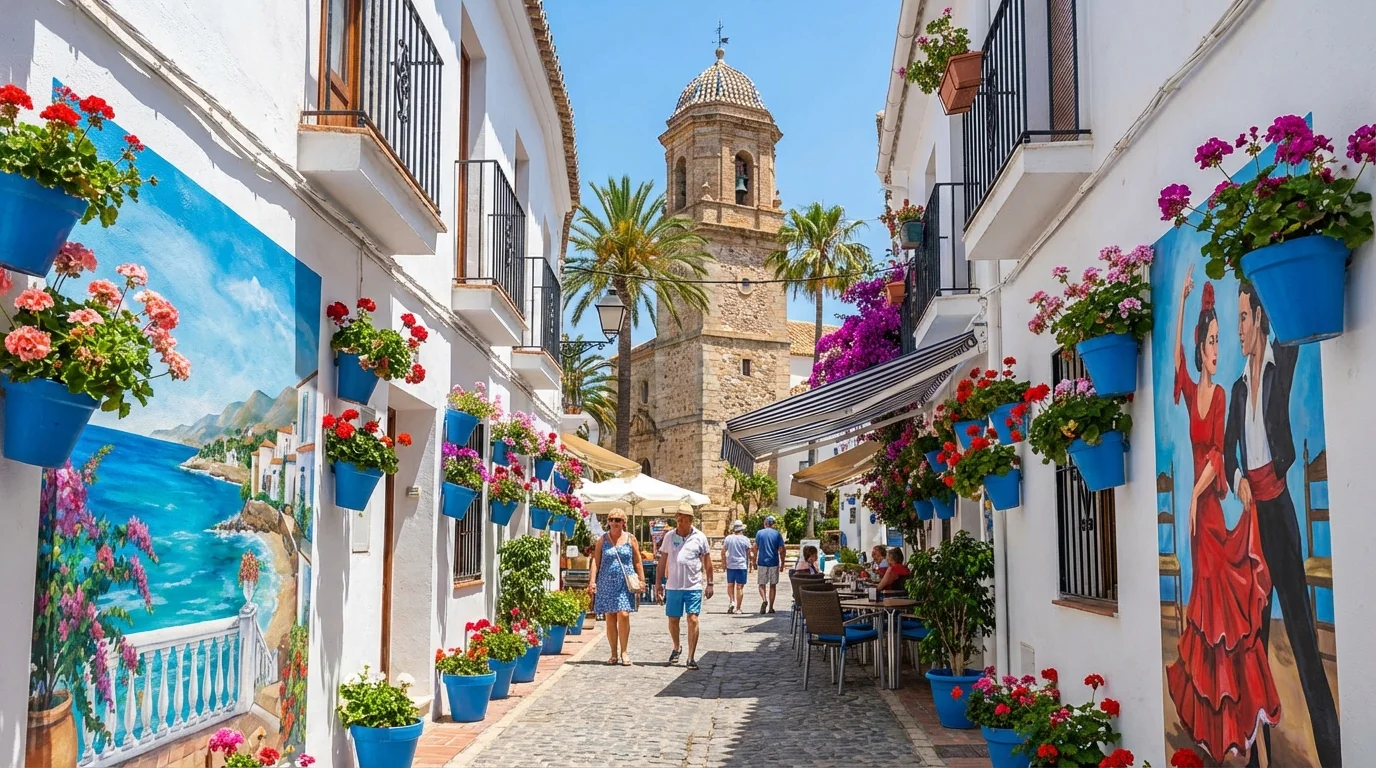
Complete guide to Estepona: murals, the orchid garden, old town, property prices and why it is called the Garden of the Costa del Sol.
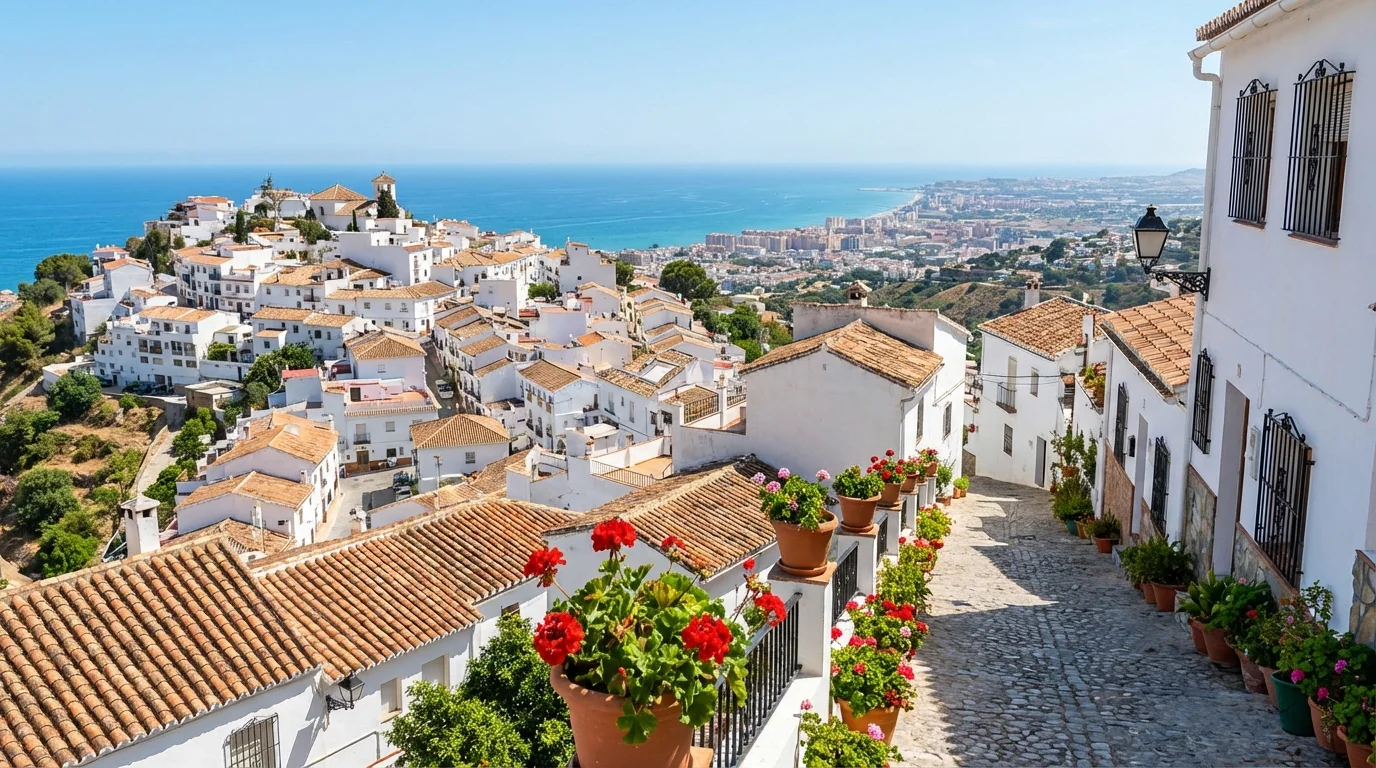
Complete guide to Mijas Pueblo: the white mountain village above Fuengirola with spectacular views, property prices, restaurants and tips for Swedish buyers.