

Area Guides
Mijas Pueblo – The White Village Above the Costa del Sol 2026
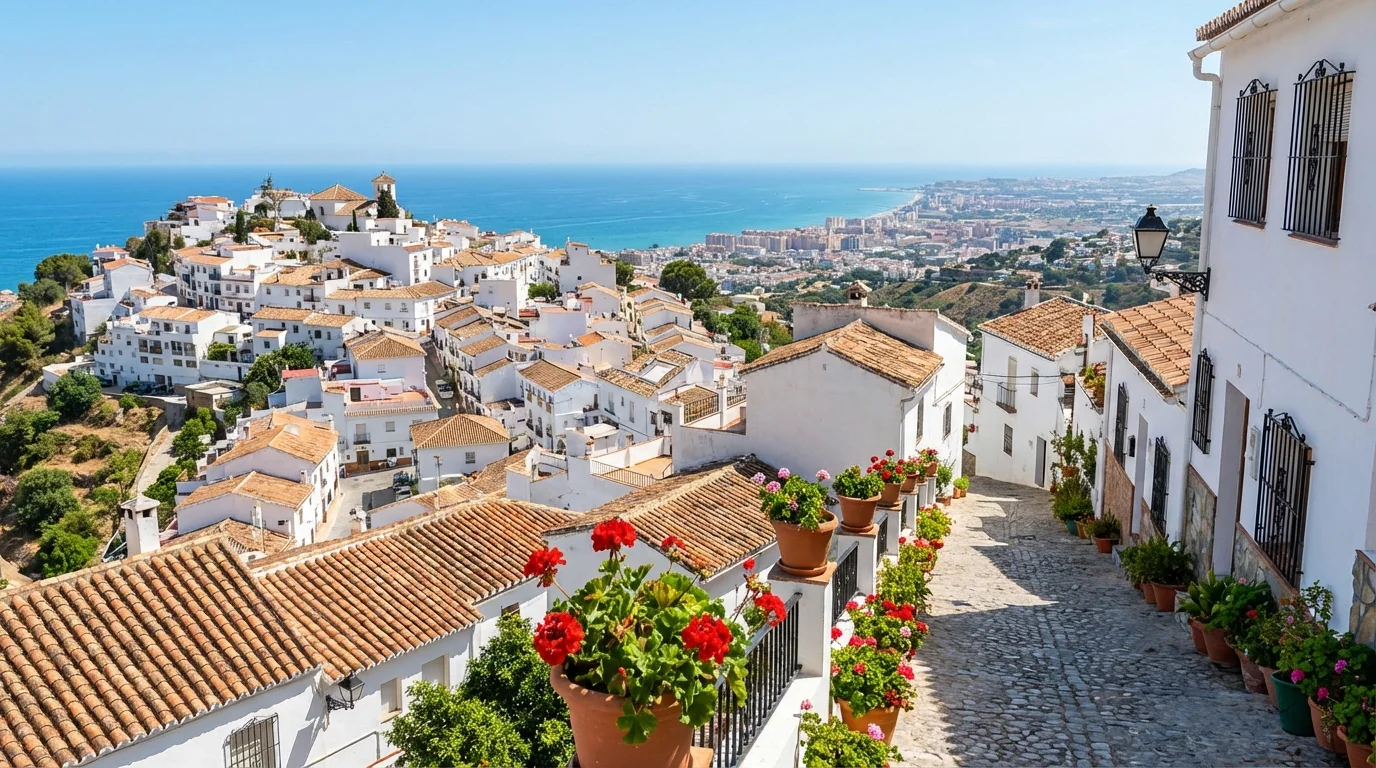
Complete guide to Mijas Pueblo: the white mountain village above Fuengirola with spectacular views, property prices, restaurants and tips for Swedish buyers.
17 min
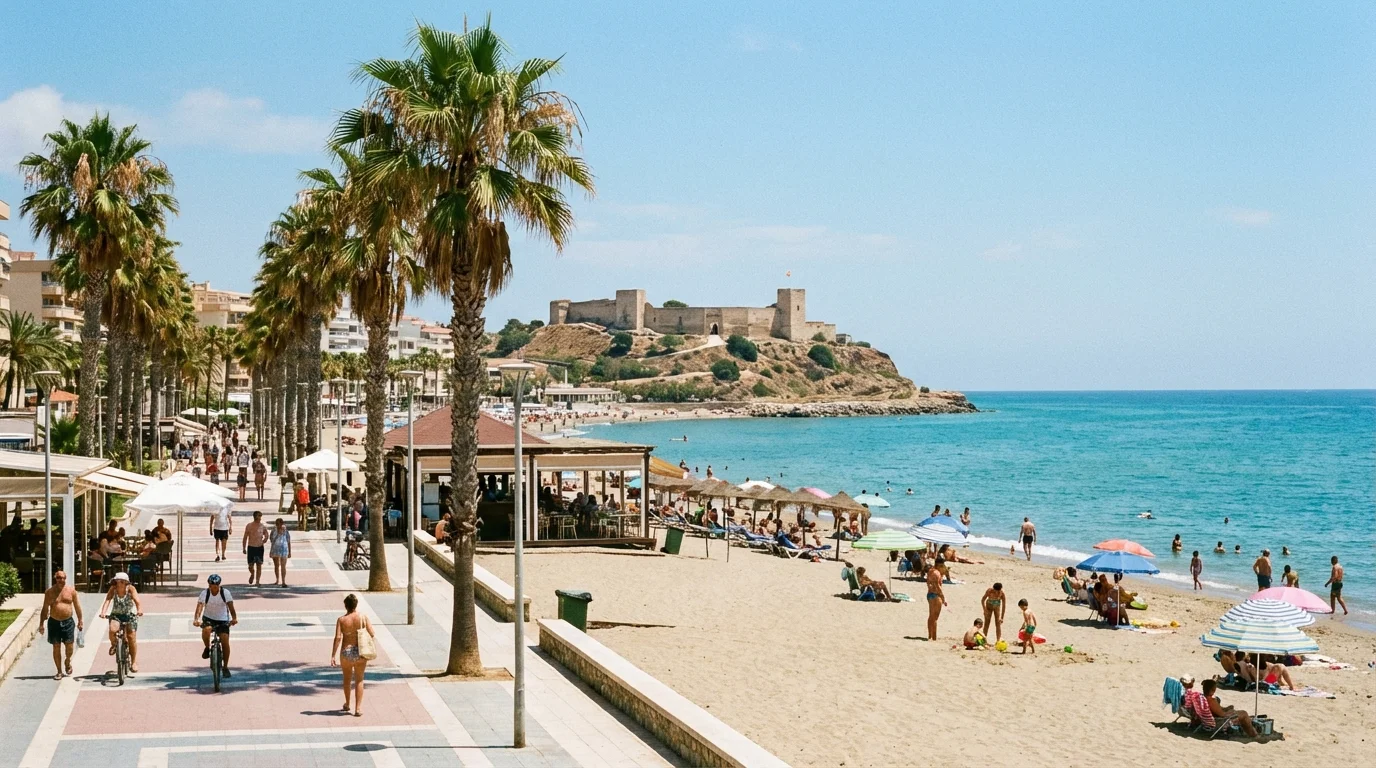
Complete guide to Fuengirola: beaches, the Swedish school, the Scandinavian community, property prices and why it is the Costa del Sol's most family-friendly city.
Fuengirola is the city on the Costa del Sol where the most Scandinavian families with children choose to settle — and there are concrete reasons for that. The city has 7 kilometres of sandy beach, a Swedish school that has been operating since 1969, Cercanías trains direct to Málaga Airport in 35 minutes, and property prices ranging from €3,500 to €4,400 per square metre (2025), making it considerably cheaper than Marbella but more expensive than inland areas. Fuengirola has over 85,000 inhabitants of whom approximately 25% are foreigners from over 120 nationalities, and the Finnish community of around 8,000 people makes the city the largest Finnish community outside Finland.
This guide is written for those considering buying a property in Fuengirola. I cover beaches, the Swedish school, property prices by neighbourhood, climate, transport, sights and an honest list of advantages and disadvantages — without any sales pitch.
Fuengirola is located on the Costa del Sol in Málaga province, Andalusia, midway between the city of Málaga and Marbella. The city stretches along the Mediterranean coast and borders Benalmádena to the east and the municipality of Mijas to the west. Despite its coastal position, Fuengirola is a compact city that is easy to navigate on foot — the city centre is largely flat, which distinguishes it from many other coastal cities in Andalusia.
Distances worth knowing:
From Sweden there are direct flights to Málaga from Stockholm Arlanda, Gothenburg Landvetter and several other cities with SAS, Norwegian and Ryanair. During high season charter operators also fly direct. Málaga Airport is the third largest in Spain and has a train station in the terminal, meaning you can be in Fuengirola within an hour of landing without a hire car.
Information
Did you know? Fuengirola has one of the few train stations on the Costa del Sol. The Cercanías line C-1 runs from Fuengirola via Benalmádena and Torremolinos to Málaga city centre and the airport. The train runs every 20 to 30 minutes and costs €3 to €4 one way.
Fuengirola's 7-kilometre coastline is divided into several named beaches, all with fine sand and a largely south-facing position. This means sun from morning until late afternoon — something not all Costa del Sol cities can offer.
The longest and best-known stretch lies directly in front of the city centre. The beach is wide with golden sand and equipped with sunloungers, showers, lifeguards (June–September) and chiringuitos — beach bars serving everything from cerveza to fried fish. The promenade (Paseo Marítimo) runs parallel and is a hub for evening walks, running and cycling.
The beach in front of the Los Boliches neighbourhood has a more relaxed, local feel. There are more Spanish families and fewer beach hotels here. The beach bar El Higuerón is a local favourite. The beach has Blue Flag certification.
Furthest east, towards the border with Benalmádena, lies Carvajal. It is Fuengirola's quietest beach with fewer visitors even in high season. Behind the beach there is a car park, which makes it popular with families who come by car.
West of the centre, towards Mijas. Torreblanca is wider and has more local beach life. Property prices in the area behind the beach are lower than in the centre, which attracts long-term residents rather than tourists.
Tip
Tip: During high season (July–August) Playa de Fuengirola can get crowded. Go to Carvajal or Torreblanca for more space. Los Boliches is a good compromise — close to the centre but quieter than the main beach.
Svenska Skolan Costa del Sol is the largest Swedish school abroad in the world and has been in Fuengirola since 1969. The school is located in the Los Pacos neighbourhood, approximately 2 kilometres inland from the centre, and offers education from pre-school to upper secondary according to the Swedish curriculum. Students receive Swedish grades that are valid for further studies in Sweden.
The school has three upper secondary programmes: economics, social sciences and natural sciences. From the 2026/2027 academic year a vocational programme in trade and services will be added. All programmes lead to a Swedish upper secondary qualification. The teaching language is Swedish, but students also learn Spanish and English, giving them a trilingual foundation.
Approximately half of the upper secondary students are guest students from Sweden who have chosen to study abroad for one to three years. Each year the school welcomes 60 to 80 Swedish students who live with host families or in student accommodation. This creates a constant stream of young Swedes in Fuengirola and helps keep the Swedish infrastructure — shops, cafés, associations — alive.
The school has a sports profile with over a hundred active students in football, golf, tennis, padel and beach volleyball. The proximity to golf courses and sports facilities makes Fuengirola an attractive base for young athletes who want to combine training with studies in a warm climate.
Information
Did you know? In the same neighbourhood, Los Pacos, there is also the Finnish school (Aurinkorannikon Suomalainen Koulu). This makes Los Pacos the most Nordic neighbourhood on the Costa del Sol — and one of the reasons so many Scandinavian families buy property specifically in Fuengirola.
Fuengirola has one of Europe's most concentrated Nordic expat communities. The city's international population of around 20,000 includes a notably large proportion of Scandinavians, and the infrastructure that has grown up around them makes everyday life easier for newcomers.
With around 8,000 registered Finnish residents, Fuengirola is the largest Finnish community outside Finland. The Finns have their own school, church (Aurinkorannikon Suomalainen Seurakunta), associations, restaurants and even a Finnish sauna at the beach. Los Pacos and Los Boliches have the highest concentration of Finnish residents.
The Swedish community is smaller than the Finnish one but well established. The Swedish School serves as a social hub and meeting point. There are Swedish associations that organise midsummer celebrations, Christmas tree parties and regular get-togethers. Sydkusten, the Swedish-language newspaper on the Costa del Sol, has its editorial office in the Fuengirola area and reports on local events.
Norwegian and Danish groups are also represented, though they are smaller. The Norwegian church in Fuengirola holds services and social events. Together with Swedes and Finns they create a Nordic microcosm where you can buy crispbread, visit a Scandinavian hairdresser and speak your mother tongue in everyday life.
Property prices in Fuengirola have risen considerably in recent years. The average price per square metre stands at around €3,500 to €4,400 (April 2025), with an increase of approximately 10% compared with the previous year. This makes Fuengirola more expensive than cities such as Torrevieja and Alicante on the Costa Blanca, but cheaper than Marbella and Nueva Andalucía.
| Neighbourhood | Average price (€/m²) | Character |
|---|---|---|
| Torreblanca del Sol | ~4,700 | Newer construction, close to beach |
| Centro/Playa | ~4,200 | City centre, walking distance to everything |
| Los Boliches | ~4,000 | Fishing village character, popular among Scandinavians |
| San Francisco | ~3,800 | Quiet residential area |
| Los Pacos | ~3,500 | Swedish/Finnish school, family-friendly |
| Boquetillo | ~3,000 | More basic construction, lower prices |
Apartments:
Townhouses:
Villas:
Properties
Explore available properties in fuengirola
In Andalusia approximately 10 to 13% is added in purchase costs on top of the purchase price. This includes ITP (transfer tax) of 7% for second-hand properties, a notary fee of 0.5 to 1%, land registry inscription of 0.3 to 0.5% and legal advice of 1 to 1.5%. New builds are subject to 10% VAT (IVA) instead of ITP.
Fuengirola has a subtropical Mediterranean climate with mild winters and warm, dry summers. The city records over 300 sunny days per year, making it one of Europe's sunniest coastal cities.
| Month | Average temp (°C) | Sun hours/day | Rainy days |
|---|---|---|---|
| January | 12 | 6 | 5–6 |
| April | 16 | 8 | 4–5 |
| July | 26 | 11 | 0–1 |
| October | 20 | 7 | 4–5 |
Summers (June–September) have daytime temperatures of 28 to 31 degrees. The sea breeze often moderates the heat, but inland it can reach 35 degrees and more. The Mediterranean water temperature reaches 23 to 25 degrees in August.
Winters (December–February) are mild with daytime temperatures of 15 to 18 degrees and night temperatures that rarely drop below 8 degrees. It rains most in November and December, but rarely more than 5 to 7 days per month. Snow is virtually non-existent at the coast.
Compared with the Costa Blanca (Torrevieja, Alicante), Fuengirola is marginally more humid and 1 to 2 degrees warmer in winter, thanks to the Sierra de Mijas mountain range that shields it from northerly winds.
Fuengirola is not a typical tourist resort — it is a functioning Spanish city with schools, hospitals, workplaces and a permanent population that keeps the community alive year round.
Demographics in figures:
Fuengirola differs from purely tourist resorts like Torremolinos in that it has a stable year-round population. Restaurants, shops and health centres remain open throughout the year — not just in season. This is most noticeable from October to April, when you still find fully occupied terrace cafés and active markets.
The large proportion of foreigners means you can get by in English in most situations, but Spanish helps enormously at government offices, at the doctor and in everyday life. Most long-term Scandinavian residents learn basic Spanish within the first year.
Los Boliches is Fuengirola's most characterful neighbourhood and one of the areas that Swedish and Finnish buyers are most often drawn to. Originally it was a fishing village that slowly merged with Fuengirola as the city grew, but Los Boliches has retained its own identity.
What you find in Los Boliches:
The atmosphere in Los Boliches feels more like an independent small coastal village than a neighbourhood in a city of 85,000. It is the neighbourhood most Scandinavian buyers look at first, and property prices reflect this — around €4,000 per square metre, somewhat above average.
Castillo Sohail is Fuengirola's most iconic landmark — a Moorish fortress perched on a hill at the western end of the city, with views across the entire coast and the Mediterranean.
The fortress was originally built in 956 AD under the rule of Abd ar-Rahman III to reinforce coastal defences. In the 12th century the Almoravids strengthened the structure with walls and towers. In 1485, during the Reconquista, the castle was captured by Christian troops. It has since undergone several rebuilding phases and restorations, most recently in the 1990s.
Castillo Sohail is open to visitors and offers free entry. The view from the walls is spectacular — you can see the entire Fuengirola coastline, Benalmádena, and on clear days you can catch a glimpse of the African coast. In summer the fortress is the stage for Marenostrum Fuengirola, an international music festival that attracts artists like David Guetta, Sting and other major stars. The arena holds up to 18,000 spectators.
The area around the castle includes a park and a walkway along the Fuengirola river, popular with joggers and families with prams.
Every city has its strengths and weaknesses, and Fuengirola is no exception. Here is an honest assessment based on what year-round residents — not tourists — report.
1. Train connection to the airport. Fuengirola is one of the few coastal cities on the Costa del Sol with a direct train to Málaga Airport. This means you do not need a hire car and visitors from Sweden can reach your door without a taxi.
2. The Swedish School. No other city on the Costa del Sol offers Swedish upper secondary education. For families with children who want their children to maintain Swedish grades, this is decisive.
3. Flat city layout. Unlike Mijas Pueblo and parts of Benalmádena, Fuengirola is largely flat. This makes the city easy to navigate with a pram, wheelchair or on foot.
4. Year-round city. Restaurants, shops and health centres do not close in winter. Fuengirola functions 12 months of the year.
5. Bioparc and family activities. Bioparc Fuengirola is an award-winning zoo in the heart of the city with over 200 species. AquaMijas water park is 10 minutes away. The city also has playgrounds, sports facilities and a long promenade.
1. Prices have risen quickly. With 10% price increases per year, Fuengirola is approaching levels that make it less attractive for budget buyers. A two-room apartment now rarely costs less than €180,000.
2. Tourist pressure in summer. July and August mean full beaches, traffic jams and harder to find parking in the centre. During the rest of the year it is considerably quieter.
3. Limited nature in the city centre. Fuengirola is urban — you have the beach, but for hiking, nature and mountain landscapes you need to go to Mijas Pueblo or Sierra de Mijas.
4. Construction noise. The rapid growth means new building works in several neighbourhoods. If you buy in a development area you should expect construction nearby.
5. Spanish required for government matters. Despite the international population, government offices, healthcare and municipal services operate in Spanish. Expect to learn the basics.
Note
Important note on purchase costs: Andalusia's transfer tax (ITP) was reduced to 7% in January 2022, but always check the current rate before calculating. New builds are subject to 10% IVA plus 1.2% AJD (stamp duty). Always budget 10 to 13% on top of the purchase price for the total cost.
The three municipalities border each other and share the same climate and infrastructure, but offer completely different lifestyles.
Benalmádena lies directly east of Fuengirola and has three distinct parts: Benalmádena Pueblo (white village on the mountain), Arroyo de la Miel (modern district with shopping centre) and Benalmádena Costa (coastal strip with Puerto Marina). Benalmádena has more large-scale tourist attractions — Tivoli World, Selwo Marina, cable car to the mountain top — but lacks Fuengirola's compact, walkable city layout.
| Aspect | Fuengirola | Benalmádena |
|---|---|---|
| Beach length | 7 km | 9 km |
| Train station | Yes (C-1) | Yes (Arroyo de la Miel) |
| Average price €/m² | 3,500–4,400 | 3,200–3,900 |
| Character | Compact coastal city | Spread-out municipality, three zones |
| Swedish school | Yes | No |
| Atmosphere | Year-round city | More touristy, especially the coast |
Benalmádena may be a better choice if you are looking for lower prices and do not need a Swedish school. Fuengirola wins on walkability, year-round character and Scandinavian infrastructure.
La Cala de Mijas and Mijas Costa offer a quieter, more spread-out lifestyle along the coast west of Fuengirola. The municipality of Mijas has more golf courses, more villas and a more British/Scandinavian expat profile. Mijas Pueblo up on the mountain provides authentic Andalusian village character but requires a car.
| Aspect | Fuengirola | Mijas (municipality) |
|---|---|---|
| Population | ~85,000 | ~92,000 |
| Foreign residents | ~25% | ~32% |
| Public transport | Excellent (train + bus) | Limited (bus, car required) |
| Urban character | Compact, urban | Spread out, rural/suburban |
| Average price €/m² | 3,500–4,400 | 3,200–4,000 |
| Best for | Families without a car, city life | Golfers, peace and quiet |
Fuengirola suits you better if you want to manage without a car and prefer city life with services within walking distance. Mijas suits you if you want more space, golf and a quieter lifestyle — but expect to need a car for everything.
Properties
Explore available properties in fuengirola
Contact
Our team knows the Costa del Sol and speaks Swedish. We help you find the right property in Fuengirola — whether you are looking for a beachfront apartment or a family villa near the Swedish School. Book a free video meeting.
Book a free consultationLast updated: April 2026. Prices and rules can change — contact us for current information.
Decision support
Genomsnittspriset per kvadratmeter i Fuengirola ligger på cirka 3 500 till 4 400 euro (2025), beroende på stadsdel. En tvårumslägenhet kostar normalt 180 000 till 280 000 euro, medan trerumsalternativ med havsutsikt hamnar på 280 000 till 450 000 euro.
Los Boliches och centrum är dyrast, medan Torreblanca och Los Pacos erbjuder lägre priser.
Ja. Svenska Skolan Costa del Sol ligger i stadsdelen Los Pacos i Fuengirola och har funnits sedan 1969.
Skolan erbjuder undervisning från förskola till gymnasium enligt svensk läroplan och tar emot 60 till 80 gäststudenter från Sverige varje år. Det är den största svenska utlandsskolan i världen.
Cercanías-tåget (linje C-1) går direkt från Málagas flygplats till Fuengirola var 20 till 30 minut. Restiden är cirka 35 minuter och biljettpriset ligger runt 3 till 4 euro.
Med bil tar det 20 till 25 minuter via motorvägen AP-7, en sträcka på cirka 25 kilometer.
Fuengirola anses vara en av Costa del Sols bästa städer för barnfamiljer. Den platta stadsplanen gör det enkelt att gå och cykla, stränderna är barnvänliga med livräddare, och Bioparc djurpark samt AquaMijas vattenpark finns i närheten.
Svenska Skolan och finska skolan ligger båda i Los Pacos, och den skandinaviska gemenskapen är väletablerad.
Fuengirola har en av Costa del Sols mest etablerade nordiska gemenskaper. Staden har runt 8 000 finska invånare, den största finska kolonin utanför Finland.
Den svenska gemenskapen är också betydande med Svenska Skolan som nav. Tillsammans med norrmän och danskar bildar skandinaverna en synlig del av stadens 85 000 invånare.
Sources

Higueron, Málaga

Higueron, Málaga

Higueron, Málaga

Higueron, Málaga

Higueron, Málaga

Centro, Málaga
Local expertise
Complete guide to Mijas Pueblo: the white mountain village above Fuengirola with spectacular views, property prices, restaurants and tips for Swedish buyers.
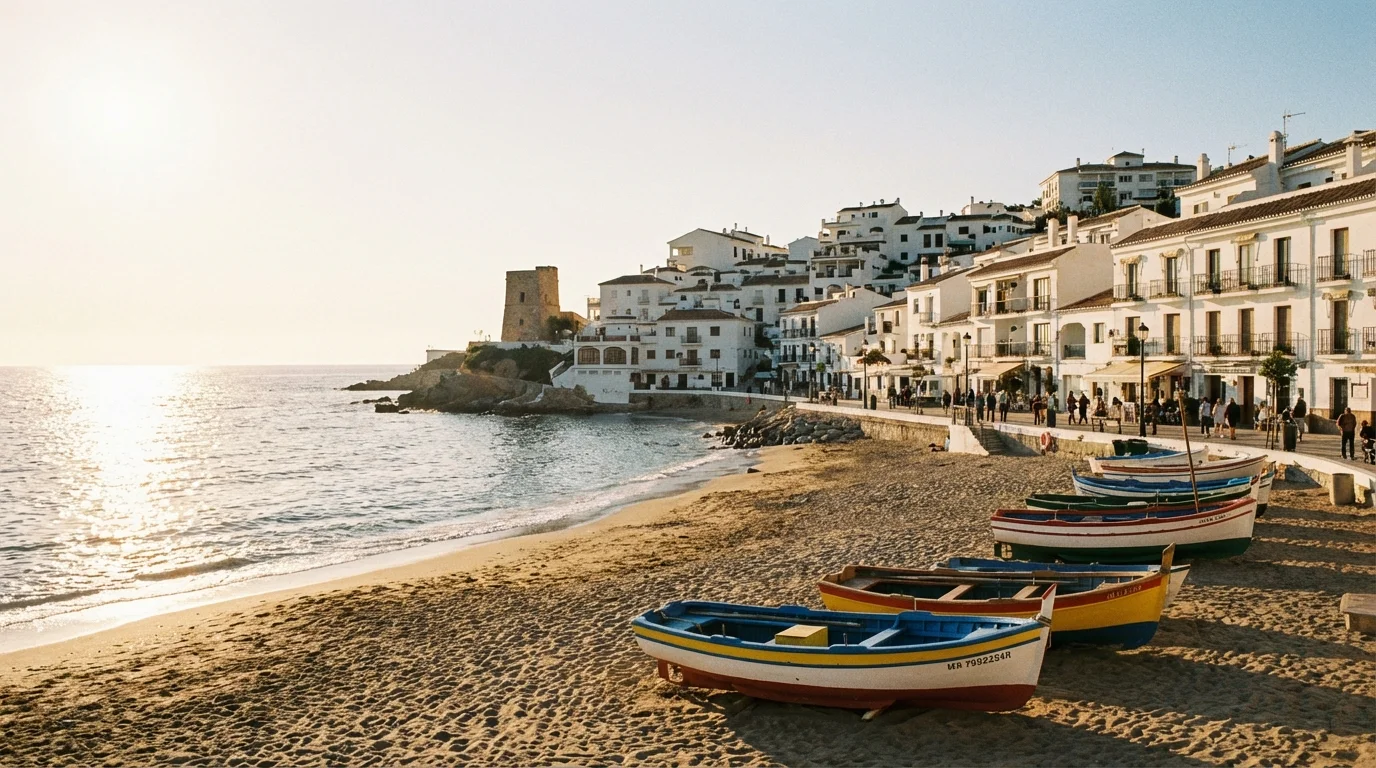
Complete guide to La Cala de Mijas on the Costa del Sol: beaches, property prices, restaurants and tips for Swedish buyers seeking charm without the tourist crowds.
How property prices are developing on Costa del Sol in 2026: area comparison, the drivers behind the price rises and where Swedish buyers should be especially careful.