

Buying Guides
Buying Property in Spain 2026 – Apartments, Houses, NIE & Mortgages
Complete guide to buying a property or apartment in Spain for Swedes: purchase process, taxes, costs, mortgages, regional differences and risks — updated 2026.
19 min
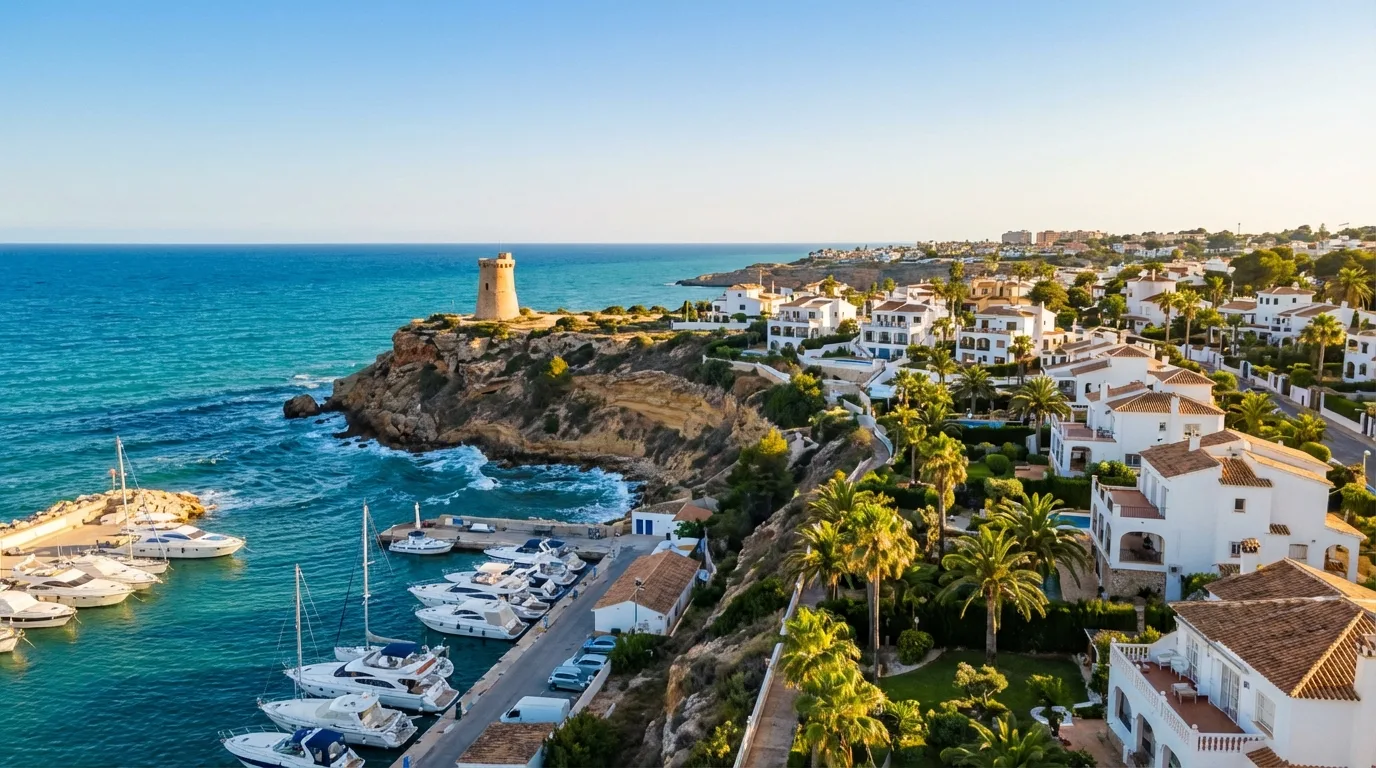
Complete guide to Cabo Roig: the marina, beaches, the market, property prices and why it is Orihuela Costa's most exclusive neighbourhood.
Cabo Roig is the most exclusive sub-area in Orihuela Costa, with property prices starting from 350,000 euros for villas and an average price of around 3,500 euros per square metre. The area stands out for its marina, the iconic headland with the 16th-century Torre Vigía watchtower and two Blue Flag beaches — Cala Capitán and La Caleta — which regularly rank among the finest on the Costa Blanca. If you are looking for a property in southern Spain with character, a beachside location and a tranquillity that is absent in the more tourist-heavy neighbouring areas, Cabo Roig deserves your attention.
This guide is written for those considering buying property in Cabo Roig. I cover location, beaches, the marina, the restaurant scene, current property prices and give you an honest comparison with La Zenia and Campoamor — including the drawbacks that estate agents tend to skip over.
Cabo Roig is in the southern part of Orihuela Costa, in the middle of southern Costa Blanca in the province of Alicante. The area belongs to the municipality of Orihuela and is wedged between La Zenia to the north and Dehesa de Campoamor to the south. The name comes from the characteristic red headland ("cabo rojo" in Spanish) that juts out into the Mediterranean and is visible far out to sea.
Key distances:
From Sweden you have direct flights to Alicante with SAS, Norwegian and Ryanair during peak season, and year-round connections from Stockholm Arlanda. Murcia airport is the faster option if you find good prices.
Information
Cabo Roig is technically a urbanización (residential development) within the municipality of Orihuela, not its own town. This means municipal decisions are made in Orihuela city, 25 kilometres inland. Services, refuse collection and planning permits are managed from there — something that can sometimes make the bureaucracy more cumbersome.
Cabo Roig Marina is the heart of the area and what gives it its exclusive character. The marina is small compared with, for example, Torrevieja harbour — it holds around a hundred berths — but that is precisely what makes it charming. Sailing boats and smaller yachts are moored at the jetty, and restaurant La Bahía serves fish and seafood with views over the bay.
Above the marina stands Torre Vigía, a 16th-century watchtower built to warn of North African pirates. The tower is Cabo Roig's most photographed landmark and the view from the headland is spectacular — in clear weather you can see all the way to La Manga del Mar Menor and Cabo de Palos.
The great attraction is the Sendero Azul (Blue Path), a 2-kilometre coastal walk that winds along the cliffs between Cala Capitán and La Caleta. The path is lit in the evenings, has safety railings all the way and takes about 25 minutes to walk. Along the way you pass dramatic rock formations, small coves and viewpoints that explain why people pay premium prices to live here.
Tip
Walk the coastal path at sunset — the sun goes down behind the cliffs and turns the sea orange. It is one of the Costa Blanca's finest evening strolls and completely free.
Cabo Roig has two main beaches, both with Blue Flag certification, lifeguards during peak season and better water quality than most beaches in the area.
Cala Capitán is the northern beach and the most well-known. The beach is sheltered by cliffs on both sides, which provides calm water even when the wind picks up. The sand is light and fine, and the beach has an unusual attraction — a small island just offshore that is unique to Orihuela Costa. Sun loungers and parasols are available for hire, there is a chiringuito (beach bar) and public showers.
Water temperature ranges from 15 degrees in winter to 26 degrees in August. The beach is never as packed as Playa Flamenca or La Zenia beach, which is one of the advantages of Cabo Roig.
La Caleta (also known as Playa Goleta) is just south of the marina and is the more intimate of the two beaches. The cove faces south and gets sun all day. The sea is sheltered by the headland and the marina, creating calm bathing conditions regardless of weather — perfect for families with children and early morning swimmers.
La Caleta has consistently been voted one of Spain's best beaches in local polls, and it is easy to understand why. Crystal-clear water, fine sand and a feeling of being on a private beach, despite it being public.
One of the most common questions concerns the Cabo Roig market. Let me be honest: it is smaller than most people expect.
Cabo Roig market is held on Thursdays from 09:00 to 14:00 on Calle Fuego. It is a traditional street market with around 45 stalls selling clothing, accessories, household items, fruit, vegetables, cheese and olives. Pleasant for a short stroll and some fruit shopping, but not a major shopping experience.
If you want more of a market feel, here are the best alternatives nearby:
Information
Bring cash to the markets — most stalls do not accept card. And arrive early (09:00–10:00) for the best selection and before it gets too warm.
Cabo Roig is the most expensive sub-area in Orihuela Costa, with prices reflecting the exclusive location at the headland and marina. During 2025 the average price in Orihuela Costa was around 3,200 euros per square metre, but Cabo Roig specifically is higher — more like 3,500–4,000 euros per square metre for beachside properties.
Price growth in Orihuela Costa has been strong — an increase of 12–13 per cent during 2025. Forecasts for 2026 point to quieter but still positive growth of 3–5 per cent. The villa segment has seen even stronger value growth, with 7–10 per cent annual rises since 2022.
Note
Budget for 10–14 per cent in additional costs on top of the purchase price: transfer tax (ITP, 9 per cent in the Valencia region since June 2026), notary costs, land registry registration and solicitor's fees. A villa for 500,000 euros therefore actually costs 550,000–570,000 euros in total.
Properties
Explore available properties in Cabo Roig
Browse current homes in the area and compare locations, price levels and property types at your own pace.
Cabo Roig shares the semi-arid Mediterranean climate that makes the entire southern Costa Blanca one of Europe's sunniest corners. The area has over 300 days of sunshine per year and only around 250 mm of rainfall — concentrated in short showers in autumn and spring.
Temperatures throughout the year:
The WHO has recommended the climate of southern Costa Blanca as one of the world's best for people with rheumatic conditions, and this is one of the reasons why so many Scandinavian retirees choose this area.
DANA warning: Heavy downpours (DANA/gota fría) can hit the area in autumn, especially in September–October. It does not happen every year, but when it does it can cause localised flooding. Always check the elevation and drainage of any property you are interested in.
Cabo Roig is sometimes called "Orihuela Costa's Riviera" — and this is reflected in the demographics. The area attracts a more affluent and mature audience compared with, say, Playa Flamenca or La Zenia.
Nationalities: Foreign nationals make up the majority of residents. British buyers are the largest group (an estimated 15–20 per cent of buyers), but Belgians, Dutch, Germans and Scandinavians have grown strongly in recent years and now account for 10–20 per cent each. You hear Swedish on the coastal path more often than you might expect.
Age distribution: Mainly retirees and part-year residents aged 50+, but also some families with children who prioritise peace and quality over nightlife. Few younger single residents — it is simply too expensive and too quiet.
Swedish community: There are Scandinavian associations in neighbouring Torrevieja, a Swedish dentist and medical practices, the Swedish Church with regular activities and Scandinavian food shops in the area. You do not need Spanish for everyday life, but it helps enormously with authorities and builds better relationships with Spanish neighbours.
Cabo Roig has a surprisingly wide restaurant offer given the size of the area. There are two dining districts to know:
Restaurant La Bahía at the marina is the flagship — Mediterranean cuisine with an emphasis on fish and seafood, views over the bay. Prices are higher than the Orihuela Costa average, but the setting justifies it. Perfect for a special dinner or Sunday lunch by the sea.
"The Strip" is the local name for the restaurant street that runs parallel to the N-332. Here you find an international buffet: Spanish, Italian, Chinese, Indian, Mexican, Argentinian and British — plus fish and chips, kebab and burgers. It is more "expat quarter" than gourmet destination, but the range is wide and prices are reasonable.
In the evenings the bars along The Strip offer live music, quiz nights, karaoke and bingo — the classic international Costa Blanca entertainment. If you want authentic Spanish tapas bars you will need to head into Torrevieja or Orihuela city.
Tip
For an authentic Spanish dining experience: have lunch (menú del día) at a local restaurant in San Miguel de Salinas, 10 minutes by car. Three courses including wine and bread for 10–13 euros — impossible to beat.
No honest guide without a balanced picture. Here is my assessment after analysing the area in detail:
Properties
Explore available properties in Orihuela Costa
Three popular options in Orihuela Costa — but with completely different characters. Here is how they differ:
La Zenia is more urban, commercial and lively. La Zenia Boulevard with 150+ shops makes it the shopping hub. The beach is wider but more crowded. Prices are lower: apartments from 110,000 euros, villas from 400,000 euros. Choose La Zenia if you want maximum convenience, a wide range of options and a lower entry price. Choose Cabo Roig if you prioritise peace, character and beach quality over shopping and nightlife.
Dehesa de Campoamor is to the south of Cabo Roig and is if anything even quieter. Pine forests reach almost down to the water, and the feel is more "gated community" than "coastal town". Prices are comparable to Cabo Roig in the premium segment. Choose Campoamor if you want maximum seclusion and greenery. Choose Cabo Roig if you want a marina, restaurants and a coastal path within walking distance.
Read our complete guide to Orihuela Costa with all sub-areasContact
Get in touch and we'll guide you forward — whether you're just starting out or ready to buy.
Contact usDecision support
Fristående villor i Cabo Roig startar från cirka 350 000 euro för enklare begagnade objekt. Premium-villor med havsutsikt och privat pool kostar 600 000-1 500 000 euro.
Cabo Roig är det dyraste delområdet i Orihuela Costa, med ett snittpris på cirka 3 500 euro per kvadratmeter (2025).
Det tar cirka 45-50 minuter att köra från Alicante-Elche flygplats (ALC) till Cabo Roig via AP-7 motorvägen, en sträcka på ungefär 60 kilometer. Från Murcia-San Javier flygplats (RMU) är det bara 25 minuter och 30 kilometer.
Cabo Roig marknad hålls på torsdagar klockan 09:00-14:00 på Calle Fuego. Det är en mindre marknad med cirka 45 stånd.
Lördagsmarknaden i Playa Flamenca (10 minuter bort) är betydligt större om du vill ha mer utbud.
Ja, Cabo Roig är mycket populärt bland pensionärer från norra Europa. Området har mildt vinterklimat med 300+ soldagar per år, bra restauranger, strandpromenader, marina och en lugnare atmosfär än mer turisttäta grannområden.
Nackdelen är att bil behövs och att priserna är högre än i till exempel Playa Flamenca eller Villamartín.
Havsbad i december-februari passar bara härdade badare då vattentemperaturen ligger på 14-16 grader. Däremot är lufttemperaturen ofta 16-18 grader dagtid, perfekt för strandpromenader.
Många bostadsområden har uppvärmda pooler som alternativ under vinterhalvåret.
Sources

Lomas de Campoamor, Alicante

Lomas de Campoamor, Alicante

Playa Flamenca, Alicante

Dehesa de Campoamor, Alicante

Dehesa de Campoamor, Alicante

Playa Flamenca, Alicante
Local expertise
Complete guide to buying a property or apartment in Spain for Swedes: purchase process, taxes, costs, mortgages, regional differences and risks — updated 2026.
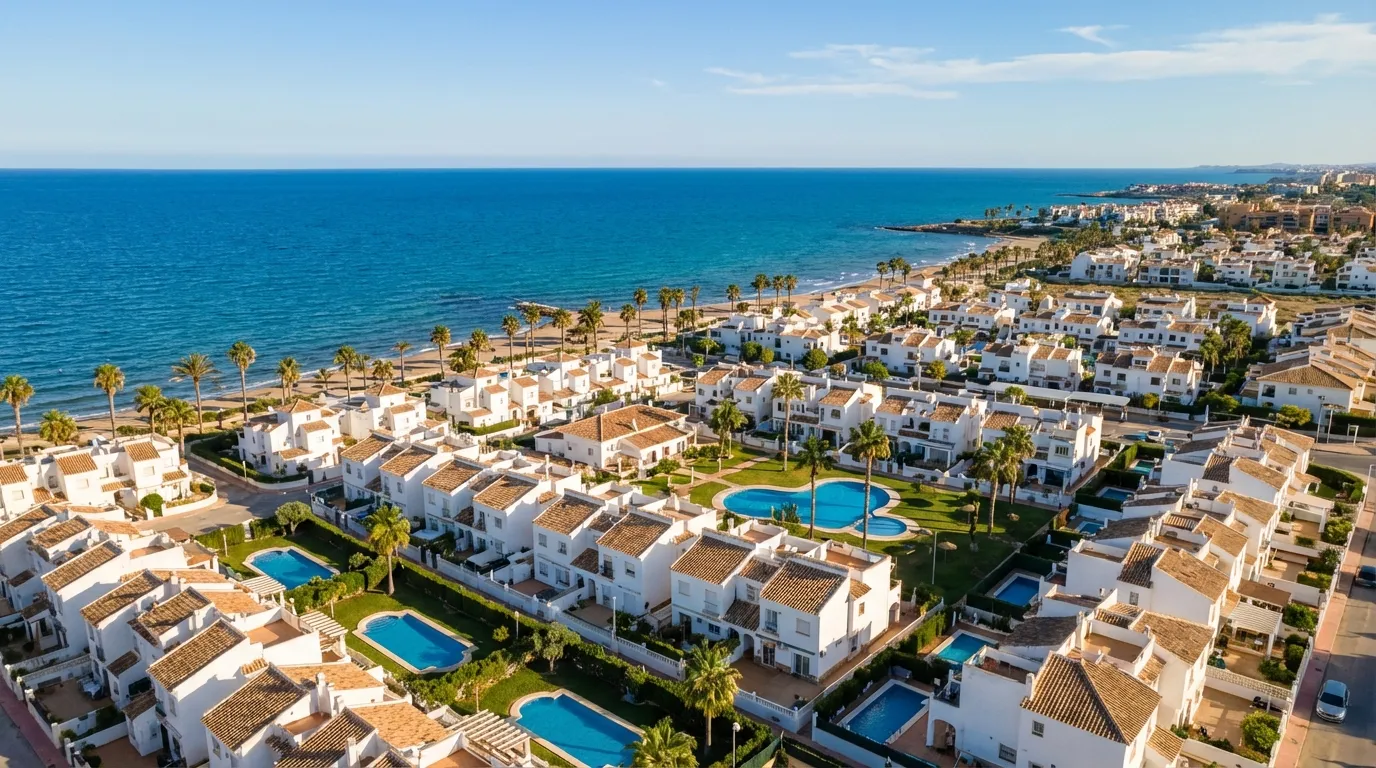
Everything you need to know about Orihuela Costa on Costa Blanca: areas, property prices, climate, beach life and tips for buying property in southern Spain.
Everything about the Cabo Roig market: day of the week, location, parking, what's on sale and how it compares to Playa Flamenca and Torrevieja for buyers looking to live near services.